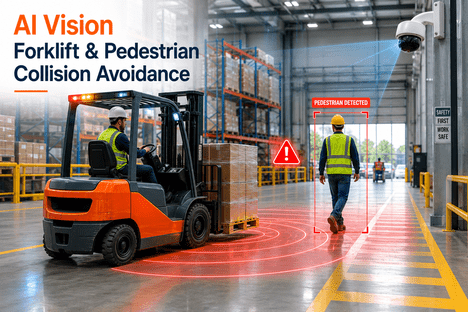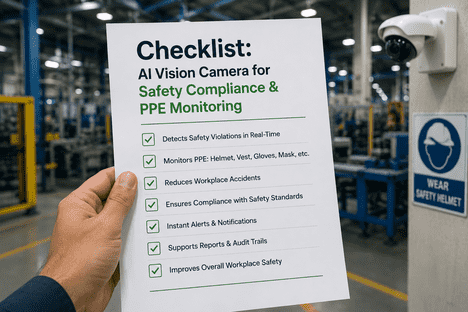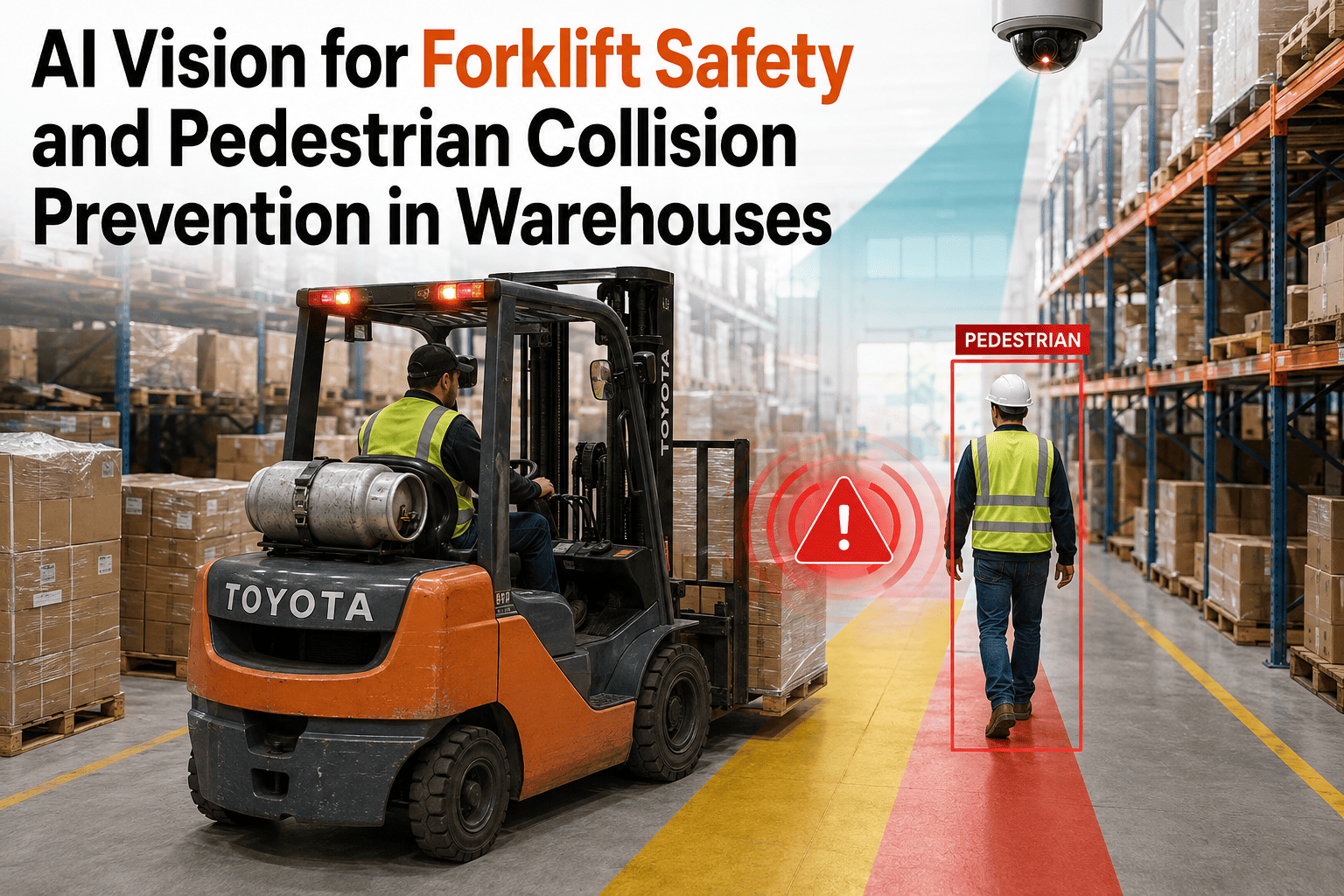
A forklift operator backs out of a narrow aisle with a raised load blocking the rear view. A picker steps around the rack corner at the exact same second, and neither sees the other until it is too late. OSHA-linked data shows 35,000 serious and 62,000 non-serious forklift-related injuries occur annually in the United States, with pedestrian strikes accounting for a disproportionate share of the fatalities. AI vision systems now watch every blind zone around a forklift continuously, flagging dangerous proximity before the operator or the pedestrian ever reacts. Facilities that have deployed this technology are seeing incident rates drop within the first quarter of use. If your floor still relies on mirrors, horns, and hope, Book a Demo to see how iFactory's AI vision platform closes that gap.
Every Forklift Has Blind Spots. Your Safety System Shouldn't.
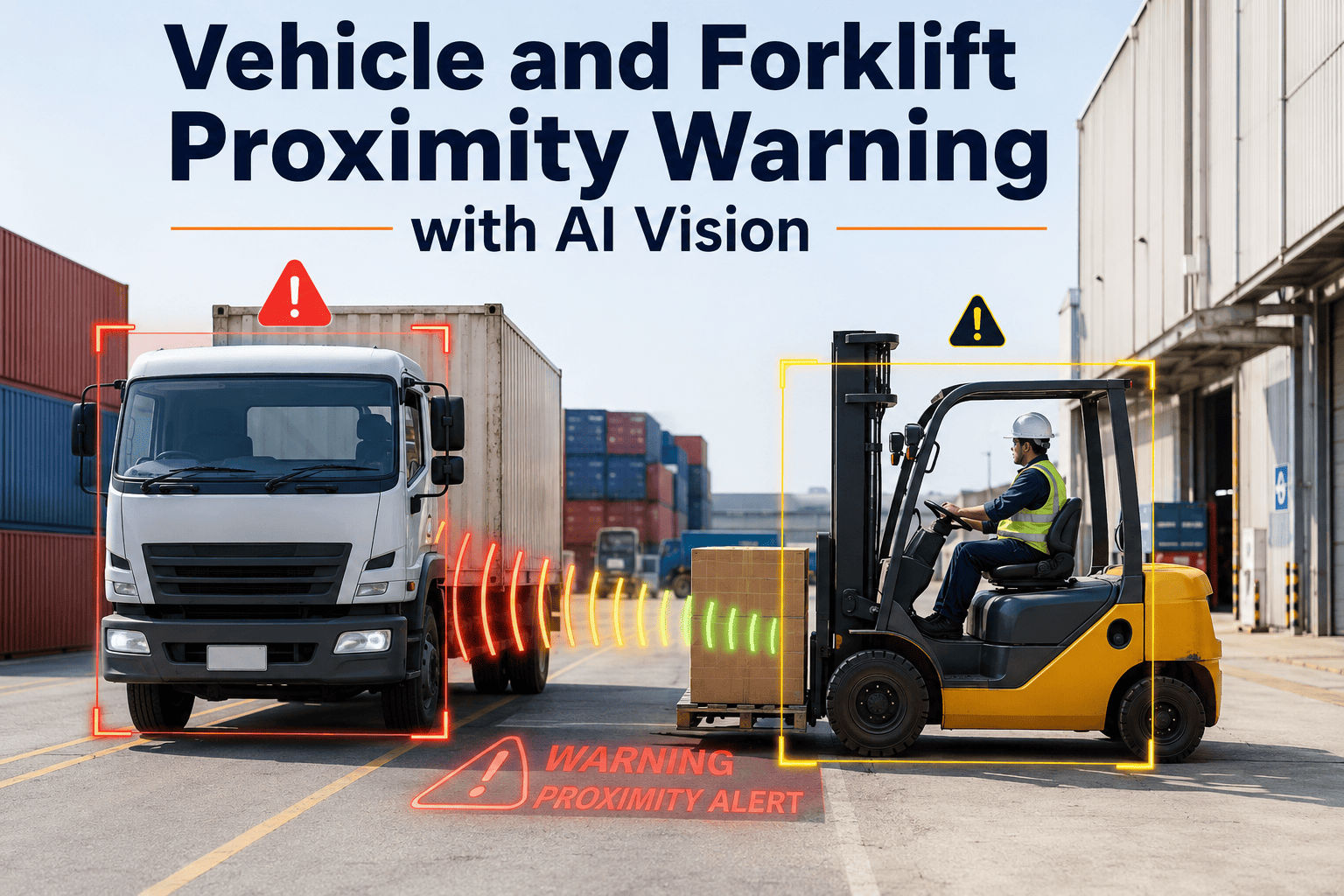
iFactory turns forklift-mounted and overhead cameras into a continuous pedestrian-detection layer — spotting dangerous proximity in milliseconds and triggering audio-visual warnings before a collision can happen.
Why Mirrors and Horns Stopped Being Enough
Forklifts were never designed with a clear line of sight in every direction. A raised load blocks the view forward. Reversing puts the counterweight and mast between the operator and anyone behind. Rack corners hide pedestrians until they are already inside the swing radius. Warehouse teams have relied on convex mirrors, backup alarms, and pedestrian training for decades, and while each helps at the margins, none of them actively watches the danger zone in real time. A mirror only works if the operator remembers to check it at the right second, and research on forklift accident causes consistently shows that a significant share of collisions are linked directly to poor operator visibility rather than a lack of training or awareness. An alarm only works if a worker can hear it over forklift traffic, packaging lines, and dock noise, and in high-throughput distribution centers that background noise is nearly constant across a full shift. Floor markings and designated pedestrian lanes help establish expected behavior, but they depend entirely on both parties following the plan every single time, with no margin for the one moment someone steps outside the marked path to reach a pallet or shortcut to a break area. AI vision closes that gap by watching continuously and alerting automatically, regardless of whether a human remembers to look, is able to hear, or happens to step outside a painted line.
Blocked by raised or bulky loads, especially on tall mast configurations carrying palletized goods above eye level.
Counterweight and overhead guard obstruct rear visibility during the reversing maneuvers that make up most of a shift.
Mast uprights and cross-aisle racking hide pedestrians approaching from the left or right until they are within feet.
Intersection points between aisles where neither the operator nor the pedestrian can see the other approaching.
What Forklift-Pedestrian Risk Actually Costs a Warehouse
The financial exposure from forklift-pedestrian incidents goes far beyond the injury itself. Direct medical costs, OSHA recordable penalties, workers' compensation claims, equipment downtime, and the operational disruption of an incident investigation all compound quickly, and few of these costs show up in a simple injury report. Facilities that treat pedestrian safety as a line-item compliance task rather than an operational risk consistently underestimate what a single serious incident actually costs across the business, because the indirect impact — retraining, insurance premium increases, lost productivity during an investigation, and the reputational cost with customers auditing your safety record — routinely outweighs the direct medical expense several times over. Manufacturing remains the industry with the highest concentration of forklift-related fatalities, followed closely by construction and general warehousing, which means the exposure is not limited to any single type of facility.
Paid annually by US employers in direct costs tied to forklift accidents
Average indirect cost impact of a single fatal forklift accident
Of forklift accidents linked to poor operator visibility
Reduction in collisions from telematics-based speed monitoring
From Camera Feed to Collision Prevented — In Under a Second
AI vision safety is not a passive recording system — it is an active detection loop running continuously on every camera feed. The system does not wait for an operator to glance at a screen; it interprets what the camera sees, classifies it, and reacts on its own. Here is the sequence that plays out every time a pedestrian enters a monitored zone around the forklift.
Continuous Frame Capture
Wide-angle cameras mounted on the mast, overhead guard, and counterweight capture the full 360-degree perimeter around the forklift, refreshing multiple times per second regardless of lighting or motion. Industrial-grade global-shutter sensors capture an entire frame at once rather than line by line, which prevents the motion blur that would otherwise make fast-moving pedestrians or a quickly turning forklift harder to classify accurately.
Human Shape Recognition
Neural network models trained to identify human posture and movement distinguish a pedestrian from a pallet, a shadow, or warehouse equipment — even when the person is partially blocked or carrying an object. These models are trained on large volumes of real warehouse footage covering different clothing colors, body positions, and lighting conditions, so a picker bending behind a rack or a technician crouching near the base of a shelf is still correctly identified as a person rather than ignored as background clutter.
Proximity and Trajectory Check
The system calculates how close the pedestrian is and whether their path intersects the forklift's direction of travel, so alerts are graduated by actual risk rather than simple distance. A pedestrian standing still fifteen feet away on a parallel walkway is treated very differently from one stepping directly into the forklift's forward path, which is what keeps the alert relevant instead of constant.
Instant Audio-Visual Warning
The operator receives an on-screen alert and audible tone within milliseconds of detection, giving enough reaction time to stop, slow, or steer clear before the pedestrian enters the danger radius. Every alert, along with the detection event that triggered it, is logged automatically so safety teams can review exactly what happened, when, and where.
Traditional Safety Measures Compared to AI Vision Detection
Most warehouses already run some combination of mirrors, horns, floor markings, and training programs. Each of these still has a place in a layered safety plan, but none of them actively monitors risk the way a vision system does, and none of them can adapt to a busy shift the way an automated detection layer can. The table below breaks down where traditional measures fall short and what changes once AI detection is added to the same forklift, so safety teams can see exactly which gaps a vision system closes rather than assuming it simply replaces everything already in place.
| Safety Measure | Requires Operator Attention | Works in Low Light / Noise | Covers Full Blind Spots | Reacts Automatically |
|---|---|---|---|---|
| Convex Mirrors | Yes — must be checked | Limited | Partial | No |
| Backup Alarms | No, but pedestrian must hear it | Poor in high-noise areas | No directional data | No |
| Floor Markings | Yes — relies on compliance | Yes | No | No |
| Pedestrian Training | Yes — human judgment | Yes | No | No |
| iFactory AI Vision | No — fully automated | Yes, purpose-built sensors | Yes, 360-degree coverage | Yes, real time |
The Seconds That Decide Whether a Near-Miss Becomes an Incident
Collision prevention is a race against time measured in fractions of a second. The earlier a pedestrian is detected relative to the forklift's path, the more options the operator has to respond safely. This timeline shows how detection timing changes the outcome of the same approach scenario.
Pedestrian Enters Outer Zone
AI vision flags the pedestrian the moment they cross into the outer monitored radius, well before they are visually obvious to the operator.
Trajectory Risk Confirmed
The system recalculates the pedestrian's path against the forklift's travel direction and escalates to an active warning if the paths converge.
Audio-Visual Alert Fires
The operator gets an on-screen indicator and audible tone, still with enough time remaining to brake, steer, or stop the load entirely.
Without Detection — Collision Window
This is the point where, without an active warning at T-1.5s, an operator relying on mirrors alone would have no remaining time to react.
Rack It, Plug It In, and Every Forklift Is Watching Every Blind Spot.
iFactory ships as a complete hardware-and-software bundle — a pre-configured NVIDIA AI server arrives racked and ready with the vision models pre-loaded. Connect power and Ethernet, and detection is live. We handle the camera mounting, PLC and dock-door integration, operator training, and 24×7 remote monitoring so your team isn't managing infrastructure — just watching the safety dashboard.
The Warehouse Zones Where Forklift-Pedestrian Incidents Actually Happen
Not every square foot of a warehouse carries the same collision risk. Incident data across distribution centers and manufacturing floors consistently points to a handful of predictable locations where forklifts and pedestrians end up sharing space at the same moment, shift after shift. Recognizing these zones is the first step in deciding where camera coverage and detection sensitivity matter most, because a system tuned for open floor traffic behaves very differently from one tuned for a tight cross-dock intersection with constant two-way movement. Mapping these zones before installation is also what keeps false-alarm rates low once the system goes live, since detection thresholds can be set to match the actual traffic pattern of each area rather than a single generic setting applied uniformly across the whole facility regardless of how each zone actually operates.
Aisle Intersections
Cross-aisle points where two forklifts or a forklift and a pedestrian approach from perpendicular directions are consistently among the highest-risk locations on any floor, because neither party can see around the rack corner until they are already within feet of each other.
Dock and Staging Areas
Loading docks combine dense pedestrian traffic from receiving and shipping teams with forklifts moving palletized freight at higher speeds than in storage aisles, creating a mismatch between pedestrian expectation and vehicle momentum.
Reversing Zones
With forklifts spending as much as 70 percent of a shift in reverse, any point where a truck regularly backs out of a pick slot or dock door becomes a recurring blind-spot exposure, especially when a raised load blocks the forward view as well.
Break and Restroom Routes
Pedestrian walking patterns during shift changes and breaks often cut directly across active forklift lanes, and because these movements happen at predictable times, they are also predictable opportunities for a proximity system to prevent an incident before it starts.
Signs Your Facility Is Overdue for AI Vision Detection
Most safety managers do not wait for a serious injury to decide their current setup is not enough — the warning signs usually show up well before that point, in the form of near-misses, recurring complaints, and audit findings that keep pointing at the same handful of locations. If any of the patterns below sound familiar on your floor, that is generally a strong indicator that mirrors, horns, and floor markings alone are no longer providing adequate coverage for the actual traffic your warehouse handles today.
Near-miss reports keep naming the same aisle intersection or dock door month after month, but the underlying layout and traffic pattern never actually change.
Your forklift fleet has grown or your pick volume has increased significantly since the current mirror and signage layout was first installed, without a corresponding safety reassessment.
Backup alarms and horns are routinely described by pedestrians as background noise they have learned to tune out during a busy shift.
Your last OSHA inspection or internal audit flagged pedestrian-vehicle separation as an area needing improvement, and the corrective action plan still relies on training reinforcement alone.
You are relying on incident reports rather than leading indicators to understand where the next serious injury is most likely to happen on your floor.
Live in 6 to 12 Weeks — Not a Year-Long Integration Project
Warehouse safety projects stall when they are treated as ground-up engineering builds. iFactory's AI vision deployment follows a fixed three-phase roadmap so your floor gets protection fast, without months of downtime for installation or integration work.
Site Assessment and Camera Mapping
Our team walks the floor, identifies every blind zone and high-traffic intersection, and maps camera placement across the forklift fleet and overhead infrastructure, using your actual near-miss history and traffic patterns to prioritize the highest-risk locations first.
Weeks 1–3Install, Calibrate, and Train
Hardware is racked, cameras are mounted and calibrated against real traffic patterns, and operators are trained on how the alert system behaves in their actual aisles rather than a generic training scenario that doesn't match their floor.
Weeks 4–8Go-Live With 24×7 Monitoring
Detection goes fully live across the floor, with iFactory's remote monitoring team validating performance and tuning alert zones during the first weeks of operation so false alarms are minimized and every genuine risk is still caught reliably.
Weeks 9–12What Warehouse Safety Teams Ask Before Deploying AI Vision
Does AI vision detection replace operator training and OSHA-required certification?
No — AI vision is a layer added on top of certified operation, not a substitute for it. OSHA still requires forklift operators to complete formal training and evaluation under 29 CFR 1910.178, and that requirement does not change with the addition of a detection system. What AI vision does is close the gap that training alone cannot close — the moments where a well-trained operator simply cannot see a pedestrian because of a raised load, a blind corner, or a reversing maneuver, no matter how experienced or attentive they are. Facilities that pair strong training programs with continuous vision monitoring see the largest reduction in incidents, because the two approaches cover different failure points rather than duplicating the same protection. The iFactory Support team can walk your safety officers through how the platform complements your existing training program rather than replacing it.
How does the system tell the difference between a pedestrian and a pallet or piece of equipment?
The detection models are trained specifically to recognize human shape and posture, not just movement or object presence. This is what separates AI vision from older motion-sensor or basic proximity systems that trigger alerts for any moving object, including pallets on a conveyor or another forklift passing by. The neural network has been trained on large volumes of real warehouse footage covering different clothing, postures, lighting conditions, and partial obstructions, so it can reliably identify a person even when they are carrying a box or crouched behind a rack. This distinction matters operationally because it keeps false-alarm rates low, which is the main reason earlier generations of safety technology lost operator trust over time.
Will installing cameras and an AI vision system slow down our forklift fleet's productivity?
In practice, most facilities see the opposite effect once the system is calibrated to their actual traffic patterns. The alerts are graduated by real proximity and trajectory risk, so operators are not interrupted by constant false warnings the way they might be with older motion-based sensors. Instead, the system only escalates when a genuine risk is developing, which means operators can maintain normal travel speeds through most of a shift and only slow down at the specific moments detection calls for it. Facilities running telematics-based speed monitoring alongside vision detection have reported measurable reductions in collision risk without a corresponding drop in throughput, because the system prevents the stop-start disruption that follows an actual incident or near-miss investigation.
What happens to the incident and near-miss data the system records?
Every detection event, alert, and near-miss is logged automatically and made available through a dashboard your safety team can review by shift, zone, or forklift unit. This turns pedestrian safety from a reactive, after-the-fact investigation process into a proactive one, because patterns become visible before they escalate into an actual injury. If a specific aisle intersection is generating repeated near-miss alerts, that is a clear signal to adjust traffic flow, add signage, or reconfigure racking before someone gets hurt. This same data set is also what most facilities use to demonstrate a documented safety improvement program to insurers and auditors, since it shows a continuous record of risk reduction rather than a single point-in-time assessment.
How long does it take to see AI vision deployed and running across a full warehouse floor?
Most facilities are fully live within six to twelve weeks from the initial site assessment, following the three-phase rollout of mapping, installation and calibration, and go-live with monitoring. The exact timeline depends on fleet size, the number of camera zones needed across the facility, and how much integration is required with existing PLC or dock-door systems. Because the hardware ships pre-configured and pre-loaded with the vision models, the bulk of the timeline is spent on physical installation and calibrating alert zones to your actual traffic patterns rather than software development. Book a Demo to get a facility-specific timeline based on your current forklift fleet and floor layout.
Stop Reacting to Near-Misses. Start Preventing Them.
Every day without continuous pedestrian detection is another shift where a blind spot decides the outcome instead of your safety program. Talk to iFactory about mapping your floor's highest-risk zones and getting AI vision live across your forklift fleet in as little as six weeks.