AI Vision for Workplace Safety Monitoring and PPE Detection

By David Cook on March 11, 2026

ai-vision-workplace-safety-monitoring

Every year, 340 million occupational accidents happen worldwide. In the United States alone, employers pay over $1 billion per week in workers' compensation for disabling injuries. The top OSHA violation? Fall protection — a hazard that's visually detectable. AI vision systems are changing the equation: instead of catching violations after someone gets hurt, they detect missing hardhats, absent harnesses, and unsafe proximity to machinery in real time — before the incident report gets written. Here's how the technology works, where it's deployed, and why it's becoming the new standard for industrial safety.

340M
Workplace Accidents Globally Every Year
$1B+
Weekly Workers' Comp Costs in the U.S.
5,070
Fatal Work Injuries in the U.S. (2024)
97%
PPE Detection Accuracy With Modern AI

The Problem With Manual Safety Monitoring

Most workplaces still rely on periodic safety walks, manual checklists, and human supervisors to enforce PPE compliance and hazard awareness. This approach has three fundamental problems that AI vision directly solves.


Coverage Gaps
A safety officer can't watch every worker on every shift. OSHA has just 1,802 inspectors for 11.8 million workplaces — one inspector for every 84,937 workers. Internal safety teams face the same ratio problem. Between scheduled walks, violations go unobserved for hours or entire shifts.

Reactive, Not Preventive
Traditional safety programs discover violations after incidents. An injury occurs, an investigation follows, corrective actions are issued. This cycle repeats because the root behavior — a worker removing a hardhat for 30 seconds in a danger zone — was never observed in the first place.

No Trend Visibility
Manual audits produce point-in-time snapshots. They can't reveal that Zone 3 has 4x more PPE violations on night shifts, or that a specific subcontractor consistently skips harness checks. Without continuous data, safety leaders can't target interventions where they matter most.

How AI Vision Safety Monitoring Actually Works

AI-powered safety monitoring uses existing CCTV or purpose-installed cameras combined with edge AI processors to continuously analyze video feeds. Here's the detection pipeline — from camera to corrective action.

1
Video Ingestion
Existing IP cameras or newly installed vision systems stream video to edge processing units. No need to rip out infrastructure — most deployments work with cameras already installed across the facility.

2
AI Model Inference
Deep learning models (YOLO, CNN-based architectures) process each frame in real time — detecting people, classifying PPE items (hardhat, vest, gloves, harness, goggles, boots), and identifying unsafe behaviors like zone intrusion or improper posture.

3
Violation Detection
The system compares detected PPE status against zone-specific safety rules. A worker entering a welding area without goggles, or approaching a crane zone without a hardhat, triggers a violation — with timestamp, location, and visual evidence captured automatically.

4
Alert & Action
Instant alerts go to supervisors via dashboard, mobile app, or on-site alarm. When connected to a CMMS, the system auto-generates a documented safety work order — creating a compliance audit trail without manual data entry.

What AI Vision Can Detect: The Complete Safety Coverage Map

Modern AI vision systems go far beyond hardhat detection. Here's the full spectrum of safety use cases being deployed across construction sites, manufacturing floors, oil and gas facilities, warehouses, and chemical processing plants.

PPE Compliance Detection
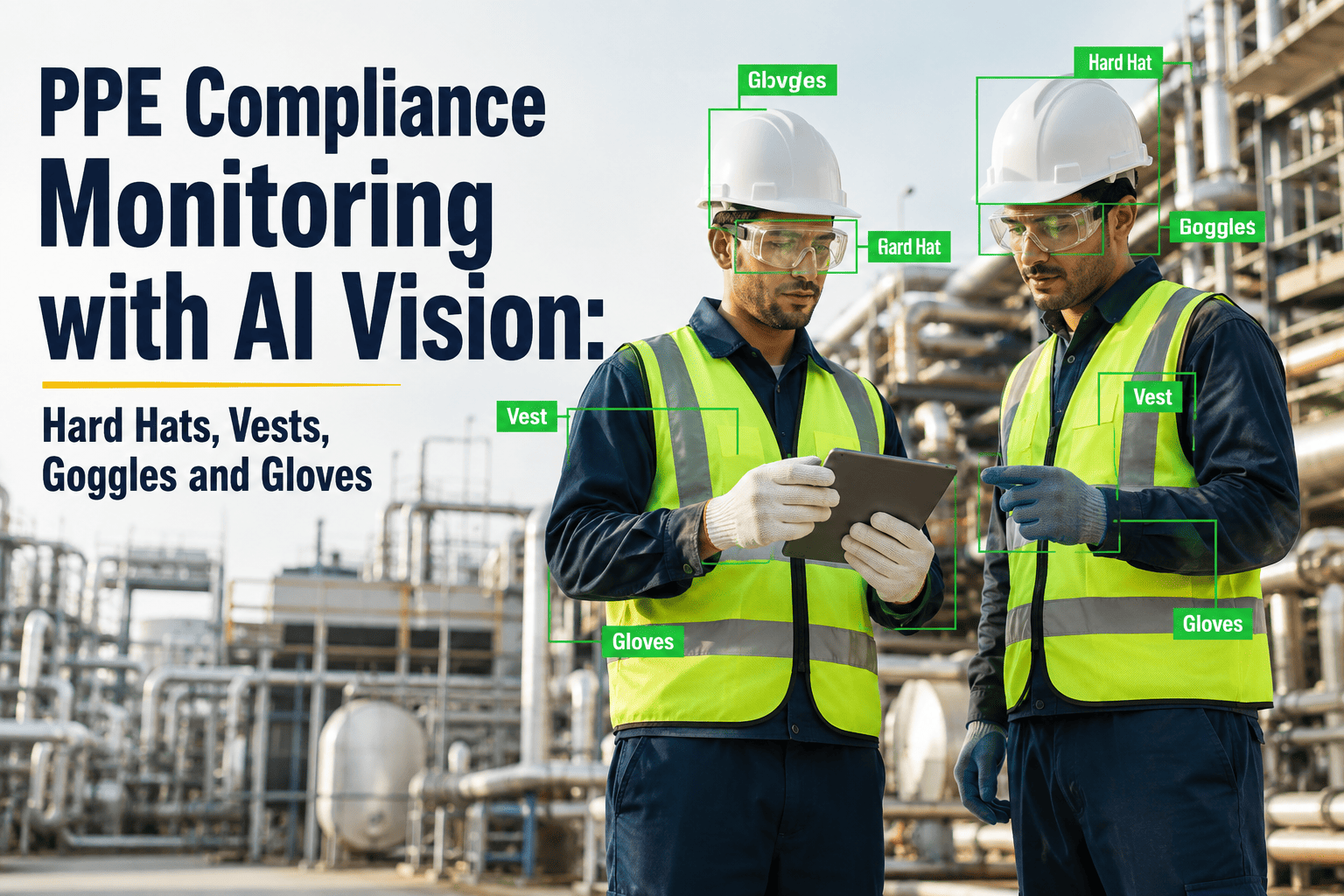
Hard Hat / Safety Helmet
Construction, manufacturing, mining, warehousing
High-Visibility Vest
Construction, logistics, roadwork, airports
Safety Goggles / Face Shield
Manufacturing, welding, chemical processing, labs
Safety Harness & Lanyard
Construction at height, oil rigs, wind turbines
Gloves, Boots, Respirators
Chemical plants, healthcare, food processing
Unsafe Behavior Detection
Restricted Zone Intrusion
Workers entering hazardous areas without authorization or proper PPE
Human-Machine Proximity
Unsafe closeness to forklifts, cranes, robotic arms, conveyor systems
Fall Risk & Edge Exposure
Workers near unprotected edges, open shafts, or elevated platforms
Unsafe Climbing or Posture
Climbing on racking, improper ladder use, ergonomic risk postures
Environmental & Facility Hazards
Spill & Leak Detection
Chemical spills, oil leaks, water accumulation on floors
Fire & Smoke Detection
Early flame or smoke presence in warehouses, factories, outdoor sites
Blocked Emergency Exits
Objects or materials obstructing evacuation routes or fire exits
Machine Guard Removal
Detecting when safety guards are removed during operation or changeovers

Industry Deployment: Where AI Safety Vision Is Already Working

AI vision for safety isn't theoretical — it's deployed at scale across industries where the cost of non-compliance is measured in lives and millions in liability.


Construction
1,075 fatalities in 2024 — highest of any U.S. industry
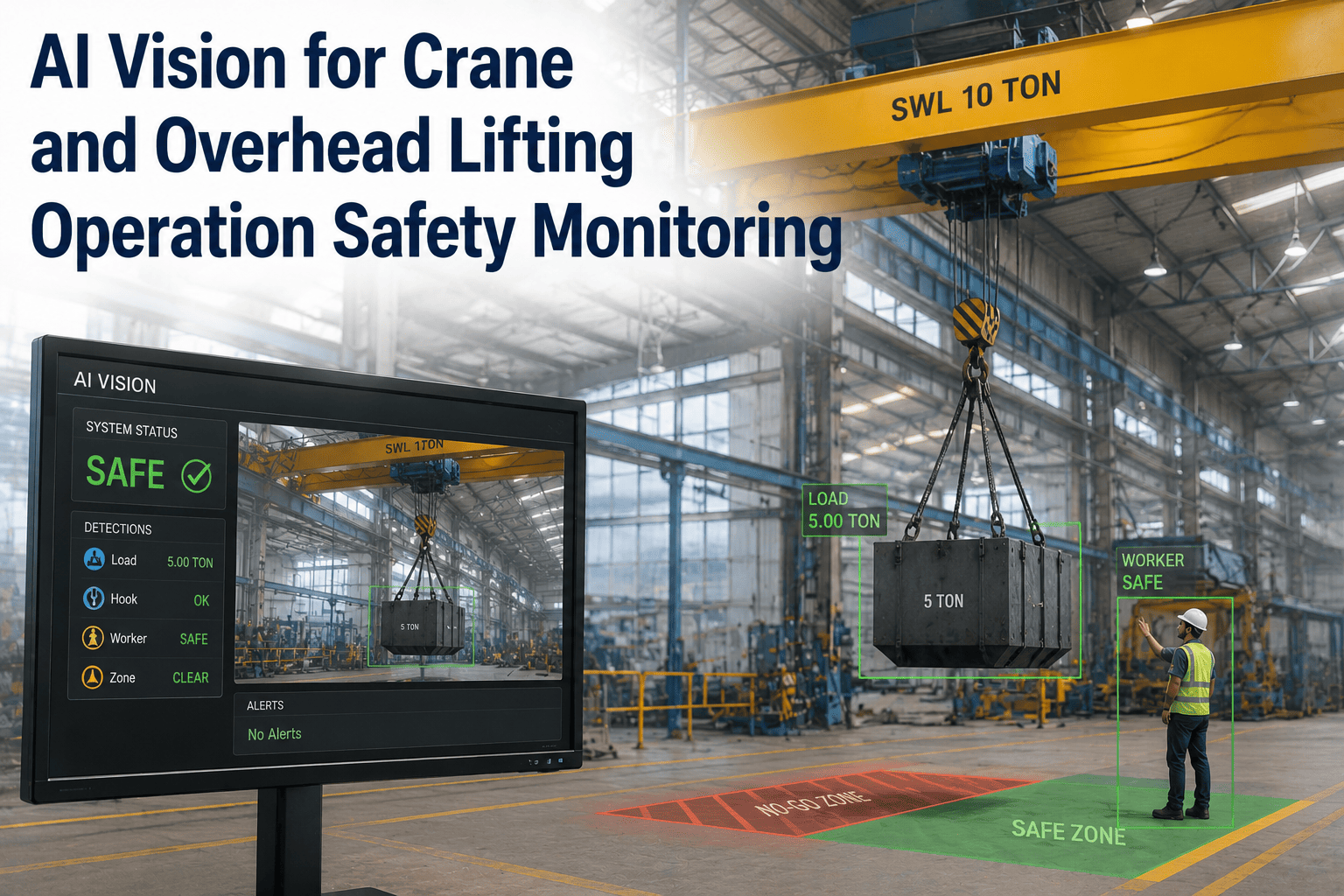
AI cameras monitor scaffolding zones, elevated work areas, and active crane zones for missing harnesses, hardhats, and edge exposure. Systems detect guard removal, unauthorized zone entry, and ladder misuse in real time. In 2026, leading projects pair edge cameras with response workflows — turning detections into supervisor actions and coaching moments, not just alerts.
Fall Protection Scaffold Safety Crane Zones

Manufacturing
2.5 million injuries reported by U.S. employers in 2024
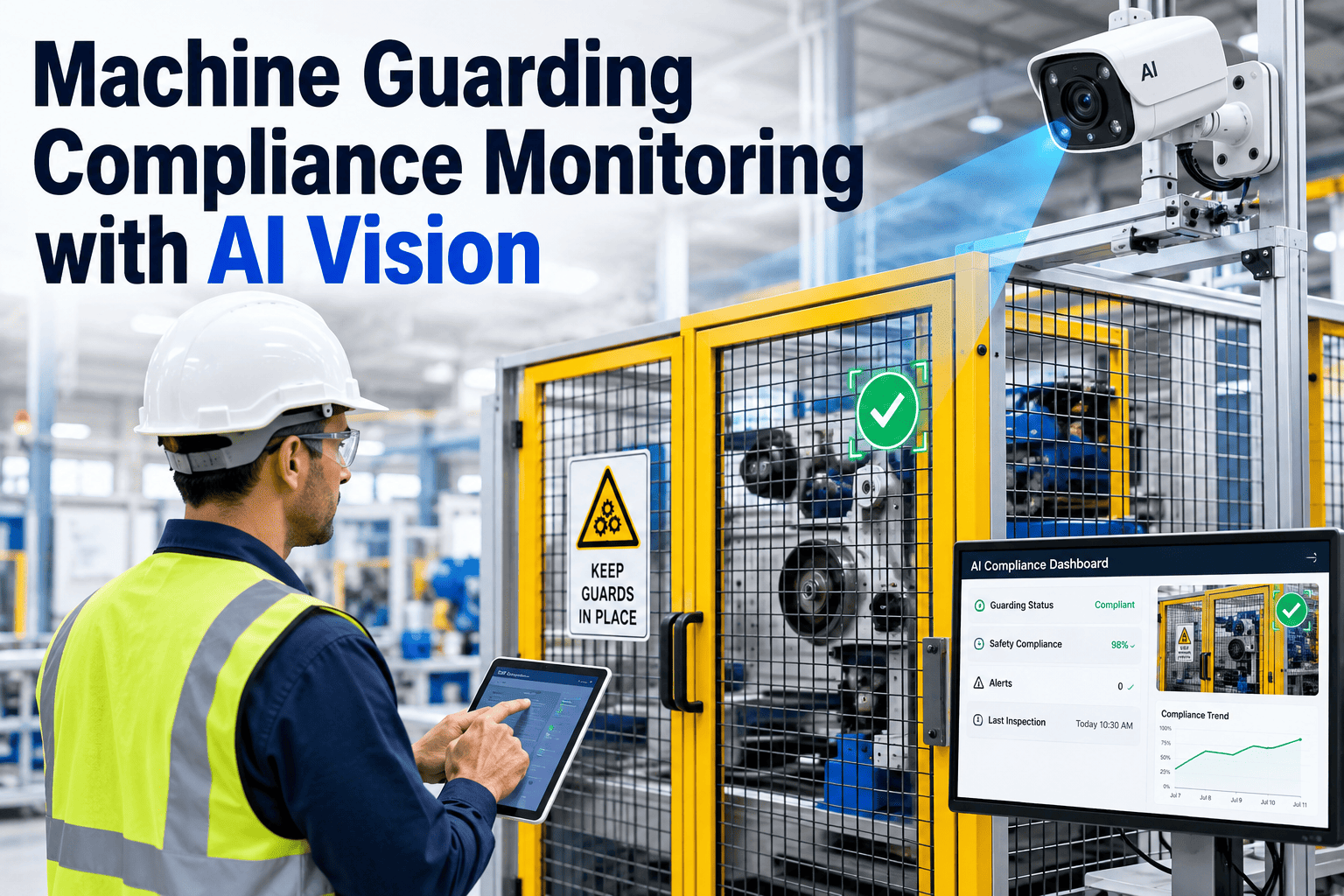
Factory floor cameras enforce goggles, gloves, and ear protection in hazard zones. Vision systems detect when machine guards are removed during changeovers — one of OSHA's most cited violations with 1,239 reports. AI monitors human-robot proximity in automated cells and flags unsafe ergonomic postures that lead to musculoskeletal injuries over time.
Machine Guarding PPE Zones Ergonomics

Oil, Gas & Chemical
High-consequence environments with mandatory FRC, gas detectors, respirators
AI vision verifies flame-resistant clothing, gas detectors, helmets, and gloves at all times in high-risk processing zones. Systems detect improper chemical decanting, missing container labels, and unauthorized personnel in restricted areas. Thermal imaging cameras integrated with AI spot equipment overheating before it escalates to a safety event.
Hazcom Compliance FRC Verification Thermal Risk

Logistics & Warehousing
1,826 OSHA violations for powered industrial trucks in 2025
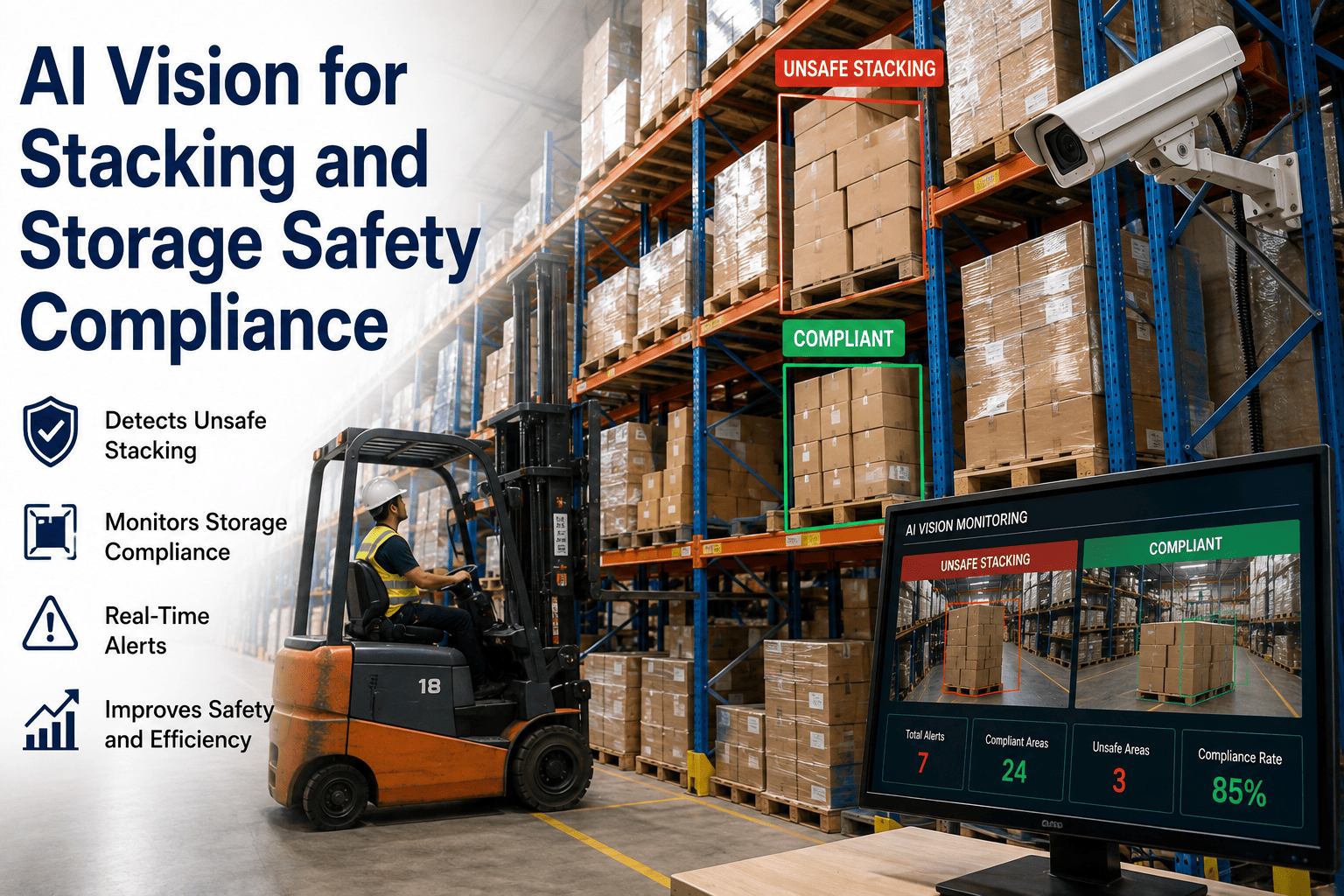
Forklift and pedestrian interaction is a leading injury source. AI cameras track vehicle-worker proximity in real time, flag near-misses in blind spots, and enforce vest and hardhat compliance in dock and aisle zones. Vision systems also monitor loading bay activity and detect blocked emergency exits — creating continuous safety coverage across shifts.
Forklift Safety Dock Monitoring Exit Compliance

Your Cameras Already See the Risk. Now Make Them Act on It.

iFactory connects AI vision safety detections to automated work orders, corrective action tracking, and compliance documentation. Every PPE violation, zone intrusion, and near-miss becomes a tracked, resolved, and auditable event — not just another alert.

The Missing Link: Detection Without Action Is Just Noise

The biggest failure in AI safety deployments isn't the technology — it's what happens (or doesn't happen) after a detection. An alert that goes to a dashboard nobody monitors is worse than no alert at all, because it creates a false sense of coverage. Here's what a closed-loop system looks like versus a typical deployment.

Alert-Only Systems
Noise
Detections without documented follow-through
Violation detected, alert sent to dashboard
No assigned owner for corrective action
No audit trail of resolution
No trend data linking violations to crews or shifts
Compliance gaps discovered during audits
Alert fatigue sets in within weeks. Supervisors stop checking. Violations persist.
VS
AI Vision + CMMS Closed Loop
Action
Every detection becomes a tracked corrective action
Violation auto-generates a prioritized work order
Assigned to supervisor with context and evidence
Resolution documented with sign-off and timestamp
Trend analytics reveal patterns by zone, shift, crew
Audit-ready compliance records generated automatically
Continuous improvement cycle. Violations decrease. Compliance is provable.

OSHA's Top 10 Violations — and How AI Vision Addresses Each

OSHA's most-cited standards map directly to capabilities that AI vision systems already deliver. Here's the alignment between regulatory requirements and what cameras can now enforce automatically.

Rank
OSHA Violation
AI Vision Capability
1
Fall Protection
Detect workers near unprotected edges, missing harnesses at height, guardrail removal
2
Hazard Communication
Verify chemical container labeling, detect improper handling, flag missing PPE at chemical stations
3
Lockout/Tagout
Monitor machine status during maintenance, detect human presence in energy-isolation zones
4
Ladders
Detect improper ladder placement, overreach posture, and missing 3-point contact
5
Respiratory Protection
Verify mask and respirator presence in designated zones, detect improper fit or removal
6
Powered Industrial Trucks
Track forklift-pedestrian proximity, flag near-misses, enforce speed and zone compliance
7
Fall Protection Training
Provide data on which workers/crews have repeated violations — identifying training needs
8
Scaffolding
Monitor scaffold access, detect missing planking or guardrails, flag overloading indicators
9
Eye and Face Protection
Real-time goggles and face shield detection in grinding, welding, and chemical handling zones
10
Machine Guarding
Detect guard removal during operation, flag human proximity to unguarded machinery
Every one of these violations is detectable by AI vision — and every detection should trigger a documented corrective action. See how iFactory automates the full cycle from detection to resolution to audit-ready compliance.

Make Safety Proactive. Make Compliance Automatic.

iFactory connects AI vision safety systems with maintenance workflows, corrective action tracking, and compliance documentation — so every detection leads to a resolution, not just a notification. Purpose-built for construction, manufacturing, oil and gas, and logistics environments where safety is non-negotiable.

Frequently Asked Questions

Modern systems using YOLO-based architectures achieve 96–97% mean average precision for detecting common PPE items like hardhats, safety vests, goggles, and harnesses. Accuracy improves further when models are fine-tuned on site-specific data — accounting for local lighting, PPE colors, and worker postures unique to each facility. Inference speeds of under 10 milliseconds per frame enable true real-time monitoring.

Yes. Most AI safety platforms are designed to work with existing IP camera installations. The AI processing happens on edge devices or gateway servers connected to your camera network — you don't need to replace cameras. Deployments can typically go live in 1–5 business days depending on site size and number of camera feeds being processed.

The system captures the violation with a timestamp, location, and visual evidence. Alerts are sent instantly to supervisors via dashboards, mobile notifications, or on-site alarms. When integrated with a CMMS like iFactory, the detection automatically generates a documented work order with assigned owner, severity, and required corrective action — creating a complete audit trail from detection to resolution.

Privacy is a legitimate consideration. Modern AI safety systems are designed to detect PPE presence and unsafe behaviors — not identify individuals by name or face. Edge processing keeps video data local rather than streaming it to the cloud. Most deployments focus on behavioral patterns and zone compliance rather than individual surveillance, and organizations should establish clear policies about how safety AI data is used and retained.

A CMMS like iFactory closes the loop between detection and action. Without a CMMS, safety alerts go to dashboards that can be ignored. With a CMMS, every detection automatically generates a tracked work order with an assigned technician, due date, and documented resolution. Over time, this creates trend analytics — showing which zones, shifts, or crews have the most violations — and produces audit-ready compliance records for OSHA inspections or internal safety reviews.
Share This Story, Choose Your Platform!