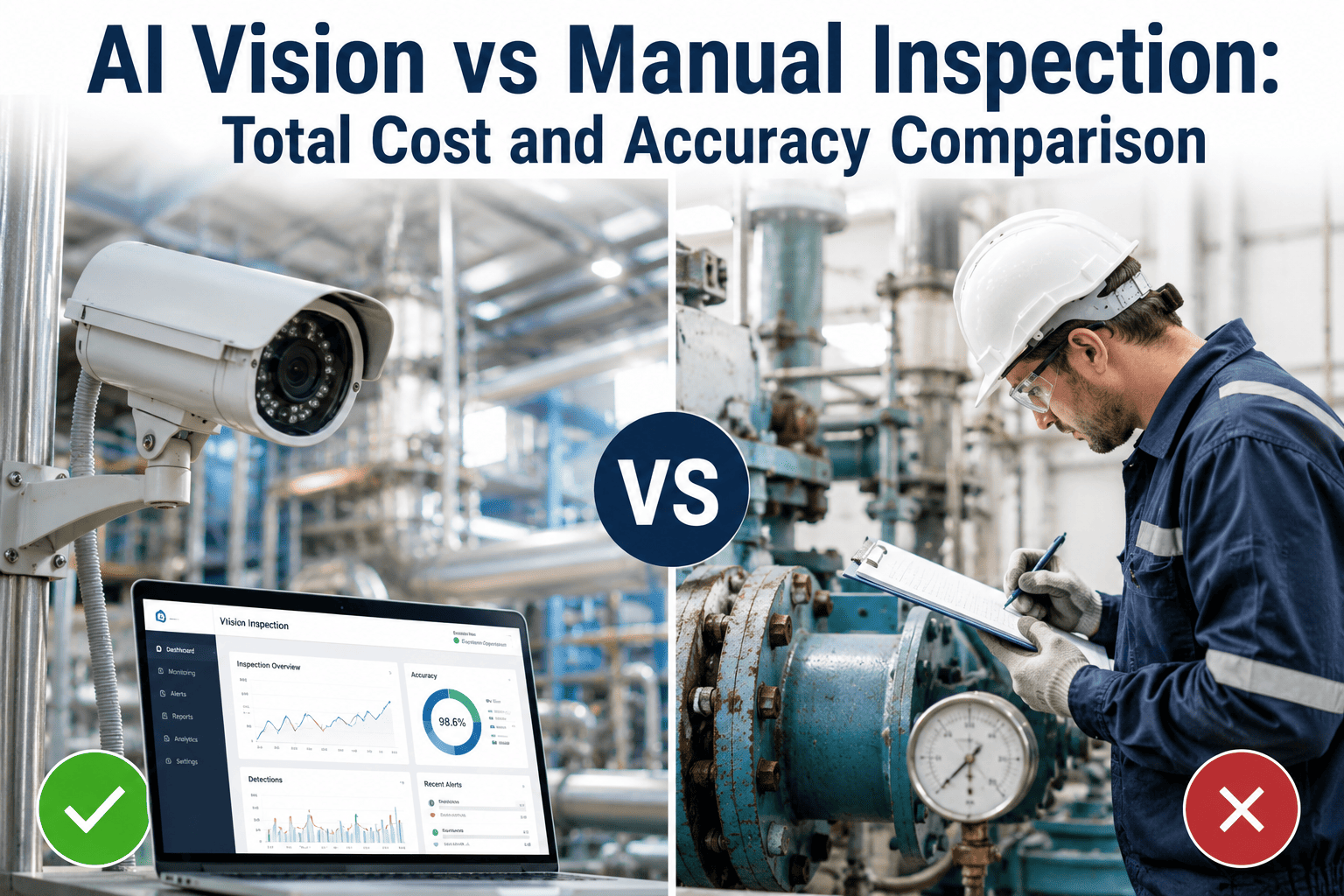
Every manufacturer eventually faces a moment of reckoning — a warranty claim, a batch recall, or a customer complaint that traces back to a defect that passed through inspection undetected. The uncomfortable truth is that manual visual inspection, still the most common quality control method in factories worldwide, operates at 70–85% accuracy under ideal conditions. On a real production floor, those conditions rarely exist. AI vision cameras fundamentally change this equation, delivering 95–99% defect detection accuracy at speeds no human team can match — and the ROI data from actual deployments proves it. Book a Demo to see how iFactory AI vision cameras deploy on your production line within 2–4 weeks.
The Core Problem With Manual Inspection
Human inspectors are skilled professionals, but the job has physiologically outgrown human capability. Modern production lines move at speeds where a new component arrives at the inspection point every fraction of a second. A trained inspector can evaluate 200–300 parts per hour with meaningful accuracy. An AI vision camera system processes thousands of parts in that same window, classifying defects by type, severity, and location in under 50 milliseconds per unit.
Beyond raw speed, consistency is the deeper problem. Inter-inspector agreement on defect severity sits at just 55–70%, meaning identical defective products receive different quality verdicts depending on which person is on shift. Inspector accuracy also degrades 15–25% after two hours of continuous observation — the exact window when end-of-shift fatigue peaks and outgoing quality is most vulnerable. AI vision cameras maintain the same detection threshold at hour one and hour twelve, on Monday and on a Friday night shift.
| Performance Metric | Manual Inspection | AI Vision Camera |
|---|---|---|
| Defect Detection Accuracy | 60–85% under ideal conditions — degrades further with fatigue and shift changes | 95–99% consistently across all shifts, 24/7 with zero degradation |
| Parts Inspected Per Hour | 200–300 parts with meaningful accuracy — hard physiological ceiling | 10,000+ parts per hour at full line speed — no throughput constraint |
| Evaluation Speed Per Part | 3–10 seconds per unit — creates inspection bottleneck at high line speeds | Under 50 milliseconds — classification before the unit exits the inspection zone |
| Consistency Across Shifts | 55–70% inter-inspector agreement — identical defects get different verdicts | 100% identical threshold every unit — no shift variation, no subjectivity |
| Fatigue-Driven Accuracy Loss | 15–25% accuracy degradation after 2 hours of continuous observation | Zero degradation — performance identical at minute one and hour twelve |
| Minimum Detectable Defect Size | 0.5mm+ under ideal conditions — sub-surface anomalies missed entirely | Sub-0.01mm surface anomalies — physiologically invisible to naked eye |
| Inspection Coverage | Statistical sampling only — 30–40% of defects pass through on every batch | 100% of every unit, every surface, every angle — no sampling gaps |
| Average ROI Payback Period | N/A — ongoing variable cost compounding annually with wage inflation | 6–12 months documented across high-volume manufacturing deployments |
Speed: Why Production Velocity Is the First Casualty of Manual Inspection
Manual inspection creates a bottleneck that manufacturers absorb silently — by adding headcount, accepting sampling gaps, or running slower lines than the machinery actually permits. An AI vision camera system eliminates this trade-off entirely. Industrial cameras capture 40,000+ lines per second under precision lighting arrays, while edge computing processes 2–8 GB of image data per second with inference latency under 50 milliseconds. The result is 100% inline inspection at full production speed — something no sampling strategy can replicate.
The speed advantage compounds through the production economics. Faster inspection throughput directly supports higher OEE (Overall Equipment Effectiveness). Automotive facilities deploying AI vision cameras have documented 22% OEE increases and 50% inspection cycle time reductions at semiconductor lines. When inspection is no longer the constraint, the entire line runs at its designed capacity.
Accuracy: The Defect Gap That Manual Inspection Cannot Close
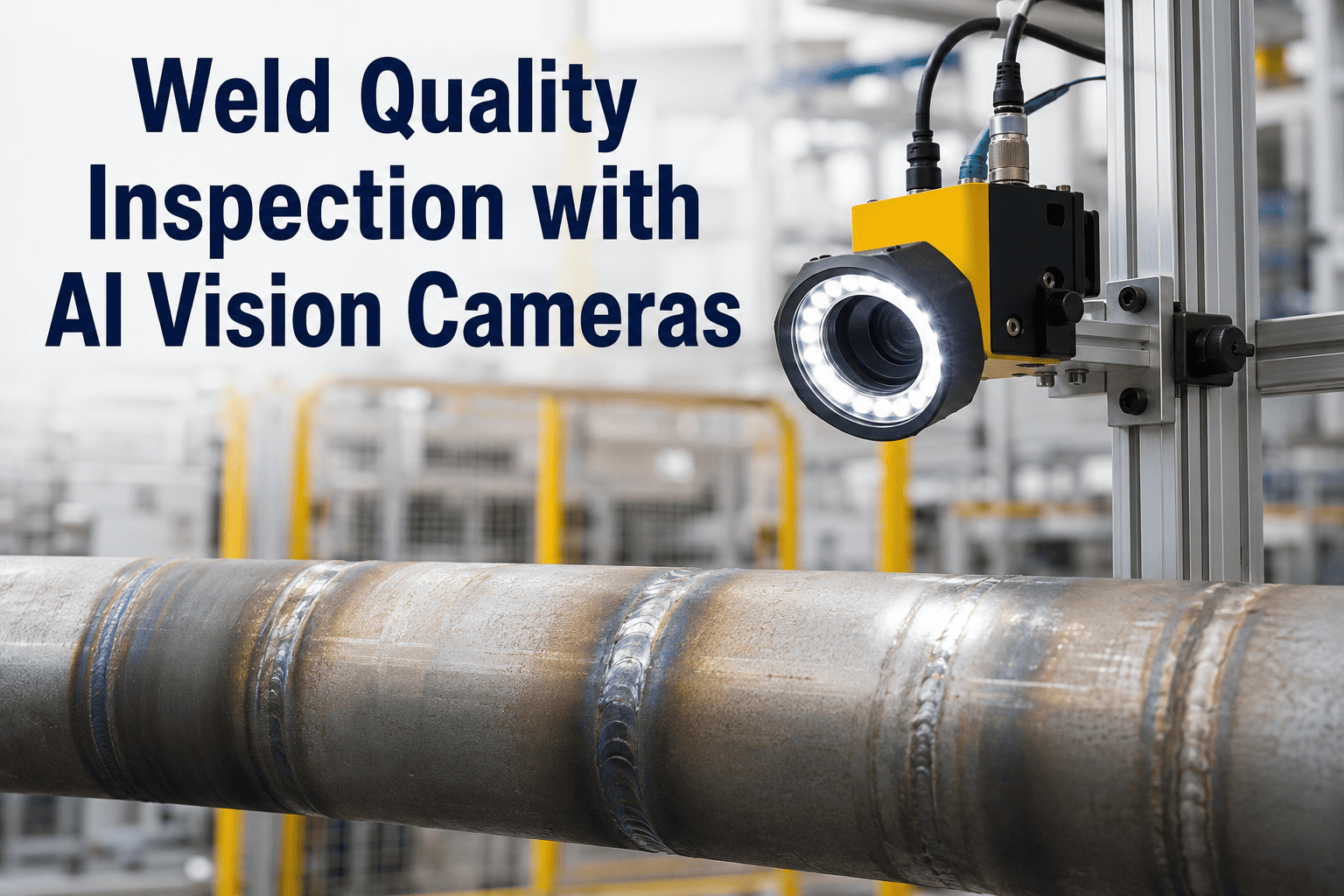
The accuracy gap between manual and AI inspection is not a matter of effort or training — it is a function of physics. Human eyes cannot reliably resolve surface anomalies below 0.5mm at production line speeds. Sub-surface cracks, hairline fractures, micro-porosity in welds, and solder bridging on PCBs require magnification and controlled lighting conditions that a moving production line cannot provide to a human inspector. AI vision cameras with structured and dark-field illumination detect defects as small as sub-0.01mm — anomalies that are physiologically invisible without equipment.
Beyond resolution, AI vision systems classify defect type, severity, and exact surface location with every inspection event — data that manual inspection cannot systematically produce. This classification layer transforms each inspection from a binary pass/fail gate into a structured quality data stream that feeds root cause analysis, process correlation, and predictive maintenance. A scratch is not just a scratch — the system knows its dimensions, its location on the part, its frequency against production parameters, and whether it is trending upward.
Want to see AI vision accuracy on your specific defect types? Book a Demo and iFactory will run a live demonstration on production-representative samples from your line.
ROI Analysis: The Real Numbers Behind AI Vision Camera Investment
The business case for AI vision cameras rests on a straightforward cost structure comparison. Manual inspection incurs variable and rising operational costs — wages, overtime, training, and shift supervision — that compound annually with inflation and labour market pressures. AI vision inspection converts quality control into a fixed capital cost that depreciates over time while the system's accuracy improves through continuous learning. Most manufacturers see full ROI within 6–12 months.
The hidden quality cost that manual inspection silently produces is where the ROI calculation becomes compelling. Quality losses consume 15–20% of total sales revenue for the average manufacturer — scattered across scrap reports, rework logs, warranty claims, and customer accounts that nobody consolidates into a single line item. A defect caught on the production line costs the unit. The same defect found at the customer site costs 10–100× more in warranty claims, sorting, premium freight, contract penalties, and irreversible reputation damage.
How iFactory AI Vision Cameras Deploy on Your Production Line
iFactory follows a structured deployment process that delivers live defect detection within the first week and full production integration by week four. Each stage has defined deliverables so quality engineers see measurable output — not months of consulting before any operational change.
When Manual Inspection Still Has a Role
A complete analysis requires acknowledging where manual inspection retains practical advantages. For facilities producing fewer than 200 parts per day, AI vision capital investment may not recover within a reasonable payback window, and a skilled inspector handles that volume comfortably. Geometrically complex inspection points — internal passages, sealed housings, deep recesses — where camera line-of-sight is not achievable without significant robotics investment may remain better served by human tactile inspection or borescopes.
For every other manufacturing scenario — high-volume lines, sub-millimetre defect requirements, 24/7 operation, regulatory compliance inspection, or any situation where a missed defect triggers costly field consequences — AI vision cameras deliver measurably superior outcomes on every performance dimension that matters to the bottom line. Book a Demo to assess the right inspection strategy for your specific production environment.