A Tier 1 automotive supplier lost a hydraulic press bearing at 2:47 AM on a Tuesday. The failure took 14 hours to diagnose and repair, halting a production line that feeds three OEM assembly plants. By the time the press restarted, the damage was done: $3.6 million in emergency repairs, missed shipments, contractual penalties, and overtime labour to recover the schedule. Post-incident analysis revealed what an AI vision system would have caught six weeks earlier — a thermal anomaly pattern on the bearing housing that was developing progressively but remained invisible to routine visual checks. The failure was predictable. It just was not predicted. AI changes that.
AI Equipment Monitoring
Predictive Maintenance Using AI Vision in Industry
How computer vision and deep learning detect equipment anomalies weeks before failure — eliminating unplanned downtime at the source
$50B
Annual cost of unplanned downtime in US manufacturing
Preventable
50%
Reduction in unplanned downtime with predictive maintenance
With AI Vision
The Problem With Reactive Maintenance
Most factories still operate on a run-to-failure or time-based maintenance model. Equipment runs until it breaks, or gets serviced on a fixed calendar — regardless of actual condition. Both approaches are expensive. One guarantees unplanned downtime. The other wastes resources maintaining equipment that does not need it while missing the equipment that does.
How Reactive Maintenance Drains Your Operation
1
The Downtime Tax
The average manufacturer experiences 800 hours of unplanned downtime annually — over 15 hours every week of paid non-productive time. Equipment failure accounts for 42% of all incidents, and each event averages 4 hours of lost production.
2
The Hourly Cost Reality
Unplanned downtime costs manufacturers between $125,000 and $260,000 per hour on average. In automotive assembly, that figure exceeds $2 million per hour. Two-thirds of companies experience unplanned downtime at least once every month.
3
The Hidden Cascade
A single machine failure does not stop at the machine. It idles operators, starves downstream processes, delays shipments, triggers contractual penalties, and consumes emergency parts at 40% premium pricing. Hidden costs typically exceed direct costs by 2–3x.
4
The Calendar Maintenance Waste
Time-based maintenance services equipment on a fixed schedule regardless of condition — replacing parts that have months of life left while missing the ones actually degrading. Up to 30% of scheduled maintenance is performed unnecessarily, consuming resources that could be spent preventing real failures.
What is unplanned downtime actually costing your plant every month? Book a demo to see how AI vision catches failures before they happen.
What AI Vision Monitors on Your Equipment
AI-powered computer vision systems continuously monitor visual indicators of equipment health that human operators cannot track at scale — thermal patterns, vibration signatures visible in surface movement, wear progression, alignment drift, and fluid leak development. These systems detect anomalies weeks before failure, giving your maintenance team the lead time to act on their terms, not the machine's.
Hot spots
Bearing overheat
Electrical faults
Friction buildup
Cooling failures
What AI Sees
Thermal imaging cameras detect temperature deviations as small as 0.1°C from baseline patterns across motors, bearings, gearboxes, and electrical panels
Lead Time
4–8 weeks warning before catastrophic bearing or motor failure
Belt degradation
Chain stretch
Seal erosion
Surface pitting
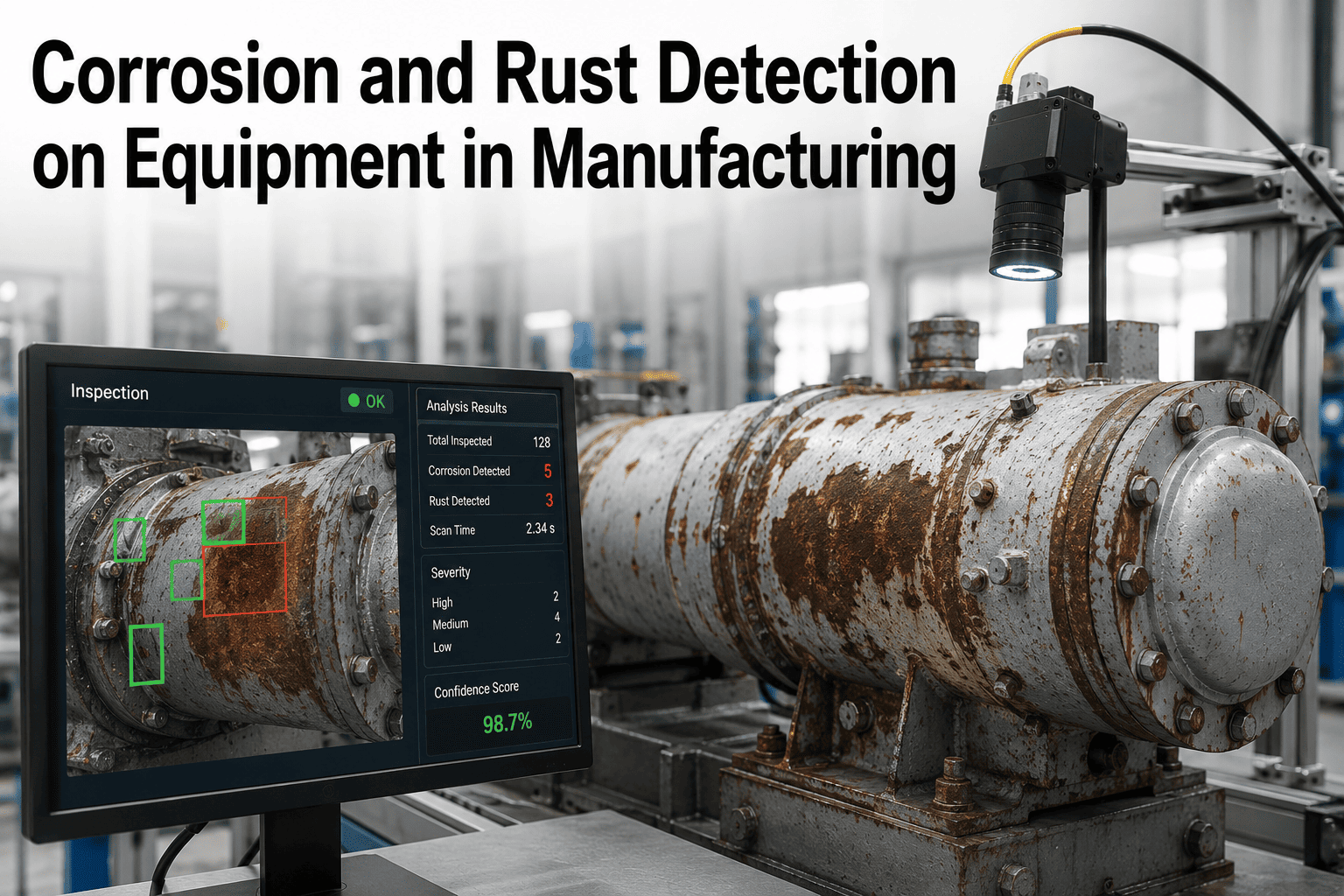
Corrosion progression
What AI Sees
High-resolution cameras track micro-level wear progression on belts, chains, seals, and contact surfaces — measuring degradation rate and predicting remaining useful life
Lead Time
2–6 weeks warning with wear rate trending and remaining life estimation
Shaft misalignment
Coupling wear
Imbalance
Looseness
Resonance shift
What AI Sees
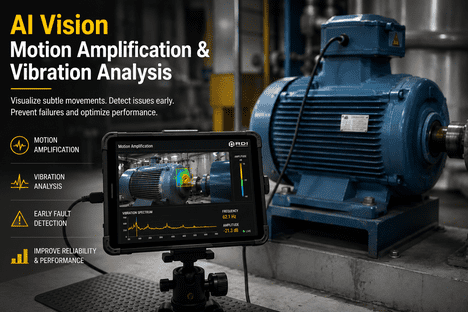
Vision-based displacement analysis detects micro-vibration patterns and alignment drift invisible to the naked eye but indicative of developing mechanical faults
Lead Time
3–8 weeks warning — vibration anomalies are the earliest failure indicator
Hydraulic leaks
Coolant seepage
Oil contamination
Pressure line failure
Condensation buildup
What AI Sees
AI detects fluid accumulation patterns, discolouration, and seepage traces on equipment surfaces and floors that indicate developing seal or line failures
Lead Time
1–4 weeks warning before seal failure or catastrophic line rupture
Cable wear
Connector corrosion
Arc damage
Insulation breakdown
Panel overheating
What AI Sees
Thermal and visual imaging detects hot joints, discoloured wiring, arc traces, and insulation degradation on electrical panels, cabinets, and motor connections
Lead Time
2–6 weeks warning — prevents electrical fires and sudden motor burnout
Foundation cracks
Mounting looseness
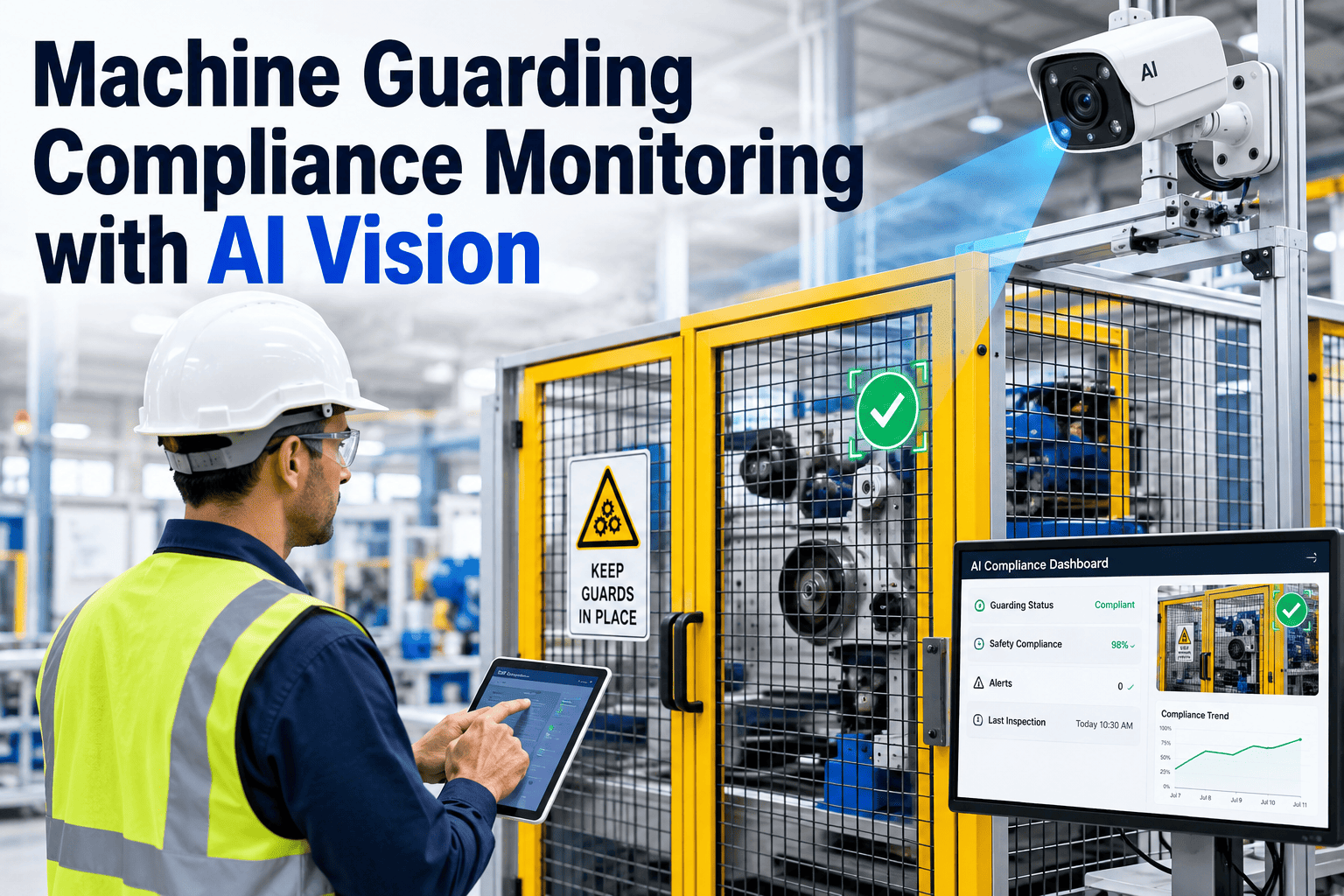
Guard displacement
Rust progression
Debris accumulation
What AI Sees
Monitors equipment mounting integrity, structural fatigue, safety guard positions, and environmental conditions that indicate developing infrastructure failures
Lead Time
Continuous monitoring prevents catastrophic structural failures and safety incidents
From Monitoring to Prevention: The AI Maintenance Loop
Monitoring alone is a dashboard. Prevention is a system. The real power of AI vision in predictive maintenance is the closed loop — continuously watching equipment, detecting anomalies as they develop, correlating them with failure patterns, and triggering maintenance actions before the machine decides for you.
AI Vision Predictive Maintenance Pipeline
Watch
Continuous Visual Monitoring
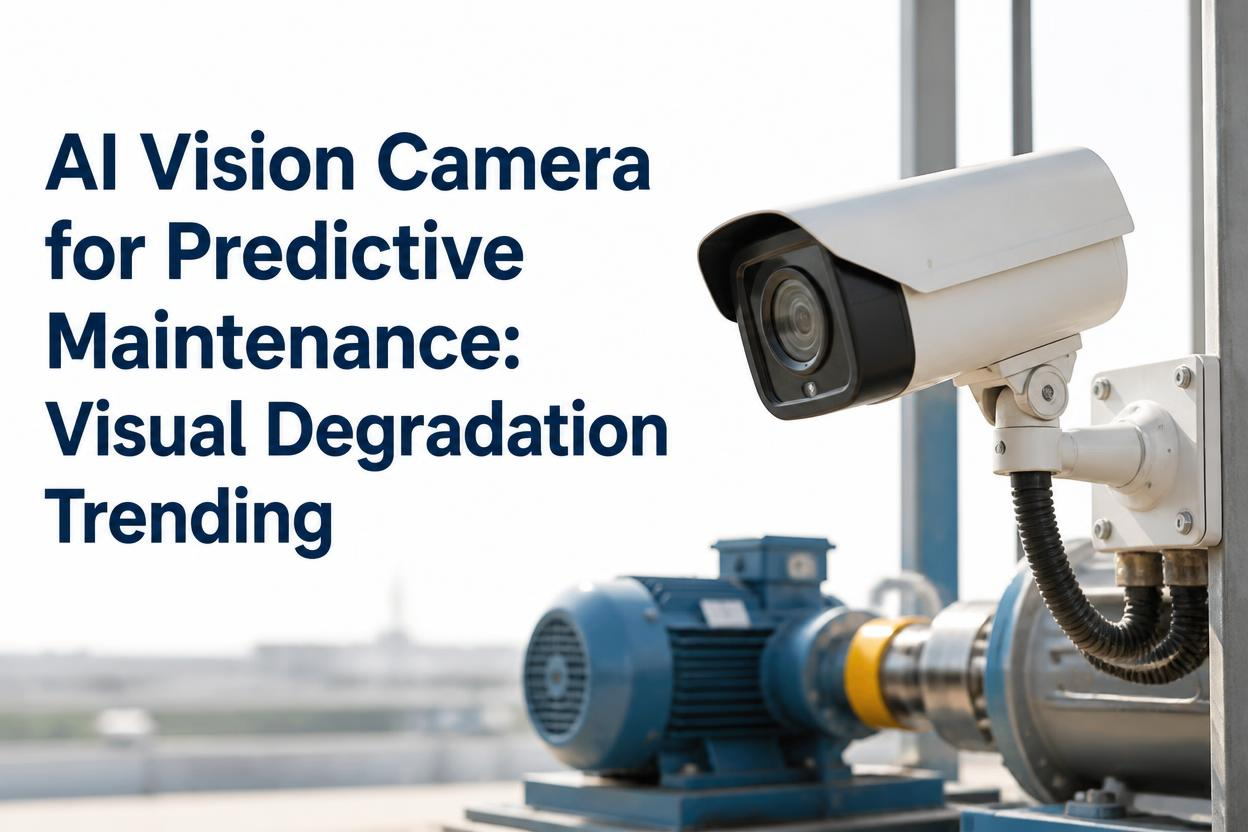
Thermal and visual cameras monitor critical equipment 24/7. AI baselines normal operating patterns and flags any deviation from expected visual signatures.
Detect
Anomaly Identification
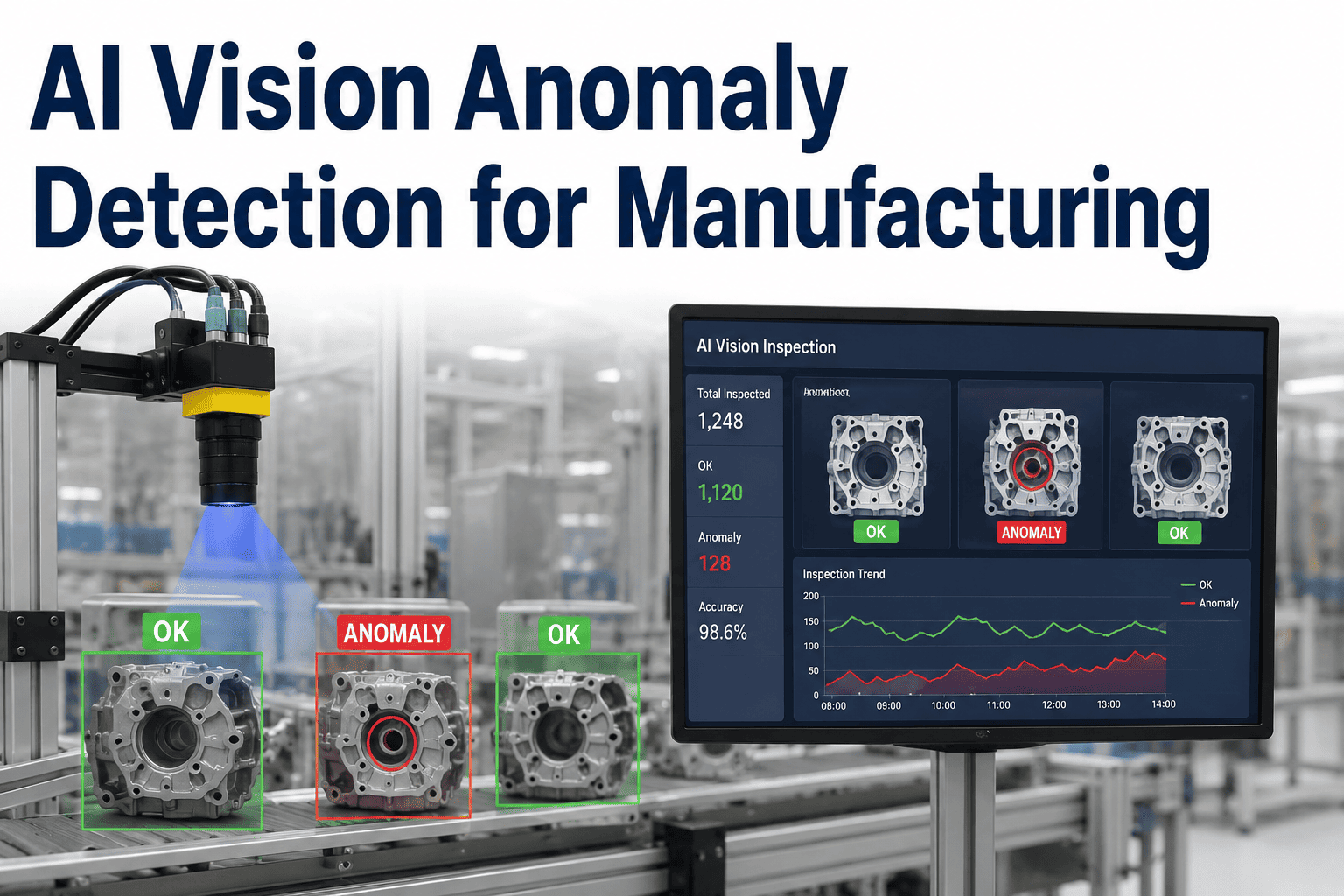
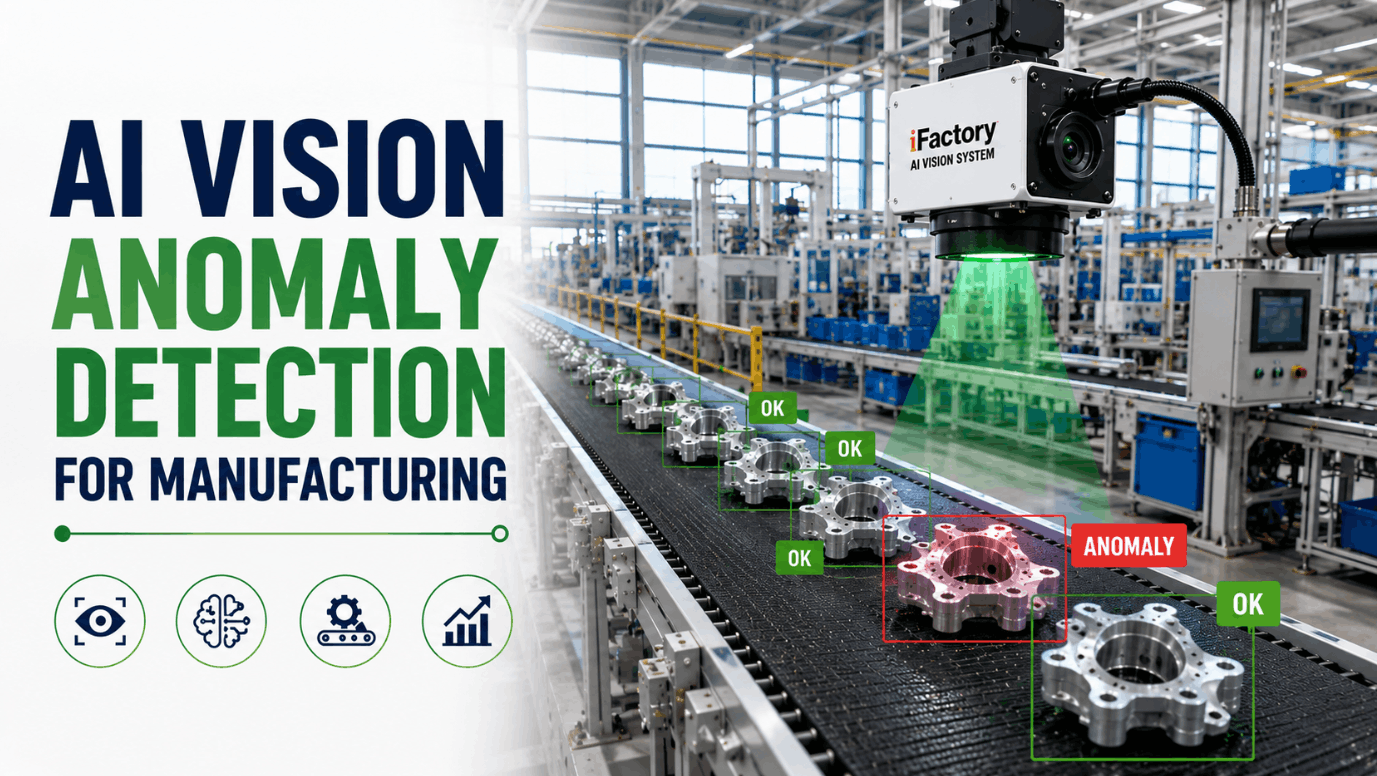
Deep learning models detect developing anomalies — thermal drift, wear progression, fluid traces, vibration changes — weeks before they become visible to operators.
Predict
Remaining Life Estimation
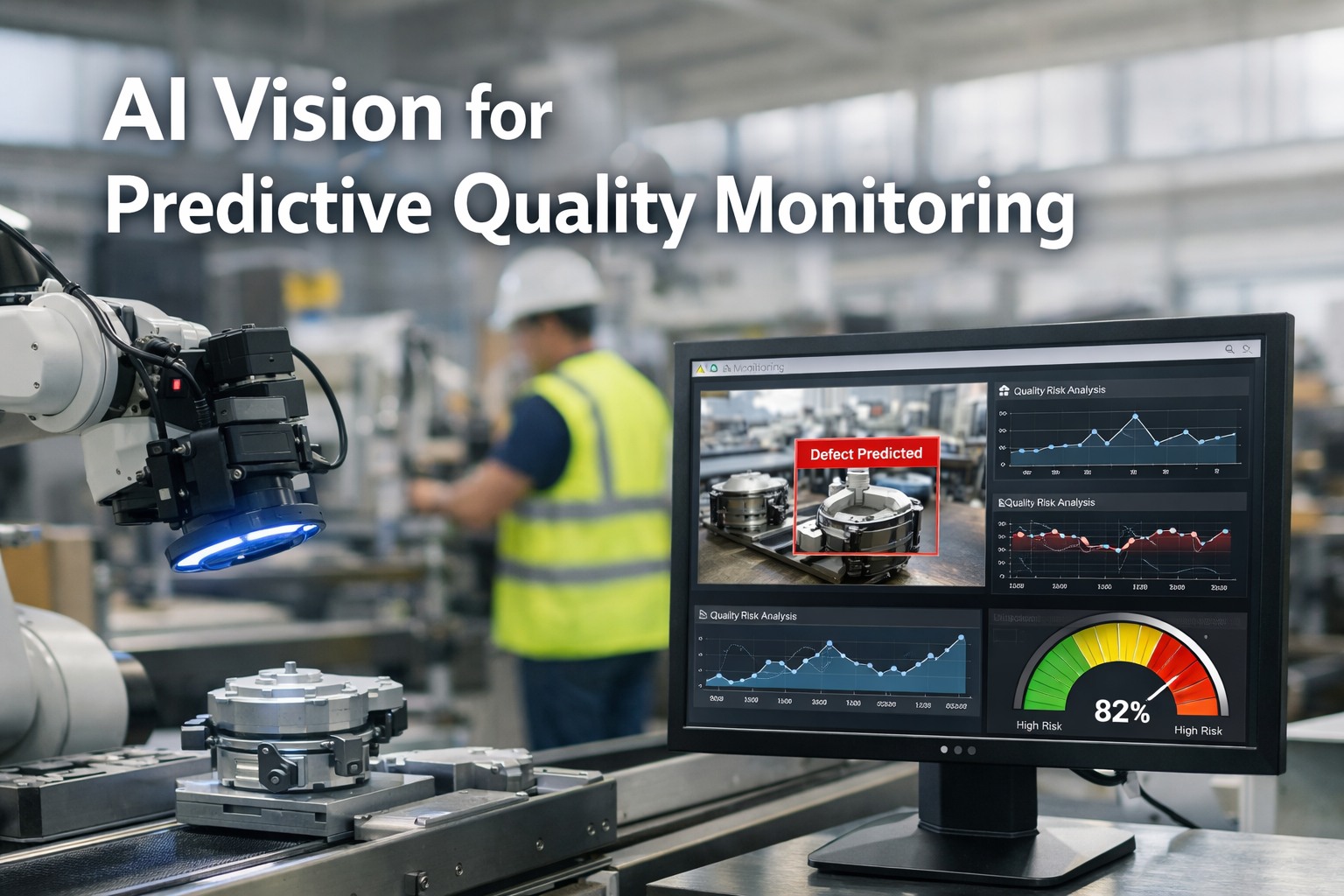
AI correlates anomaly patterns with historical failure data to estimate remaining useful life and predict the failure window — giving maintenance precise scheduling data.
Act
Automated Work Order Generation
System generates prioritised maintenance work orders, schedules repairs during planned windows, orders parts proactively, and tracks resolution — all without manual intervention.
Stop Waiting for Equipment to Tell You It's Broken
iFactory's AI vision platform monitors your critical assets continuously, detects developing failures weeks in advance, and generates maintenance actions automatically — turning reactive firefighting into planned prevention.
The Real Cost of Doing Nothing
Every plant manager knows downtime is expensive. Few know exactly how expensive — because the true cost extends far beyond the repair bill. Here is the full picture of what unplanned downtime extracts from your operation every year.
Lost Production
800 hours of annual downtime at $125K–$260K per hour. Every minute the line is down, output stops but overheads continue — labour, energy, facility costs all running at full rate with zero output.
$2M–$10M/year
Emergency Repairs
Unplanned breakdowns command emergency service calls, expedited parts at 40% premium, and overtime maintenance labour at 1.5–2x rates. Reactive repair costs 5–10x more than planned maintenance.
$500K–$3M/year
Cascade Damage
Missed shipments trigger customer penalties, schedule recovery requires overtime production, idle workers during downtime, and supply chain partners absorb downstream disruption costs.
$1M–$5M/year
Total Annual Downtime Cost
Combined direct and indirect costs from unplanned equipment failures — before accounting for customer churn and reputation damage that compounds over years.
$3.5M–$18M/year
How the Technology Works
AI vision for predictive maintenance combines industrial camera hardware with edge-deployed deep learning models that learn the visual signature of healthy equipment — and detect the earliest deviations that precede failure. Here is the architecture.
Layer 1
Multi-Spectrum Imaging
Thermal cameras (LWIR/MWIR) capture heat distribution patterns while high-resolution visible cameras monitor physical condition. Combined imaging detects both thermal anomalies and visual wear simultaneously across all critical equipment.
Layer 2
Baseline Learning
AI models establish normal operating signatures for each monitored asset — thermal profiles, visual condition, vibration patterns, and environmental context. The system learns what healthy looks like for your specific equipment under your specific operating conditions.
Layer 3
Edge AI Processing
GPU-accelerated edge computing analyses visual data in real time without dependence on cloud connectivity. Models run inference locally with sub-second response times, ensuring monitoring continues through network outages.
Layer 4
Anomaly Detection & Trending
Deep learning models detect deviations from baseline and track their progression over time. Trending algorithms estimate degradation rate and predict the remaining useful life window — converting raw anomaly data into actionable maintenance timelines.
Layer 5
CMMS & ERP Integration
Direct integration with your CMMS, ERP, and maintenance planning systems. AI-generated work orders flow into existing workflows with asset ID, failure mode, urgency, and recommended action — no manual data entry, no information gaps.
See the full monitoring stack running on live equipment data. Schedule a live demonstration.
Proven Results from AI Predictive Maintenance
Where AI Vision Predictive Maintenance Creates Impact
Every industry with rotating equipment, electrical systems, or mechanical components subject to wear can benefit from AI vision monitoring. Here are the sectors seeing the fastest adoption and highest returns.
Manufacturing & Assembly
Monitor CNC machines, presses, conveyors, robotic arms, and packaging lines for thermal anomalies, mechanical wear, and alignment drift — preventing the failures that cause 42% of all downtime incidents.
Manufacturing is the largest adopter — reducing 800 hrs/year of unplanned downtime
Energy & Utilities
Inspect turbines, transformers, switchgear, and pipeline infrastructure for thermal faults, insulation degradation, and corrosion progression without manual inspection shutdowns.
Prevents catastrophic failures in high-consequence, hard-to-access equipment
Automotive & Aerospace
Monitor stamping presses, welding robots, paint booth equipment, and precision machining centres where downtime costs exceed $2M per hour in assembly operations.
Highest ROI sector — every prevented hour saves $50K–$3M in downstream costs
Steel, Mining & Heavy Industry
Track mill rolls, crushers, kiln drives, furnace components, and conveyor systems in extreme environments where equipment failure causes multi-day shutdowns and massive restart costs.
AI vision works in extreme heat, dust, and vibration where human inspection fails
Frequently Asked Questions
How far in advance can AI predict equipment failure?
AI vision systems typically detect developing anomalies 2–8 weeks before failure, depending on the failure mode. Thermal anomalies in bearings and motors provide 4–8 weeks of lead time. Mechanical wear provides 2–6 weeks. This gives your maintenance team ample time to plan repairs during scheduled windows rather than reacting to emergencies.
Does this require installing sensors on every machine?
No. AI vision uses cameras — not contact sensors — which means a single camera installation can monitor multiple machines and components simultaneously. Thermal cameras cover wide areas, and visual cameras can track wear on multiple points from a single mounting position. This dramatically reduces installation cost and complexity compared to sensor-per-asset approaches.
What is the ROI for AI predictive maintenance?
Most manufacturers achieve full payback within 6–12 months. ROI comes from reduced unplanned downtime (50% reduction documented), lower emergency repair costs (reactive repairs cost 5–10x more than planned), extended equipment life (up to 40% longer), and reduced spare parts inventory through predictive ordering. Full AI maintenance infrastructure delivers 200–300% ROI.
Can this integrate with our existing CMMS?
Yes. The system integrates directly with all major CMMS, ERP, and maintenance management platforms. AI-generated work orders flow into your existing workflows with full asset context — failure mode, urgency level, recommended action, and parts requirements. Your maintenance team works in the same system they already use, with better data.
Does AI predictive maintenance replace our maintenance team?
AI augments your maintenance team — it does not replace them. The system handles the continuous monitoring that no human team can sustain 24/7, and provides your technicians with precise diagnostic data and lead time they have never had before. Your team shifts from reactive firefighting to planned, efficient maintenance execution.
See Every Anomaly. Predict Every Failure. Prevent Every Shutdown.
Your equipment is showing warning signs right now that no one is seeing. AI vision catches them all — 24/7, weeks before failure. Find out what your current maintenance is missing.