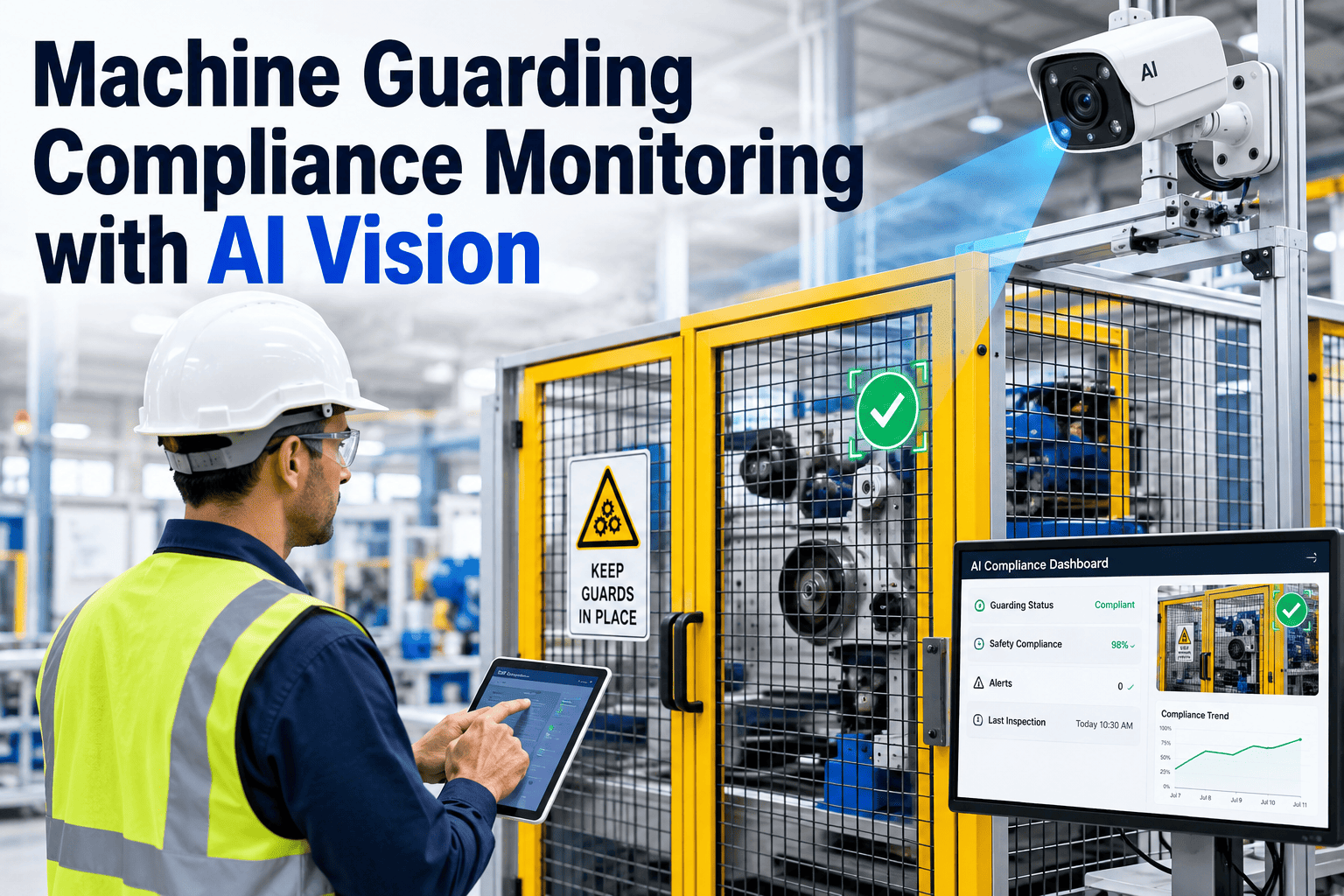
Machine guarding failures cause approximately 18,000 severe injuries and more than 800 workplace deaths in the United States every year, and the standard remains on OSHA's Top 10 most-cited list at position ten with 1,239 violations recorded in Fiscal Year 2025. Missing guards, bypassed interlocks, and improperly reinstalled barriers after cleaning or changeovers are the leading root causes — nearly half of all workplace amputations happen inside manufacturing facilities where guards are the first and often only barrier between operators and rotating shafts, presses, blades, and nip points. Traditional periodic inspections catch these violations too late, sometimes weeks after the guard was first defeated. AI vision monitoring closes that gap by watching every guarded machine continuously and flagging removed or bypassed guards the moment the exposure begins — before an injury, an OSHA citation, or an amputation ever occurs. Plant safety leaders can talk to our team about a six-week vision safety pilot tailored to their equipment mix.
See every guard, every shift — before OSHA does
iFactory AI vision cameras watch every guarded machine on your floor and alert your team the instant a guard is removed, bypassed, or reinstalled incorrectly. Turnkey delivery in 6 to 12 weeks with 1000+ plants already deployed.
Why machine guarding remains one of the deadliest gaps on the plant floor
Machine guarding is not a new problem. The OSHA general industry standard 29 CFR 1910.212 has existed since 1971, yet it appears on the agency's Top 10 most-cited list every single year, and the National Emphasis Program on Amputations in Manufacturing was renewed in June 2025 for another five years through 2030. The reason is simple. Guards get removed for legitimate reasons — cleaning, changeover, jam clearing, blade replacement — and then forgotten, hurried back into place, or deliberately defeated because the guard slows the operator. Between periodic supervisor walkthroughs, an unguarded press or unshielded belt drive can run for hours, days, or entire shifts without anyone documenting it. The gap between a guard coming off and someone noticing is where amputations happen.
Six guarding failures AI vision catches within seconds of exposure
Not every guarding failure looks the same. Manual audits usually catch the obvious cases — a missing guard on a saw — but miss the subtler and more common failures like a bypassed interlock or a guard that was reinstalled with the wrong hardware. Vision AI detects each category independently and produces a specific alert with clip evidence for the supervisor, not just a generic notification.
Point-of-operation guard, side shield, or belt cover has been removed entirely and the machine is running. Highest-severity alert, escalated to shift lead in under 30 seconds.
Interlock switch has been taped, wedged, or defeated so the machine runs with the guard open. Vision detects the abnormal geometry even when the electrical circuit reads closed.
Guard is back in place but hardware is missing, misaligned, or the wrong panel was installed after cleaning or changeover. Common cause of delayed-onset injury weeks later.
Guard is cracked, warped, or has a gap large enough to admit a finger or hand. Detected by comparing the guard shape against a learned reference baseline for that machine.
A hand, sleeve, or tool has entered the pinch zone between rollers, gears, or moving belts. Instant on-machine visual and audible alert with automatic incident log.
Operator is reaching over, under, or around a fixed guard toward the point of operation. Flagged for coaching before the reach becomes contact with a moving part.
From camera pixel to supervisor alert in under 2 seconds
iFactory Machine Guarding AI runs entirely on a pre-configured NVIDIA edge server that ships racked and ready. Plug in power and Ethernet, connect the RTSP streams from your existing IP cameras, and the AI is live. No cloud round-trip, no video leaves the plant, no re-cabling of production equipment.
Existing IP cameras stream RTSP video to the edge server. Any camera pointing at guarded equipment is a sensor — no new hardware on the machine itself.
A YOLO-family object detector, trained on your specific guard geometries, checks every frame for guard presence, position, and pixel-level fit to the learned baseline.
A per-machine rule engine correlates guard state with machine motion. Guard removed while machine idle is logged. Guard removed while machine runs is an incident.
Incident triggers on-machine strobe or horn, mobile alert to supervisor, and a corrective action ticket in iFactory. Optional PLC hard-stop for the highest-severity classes.
Every detection is stamped with time, camera, machine ID, and a short video clip stored for the OSHA-recommended five-year retention window. Auditors get clean reports.
Cover every guarded machine on your floor with your existing cameras
Pre-configured NVIDIA edge server ships racked and ready with software pre-loaded. We handle cabling, camera integration, PLC hooks, operator training, and 24×7 remote monitoring.
What AI vision catches versus manual inspection cycles
Manual walk-arounds and periodic PPE audits catch a fraction of guarding violations, and only after they have been active for hours. The table below compares typical manual detection performance against continuous vision monitoring across the most common OSHA 1910.212 exposure categories.
| Guarding Failure | Manual Audit Detection | AI Vision Detection | Typical Exposure Window | OSHA Severity |
|---|---|---|---|---|
| Missing point-of-operation guard | Only during scheduled walk | Under 2 seconds | Hours to a full shift | Serious to Willful |
| Bypassed interlock switch | Rarely visible during audit | Continuous, per frame | Days to weeks | Serious to Willful |
| Improperly reinstalled guard | Requires hands-on inspection | Compared to learned baseline | Until next incident | Serious |
| Damaged or cracked guard | Weekly or monthly cycle | Every video frame | Weeks to months | Serious |
| Nip point hand entry | Not detectable manually | Real-time pose estimation | Fractions of a second | Willful |
| Reaching around a guard | Requires direct observation | Continuous body-pose tracking | Seconds to minutes | Serious |
| Operator inside pinch zone | Only when supervisor present | Zone intrusion under 1 second | Seconds | Willful |
From detection to documented resolution in under 15 minutes
A vision alert that only lights up a dashboard is a compliance record. A vision alert that flows into a maintenance workflow, a corrective action, and an OSHA-ready audit log is a safety program. iFactory closes the full loop from pixel to paperwork.
Operator removes side shield during a jam clear. Machine is still in run mode. Vision AI classifies the event within one frame at 25 fps and confirms with three consecutive frames to reject false positives.
Amber strobe or audible tone triggers at the workstation. Operator sees the alert. In configurations with a PLC hook, the machine automatically enters safe stop before contact with the moving part is possible.
Shift lead receives a mobile push alert with the machine ID, a 10-second clip of the exposure, and a one-tap acknowledgment button. Escalates to plant manager if not acknowledged in five minutes.
iFactory automatically creates a corrective action ticket assigned to the maintenance team. Guard reinstall is verified by the same vision model before the ticket can be closed by anyone.
Event, response, and closure are stamped into the compliance log with immutable timestamps. If an OSHA inspector asks for a 1910.212 audit trail, the report is ready in one click.
The cost of one unguarded machine versus the cost of continuous coverage
The financial case for AI vision on guarded equipment rarely closes on OSHA penalty avoidance alone. It closes on the combined cost of a single serious incident — direct medical, workers' compensation, lost production, reputation, and legal — measured against a per-camera annual subscription that covers dozens of machines.
covers 4 to 8 guarded machines on a single production line, depending on line-of-sight and machine density.
from purchase order to live monitoring across the entire plant, with a pilot line often live in six weeks.
reduction in machine-related near-miss and recordable incidents in the first year of deployment across peer plants.
edge server uptime with 24×7 remote monitoring included, backed by 1000+ deployed plants worldwide.
Frequently asked questions on AI machine guarding compliance
Does AI vision replace physical machine guards or OSHA-required safeguards?
No. AI vision monitoring is not a substitute for the physical guards, interlocks, presence-sensing devices, and lockout/tagout procedures required under OSHA 1910.212, 1910.147, and related standards. Physical safeguards remain the primary line of defense and are non-negotiable under federal regulation. What vision AI adds is continuous verification that those safeguards are actually in place, undamaged, and correctly configured during every shift, every day, on every machine — the layer that manual inspection cycles cannot cover. Think of vision as a 24×7 second set of eyes that never misses a walk-around, never gets distracted, and generates the audit trail your safety team needs. Teams evaluating this layer typically start with a scoped pilot on their highest-risk line before rolling it plant-wide.
Do we need to install new cameras or replace our existing CCTV infrastructure?
In most cases, no. iFactory Machine Guarding AI integrates with any IP camera capable of producing an RTSP stream, which covers the vast majority of factory CCTV systems installed in the last decade. Our integration team reviews your camera placement during the scoping call and typically identifies existing coverage as sufficient for 70 to 90 percent of the guarded equipment on a typical plant floor. Where new cameras are needed, we specify industrial-rated models suited to the vibration, dust, and lighting conditions of the specific work cell, and our field team handles the mounting, cabling, and calibration as part of the turnkey deployment. For plants that want to scope this without commitment, our support team runs a free camera-coverage assessment from a floor plan and photos.
How does the system avoid false positives that would overwhelm my safety team?
False positive suppression is engineered into every layer of the detection pipeline. The AI model is trained specifically on your guard geometries, not a generic guard database, so it learns exactly what your equipment should look like when properly guarded. Every alert requires confirmation across three consecutive frames at 25 frames per second before it triggers, which eliminates transient occlusions from passing operators or forklifts. Alerts are also gated by machine state, so a guard removed while the machine is locked out and idle is logged silently rather than sirened. In production deployments, our plants see an average of 1.2 verified alerts per camera per week after the first tuning cycle, which is a manageable review load for a single supervisor and well below the threshold where alert fatigue becomes a problem.
What OSHA standards and audit requirements does the audit trail satisfy?
The compliance log captures the data OSHA inspectors typically request during an amputation NEP inspection, which was renewed in June 2025 and now runs through 2030. Every guarding event, corrective action, response time, and resolution verification is stamped with immutable timestamps and stored in an OSHA-recommended five-year retention window. The system generates one-click reports aligned to 29 CFR 1910.212 general requirements and 1910.147 lockout/tagout, and the video clip evidence associated with each event is directly attachable to OSHA Form 300 and 301 incident records when required. Safety leaders can book a demo to walk through a sample audit report generated from a live deployment before committing.
How long does deployment take and what does the pilot pathway look like?
Standard turnkey deployment runs 6 to 12 weeks from purchase order to plant-wide live monitoring. The pathway starts with a 2-week scoping and baseline capture, during which our team maps every guarded machine, captures reference video, and configures the state machine per work cell. Weeks 3 and 4 cover edge server installation, camera integration, PLC hook-up where required, and model calibration on your specific guards. Weeks 5 and 6 are the pilot line running live with your safety team, tuning alert thresholds and validating the audit report. Plants that want to prove the value on one line before committing to the full plant typically choose our 6-week pilot pathway, which is fully credited toward the eventual full deployment if the plant proceeds. Reach out to support for a detailed deployment plan matched to your equipment count.
Stop chasing guard violations after the fact — see them the moment they happen
iFactory Machine Guarding AI ships as a pre-configured NVIDIA edge server with software pre-loaded. Rack it, plug in power and Ethernet, connect your existing IP cameras, and every guard on your floor is under continuous AI monitoring. Turnkey delivery in 6 to 12 weeks with cabling, PLC integration, and operator training included.