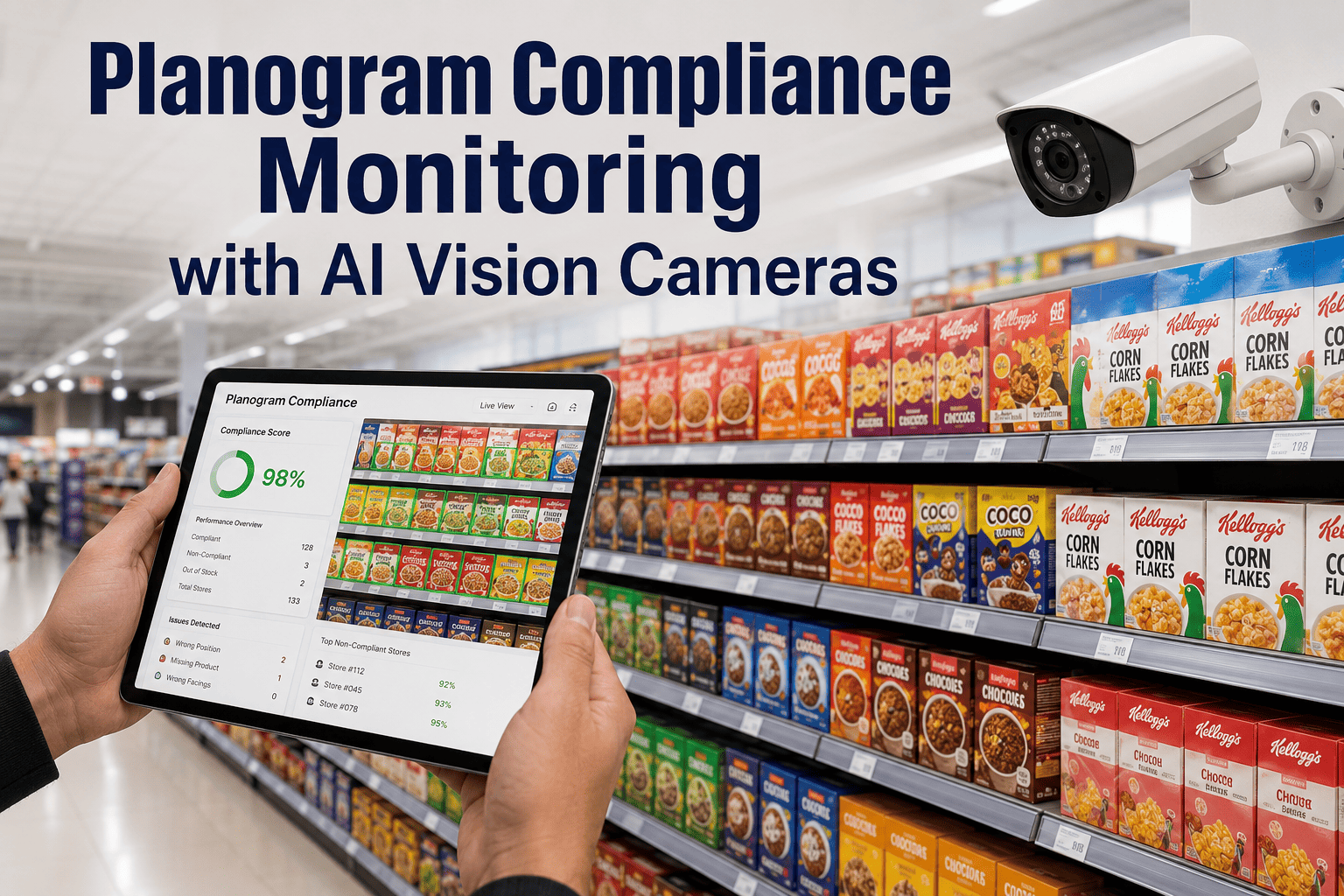
The 2025 OSHA Top 10 list looks almost identical to the 2024 list, and the 2024 list looked almost identical to the 2023 one. Fall protection has held the number-one violation slot for fifteen consecutive years. Hazard communication, machine guarding, lockout-tagout, and eye protection have all cycled through the same top ten for over a decade. The pattern is not a mystery — it is proof that manual, walk-the-floor safety inspection cannot scale to the number of unsafe moments a real plant produces in a single shift. AI vision changes the arithmetic by watching every camera every second and turning unsafe conditions into documented, actioned events before an inspector or an incident ever arrives. You can book a demo to see it run against a live camera on your own floor.
OSHA · AI VISION · WORKPLACE SAFETY · FY 2025
Every OSHA Violation on Your Floor Was Already Visible to a Camera — Nobody Was Watching in Real Time
iFactory's safety vision layer monitors PPE, machine guarding, fall protection, and exclusion zones on every camera you already own, then documents every event automatically so audit records write themselves and unsafe moments become work orders instead of incidents.
5,914
Fall protection citations in FY 2025 — the number-one OSHA violation for 15 years running
$165,514
Maximum per-violation OSHA penalty for willful or repeat citations in 2025
23,537
Total FY 2025 citations across the OSHA Top 10 alone, before industry-specific standards
24/7
Camera coverage that never blinks, forgets a checklist item, or files paperwork late
FY 2025 · OSHA TOP 10 · LEADERBOARD
The Ten Standards That Generated 23,537 Citations Last Year, Ranked by Violation Count
The value of the OSHA Top 10 list is not the rankings themselves — it is the fact that nearly every entry describes a condition or behaviour a camera can observe. Falls at height, missing PPE, unguarded machinery, unauthorised entry into a lockout zone, forklift proximity — every one of these leaves a visual signature the moment it happens. That is the entire premise of AI safety vision.
01
Fall Protection — General Requirements 29 CFR 1926.501
02
Hazard Communication 29 CFR 1910.1200
03
Ladders, Construction 29 CFR 1926.1053
04
Control of Hazardous Energy (Lockout/Tagout) 29 CFR 1910.147
05
Respiratory Protection 29 CFR 1910.134
06
Fall Protection Training 29 CFR 1926.503
07
Scaffolding, Construction 29 CFR 1926.451
08
Powered Industrial Trucks (Forklifts) 29 CFR 1910.178
09
Eye and Face Protection 29 CFR 1926.102
10
Machine Guarding, General Industry 29 CFR 1910.212
FOUR SAFETY DOMAINS · WHAT AI VISION ACTUALLY WATCHES
Four Domains That Together Cover More Than Half of the OSHA Top 10 With a Single Camera Layer
AI safety vision is not one detector — it is a library of models sharing the same camera feed. These four domains are where the technology has matured the furthest and where the ROI conversation is easiest to open with a plant manager who has an audit coming up.
DOMAIN 01
PPE Compliance
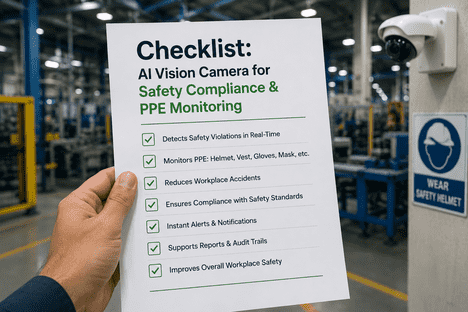
Hard hats, hi-vis vests, safety glasses, gloves, hearing protection, and steel-toe footwear detected on every person entering a monitored zone. Missing items trigger a discreet supervisor alert rather than a public shout-out.
Ties to OSHA #9 · Eye/Face Protection
DOMAIN 02
Machine Guarding & Access
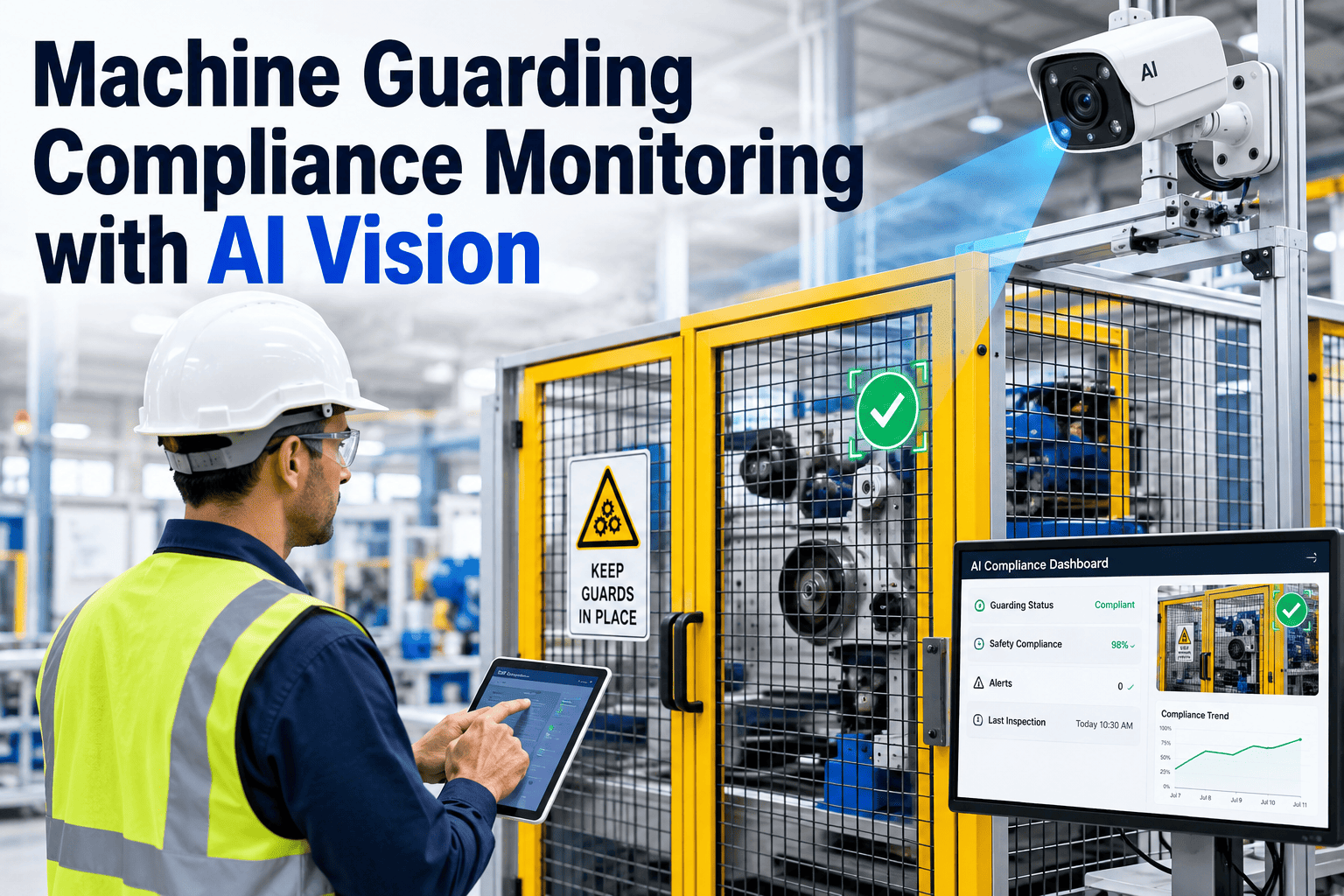
Missing guards, opened access panels, and reach-ins toward moving parts are all detectable from an overhead camera. The same feed can enforce lockout-tagout by refusing to close a work order if a body is still in the safe zone.
Ties to OSHA #4 & #10 · LOTO / Guarding
DOMAIN 03
Fall & Height Hazards
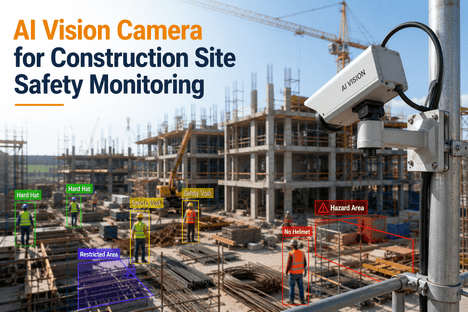
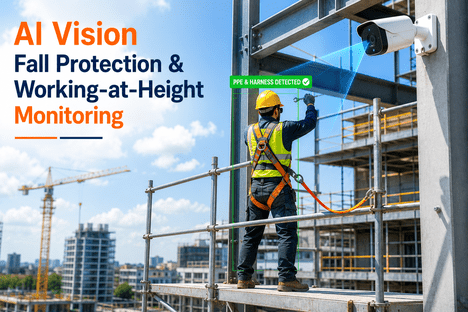
Workers approaching an unprotected edge, climbing a ladder without a harness above six feet, or entering elevated work zones without required PPE all produce clear visual signatures a model can flag before an incident.
Ties to OSHA #1, #3, #6, #7
DOMAIN 04
Exclusion & Forklift Zones
Pedestrian intrusion into forklift lanes, robot cells, or hot-work zones is one of the highest-value use cases because the mechanism of injury is so severe. A single detection can prevent a career-ending event.
Ties to OSHA #8 · Powered Industrial Trucks
THE DETECTION-TO-ACTION LOOP
Every Unsafe Moment Becomes a Documented, Actioned Event — Five Stages, Continuously Repeating
An unsafe observation is only useful if it leads to a corrective action and a record of both. The five-stage loop below is what turns raw computer vision into an actual safety programme. It runs continuously across every camera on the floor, day and night, with no supervisor asked to watch a monitor.
01
Detect
Vision model classifies the event by type (missing PPE, unsafe reach, unauthorised zone entry) with a confidence score and a saved evidence clip.
02
Route
Alert is directed to the correct supervisor or the CMMS based on the location, severity, and time of day the event was captured.
03
Act
Supervisor responds on the floor, or the CMMS auto-generates a work order for a physical fix such as a missing guard or damaged signage.
04
Document
Detection, response, and corrective action are timestamped together so the audit trail exists without anyone typing anything into a form.
05
Loop
The event feeds back into the training data and the risk dashboard so patterns emerge and the highest-frequency hazards get engineered out.
This loop runs continuously — Stage 05 always feeds back into Stage 01, so the safety programme keeps learning from every event.
See What a Camera on Your Floor Is Already Recording That Nobody Is Watching
Send us one live camera feed. We will show you PPE, exclusion-zone, and machine-guarding detection running against it inside a single working session.
THE FULL COST OF A SINGLE RECORDABLE INCIDENT
The Real Cost of One Incident Is Almost Never What Shows Up on the Insurance Claim
OSHA's maximum $165,514 willful-violation penalty gets the headline, but it is usually the smallest line item on the incident's true total cost. Direct medical and legal costs are visible; indirect costs — production loss, replacement labour, investigation time, training reset, and reputational drag — quietly triple or quadruple the number that ever reaches the CFO's desk.
Direct costs — visible on the claim
Indirect costs — usually hidden
Medical & hospital
Workers' comp
OSHA penalty
Legal & investigation
Production downtime
Replacement labour
Training reset
Reputation & morale
A recordable incident's true total cost typically runs 3-4x the direct-claim number. AI safety vision reduces both halves at once by catching the unsafe condition before it becomes an incident, and by documenting the response when it does.
AUDIT-READY DOCUMENTATION · WHAT INSPECTORS ACTUALLY ASK FOR
The Documentation Trail an OSHA Inspector Wants — Produced Automatically for Every Event
When an inspector arrives after an incident, or during a scheduled audit, the questions are always the same: what happened, when, what did you do about it, and what have you done since to make sure it does not happen again. The vision layer answers all four questions on its own, per event, without a single manual entry.
T + 0.0 seconds
Event Detected
Model detects the condition — for example, a worker on an elevated platform without a harness — saves a short video clip with the frame, camera ID, and a confidence score.
T + 3 seconds
Alert Routed
Notification is sent to the correct area supervisor on their mobile device, with the evidence clip attached, and a matching entry is logged in the CMMS event queue.
T + 90 seconds
Supervisor Response
Supervisor acknowledges the alert on their device, walks to the location, and records the outcome — corrected on the spot, work order created, or false positive marked.
Same day
Corrective Work Order
If physical remediation is required, a CMMS work order is generated automatically with the evidence attached, so the fix has the same audit trail as any other maintenance job.
Weekly
Pattern Report
Aggregated events roll up into a heatmap that shows which zone, shift, or task has the highest event frequency, so engineering controls target the biggest source first.
On demand
Audit Export
Any date range, any camera, any event type — a single export delivers the full timestamped record for an OSHA inspector, insurance carrier, or corporate safety review.
HONEST BOUNDARIES · WHAT AI VISION SHOULD AND SHOULD NOT DO
Where the Technology Is Strong, Where It Is Not, and Why That Distinction Matters
A safety programme built on overpromised capability erodes trust the first time it under-delivers. These are the honest edges of the technology — worth reading before any deployment conversation gets underway.
Strong Fit
- Objectively visible conditions — PPE presence, guard position, zone occupancy
- Continuous monitoring across many cameras without operator fatigue
- Timestamped evidence capture for every alert, corrected or not
- Trend and heatmap reporting that a manual programme cannot produce
- Integration with an existing CMMS for corrective work order flow
Weaker Fit or Human Required
- Judgement calls about fatigue, distraction, or intent — a supervisor's job
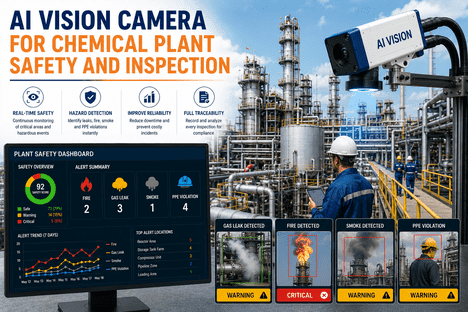
- Chemical, gas, and airborne hazards without dedicated sensor input
- Cultural and behavioural safety issues that need conversations, not alerts
- Areas where cameras cannot be installed for legitimate privacy reasons
- Anything happening outside the field of view of the existing camera fleet
FREQUENTLY ASKED QUESTIONS
What Safety, Operations, and Compliance Leaders Ask About AI Vision Under OSHA
Does AI safety vision replace human safety officers?
No, and any vendor claiming it does is overselling. AI vision handles the coverage problem — watching every camera continuously — and the documentation problem — capturing timestamped evidence for every event. Human safety officers still handle judgement, culture, training, and the conversations that turn observations into behaviour change. The right pairing is a small team of humans focused on high-value work, freed up by a vision layer that no longer requires them to walk the floor to catch a missing hard hat. You can
book a demo to see how the two roles complement rather than replace each other.
How does the system handle worker privacy concerns?
Privacy is the number-one question in every deployment conversation, and rightly so. The strongest deployments run detection on-premises, store only the short evidence clips tied to a genuine safety event, keep worker identities anonymised at the model level, and follow the plant's existing employee-monitoring notice policy. Cameras stay out of restrooms, locker rooms, and break areas. The goal is safer people, not surveillance.
Talk to our support team to walk through the privacy architecture in detail for your site.
Will the documentation actually hold up in an OSHA inspection?
The evidence chain the system produces — timestamped clip, camera ID, event classification, supervisor response, corrective work order — is exactly the record OSHA inspectors and insurance carriers ask for during an incident review. What matters is that the record is contemporaneous, not backfilled after the fact, and that the corrective action is genuinely traceable. Automated capture solves both requirements by default. You can
book a demo to see a sample audit export against a walk-through incident.
What happens when the model produces false positives?
False positives are a fact of life in the first weeks of any deployment, which is why the shadow-run phase exists. During that phase, alerts are reviewed but not acted on directly, and every one flagged as false is fed back into the model so the confidence threshold and detection zones sharpen. Once the false-positive rate is inside the agreed-upon operational tolerance, the alerts go live to the supervisor workflow.
Contact support to walk through the shadow-run process for your site.
How does this connect to our existing CMMS or safety software?
The vision layer publishes detection events as structured records — event type, location, evidence link, confidence — that can flow directly into an existing CMMS, EHS platform, or safety information system through an event API or webhook. Nothing needs to be ripped out. The camera layer sits alongside your current tools and gives them a stream of high-quality, evidence-backed events they previously had no way to receive. You can
book a demo that includes a live handoff into your existing system.
START WITH ONE CAMERA · ONE ZONE · ONE WEEK
Pick One Zone. Watch AI Vision Document Every Unsafe Moment for a Week. Then Decide.
The fastest way to evaluate a safety vision layer is to point it at a zone you already know has issues. In one week, you will have a documented record of exactly what was happening on that floor when nobody was watching.
01
Pick one zone and one live camera you already run
02
Watch PPE, guarding, and zone models run in shadow mode
03
Review one week of timestamped, audit-ready events
04
Get a scoped roll-out plan for the rest of the floor