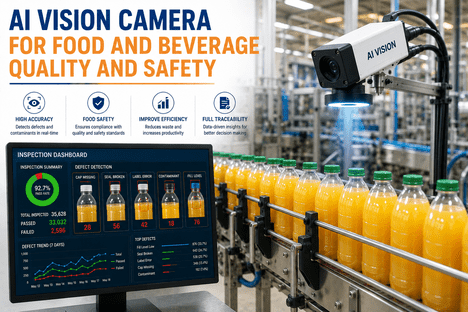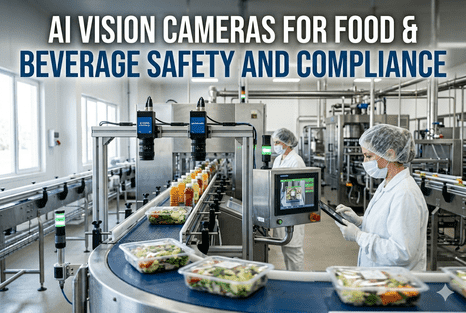
AI Vision Cameras are redefining how food and beverage manufacturers detect contamination, enforce quality standards, and maintain regulatory compliance on high-speed production lines. From raw ingredient intake to final packaging, iFactory's AI Vision Camera platform delivers real-time, automated inspection accuracy that no manual team can match — catching foreign objects, seal failures, label errors, and surface defects at machine speed, before a single compromised unit leaves the facility. Food and beverage plants that Book a Demo with iFactory consistently uncover inspection gaps that were entirely invisible in their legacy camera or manual QC setups.
Stop Contamination Before It Leaves the Line
iFactory's AI Vision Camera platform delivers real-time defect detection, label verification, and HACCP-ready compliance documentation — purpose-built for food and beverage manufacturers who demand zero-compromise quality control.
Why Food & Beverage Safety Demands AI Vision — Not Manual Inspection
Food safety failures cost the global industry billions every year, and the most dangerous contamination events happen faster than any human inspector can respond. Traditional QC methods — manual visual checks, fixed-rule machine vision, or periodic sampling — are structurally incapable of providing the continuous, high-accuracy coverage that modern food production lines require. AI Vision Cameras overcome this limitation by deploying deep learning models trained on millions of labeled food images, enabling simultaneous detection of foreign objects, surface defects, packaging failures, and label non-conformances — all in under 10 milliseconds per frame, at full line speed. For food and beverage facilities operating under FDA FSMA 204, BRC, SQF, or HACCP regulatory frameworks, this shift from reactive sampling to continuous AI inspection is no longer a competitive advantage — it is a compliance necessity. Plant quality managers who Book a Demo with iFactory routinely discover that their existing camera infrastructure is already sufficient to deploy AI vision — requiring only a software and edge-processing upgrade, not a full hardware replacement.
The Food & Beverage Production Line — Where AI Vision Matters Most
A fully integrated food and beverage line presents multiple distinct inspection zones, each with unique contamination and quality risks. AI Vision Cameras from iFactory are deployed across the entire production flow.
Raw Ingredient Intake
AI inspects incoming produce, protein, or bulk ingredients for surface defects, discoloration, foreign matter, and size non-conformance before processing begins.
Processing & Preparation
Vision models monitor cutting, portioning, and mixing stations for bone fragments, equipment-shed metal, and product deviations invisible to line workers.
Filling & Sealing
AI verifies fill levels, detects channel leaks in pouch seals, confirms cap torque, and flags tamper-evident band failures on every unit at full line speed.
Labeling & Packaging
Label placement, barcode readability, allergen statement presence, and expiration date legibility are verified on 100% of units — eliminating mislabeling recalls.
Contamination Detection: Finding What Other Systems Miss
Contamination detection is the highest-stakes function of any food safety inspection system. iFactory's AI Vision Camera platform analyzes products under multiple imaging spectrums — RGB visible light, near-infrared (NIR), UV, and optional X-ray integration — enabling detection of a full range of foreign materials that standard single-spectrum cameras routinely miss.
Foreign Object Detection — Metal, Glass, Plastic & Bone
AI models trained on contamination signatures across material types detect metal fragments, glass shards, plastic particulates, and bone matter at thresholds well below traditional X-ray sensitivity — including low-density contaminants that are invisible under standard lighting. Every detection event is logged with annotated image evidence, defect classification, timestamp, and lot code for full FSMA 204 audit trail compliance.
Surface Defect & Biological Contamination Detection
High-resolution AI vision catches mold growth, bruising, discoloration, cracks, and surface blemishes on perishable products at line speed — including subtle anomalies that human inspectors miss due to fatigue or lighting variability. In validated trials, AI models achieve over 98% accuracy in defect detection on perishable goods, outperforming even experienced inspection teams on high-throughput lines running thousands of units per hour.
Allergen & Cross-Contamination Risk Identification
For facilities processing multiple product lines with allergen-sensitive SKUs, AI Vision Cameras monitor production changeovers, equipment cleaning verification, and label allergen statement accuracy in real time — providing a continuous visual audit layer that supports both regulatory compliance and consumer protection requirements under FSMA and EU Food Information Regulation standards.
Packaging Integrity & Label Verification at 100% Inspection Coverage
Packaging and labeling failures are among the leading causes of food and beverage product recalls — and they are almost entirely preventable with AI vision inspection. iFactory's platform verifies every unit leaving the line, replacing statistical sampling with complete coverage.
Seal & Fill Integrity Verification
100% Unit CoverageAI vision verifies fill levels within precise tolerances, detects channel leaks and micro-tears in flexible pouch seals, and confirms tamper-evident band integrity across every container format — preventing spoilage from reaching consumers and protecting brand equity against seal-failure recalls.
Label Accuracy & Compliance Verification
Zero MislabelingEvery label is verified for correct placement, barcode scannability, expiration date legibility, allergen declaration completeness, and net weight statement accuracy — catching misprints, shifted labels, and missing compliance elements that would otherwise trigger regulatory action or costly consumer recalls.
Grading, Sorting & Cosmetic Classification
AI-Driven GradingAI Vision Cameras automatically grade and sort products by size, color uniformity, and shape conformance — replacing manual grading tables with consistent, fatigue-free classification that maintains product presentation standards across every production shift and adapts to new SKUs without manual reprogramming.
HACCP Compliance & Regulatory Documentation — Automated, Immutable, Audit-Ready
Regulatory compliance in food and beverage manufacturing requires more than inspection — it demands continuous, documented evidence of controlled conditions that can withstand FDA, BRC, or SQF audit scrutiny. iFactory's AI Vision Camera platform transforms compliance from a manual documentation burden into an automated, real-time process. Every inspection event — whether a detected contaminant, a seal failure, or a label non-conformance — is automatically logged with annotated image evidence, defect classification, lot code, and timestamp. This creates an immutable digital audit trail that meets FDA FSMA 204's 24-hour electronic record production requirements without any manual log entry. Quality managers responsible for building defensible HACCP documentation who Book a Demo with iFactory consistently report eliminating the manual log gaps that most frequently generate audit findings and corrective action requests.
Food & Beverage AI Vision Metrics That Matter
AI vision detects contaminants, defects, and packaging failures with 99.4% accuracy — consistently outperforming manual inspection teams on high-speed lines.
Every unit inspected at full line speed — replacing statistical sampling with complete production coverage and eliminating sampling gaps that allow defects to ship.
AI vision automates the inspection workload, freeing quality teams to focus on process improvement and compliance management rather than repetitive visual checks.
Typical payback period for AI Vision Camera deployment across food and beverage production lines, driven by recall prevention, labor optimization, and throughput gains.
iFactory AI Vision Camera — Designed for Food & Beverage Environments
iFactory's AI Vision Camera platform is engineered to integrate with the physical and regulatory realities of food and beverage production environments — not just the controlled conditions of a laboratory demonstration. The system ingests data from existing ONVIF-compatible cameras, thermal imagers, and 3D depth sensors via standard industrial protocols, eliminating the need to replace installed camera infrastructure. Edge AI processing runs on NVIDIA GPU hardware deployed on-premise, ensuring sub-50ms inference latency with zero cloud dependency — critical for high-speed lines where internet connectivity cannot be a single point of failure. When an AI model detects a contamination event or packaging failure, it automatically raises a work order in the iFactory CMMS, assigns the responsible technician, sends push and SMS alerts, and syncs the rejection record to SAP PM or any connected quality management system. Food and beverage quality directors who want to see how this integrates with their existing BRC or SQF documentation workflows are encouraged to Book a Demo and walk through a line-specific deployment scenario.
AI Vision Cameras for Food & Beverage — Frequently Asked Questions
Can iFactory AI Vision integrate with our existing production line cameras?
Yes. iFactory supports integration with any ONVIF or RTSP-compatible camera system currently installed on your production line. The AI inference engine and edge processing hardware are deployed as an overlay — no camera replacement is required in most food and beverage facility configurations.
How does the system generate HACCP-compliant documentation automatically?
Every AI inspection event — pass, rejection, or deviation — is automatically logged with annotated image evidence, defect classification, lot code, and timestamp. These records are stored in an immutable audit log formatted for HACCP, FSMA 204, BRC, and SQF compliance, and can be exported on demand for regulatory inspections or customer audits without any manual data entry.
What types of food contaminants can the AI Vision system detect?
iFactory's AI Vision platform detects metal fragments, glass shards, plastic particulates, bone matter, insect contamination, mold, discoloration, and biological surface defects — using multi-spectrum imaging including visible light, near-infrared, UV, and optional X-ray channel integration depending on the specific contamination risk profile of the production line.
How long does it take to train the AI model for a new food product SKU?
iFactory's AI Vision system supports rapid model retraining for new product SKUs in under one hour — no specialist integrator required. Quality teams can define new defect categories and retrain detection models directly through the platform interface, enabling rapid new product introduction without extended inspection downtime.
Does the platform handle allergen cross-contamination monitoring?
Yes. AI Vision Cameras support allergen risk monitoring by visually verifying production changeover cleaning procedures, confirming correct label allergen declarations on every unit, and flagging visible residue or cross-contact indicators at changeover points — providing a continuous visual audit layer alongside your existing allergen management program.
What is the typical ROI timeline for food and beverage AI vision deployment?
iFactory performs a data-driven ROI baseline assessment in 2–4 weeks using your current production, quality, and recall history data. Most food and beverage facilities achieve full platform ROI within 60–120 production days, primarily driven by recall avoidance, reduced manual inspection labor, and throughput recovery from fewer false reject events.
Ready to Build a Safer, Smarter Food & Beverage Production Line?
iFactory's AI Vision Camera platform delivers 99.4% detection accuracy, 100% unit coverage, and audit-ready compliance documentation — purpose-built for food and beverage manufacturers who cannot afford inspection gaps.