Food and beverage manufacturing carries a quality and safety burden that no other consumer goods sector shares — a single contamination event, mislabeled allergen, or compromised packaging seal can trigger a Class I FDA recall, harm consumers, and permanently damage brand equity built over decades. The FDA's Food Safety Modernization Act mandates preventive controls that require manufacturers to identify hazards, implement verified controls, and maintain documented records across every production stage — standards that manual inspection cannot reliably meet at modern line speeds. AI vision cameras are now the production standard for meeting FSMA preventive control verification requirements while simultaneously driving measurable improvements in foreign object detection, fill level accuracy, label compliance, and packaging integrity. Food and beverage manufacturing accounts for one of the fastest-growing AI vision deployment segments globally, with recall prevention economics alone justifying deployment: the average FDA Class I food recall costs between $10 million and $30 million in direct costs, excluding brand damage and lost distribution. iFactory's AI Vision Camera platform provides 100% inspection coverage across contamination detection, foreign object identification, fill level verification, label accuracy, and packaging seal integrity — at full production line speed, on existing ONVIF camera infrastructure, with NVIDIA edge processing that keeps all product imagery within your facility. Quality assurance managers, food safety coordinators, and plant operations teams evaluating AI vision for FSMA compliance and quality improvement programs are encouraged to Book a Demo with iFactory to assess how visual AI maps to their specific line configuration and regulatory environment.
Deploy AI Vision Inspection That Meets FSMA Preventive Control Verification Standards
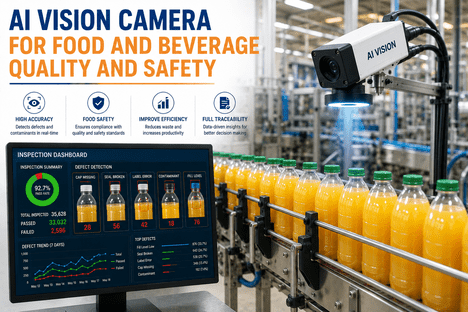
iFactory's AI Vision Camera inspects every unit for contamination, foreign objects, fill levels, label accuracy, and packaging seal integrity — at line speed, on existing infrastructure, with automatic FDA-ready audit records.
AI Vision Camera for Food and Beverage: Meeting FSMA Requirements While Eliminating the Hidden Cost of Quality Escapes
A technical guide to how AI vision cameras detect contamination, foreign objects, fill level deviations, label inaccuracies, and packaging failures in food and beverage production — delivering 100% inspection coverage, automatic FDA audit documentation, and real-time corrective action triggers at full line speed. Book a Demo to see iFactory's detection capabilities on your specific product and line configuration.
Six Critical Inspection Points Where AI Vision Cameras Protect Food and Beverage Quality
Effective food and beverage quality inspection requires AI vision coverage across six distinct failure modes — each carrying its own regulatory, safety, and commercial risk profile. iFactory's AI Vision Camera platform addresses all six from a unified inspection layer that connects to existing ONVIF cameras without hardware replacement. Quality teams evaluating AI vision deployment can Book a Demo to see iFactory's detection accuracy benchmarks on comparable product categories.
Foreign Object Detection
AI vision identifies glass fragments, metal shards, bone splinters, plastic contamination, and extraneous material in food products and open containers before sealing — providing a verification layer that complements metal detectors and X-ray systems by covering non-metallic contaminants at visual inspection speed.
Contamination and Surface Defect Detection
The system detects surface contamination, mold, discoloration, bruising, and physical damage on raw ingredients and finished products — enabling removal of non-conforming units before they enter the production stream or reach primary packaging.
Fill Level Verification
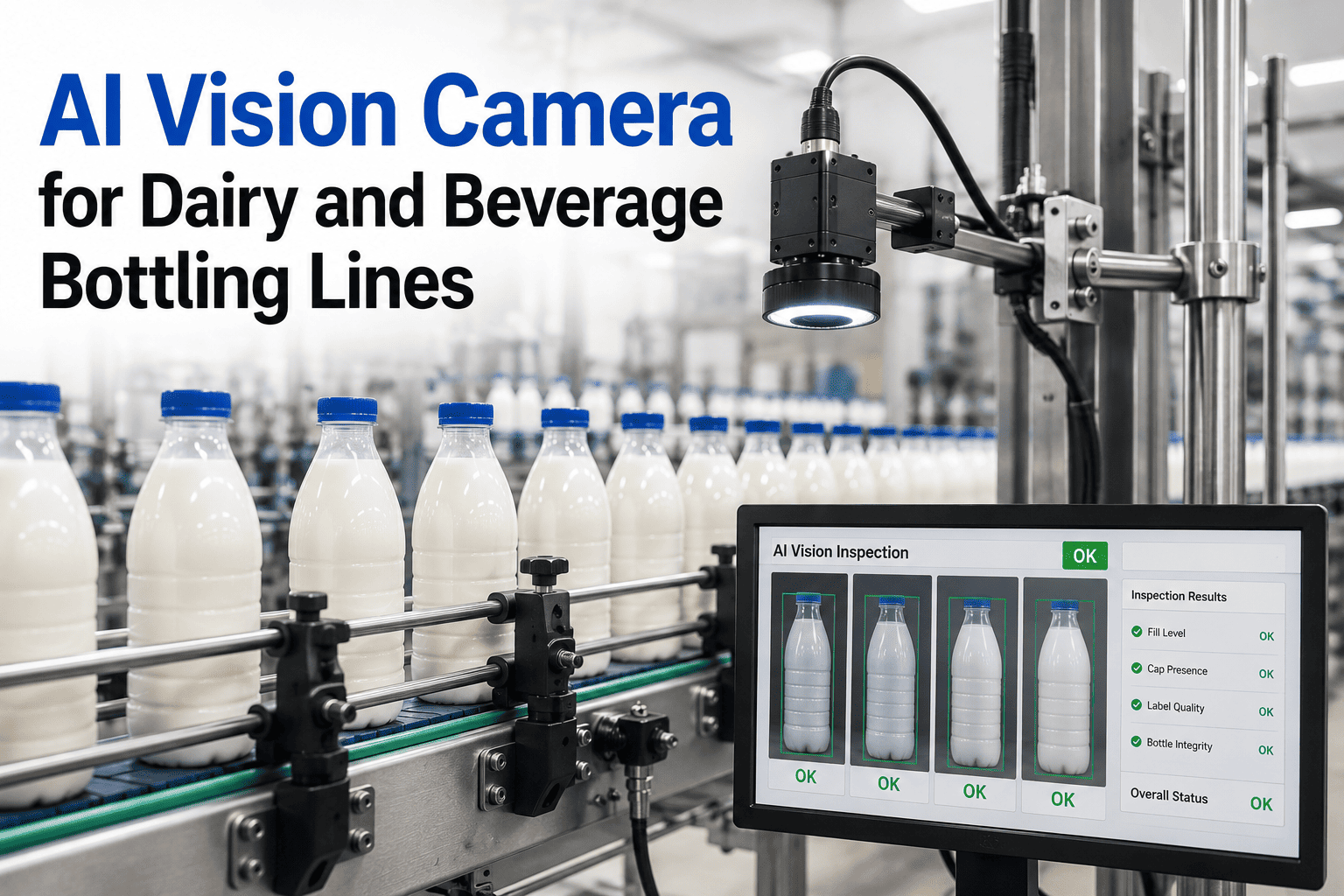
Every container is inspected for correct fill height or weight-equivalent fill level — detecting underfill that creates regulatory non-compliance and consumer complaints, and overfill that generates direct material cost losses across high-volume production runs.
Label Accuracy and Allergen Compliance
Label inspection verifies correct label application, readability, orientation, barcode quality, expiration date presence, and allergen declaration accuracy — preventing the mislabeled-allergen recalls that account for the largest single category of FDA food recall events.
Packaging Seal and Closure Integrity
AI vision detects compromised heat seals, improperly seated caps, damaged pouches, and closure alignment failures — identifying packaging integrity defects before units exit the line and before contamination or spoilage events develop during shelf life.
Case and Pallet Configuration Verification
At secondary packaging and palletization, the system verifies case count accuracy, tray configuration completeness, and pallet pattern correctness — preventing short-count shipments and warehouse pick errors that generate customer deductions and return claims.
Traditional Food Inspection vs. iFactory AI Vision: Performance Benchmarks
The gap between conventional food inspection methods and AI vision inspection is measurable across defect detection rate, regulatory documentation quality, and recall risk exposure.
| Inspection Area | Traditional Method | iFactory AI Vision Camera | Impact |
|---|---|---|---|
| Foreign Object Detection | Metal detector and periodic manual visual check — misses non-metallic contaminants | 100% visual scan of open containers detecting glass, plastic, bone, and extraneous material | Closes the non-metallic contamination gap |
| Fill Level Accuracy | Statistical sampling with checkweigher — underfill and overfill escapes between checks | Every container inspected for fill level deviation before sealing | Eliminates fill variance escapes entirely |
| Label Compliance | Manual audit sampling — allergen mislabeling escapes undetected at speed | 100% label verification including allergen declaration, expiration, and barcode quality | Eliminates leading category of FDA food recalls |
| Seal and Closure Integrity | Periodic pull-test sampling — compromised seals reach distribution | AI vision detects seal defects, loose caps, and pouch damage on every unit | Prevents shelf-life failures reaching retail |
| FSMA Audit Documentation | Manual paper or spreadsheet records — incomplete, delayed, audit risk | Automatic per-unit records with timestamped image evidence and defect classification | FDA-ready audit trail on every production run |
How iFactory AI Vision Camera Supports FSMA Preventive Controls Compliance
The FDA Food Safety Modernization Act's Preventive Controls for Human Food rule requires registered food facilities to implement a written food safety plan that identifies hazards, establishes preventive controls, specifies monitoring procedures, and maintains verifiable records of control effectiveness. iFactory's AI Vision Camera addresses the monitoring and verification requirements directly — providing continuous, automated inspection at each critical control point with automatic generation of the production records that FSMA auditors require. The system creates a timestamped, per-unit inspection record for every product that passes through a monitored station, documenting what was inspected, what the AI system determined, and whether the unit was accepted or flagged for removal. These records are stored locally on NVIDIA edge hardware within the facility, satisfy the FSMA requirement for records that are accurate, indelible, and legible, and can be retrieved for FDA inspection without manual reconstruction from paper logs. For facilities subject to the Foreign Supplier Verification Program and Sanitary Transportation rule, iFactory also provides documentation that incoming ingredient and packaging inspections were performed at receipt — closing additional FSMA verification gaps that manual inspection programs frequently leave exposed.
Hazard Identification at Inspection Stations
iFactory's platform maps each AI vision inspection station to the corresponding hazard category in your FSMA food safety plan — foreign object contamination, allergen cross-contact, undeclared ingredients, or packaging integrity failure. This mapping ensures that every inspection result is recorded against the correct preventive control category for audit traceability.
Continuous Monitoring at Critical Control Points
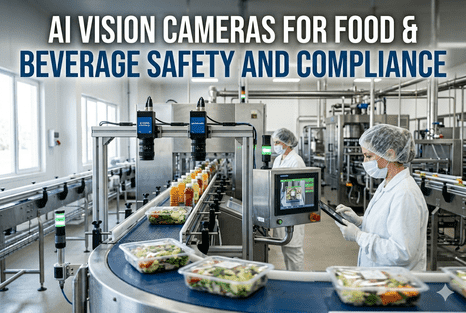
The AI Vision Camera provides uninterrupted monitoring at each CCP — foreign object inspection before sealing, fill level verification at the filler, label check at the labeler, and seal integrity verification at the heat sealer. Unlike periodic manual monitoring, AI vision operates at 100% coverage every shift without fatigue-related performance variation.
Automatic Corrective Action Triggering
When the system detects a defect or deviation at any monitored CCP, it immediately flags the affected unit for removal and generates a corrective action record in the connected CMMS or quality management system. The record includes defect classification, severity, timestamped image evidence, and line position data — satisfying FSMA's requirement that corrective actions be documented and implemented promptly.
FDA-Ready Production Records and Audit Support
Every inspection run produces a complete production record — total units inspected, units rejected at each CCP, defect type breakdown, and operator acknowledgment of corrective actions. Records are stored in tamper-evident format on local edge hardware and can be exported in standard formats for FDA inspection review, third-party audits, and customer quality assurance requests.
Close Your FSMA Inspection Gaps with AI Vision — On Cameras You Already Own
iFactory connects to existing ONVIF cameras at your CCPs, delivers 100% inspection coverage at line speed, and generates FDA-compliant production records automatically — without shutting down the line or replacing existing equipment.
Deploying AI Vision Inspection in Food and Beverage Facilities: Sanitation, Safety, and Speed
Food and beverage manufacturers evaluating AI vision deployment consistently raise three facility-specific concerns: whether camera hardware meets food-zone sanitation requirements, how the system handles the visual variation inherent in natural food products, and whether production imagery is stored securely within the facility. iFactory's platform addresses all three. Camera enclosures are available in IP69K-rated configurations suitable for high-pressure washdown environments in food processing zones. AI models for food inspection are pre-trained on large libraries of natural food product variation — accommodating the color, texture, and shape variation that causes rule-based inspection systems to generate excessive false calls on food products. All imagery and inspection records are processed and stored on NVIDIA edge hardware within the production facility; no product imagery is transmitted to external cloud servers, satisfying both internal IP security requirements and the data handling expectations of retail and foodservice customers conducting supplier quality audits.
Frequently Asked Questions: AI Vision Camera for Food and Beverage Quality and Safety
Q: Can iFactory's AI Vision Camera detect non-metallic foreign objects that metal detectors miss?
Yes — iFactory's AI Vision Camera visually inspects open containers and product surfaces for glass fragments, hard plastic shards, bone splinters, stone contamination, and extraneous plant material — defect categories that metal detectors and X-ray systems cannot reliably identify. AI vision functions as a complementary inspection layer that closes the non-metallic contamination gap in existing detection programs.
Q: How does the system handle natural variation in food product appearance?
iFactory's food inspection models are trained on extensive libraries of natural product variation — accounting for color, texture, shape, and size variation that differs across batches, seasons, and ingredient sources. The AI system learns what acceptable variation looks like for your specific product, dramatically reducing the false call rates that make rule-based inspection systems impractical for natural food products.
Q: Does the AI vision system generate the records needed for FSMA preventive controls compliance?
Yes — iFactory automatically generates per-unit inspection records, CCP monitoring logs, corrective action documentation, and production run summaries in formats that satisfy FSMA recordkeeping requirements. Records include timestamped image evidence, defect classification, and unit disposition — providing the indelible, accurate, legible documentation that FDA inspectors require. Book a Demo to review how iFactory's record structure maps to your specific FSMA food safety plan.
Q: Can iFactory inspect labels for allergen declaration accuracy?
Yes — iFactory's label inspection module verifies that the correct label is applied to each product, confirms allergen declarations are present and legible, validates expiration date format and presence, and checks barcode quality for readability. Allergen mislabeling is the single largest category of FDA food recalls by count, and label verification at 100% inspection coverage eliminates the sampling gaps where mislabeled product can escape detection.
Q: Is the camera hardware suitable for food processing environments with washdown requirements?
Yes — iFactory AI Vision Cameras are available in IP69K-rated enclosures designed for high-pressure hot water washdown in food processing and beverage filling environments. Enclosure materials are compatible with food-zone cleaning chemical standards, and installation configurations are available for both overhead and inline mounting positions at filling, sealing, and labeling stations.
Q: Does product imagery leave the facility for cloud processing?
No — all AI inference and data storage runs on NVIDIA edge processors located within the production facility. Product imagery, inspection records, and quality data are processed and retained locally. No production data is transmitted to external servers, satisfying both internal data security policies and the data handling requirements that major retail and foodservice customers increasingly specify in supplier quality agreements.
Protect Your Brand, Meet FDA Requirements, and Eliminate Recall Risk with AI Vision
iFactory's AI Vision Camera delivers 100% inspection coverage for contamination, foreign objects, fill levels, label accuracy, and packaging seal integrity — at line speed, on existing infrastructure, with automatic FSMA-compliant documentation on every production run.