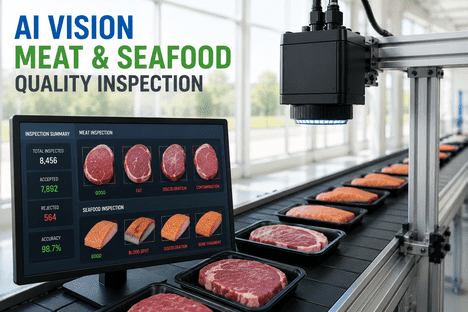
Grading meat and seafood by eye has always meant judging things a standard camera cannot fully see — fat distribution running through the tissue, bone fragments hidden beneath the surface, and subtle discoloration that signals a freshness issue before it becomes obvious. Traditional visual inspection and manual grading are time-consuming, inconsistent between graders, and limited to what is visible on the surface, which means bone fragments and internal quality variation routinely pass through standard checks undetected. AI vision meat and seafood inspection addresses this by combining standard imaging with hyperspectral sensing, which captures information across wavelengths beyond what the human eye or an ordinary camera can register, revealing fat content, foreign material, and tissue composition that surface inspection alone would miss. In 2026, as processors face tightening food safety expectations and yield pressure on every cut, this shift from manual grading to AI-assisted vision and hyperspectral inspection is becoming standard practice across meat, poultry, and seafood lines. iFactory's AI-driven EAM platform brings this capability to processing and grading lines through its Vision Classification feature. Quality and operations teams evaluating automated inspection are encouraged to Book a Demo with iFactory to start a pilot on your own processing line.
See Beyond the Surface — Bone, Fat Ratio, and Defects in One Pass
iFactory's Vision Classification feature detects bone, analyzes fat ratio, identifies defects, and grades meat and seafood using AI vision and hyperspectral sensing, improving yield and safety.
Why Standard Cameras Cannot Grade Meat and Seafood Alone
A standard color camera sees what is on the surface — overall shape, visible color, and obvious surface defects — but it cannot tell a grader how fat is distributed through a cut, whether a bone fragment is sitting just beneath the surface, or whether early tissue degradation has begun before any visible discoloration appears. Hyperspectral imaging closes this gap by capturing data across many narrow wavelength bands rather than the three channels a standard camera uses, picking up chemical and compositional differences in tissue that correspond to fat content, contamination, and freshness. Combined with deep learning classification trained on the specific product being inspected, this approach lets a system grade meat and seafood on attributes that used to require manual cutting, lab testing, or simply could not be assessed at all on a moving line.
Detects What's Hidden
Hyperspectral and dual-sensor imaging identifies bone fragments and foreign materials such as plastic or packaging residue that are invisible to standard surface inspection.
Fat Ratio Analysis
Fat distribution and marbling patterns are analyzed and classified, identifying lean-to-fat ratios that support consistent grading rather than visual estimation alone.
Freshness & Discoloration
Color and tissue composition are analyzed for early signs of discoloration or degradation, supporting freshness assessment beyond what visible color alone indicates.
Shape & Cut Consistency
Geometry, size, and trim consistency are measured against target specifications, supporting consistent grading and yield across high-volume cutting and processing lines.
What AI Vision and Hyperspectral Sensing Identify in Meat & Seafood
A complete meat or seafood inspection program combines several detection approaches, each suited to a different quality or safety attribute. The table below outlines the main categories iFactory's Vision Classification feature addresses across meat, poultry, and seafood products. Book a Demo to see how this maps to your own product mix and grading standards.
| Inspection Category | What Is Identified | Imaging Approach | Why It Matters |
|---|---|---|---|
| Bone & Hard Foreign Material | Bone fragments and dense foreign material below the surface | Hyperspectral sensing combined with deep learning classification | A leading cause of recalls and customer safety complaints |
| Soft Foreign Material | Plastic film, packaging residue, and organic contaminants | Hyperspectral imaging insensitive to color or shape variation | Catches contaminants that visual checks alone often miss |
| Fat Ratio & Marbling | Lean-to-fat ratio and marbling distribution across the cut | Spectral analysis of tissue composition | Directly affects grading, pricing, and customer specification |
| Discoloration & Freshness | Early color shifts and tissue changes linked to degradation | Color and spectral analysis against freshness baselines | Supports food safety decisions earlier than visible spoilage |
| Shape, Size & Trim | Cut geometry, dimensions, and trim consistency | High-resolution imaging compared against target specifications | Improves yield and consistency across high-volume cutting lines |
How iFactory's AI Vision Camera Improves Yield and Safety
Detecting a bone fragment or measuring a fat ratio only delivers value if the grading decision happens fast enough to keep pace with the line and feeds into a consistent standard across every shift. iFactory's AI Vision Camera applies on-premise edge inference to classify each cut or unit in real time, combining visual and hyperspectral data into a single grading decision and logging every result with supporting image data rather than relying on a grader's visual judgment alone. Because the same classification standard applies to the first unit of a shift and the last, fat ratio grading and defect detection stop varying between graders and start showing up as a consistent, auditable record — supporting both yield optimization and the documentation that food safety reviews require. Reported deployments of AI-powered vision grading in meat and poultry processing have reduced discard levels by as much as 40 percent, illustrating the yield impact of catching grading and defect issues consistently rather than relying on sampled manual review. Many processors start with a focused pilot on one line or product category before expanding coverage. Book a Demo to start a pilot for your own facility.
AI Vision Meat & Seafood Inspection — Frequently Asked Questions
Why is hyperspectral imaging used for meat and seafood inspection?
Hyperspectral imaging captures data across many wavelength bands rather than the three channels a standard camera uses, revealing tissue composition, fat content, and contamination that are invisible to standard surface imaging alone.
Can AI vision detect bone fragments in meat and poultry?
Yes — hyperspectral and dual-sensor imaging combined with deep learning classification can identify bone fragments and other dense foreign material beneath the surface, supporting food safety checks that surface-level visual inspection cannot perform.
How does AI vision analyze fat ratio and marbling?
Spectral analysis of tissue composition identifies lean-to-fat distribution and marbling patterns across a cut, supporting consistent grading decisions rather than relying on a grader's visual estimation.
Does AI vision inspection improve yield in meat and seafood processing?
Reported deployments of AI-powered vision grading in meat and poultry processing have reduced discard levels by as much as 40 percent by applying a consistent grading standard across every unit rather than sampled manual review.
What does a meat or seafood inspection pilot involve?
A pilot typically installs vision and hyperspectral imaging on one processing or grading line, trains classification models on your specific product and defect types, and validates detection accuracy against your existing quality standards before wider rollout.
Grade Every Cut on Bone, Fat Ratio, and Defects — Not Just Appearance
iFactory's Vision Classification feature detects bone, analyzes fat ratio, and identifies defects on meat and seafood lines using AI vision and hyperspectral sensing, improving yield and safety from the first pilot onward.