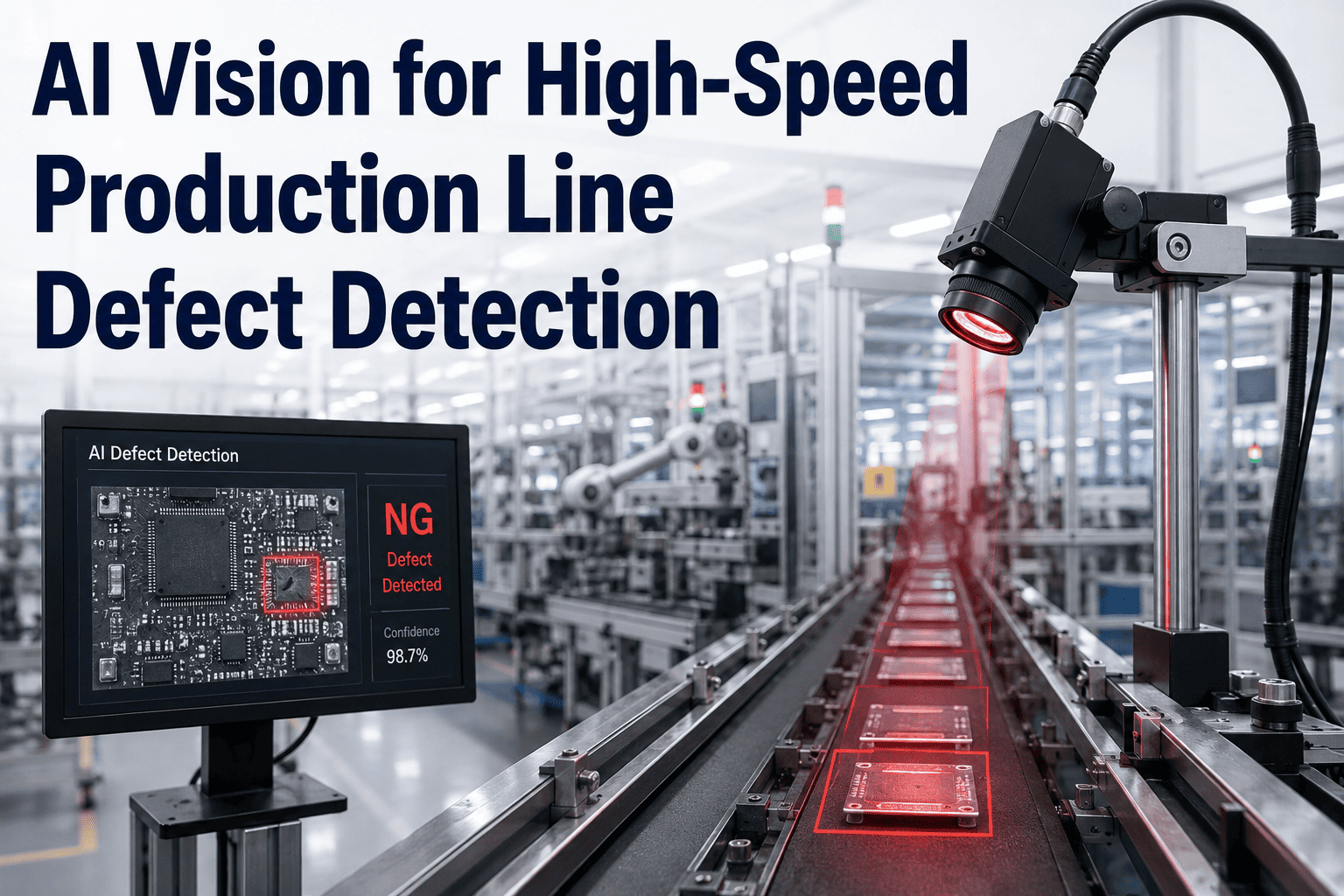
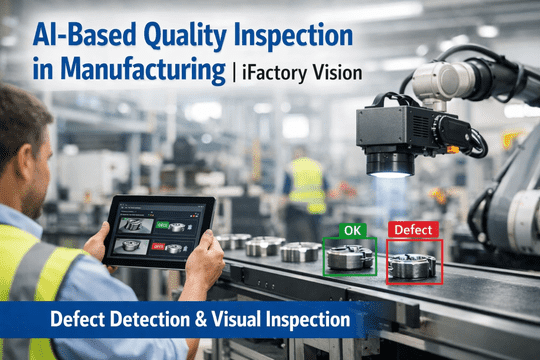
Every minute your production line runs, defects are forming. Micro-cracks in castings. Misaligned components in assemblies. Contamination in packaging. Your human inspectors catch most of them — on a good day, maybe 80%. On the 3,000th unit of an 8-hour shift, that number drops. The defects that escape become warranty claims, recalls, and lost customers. AI vision systems for automated quality inspection eliminate this gap. They inspect every single unit at production speed — detecting defects as small as 0.1mm at 99%+ accuracy, 24 hours a day, without a single coffee break. This is not emerging technology. It is the new standard. Book a demo to see it running on your product type.
From Sampling to 100% Inspection: The Quality Revolution
Traditional quality control inspects a statistical sample — maybe 1 in 50 units, maybe 1 in 100. The assumption is that if the sample passes, the batch passes. That assumption fails when a tool wears mid-run, when a material batch varies, when a temperature drifts. AI vision systems reject this compromise entirely. They inspect 100% of production — every unit, every surface, every dimension — at line speed. The shift from sampling to total inspection is the single biggest quality improvement available to manufacturers today.
How many defects are escaping your current inspection process? Book a free quality audit — we will identify your highest-risk inspection points and calculate the cost of escape.
The Anatomy of an AI Vision Inspection System
An AI vision system is not a single camera bolted to a conveyor. It is an engineered system of four tightly integrated components — each critical, each designed for the specific product geometry, defect types, and line speed of your production environment.
What Happens in 200 Milliseconds
From the moment a product enters the inspection zone to the moment a pass/fail decision triggers the reject mechanism — the entire AI vision inspection cycle completes in under 200 milliseconds. Here is every step, in sequence, happening faster than a human blink.
Photoelectric sensor detects product entering the inspection zone. PLC sends trigger signal to camera system.
Multi-angle cameras fire simultaneously. Specialized lighting activates. High-resolution images acquired from every critical surface.
Images normalized, aligned, and prepared for AI inference. Region-of-interest extraction focuses compute on critical zones.
Deep learning model classifies defects, measures dimensions, verifies assembly. Multiple inspection tasks run in parallel on edge GPU.
Pass/fail/borderline decision made. Defect type classified. Severity scored. Confidence level calculated.
PLC triggers reject mechanism. Image + result published to UNS. Quality dashboard updated. Traceability record stored. CMMS alert if pattern detected.
AI Vision vs. Traditional Inspection: The Full Comparison
The difference between manual inspection, rule-based machine vision, and AI-powered inspection is not incremental — it is generational. Here is how each approach performs across the metrics that matter.
| Capability | Manual Inspection | Rule-Based Vision | AI Vision Systems |
|---|---|---|---|
| Detection Accuracy | 70–80% | 85–92% | 99%+ |
| Speed | 1 unit / 30–60 sec | 100–500 units / min | 1,000+ units / min |
| Consistency | Degrades with fatigue | Consistent but rigid | Consistent and adaptive |
| New Product Setup | Training: days | Reprogramming: weeks | Retraining: hours to days |
| Unknown Defects | Depends on experience | Cannot detect | Anomaly detection mode |
| False Reject Rate | 10–20% | 5–15% | <1% |
| Continuous Learning | No | No | Yes — improves over time |
| Data Output | Paper / none | Basic pass/fail logs | Full analytics, traceability, trend data |
See the Difference in Real Time
We will run a live AI vision inspection demo on your actual product images — showing exactly what defects the system catches that your current process misses.
Industry-Specific Inspection Applications
AI vision inspection adapts to the unique defect types, regulatory requirements, and production speeds of every manufacturing sector. Here is how leading industries are deploying automated quality inspection in 2026.
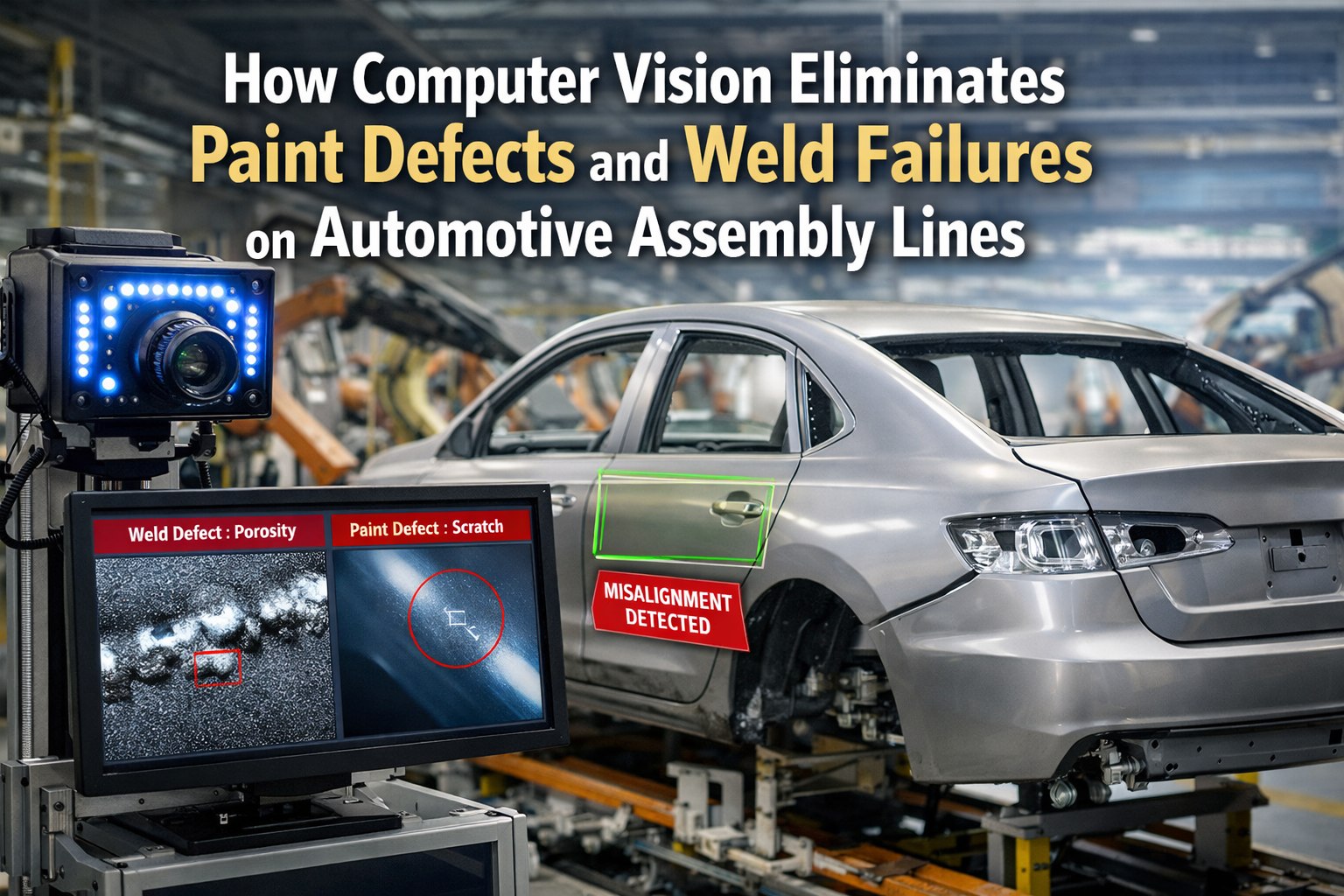
Paint surface defects invisible to naked eye. Weld bead consistency and cold joint detection. Component assembly verification. Dimensional tolerance at line speed. Leading manufacturers report 60% reduction in warranty claims and 37% fewer defects after AI deployment.
Solder joint inspection at 99.97% accuracy on miniaturized PCBs. Die-level wafer defect classification at 98.5%. Component placement verification. One semiconductor manufacturer reduced labor costs by 80% through automatic defect classification replacing 12-inspector rotating shifts.
Foreign object detection and contamination screening. Label placement and OCR verification. Fill-level monitoring. Packaging seal integrity. AI vision sustains 1,200 cap inspections per minute on bottling lines — 72,000 units per hour with consistent accuracy.
Particle detection in injectable liquids. Pill quality and dosage accuracy verification. Packaging integrity and sterility validation. Full traceability for FDA, GMP, and ISO compliance. AI handles subjective inspection tasks with consistency that eliminates operator-to-operator variability.
Micro-crack and material fatigue detection in aircraft components with higher accuracy than traditional NDT methods. Surface defect classification on turbine blades. FAA and AS9100 regulatory compliance documentation generated automatically from inspection data.
Surface defect classification on hot-rolled and cold-rolled steel. Crack detection in castings and forgings. Coating uniformity measurement. Dimensional gauging at continuous production speeds. Steel producers report 1900% ROI on AI vision inspection deployments.
The ROI Equation
AI vision inspection is one of the fastest-returning capital investments in manufacturing. The math is straightforward: defects caught earlier cost exponentially less to fix. A defect caught at the planning stage costs $100. The same defect caught after shipping can cost $10,000. AI vision catches them on the line — before any downstream value is added.
Want an ROI projection specific to your production line? Book a free ROI assessment — we will calculate your exact savings based on current defect rates, scrap costs, and inspection labor.
How iFactory Deploys AI Vision Quality Inspection
iFactory integrates AI vision inspection into your complete factory data architecture. Every inspection result feeds into the Unified Namespace, triggers CMMS work orders when patterns emerge, updates digital twins in real time, and provides the quality intelligence that agentic AI systems use to optimize production autonomously.
We walk your production floor, identify highest-impact inspection points, document defect types, and calculate expected savings before any hardware is specified.
Camera selection, lighting engineering, edge compute sizing, and mounting design — all specified to your product geometry, defect profiles, and line speed requirements.
Deep learning models trained on your actual production images. Synthetic data augmentation for rare defect types. Blind-sample validation until 99%+ accuracy is confirmed.
PLC integration, reject mechanism configuration, UNS data publishing, CMMS triggers, and operator training. Full production deployment with monitoring dashboard from day one.
Model retraining, new defect category addition, accuracy monitoring, and production data analytics. The system gets smarter every week it operates.
Frequently Asked Questions
Every Defect That Escapes Costs You. AI Vision Stops the Escape.
99%+ accuracy. Sub-200ms decisions. 100% inspection. Integrated with your UNS, CMMS, and digital twin from day one.