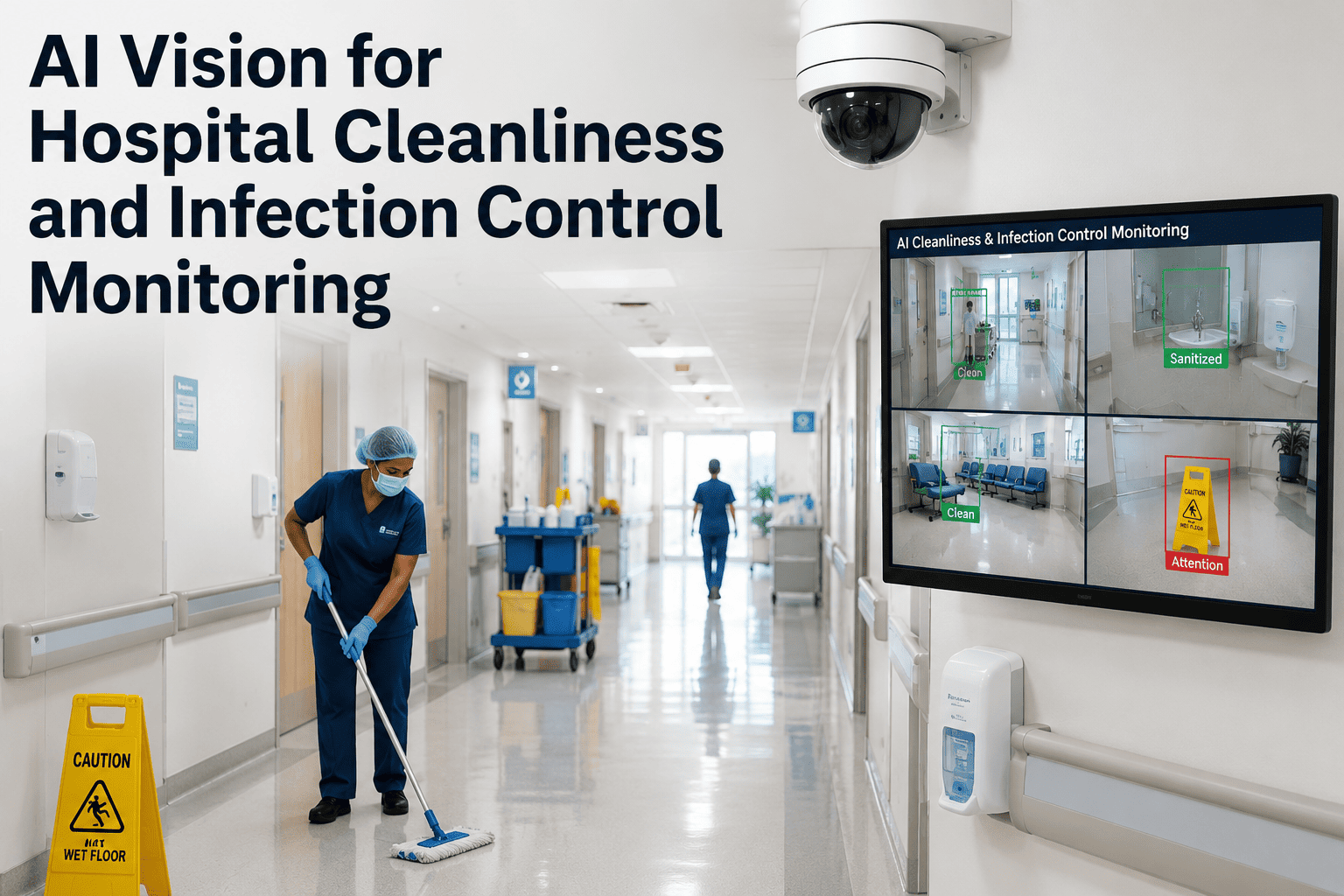
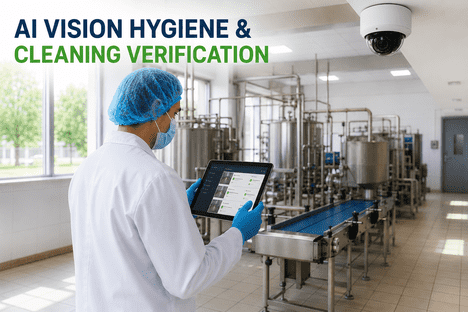
A hospital room can look spotless and still fail a fluorescent marker test on more than a quarter of its high-touch surfaces, because visible clean and actually disinfected are not the same thing. Hand hygiene compliance, tracked the traditional way by a person with a clipboard, is measured on a small sample of moments and known to run higher than what actually happens on the floor. Hospital-acquired infections tied to these exact gaps cost the U.S. healthcare system tens of billions of dollars a year and remain one of the most preventable categories of harm in a hospital. AI vision is now being placed at sinks, room doorways, and isolation zones to turn cleaning and hygiene compliance from a periodically sampled estimate into a continuously verified record. To see how this applies to your facility, book a demo.
HEALTHCARE VISION · INFECTION PREVENTION · CONTINUOUS VERIFICATION
What Your Infection Control Program Can't See With a Clipboard
Direct observation and periodic audits cover a fraction of the moments that matter. AI vision watches the ones that don't get sampled — every handwash, every high-touch surface, every PPE step, every shift — and turns that watching into a record your infection prevention team can act on.
$5.7–31.5B
Annual direct healthcare cost range attributed to hospital-acquired infections in the U.S.
25%+
Of high-touch surfaces left inadequately cleaned in community hospital baseline audits before intervention
18 pts
Hand hygiene adherence improvement reported after real-time AI monitoring feedback in one hospital deployment
$35K+
Added average cost per patient from a single HAI-driven extended ICU stay
WHY THE TRADITIONAL AUDIT MODEL FALLS SHORT
Sampling Was Never Meant to Catch Everything
Every hospital already tracks hand hygiene and surface cleaning in some form. The limitation is not effort, it is coverage — a trained observer or a periodic fluorescent-marker audit can only be in one place at a time, and infection risk does not wait for the next scheduled check.
Direct Observation Samples a Fraction of Moments
A single observer assigned to a unit can log only a small slice of the hand hygiene opportunities that occur across a shift, and staff behavior is known to shift when someone is visibly watching, a limitation infection control literature refers to as observation bias.
Cleaning Self-Reports Don't Always Match Reality
Studies comparing environmental services self-monitoring against independent validation have found meaningful gaps between reported cleaning thoroughness and what parallel testing actually found on the same surfaces.
Feedback Effects Fade Without Continuous Reinforcement
Research reviewing environmental cleaning interventions has found that cleaning thoroughness commonly declines within six to eighteen months of the last feedback session, meaning a one-time audit push does not hold on its own.
THREE MONITORING DOMAINS, ONE CAMERA SYSTEM
What AI Vision Watches Across the Clinical Environment
Infection prevention depends on three separate behaviors happening consistently, in three different physical locations. AI vision is configured to monitor each one against its own defined standard rather than treating hygiene compliance as a single generic metric.
01
Hand Hygiene Compliance
Cameras positioned near sinks, alcohol-based rub dispensers, and room entry and exit points detect hand hygiene opportunities as defined by the WHO's Five Moments framework and verify whether a wash or sanitize event occurred, its duration, and its technique against recognized gesture patterns.
Entry and exit point detection
Wash duration and technique
Every opportunity, not a sample
02
Surface Cleaning Verification
Rather than relying on a periodic fluorescent-marker spot check, vision-based verification confirms that defined high-touch surfaces — bed rails, door handles, light switches, call buttons — were actually addressed during a cleaning pass, giving environmental services a per-room, per-surface completion record instead of a sampled estimate.
High-touch surface tracking
Per-room completion record
Continuous, not periodic
03
PPE Compliance in Isolation Zones
At isolation room thresholds, cameras verify that gowns, gloves, masks, and eye protection are worn correctly before entry, flagging staff who bypass a required step, which matters most in exactly the high-risk zones where a missed step has the highest transmission consequence.
Entry-point PPE verification
Isolation zone priority
Real-time bypass alerts
See what continuous monitoring would show on your units
iFactory configures hand hygiene, surface cleaning, and PPE monitoring around your facility's own units, isolation protocols, and current audit data — not a generic compliance benchmark.
SAMPLED AUDIT VS. CONTINUOUS VERIFICATION
What Changes When Every Moment Is Observed
The compliance standard itself does not change — hand hygiene still needs to happen at the same five moments, and the same high-touch surfaces still need to be cleaned. What changes is whether the record reflects a sample of the shift or the entire shift.
| Monitoring Factor |
Traditional Sampled Audit |
AI Vision Monitoring |
| Coverage of hand hygiene opportunities |
Small observed sample per shift |
Every detected opportunity at monitored points |
| Observer effect on behavior |
Compliance often rises when observer is visible |
Consistent camera presence, no observation spike |
| Surface cleaning confirmation |
Periodic fluorescent-marker spot checks |
Per-surface, per-room completion tracking |
| Feedback timing |
Delayed, often batched into a weekly or monthly report |
Near real-time alert at the point of the miss |
| Sustainability of improvement |
Compliance drift observed after feedback sessions end |
Standard applied continuously, not tied to a feedback cycle |
HOW A MONITORED MOMENT BECOMES A RECORD
From Camera Detection to Infection Prevention Dashboard
The monitoring layer sits alongside the workflow staff already follow, at the sink, the doorway, and the isolation threshold, rather than requiring a separate check-in step.
1
Opportunity Detected
A camera identifies a hand hygiene moment, a room-cleaning event, or a PPE entry point using the same clinical triggers infection control teams already define.
2
Action Verified Against Standard
The system checks whether the required action occurred — a wash of sufficient duration, a surface addressed during cleaning, a PPE item worn correctly — against the defined protocol for that zone.
3
Compliant Events Logged Silently
Compliant moments are recorded without interrupting staff workflow, building the continuous dataset infection prevention teams currently have to estimate from a sample.
4
Missed Steps Trigger Timely Feedback
A missed or incomplete step generates a near real-time signal, closing the feedback gap that delayed batch reporting leaves open.
5
Unit-Level Trends Reach Infection Prevention
Aggregated compliance data by unit, shift, and zone gives infection prevention leadership a continuous view instead of a monthly snapshot, supporting the documentation reviewed during accreditation.
WHY CONSISTENCY MATTERS MORE THAN A SINGLE HIGH SCORE
The Gap Between an Audit Result and What Actually Happened
A hospital-wide hand hygiene compliance rate that looks strong on a quarterly report can still coexist with real gaps at the unit or shift level, because the number reflects a sample, and a sample can miss exactly the moments where risk is concentrated. Peer-reviewed comparisons of hand hygiene compliance and infection rates have found that the relationship between compliance and outcomes holds most clearly up to roughly 60 percent compliance, after which small differences in true adherence, not just the reported number, start to matter more than the headline percentage.
The same pattern shows up in environmental cleaning research. Studies comparing what environmental services self-reported against independent parallel testing on the same rooms have found the two do not always agree, and thoroughness that looks strong immediately after a training or feedback push has been shown to decline within six to eighteen months once that reinforcement stops. Continuous monitoring is built to close both gaps at once — it removes the sampling limitation that makes a compliance number uncertain, and it removes the dependency on a feedback cycle that fades once attention moves elsewhere.
BEFORE YOU START
What Infection Prevention Leadership Should Have Ready
Facilities that move fastest from evaluation to a working pilot generally arrive with a clear picture of their current audit process and their highest-priority units, rather than starting that conversation from a blank slate.
1
Current Compliance Baseline
Existing hand hygiene and cleaning audit data, however sampled, so a pilot has a documented starting point to measure against.
2
Priority Units and Zones
Which units — ICU, isolation, OR, or a specific medical-surgical floor — carry the highest current HAI concern, so pilot scope reflects where risk is concentrated.
3
Existing Camera and Network Infrastructure
A sense of current camera coverage and network capacity at sinks, doorways, and isolation thresholds, since deployment is scoped around what already exists where possible.
4
Privacy and Compliance Review Contacts
Who on your team handles HIPAA and facility privacy review, since disclosure, scope limitation, and health-information handling are reviewed before any camera goes live in a clinical area.
FREQUENTLY ASKED QUESTIONS
What Infection Prevention Teams Ask Before Adopting AI Vision
Does this replace our infection prevention team or our existing audit process?
No. AI vision monitoring is built to feed better data into the infection prevention program your team already runs, not to replace the clinical judgment behind it. Your team still sets the compliance standards, reviews the trends, and decides how to intervene at the unit level — the difference is that those decisions are now based on a continuous record instead of a sampled estimate that may not reflect what happens outside observed windows. Existing audit methods can continue to run in parallel during a transition period if your facility prefers that approach.
Contact our support team to see how this integrates with your current infection prevention workflow.
How does the system handle HIPAA and patient privacy in clinical areas?
Monitoring is scoped to staff hand hygiene, cleaning, and PPE behavior at defined points like sinks, doorways, and isolation thresholds, not to capturing identifiable patient health information, and deployments are reviewed against HIPAA and applicable facility privacy policy before going live. Camera placement, retention periods, and access controls are configured with your compliance and legal team as part of the planning process, not decided unilaterally by the vendor. This is a standard part of scoping any clinical-area camera deployment and is addressed before installation, not after.
Book a demo to walk through the privacy and compliance review process for your facility.
Will staff feel like they're under constant surveillance, and will that affect morale?
This is a fair concern, and it is one of the first things to plan for in any deployment, since a monitoring system introduced without context can understandably feel punitive. Facilities that see the strongest results generally frame the system as a feedback and improvement tool rather than a disciplinary one, use aggregated unit-level trends rather than individual call-outs for most reporting, and involve frontline staff and unit leadership early in the rollout. Real-time feedback loops in published deployments have been associated with meaningful compliance improvements when introduced this way.
Contact our support team to discuss rollout and communication approaches that have worked for other facilities.
Can the system tell the difference between a proper handwash and someone just running water over their hands?
Hand hygiene gesture recognition is trained to distinguish wash duration, hand coverage, and technique against recognized hand-hygiene protocol steps, rather than simply detecting proximity to a sink or dispenser. This is a meaningfully harder problem than presence detection alone, which is why gesture-level models are trained on healthcare-specific motion datasets rather than generic activity-recognition models. Detection accuracy is validated against your facility's own sink and dispenser setup during the pilot phase before being trusted for reporting.
Book a demo to see gesture-level detection in action.
How long does it take to get monitoring running on a unit, and what's the first step?
Timelines depend on how many zones and units are in scope and how much existing camera infrastructure can be reused, but a scoped pilot on a single high-priority unit is generally the fastest way to validate detection accuracy against your own baseline before a wider rollout is considered. Most of the pilot timeline goes toward calibrating detection to your specific sinks, doorways, and room layouts rather than physical installation, since existing camera networks are used wherever feasible.
Contact our support team to scope a pilot timeline for your priority units.
EVERY MOMENT, NOT JUST THE SAMPLED ONES
Bring Continuous Verification to Your Infection Prevention Program
Hand hygiene, surface cleaning, and PPE compliance decide whether your infection prevention program works between audits, not just during them. iFactory configures continuous monitoring around your units, your protocols, and your existing infrastructure.