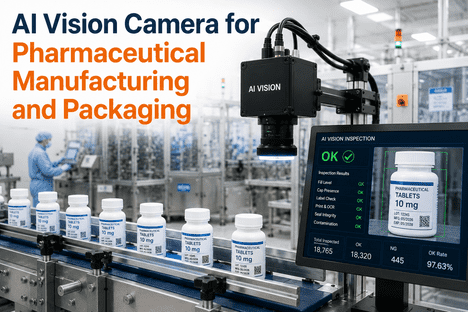
Pharmaceutical manufacturing operates under the most demanding quality and regulatory standards of any production environment globally. A single undetected defect — an incorrect dosage unit, a contaminated injectable vial, or a mislabeled blister pack — can cause patient harm, trigger a Class I FDA recall, and permanently damage a manufacturer's regulatory standing. Traditional quality inspection programs built on manual visual checks and statistical sampling are structurally incapable of providing the 100% inspection coverage that modern pharmaceutical production requires. iFactory's AI vision cameras are transforming pharmaceutical quality control by delivering fully automated inspection at line speed, with defect detection accuracy that consistently outperforms human inspection — while generating the time-stamped, audit-ready digital records that FDA 21 CFR Part 11, EU GMP Annex 1, and current Good Manufacturing Practice requirements demand as objective evidence of process control.
AI VISION CAMERAS · PHARMACEUTICAL QUALITY · COMPLIANCE AUTOMATION
See How AI Vision Cameras Eliminate Pharmaceutical Defects at Line Speed
iFactory's AI vision camera platform delivers 100% automated inspection for tablets, vials, blister packs, and labels — purpose-built for pharmaceutical manufacturers who cannot tolerate a gap in quality coverage or compliance documentation.
What AI Vision Cameras Deliver in Pharmaceutical Quality Control
AI vision cameras in pharmaceutical manufacturing use deep learning models trained on millions of defect images to detect quality deviations that are invisible to the human eye or too rapid for manual inspection to catch at production speed. Unlike traditional rule-based machine vision systems that require manual threshold adjustment for each new defect type, AI-powered inspection systems learn from labeled defect data and generalize to new defect presentations without reprogramming — making them significantly more adaptable as product portfolios expand and production conditions change.
For pharmaceutical manufacturers, the critical distinction is that AI vision camera systems provide 100% inspection coverage across every unit produced — not the 0.1–1% sampling coverage that statistical quality control methods permit. This shift from sampling to 100% inspection is the difference between catching a systemic contamination event on the first affected unit versus discovering it after thousands of defective units have been packaged and distributed. Pharmaceutical quality managers ready to see this capability applied to their specific product portfolio can Book a Demo with iFactory's pharmaceutical inspection specialists.
99.8%
defect detection accuracy achieved by AI vision systems versus 85–90% for manual inspection
100%
unit-level inspection coverage at full line speed — replacing statistical sampling permanently
38%
of pharmaceutical recalls attributed to contamination, incorrect dosage, or labeling failures annually
2 min
average batch record assembly time with AI vision vs. 4–8 hours manual documentation
Root Cause Analysis
Why Quality Failures Still Occur in Pharmaceutical Production
Despite decades of cGMP enforcement and continuous investment in quality management systems, pharmaceutical manufacturers continue to experience quality failures that result in costly recalls and patient safety events. The root causes are operational rather than procedural — quality control architectures designed around human inspection and sampling statistics cannot provide the coverage speed or objectivity that modern pharmaceutical production demands. iFactory's AI vision cameras address each of these structural failure modes directly, replacing reactive detection with real-time automated prevention.
01
Human Inspection Fatigue and Subjectivity
Manual visual inspection is the most widely used quality control method in pharmaceutical packaging and tablet finishing lines — and the most unreliable. Studies consistently show that human inspectors miss 10–30% of visible particulate defects and exhibit significant inter-inspector variability in acceptance criteria. Fatigue-driven miss rates increase substantially after the first two hours of a shift. AI vision cameras eliminate inspector fatigue as a quality risk by maintaining identical detection sensitivity from the first unit of a production run to the last, with no variability between operators or shifts.
02
Sampling-Based Inspection Coverage Gaps
Statistical process control methods provide quality confidence across the sampled population — but they cannot catch defects that occur in the unsampled majority of production. For pharmaceutical products where a single defective unit can cause serious patient harm, this coverage gap represents an unacceptable structural risk. AI vision camera systems close this gap permanently by inspecting 100% of units at full production speed without slowing throughput or adding inspection labor costs to the quality budget.
03
Inadequate Documentation for Regulatory Audits
FDA 21 CFR Part 11 and EU GMP Annex 11 require that automated quality systems generate complete, unalterable electronic records of inspection results with full audit trails. Paper-based and semi-digital inspection records fail this standard because they cannot provide the unit-level inspection detail, timestamp integrity, or audit trail completeness that regulators require. iFactory's AI vision platform automatically generates compliant electronic batch records for every inspection event without any manual documentation effort from production or QA teams.
04
Late Detection of Systematic Defects
When quality deviations are detected through end-of-batch sampling or customer complaints rather than in-line inspection, the financial and compliance consequences multiply rapidly. Every unit produced between the onset of the defect and its discovery represents potential product loss, recall liability, and patient safety exposure. AI vision systems detect systematic defects in real time — triggering immediate line stops and alerts at the first occurrence rather than after thousands of defective units have been produced and packaged.
Platform Capabilities
Five Core Capabilities of iFactory's Pharmaceutical AI Vision Camera System
iFactory's AI vision camera platform for pharmaceutical manufacturing is designed around the specific inspection challenges that drug product manufacturers face — from solid oral dosage forms to sterile injectables and secondary packaging lines. Each capability delivers objective, sensor-verified quality decisions that satisfy regulatory requirements while integrating with existing MES, LIMS, and ERP systems without requiring infrastructure replacement. Pharmaceutical quality managers who want to see all five capabilities demonstrated on their specific product types can Book a Demo with iFactory's pharmaceutical validation team.
01
Tablet and Capsule 100% Visual Inspection
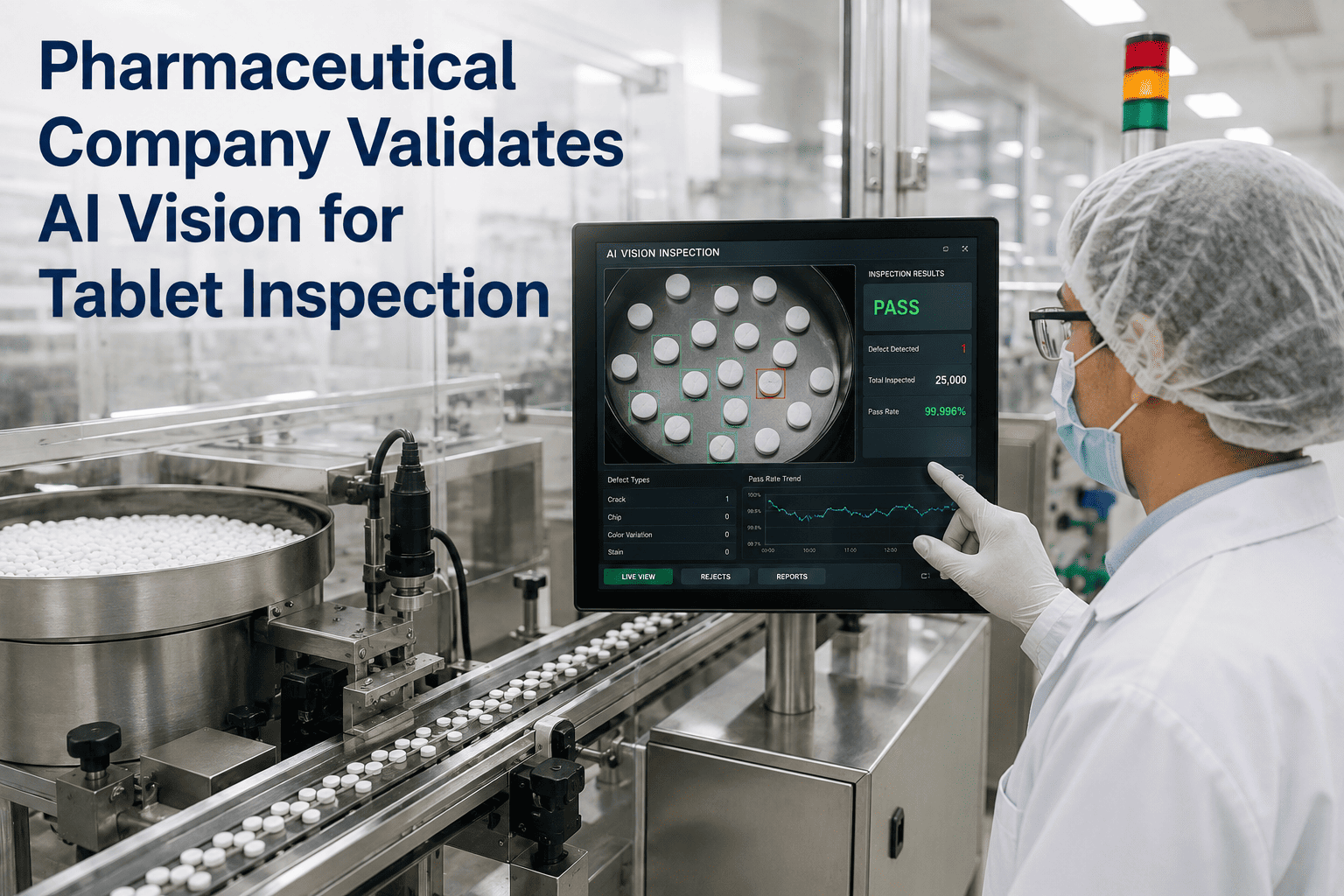
AI vision cameras inspect every tablet and capsule on the production line for dimensional deviations, coating defects, surface cracks, foreign particle inclusion, color non-conformance, and shape irregularities at speeds exceeding 1,000 units per minute. Defect classification models are trained on product-specific defect libraries and continuously refined as new defect presentations are encountered. Each rejected unit is automatically removed, photographed, and logged with a timestamped defect classification record that becomes part of the completed batch documentation package submitted to QA for release review.
02
Vial, Ampoule, and Prefilled Syringe Inspection
Sterile injectable product inspection requires detection of particulate matter, container integrity defects, fill level deviations, stopper and crimp seal anomalies, and cosmetic defects — all within the constraints of USP <790> visible particulate standards and EU GMP Annex 1 requirements. iFactory's AI vision system uses multi-angle illumination and high-frame-rate imaging to detect sub-visible particulates and container defects that conventional inspection methods consistently miss. Every container receives a full inspection record linked to its production batch, lot number, and sterile fill timestamp.
03
Blister Pack and Packaging Integrity Verification
Blister pack inspection covers unit presence and count verification, correct tablet or capsule placement, foil seal integrity, cavity deformation detection, and printing quality validation on the blister card. AI vision cameras detect missing units, wrong product placement in multi-drug blister configurations, and foil seal defects that create moisture ingress risk compromising product stability. The system handles variant product configurations — multiple SKUs, different blister formats, seasonal packaging artwork changes — without manual reconfiguration between production orders.
04
Label, Barcode, and Serialization Verification
AI vision cameras verify label placement accuracy, printed content completeness, expiry date and lot number legibility, barcode grade, and 2D matrix code readability for DSCSA and EU FMD serialization compliance. Every label verification event is logged with the serialization code, batch number, and timestamp — creating an unbroken digital audit trail from packaging to distribution that satisfies both DSCSA transaction reporting requirements and FDA 21 CFR Part 11 electronic record standards without any manual transcription steps.
05
Automated Batch Record Generation and LIMS Integration
Every inspection event captured by iFactory's AI vision cameras is automatically compiled into a structured electronic batch record that satisfies FDA 21 CFR Part 11 and EU GMP Annex 11 audit trail requirements. Inspection results, rejection counts, defect classifications, and camera system status are pushed to the facility LIMS and MES in real time — eliminating manual data transcription errors and reducing batch record assembly time from hours to under two minutes. This single capability delivers immediate, measurable ROI through audit preparation labor reduction and data integrity risk elimination.
PHARMACEUTICAL INSPECTION · AI VISION · cGMP COMPLIANCE
Deploy 100% AI Vision Inspection Across Your Pharmaceutical Production Lines
iFactory's AI vision camera platform integrates with existing pharmaceutical production infrastructure to deliver 100% unit inspection, automated batch records, and real-time defect detection — without production line downtime during deployment.
Performance Benchmark
AI Vision vs. Manual Inspection: Pharmaceutical Quality Performance Comparison
The following benchmark compares pharmaceutical quality inspection programs operating under manual, semi-automated, and fully AI-driven inspection architectures. The performance data reflects operational results across solid oral dosage, sterile injectable, and secondary packaging inspection operations in regulated pharmaceutical manufacturing environments.
Pharmaceutical Inspection Performance Benchmark — 2026
Regulatory Compliance
Pharmaceutical Regulatory Requirements AI Vision Cameras Satisfy
The regulatory landscape governing pharmaceutical quality inspection has become substantially more demanding following the FDA's 2023 computer software assurance guidance update and the EMA's 2022 revision of EU GMP Annex 1. Quality managers must now demonstrate not only that inspection procedures exist, but that automated systems provide objective, verified evidence of their effective operation on every production batch. iFactory's AI vision camera platform is architected to satisfy each of the following regulatory requirements as an inherent output of its inspection operations — not as a separate compliance documentation exercise. Pharmaceutical quality teams ready to map these requirements to specific platform capabilities can Book a Demo for a compliance-focused walkthrough tailored to their current certification scheme.
FDA 21 CFR Part 11 — Electronic Records and Audit Trails
Part 11 requires that electronic records used to satisfy cGMP obligations include complete audit trails, access controls, and data integrity protections against unauthorized modification. iFactory's AI vision cameras generate timestamped inspection records with immutable audit trails, user authentication logs, and cryptographic data integrity checksums that satisfy Part 11 requirements as a built-in system output — without separate compliance software overlays or manual record-keeping steps.
EU GMP Annex 1 — Sterile Medicinal Products
The 2022 revision of EU GMP Annex 1 introduced enhanced requirements for contamination control strategy documentation and automated inspection system performance qualification for sterile manufacturing. AI vision camera systems generate the performance qualification data — detection sensitivity benchmarks, false rejection rates, and system suitability records — that Annex 1 auditors require as objective evidence of inspection system effectiveness in sterile fill-finish environments.
DSCSA and EU FMD Serialization Requirements
The Drug Supply Chain Security Act and EU Falsified Medicines Directive require 100% verification and logging of serialization codes on pharmaceutical packaging at the point of production. iFactory's AI vision cameras read, verify, and log every 2D matrix code and linear barcode at packaging line speed — generating the complete serialization event records required for DSCSA transaction reporting and EU FMD authentication system compliance without dedicated serialization hardware additions.
ICH Q10 and Continuous Process Verification
ICH Q10 encourages continuous process verification using statistical methods applied to production quality data. AI vision camera systems provide the real-time, unit-level quality data that continuous process verification programs require — enabling pharmaceutical manufacturers to identify process drift, emerging defect trends, and equipment degradation signals before they produce out-of-specification batches or trigger regulatory investigations.
Implementation Roadmap
Deploying AI Vision Cameras in Pharmaceutical Manufacturing: A Phased Approach
Deploying AI vision cameras across a pharmaceutical manufacturing operation requires a validated, risk-based implementation approach that satisfies both cGMP change control requirements and production continuity objectives. The following roadmap reflects deployment patterns validated across pharmaceutical operations ranging from single-product solid oral dose facilities to large-scale multi-product sterile filling and secondary packaging lines.
Phase 1
Quality Gap Assessment and Inspection Specification (Weeks 1–4)
Conduct a product-level inspection specification review covering all defect categories, acceptance criteria, and regulatory documentation requirements for each product line in scope. Map current inspection coverage, miss rate data, and batch record documentation gaps against the objective verification standard required by applicable regulatory frameworks including FDA CSA guidance and EU GMP Annex 11. This specification becomes the validated inspection configuration input for Phase 2 deployment. Pharmaceutical quality teams can access iFactory's structured inspection specification methodology by scheduling a session directly at our
Book a Demo page.
Outcome: Product inspection specifications, regulatory gap analysis, system configuration blueprint
Phase 2
Pilot Installation and IQ/OQ/PQ Validation (Weeks 5–14)
Install AI vision cameras on the highest-risk production line and complete Installation Qualification, Operational Qualification, and Performance Qualification protocols per FDA computer software assurance guidance and GAMP 5 principles. Establish detection sensitivity benchmarks, false rejection rate baselines, and system suitability test procedures. Train QA and production teams on the inspection platform and electronic batch record workflow. Complete the change control documentation package required under the facility's cGMP quality management system before expanding to additional lines.
Outcome: Validated AI vision system, IQ/OQ/PQ documentation package, operational team certified
Phase 3
Full Facility Rollout and LIMS/MES Integration (Weeks 15–26)
Expand AI vision camera deployment to all in-scope production and packaging lines using the validated configuration template from Phase 2. Activate LIMS and MES integration to enable real-time data flow from inspection events to quality management and manufacturing execution systems. Establish ongoing performance monitoring dashboards and defect trend reporting for the continuous process verification program. Conduct mock regulatory audit exercises using AI-generated batch records to confirm audit readiness before the next scheduled external inspection.
Outcome: Enterprise AI vision coverage, LIMS/MES integration live, full audit-ready documentation active
Frequently Asked Questions
AI Vision Cameras in Pharmaceutical Manufacturing — Frequently Asked Questions
How do AI vision cameras achieve higher accuracy than human inspectors in pharmaceutical inspection?
AI vision systems process hundreds of image data points per unit in milliseconds without fatigue, lighting variability, or inter-inspector subjectivity. Deep learning models trained on pharmaceutical-specific defect libraries detect patterns and deviations invisible to human inspectors, achieving 99.5–99.9% detection accuracy consistently across full production shifts and multiple product changeovers.
Are iFactory's AI vision camera systems compliant with FDA 21 CFR Part 11?
Yes. iFactory's AI vision cameras generate fully Part 11-compliant electronic records including immutable audit trails, timestamped inspection events, user authentication logs, and cryptographic data integrity protection. Records are generated automatically without manual transcription, eliminating the data integrity risks associated with paper-based and hybrid documentation systems that remain common in pharmaceutical quality control.
Can AI vision systems inspect sterile injectables for particulate matter under USP standards?
Yes. iFactory's system uses high-frame-rate multi-angle imaging to detect visible particulates in vials, ampoules, and prefilled syringes in accordance with USP <790> visible particulate standards. The system generates per-container inspection records linking each detection event to its batch, lot number, fill timestamp, and operator session — satisfying EU GMP Annex 1 container inspection documentation requirements.
How does the AI vision camera platform integrate with existing pharmaceutical MES and LIMS systems?
iFactory's platform uses standard pharmaceutical data integration protocols to push inspection results, rejection counts, defect classifications, and batch records to existing MES, LIMS, and ERP systems in real time. Integration does not require system replacement — the AI vision layer operates above existing infrastructure and connects via standard interfaces, minimizing validation scope for the integration itself.
What validation documentation does iFactory provide for pharmaceutical qualification packages?
iFactory provides a complete GAMP 5-aligned validation documentation package including IQ, OQ, and PQ protocols, risk assessments, data integrity impact assessments, and system configuration specifications. This package is designed to satisfy FDA CSA guidance and EU GMP Annex 11 qualification requirements with minimal customer-side validation authoring effort, accelerating the change control timeline considerably.
What ROI timeline should pharmaceutical manufacturers expect from AI vision camera deployment?
Pharmaceutical manufacturers typically achieve full ROI within 12–18 months through avoided recall costs, reduced inspection labor, batch record assembly time savings, and improved first-pass audit rates. Facilities with prior recall history in quality-sensitive dosage forms or sterile products often achieve payback within 6–10 months based on recall cost avoidance alone.
AI VISION CAMERAS · PHARMA QUALITY · COMPLIANCE AUTOMATION · 2026
Deploy AI Vision Camera Inspection Across Your Pharmaceutical Operation
iFactory's purpose-built pharmaceutical AI vision camera platform automates 100% unit inspection, defect detection, serialization verification, and batch record generation — giving quality managers the real-time control and audit-ready documentation their regulatory obligations demand.