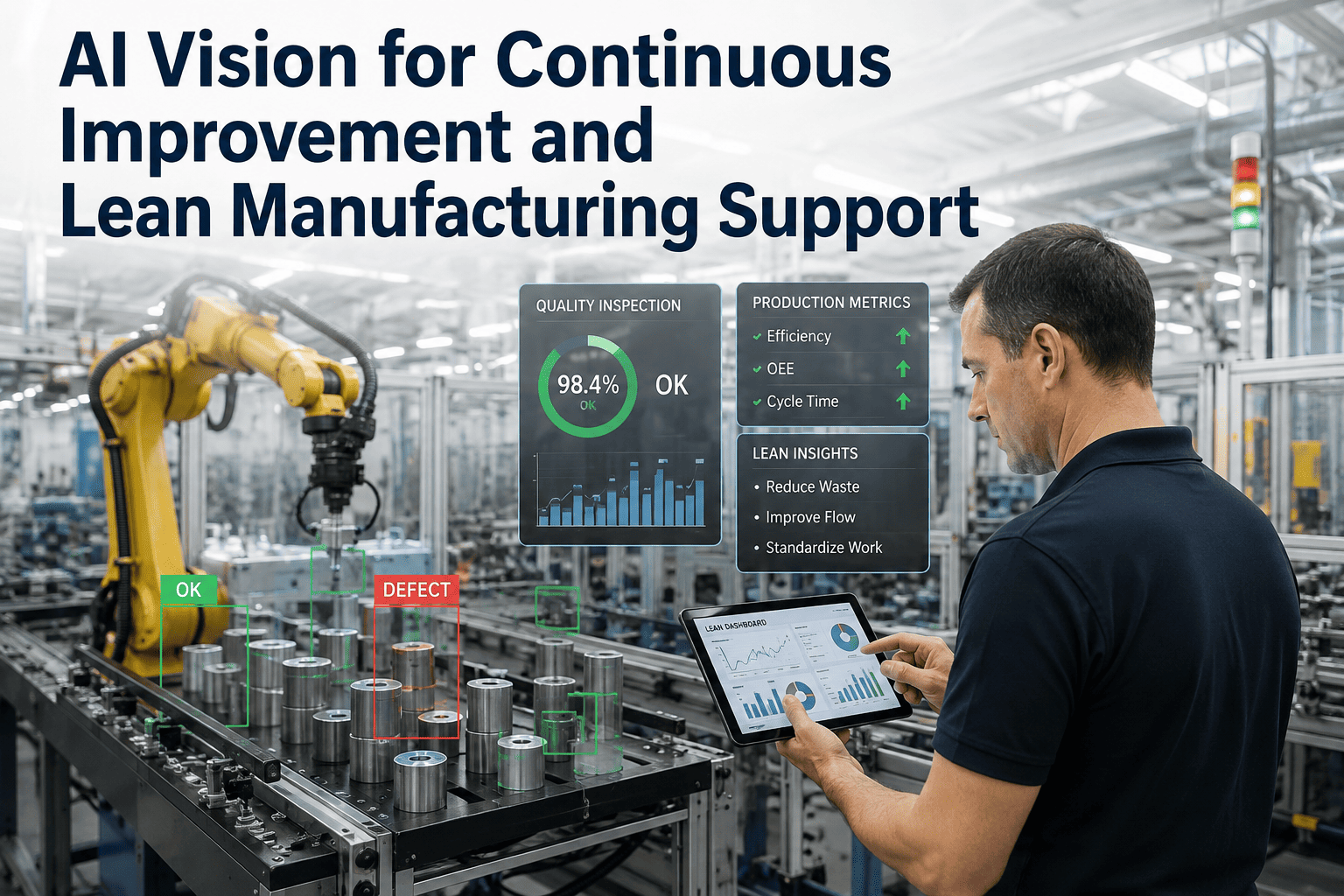
In regulated manufacturing — pharmaceutical, food and beverage, medical devices, and biotechnology — compliance is not a reporting obligation that sits alongside production. It is a continuous operational requirement woven into every inspection decision, every production record, and every quality event that occurs on the manufacturing floor. FDA investigators reviewing a 21 CFR Part 820 quality system or ISO 13485 surveillance audit are not evaluating whether a company has a documented procedure for inspection. They are evaluating whether that procedure is being executed consistently, whether the execution is objectively verifiable, and whether the evidence would survive adversarial scrutiny. Manual inspection programs fail this standard structurally — not because of inadequate personnel, but because human visual inspection generates subjective evidence, produces inconsistent results between shifts and inspectors, and cannot demonstrate the statistical detection capability that 21 CFR Part 820 Section 820.80 and ISO 13485 Clause 8.2.4 require as evidence of inspection method validation. AI Vision Cameras eliminate these structural failures by converting the inspection function from a human-dependent, subjective activity into an automated, objectively documented, statistically validated process — generating the quality evidence that regulatory frameworks require and that manual programs cannot produce at the required completeness and objectivity standard. To see how iFactory's AI Vision Camera platform generates FDA 21 CFR Part 820, ISO 13485, ISO 9001, and GFSI-aligned inspection documentation automatically as a production byproduct, Book a Demo with iFactory's compliance team today.
FDA COMPLIANCE · ISO 13485 · GFSI · 21 CFR PART 820
Is Your Inspection Program Generating the Evidence FDA and ISO Auditors Actually Require?
iFactory's AI Vision Camera platform automatically generates per-unit inspection records, model validation data, and statistical process evidence that satisfies 21 CFR Part 820, ISO 13485, ISO 9001, and GFSI audit requirements — without additional quality team documentation overhead.
97.4%
First-pass GFSI scheme audit compliance rate for facilities using iFactory's AI vision inspection records — versus 83.1% pre-deployment median
–87%
Reduction in FDA/ISO audit preparation labor — from 22+ hours manual record assembly to under 3 hours with automated inspection record retrieval
Zero
Form 483 observations related to inspection documentation gaps reported by iFactory-deployed facilities in the 2026 benchmark population
100%
Per-unit inspection record completeness — every unit inspected gets a timestamped, model-versioned record with statistical confidence data attached
The Compliance Documentation Gap That Manual Inspection Cannot Close
The most common finding in FDA 21 CFR Part 820 warning letters and ISO 13485 audit non-conformances related to inspection programs is not that inspection was absent — it is that the evidence of inspection execution and inspection method capability is insufficient. FDA investigators consistently cite three specific documentation failures: the inability to demonstrate that inspection procedures were performed consistently across all shifts and operators; the absence of statistical evidence that the inspection method can detect the defect types it is claimed to detect; and the lack of per-lot inspection records that provide objective confirmation of acceptance or rejection decisions. Manual inspection programs generate evidence that is subjective, operator-dependent, and impossible to validate retrospectively — creating a documentation structure that FDA investigators find inadequate when they review it under the standard of 21 CFR Part 820 Section 820.80. AI Vision Cameras address all three failure categories simultaneously: automated execution eliminates inter-operator variability, model validation documentation provides statistical detection capability evidence, and per-unit records provide objective acceptance evidence for every unit in every lot. Regulated manufacturers ready to close this documentation gap can Book a Demo with iFactory's compliance team for a regulation-specific documentation review.
Regulatory Framework Coverage: How AI Vision Addresses Each Standard's Requirements
The specific documentation and inspection evidence requirements vary by regulatory framework — what FDA 21 CFR Part 820 requires differs in emphasis from what ISO 13485 requires, which differs again from GFSI scheme requirements for food manufacturing. iFactory's AI Vision Camera platform generates inspection records structured to satisfy all of these frameworks simultaneously, enabling manufacturers supplying customers across multiple regulated industries to maintain a single inspection record that satisfies every audit program in their compliance portfolio.
The Six Compliance Documentation Categories AI Vision Generates Automatically
The most significant practical compliance benefit of AI Vision Camera deployment for regulated manufacturers is the elimination of the documentation assembly work that currently consumes quality team capacity before every audit. iFactory's platform generates six specific documentation categories that FDA investigators, ISO auditors, and GFSI scheme auditors request during inspections — automatically, as a byproduct of production inspection, without requiring quality team intervention to assemble the documentation package after an audit is announced.
01
Per-Unit Inspection Records with Electronic Signature Equivalent
Time-stamped inspection record for every unit inspected, including the AI model version active at the time of inspection, the confidence score for each classification decision, the pass/fail status per defect class, and the operator-equivalent electronic authentication. These records satisfy FDA 21 CFR Part 11 electronic records requirements and ISO 13485 Clause 4.2.5 record control requirements simultaneously.
02
AI Model Validation Documentation — IQ/OQ/PQ Evidence Package
For each AI vision model deployed in production, iFactory maintains Installation Qualification, Operational Qualification, and Performance Qualification documentation — including detection accuracy metrics against the validated test dataset, false positive and false negative rates by defect class, and the statistical basis for the confidence threshold values used in production. This is the evidence that FDA investigators require under 21 CFR Part 820 Section 820.250 that manual inspection programs cannot produce at any equivalent standard.
03
Lot-Level Inspection Certificates and Statistical Summary Reports
At lot closure, iFactory automatically generates a lot-level inspection certificate confirming total units inspected, percentage passing each inspection category, defect rate by category, any deviation events with investigation outcomes, and the model configuration and calibration status active during lot production. These certificates satisfy the CoC documentation requirements of ISO 13485, FDA 21 CFR Part 820, and AS9100 Rev D supply chain documentation standards simultaneously.
04
Defect Trend Analytics for CAPA Root Cause Evidence
AI vision inspection data generates continuous defect trend reports segmented by defect class, production line, shift, SKU, and raw material lot — providing the objective, statistically grounded root cause evidence that CAPA processes require under 21 CFR Part 820 Section 820.100 and ISO 13485 Clause 8.5.2. Defect trend data that previously required weeks of manual data compilation is generated in seconds from iFactory's inspection record database.
05
Inspection System Performance Monitoring Records
Ongoing AI vision system performance monitoring — including image quality metrics, model confidence score trends, and calibration records — generates a continuous system performance record that demonstrates the inspection system is operating within its validated performance envelope throughout the production period covered by any audit review. This record satisfies the equipment maintenance and calibration documentation requirements of 21 CFR Part 820 Section 820.70 and ISO 13485 Clause 7.6.
06
Audit-Ready Searchable Inspection History Database
Every inspection record is stored with searchable metadata — lot number, date range, SKU, production line, defect category, model version — enabling complete inspection history retrieval for any production period within minutes of an audit request. The retrieval speed and completeness of iFactory's inspection history database eliminates the multi-day documentation assembly that manual programs require when FDA investigators or ISO auditors arrive with 24-hour notice, removing the most time-pressured phase of regulated manufacturer audit preparation.
Common FDA and ISO Compliance Failures That AI Vision Eliminates
The compliance violations that AI vision inspection deployment directly prevents are consistent across regulated manufacturing sectors — they are the recurring findings in FDA warning letters, ISO certification suspension notices, and GFSI scheme major non-conformances that quality management teams in pharmaceutical, medical device, and food manufacturing organizations address repeatedly through corrective action programs that manual inspection cannot structurally resolve. The following violations represent the most frequently cited inspection-related compliance failures in regulated manufacturing — each of which AI vision eliminates through systematic architectural change rather than procedural overlay. Regulated manufacturers who want to audit their current inspection program against these violation categories can Book a Demo with iFactory's compliance team for a regulation-specific gap assessment.
Violation
How It Occurs
Regulatory Consequence
AI Vision Solution
Inadequate Inspection Method Validation
Manual inspection declared as the inspection method with no statistical evidence that inspectors can consistently detect the defect types at the required AQL level under production conditions
FDA Form 483 observation under 21 CFR Part 820 Section 820.250 — requires validation study and may trigger product hold during investigation
iFactory's IQ/OQ/PQ validation documentation provides statistical detection capability evidence for every AI model — satisfying 21 CFR Part 820 Section 820.250 with objective data
Inspection Record Completeness Gaps
Inspection records missing for specific shifts, lines, or lot segments — caused by documentation backlogs, shift handover failures, or manual logging errors that are common in paper-based programs
ISO 13485 Clause 4.2.5 major non-conformance — incomplete records cannot demonstrate product conformity for the affected lots, potentially requiring product hold and retrospective review
AI vision generates inspection records automatically for every unit — record completeness is a system property that cannot be degraded by shift handover or logging omission
Inter-Inspector Variability Not Addressed
Gauge R&R or MSA studies reveal significant differences in defect detection rates between inspectors — with no demonstrated corrective action in the inspection system design
FDA audit observation under 21 CFR Part 820 Section 820.70 — demonstrates that the production process control is operator-dependent rather than systematic, requiring QMS corrective action
AI vision delivers identical detection accuracy across all shifts and all operators — eliminating inter-inspector variability by design rather than through training and SOP programs
CAPA Root Cause Insufficient Evidence
CAPA records cite inspection failures without statistical process data demonstrating the defect pattern's origin — because manual inspection data is too sparse and subjective to support defensible root cause analysis
ISO 13485 Clause 8.5.2 non-conformance and FDA warning letter finding — CAPAs without objective root cause evidence are classified as inadequate and require re-investigation
iFactory's defect trend analytics by SKU, shift, material lot, and line provide the objective, statistically grounded root cause evidence that CAPA investigations require
Audit Record Retrieval Failure
Quality team unable to produce complete inspection records for a requested lot within the audit timeframe — because records exist across paper logs, spreadsheets, and multiple CMMS entries that require manual assembly
FDA investigator characterizes record control as inadequate under 21 CFR Part 820 Section 820.180 — damages the facility's audit standing and may extend the inspection scope
iFactory's searchable inspection database retrieves complete inspection history for any lot within minutes — enabling same-day audit record production regardless of how the audit is scoped
iFactory AI Vision — Compliance Documentation Platform
Generate FDA and ISO Compliance Evidence Automatically — Every Production Lot, Every Shift
iFactory's AI Vision Camera platform creates the per-unit inspection records, model validation documentation, lot-level certificates, and statistical process data that FDA investigators and ISO auditors require — automatically, as a byproduct of production inspection, with no additional quality team overhead per audit cycle.
Implementation: How Regulated Manufacturers Deploy AI Vision for Compliance-Aligned Inspection
Deploying AI Vision Cameras in a regulated manufacturing environment requires a structured implementation approach that integrates compliance validation requirements into the deployment timeline — not as an afterthought, but as a parallel workstream that ensures the system is validated for its intended use before live production inspection begins. iFactory's regulated industry deployment methodology follows the same validation lifecycle structure that regulated manufacturers apply to all production equipment and software systems under 21 CFR Part 820 Section 820.70 and ISO 13485 Clause 7.5.1.
Requirement
Document the inspection requirements — defect types, acceptance criteria, AQL levels, and statistical performance requirements — that the AI vision system must satisfy to replace or supplement the existing inspection method
Risk
Conduct FMEA on the AI vision inspection process — identifying failure modes specific to AI vision (model drift, lighting change, camera misalignment) and documenting risk controls for each
Regulatory
Establish the regulatory framework coverage required for the facility's audit programs — FDA 21 CFR Part 820, ISO 13485, GFSI scheme, or combination — and confirm iFactory's documentation architecture satisfies all applicable requirements
Output: User Requirements Specification (URS) and Risk Assessment documentation forming the basis of the validation protocol
IQ
Document that the AI vision system hardware and software are installed according to the manufacturer's specifications — camera positions, lighting configurations, edge hardware installation, and software version — creating the Installation Qualification evidence required by 21 CFR Part 820 Section 820.70
OQ
Verify that the AI vision system operates within specified parameters across its operational range — including performance at minimum and maximum line speeds, under the range of environmental conditions present in the facility, and through the full product variant library — creating the Operational Qualification evidence that validates the system's functional boundaries
SOPs
Establish validated SOPs for AI vision system operation — covering calibration verification, model change control, deviation reporting, and system performance review — that satisfy 21 CFR Part 820 Section 820.40 document control requirements
Output: IQ and OQ protocols and reports, validated SOPs, and document control records in the facility's quality management system
PQ
Run the AI vision system in shadow mode — generating inspection decisions alongside the existing inspection program for a defined production period covering all product variants and production conditions — to generate the statistical performance data confirming the system achieves the acceptance criteria established in the URS
Challenge
Introduce known defective samples — covering all defect classes in the acceptance criteria — to confirm detection rates meet specification under production conditions. Document the challenge test protocol and results as the core PQ evidence for the AI vision inspection method
Approval
Quality unit review and approval of the complete IQ/OQ/PQ validation package before authorizing the AI vision system for live production inspection — establishing the regulatory start date for the validated inspection method
Output: PQ protocol and report, challenge test records, Quality Unit validation approval — complete validation package ready for FDA or ISO auditor review
Monitor
iFactory's automated performance monitoring tracks model confidence scores, image quality metrics, and detection performance continuously — generating the ongoing system performance record that demonstrates the validated system remains within its qualified operating parameters throughout its production service life
Change
Model updates, camera configuration changes, and new product introductions are managed through iFactory's change control workflow — generating change assessment documentation that satisfies 21 CFR Part 820 Section 820.70 change control requirements before changes are implemented in validated production use
Revalidate
Periodic revalidation activities — triggered by significant changes, performance trending alerts, or scheduled review cycles — are documented in iFactory's validation record system, maintaining the continuous validation status that regulated manufacturing quality systems require
Output: Continuous compliance monitoring record, change control documentation, and revalidation records maintaining validated system status throughout production service life
Frequently Asked Questions: AI Vision Cameras and FDA/ISO Compliance
Does iFactory's AI Vision Camera system need to be validated under 21 CFR Part 820 before use in a medical device manufacturing environment?
Yes — any automated inspection system used as a production acceptance activity in a medical device facility must be validated under 21 CFR Part 820 Section 820.70 before use in production inspection. iFactory provides a complete validation support package — including a pre-written IQ/OQ/PQ protocol template, a challenge test protocol, and a validation report structure — that regulated facilities adapt to their specific product and facility context. The validation is designed to be completed by the facility's quality team without requiring external validation specialists, using iFactory's platform documentation as the primary source for technical parameters and performance specifications.
Book a Demo to review iFactory's validation support package for 21 CFR Part 820 compliance.
How does iFactory's AI Vision Camera documentation satisfy the electronic records requirements of FDA 21 CFR Part 11?
iFactory's inspection records are generated with time-stamped, immutable entries that cannot be modified after creation — satisfying the audit trail requirements of 21 CFR Part 11 Section 11.10(e). Each inspection record includes the system-generated equivalent of an electronic signature — uniquely identifying the production context, model version, and system configuration that generated the record — satisfying the identification and authentication requirements of 21 CFR Part 11 Section 11.10(i). Record access controls, backup procedures, and record retention configurations are documented in iFactory's system documentation package as the audit evidence that 21 CFR Part 11 compliance requires.
Can iFactory's AI vision inspection records be used as the primary inspection evidence in ISO 13485 Device History Records?
Yes — iFactory's per-unit and lot-level inspection records are structured to integrate directly with ISO 13485 Device History Record systems through API connectors that export inspection data in standard formats compatible with QMS document management systems. The DHR integration enables automatic population of the inspection evidence section of the DHR at lot closure, eliminating the manual transcription of inspection results from separate inspection records into the DHR that is a common source of documentation error and audit finding in manual programs. Facilities using iFactory for DHR integration report eliminating the inspection record assembly step from their batch release process entirely.
What evidence does iFactory generate to demonstrate AI model performance for GFSI scheme auditors who require inspection method validation?
iFactory's model validation documentation for GFSI scheme compliance includes: the detection accuracy metrics from the held-out test dataset validation — true positive rate, false positive rate, and false negative rate by defect class; the shadow mode validation data showing AI vision performance compared to the existing inspection program on production product under production conditions; the confidence threshold calibration rationale showing how thresholds were set to balance detection sensitivity and false positive rate for each defect class; and the ongoing performance monitoring records confirming the model continues to perform within its validated parameters after go-live. GFSI scheme auditors reviewing this documentation for SQF, BRC, or FSSC 22000 compliance consistently find it satisfies their inspection method validation evidence requirements without additional documentation requests.
How does AI vision defect trend data improve CAPA effectiveness for regulated manufacturers under ISO 13485 Clause 8.5.2?
ISO 13485 Clause 8.5.2 requires that CAPA root cause analysis be based on appropriate statistical analysis of data from monitoring and measurement activities. AI vision inspection data provides the high-frequency, objective defect occurrence data that makes this statistical analysis genuinely possible — whereas manual inspection data is too sparse, too subjective, and too variable between inspectors to generate statistically defensible root cause identification. iFactory's defect trend analytics segment defect frequency by product variant, production line, shift, raw material lot, equipment configuration, and environmental conditions — enabling the multi-factor root cause analysis that demonstrates both the cause identification and the effectiveness verification steps of Clause 8.5.2 with objective data rather than subjective assessment. Regulated manufacturers consistently report that iFactory's defect trend data reduces CAPA cycle time by 40–60% while simultaneously improving the defensibility of root cause determinations against auditor challenge.
Book a Demo to see iFactory's CAPA analytics module for ISO 13485 regulated manufacturers.
What is the typical FDA and ISO audit preparation time reduction that manufacturers achieve after deploying iFactory's AI vision platform?
The 2026 iFactory benchmark data across regulated manufacturing deployments shows a median audit preparation labor reduction of 87% — from 22.4 hours median manual record assembly to 2.8 hours with iFactory's automated inspection record retrieval. The primary driver of this reduction is the elimination of the manual assembly process that paper-based and semi-digital inspection programs require — searching paper logs, reconciling CMMS records, compiling inspection summaries, and organizing documentation packages for the specific audit scope. iFactory's searchable inspection database retrieves all records relevant to any specified audit scope within minutes, generating the complete documentation package that previously required days of quality team preparation time concentrated immediately before the audit window.
Full FDA & ISO Compliance Automation — Every Regulation, Every Audit
Inspection Evidence That Satisfies 21 CFR Part 820, ISO 13485, and GFSI — Generated Automatically, Every Lot.
iFactory's AI Vision Camera platform is the only inspection system that generates FDA-aligned per-unit records, IQ/OQ/PQ validation documentation, ISO 13485 DHR-ready data, and GFSI-compliant inspection evidence simultaneously — eliminating the documentation gap that drives Form 483 observations, ISO major non-conformances, and GFSI certification failures in regulated manufacturing facilities worldwide.