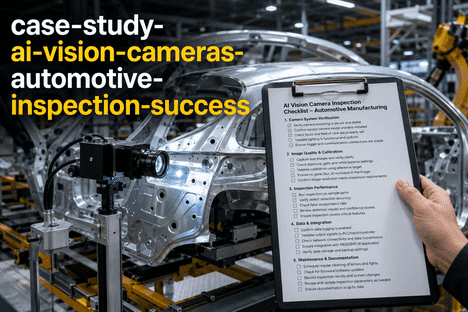
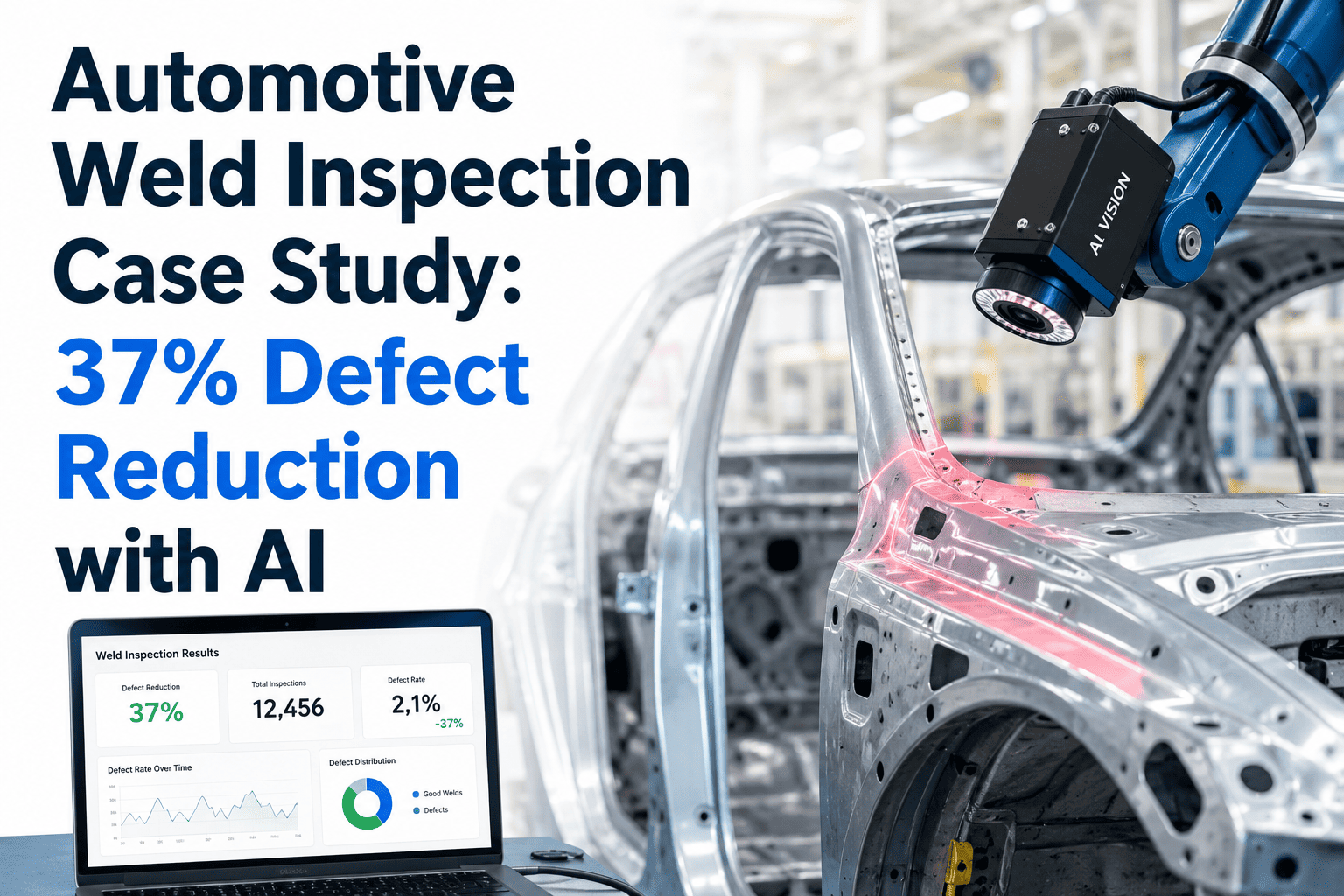
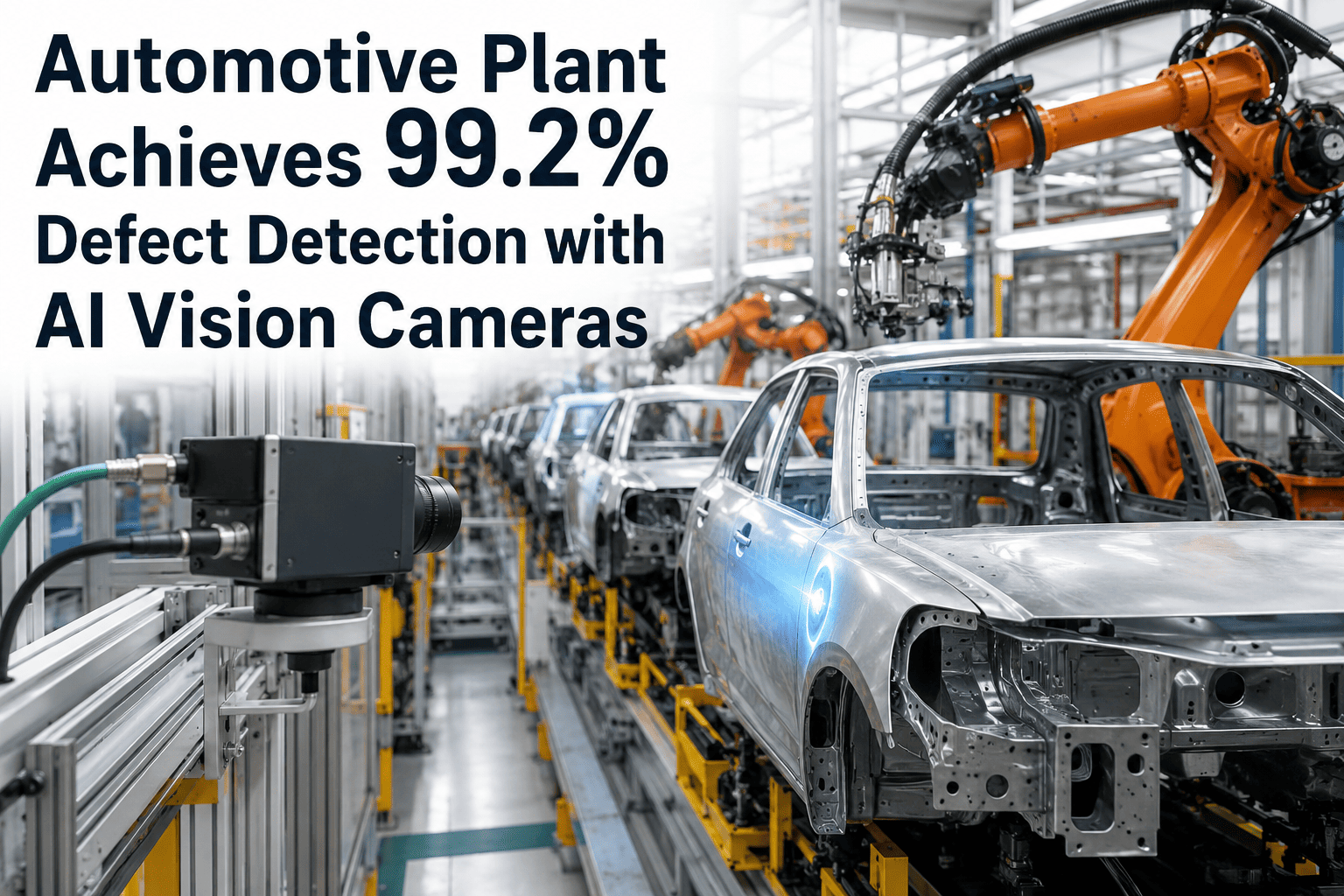
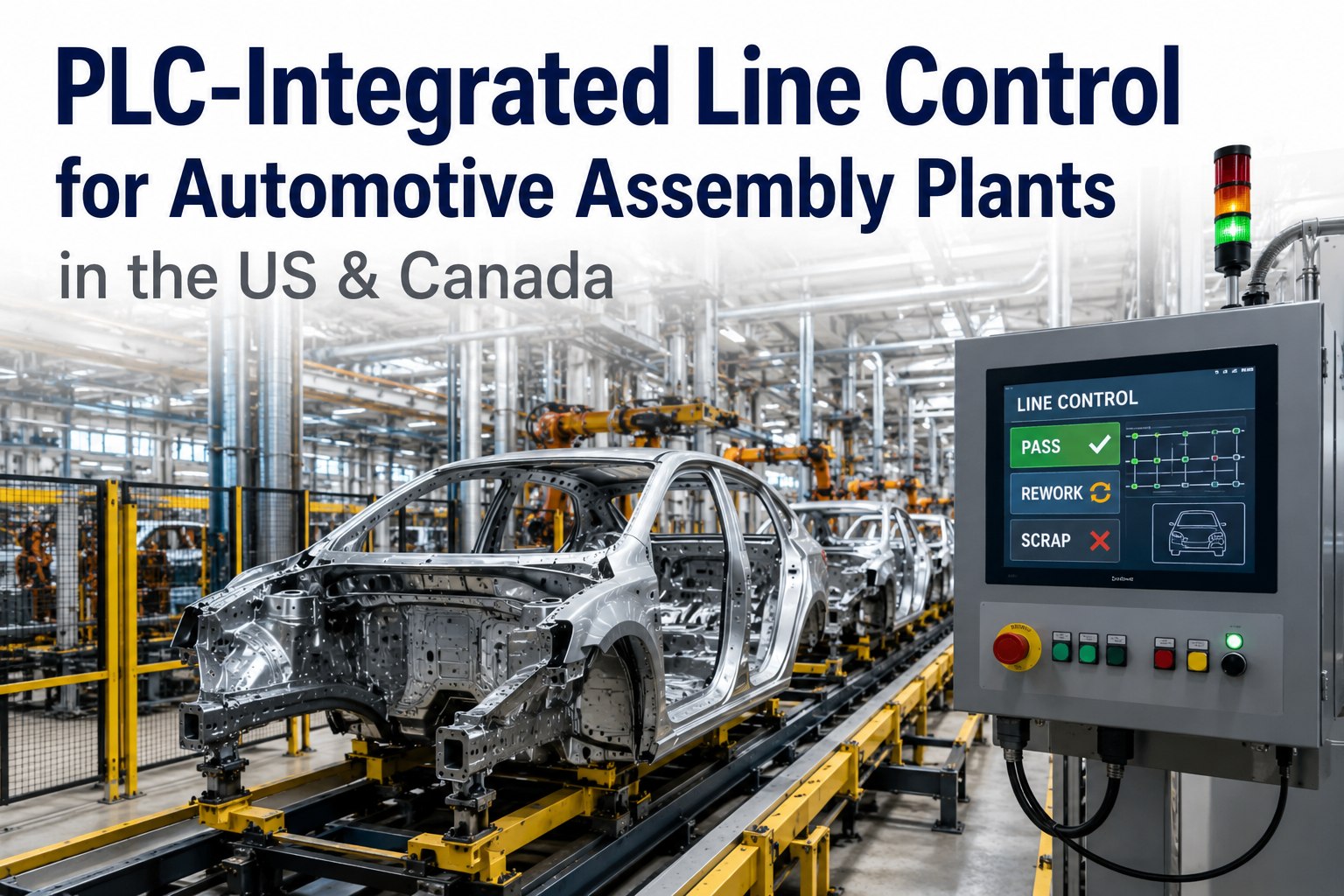
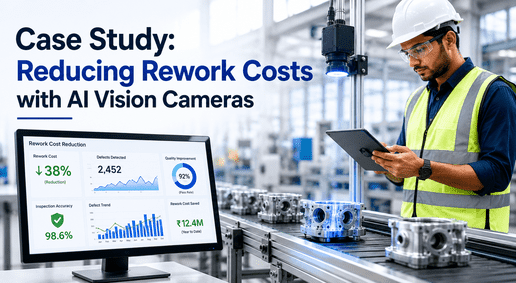
When a premium automotive manufacturer running three high-volume body assembly lines and two paint shop finishing lines needed to eliminate the defect escape rates driving escalating warranty claims and recall risk, the engineering team made a decisive commitment to AI-powered visual inspection. Traditional sampling-based quality checks and manual visual inspection gates were producing defect escape rates incompatible with the precision demands of modern vehicle assembly. The implementation of iFactory's AI Vision Camera platform across all five production lines marked the beginning of a measurable quality transformation — one that delivered an 87% reduction in defect escapes, a 34% throughput improvement, and sub-2-minute recall traceability within the first year of full deployment.
AI VISION CAMERAS · AUTOMOTIVE INSPECTION · DEFECT DETECTION
See How AI Vision Cameras Eliminate Defects on Your Automotive Production Line
iFactory's AI Vision Camera platform delivers real-time surface defect detection, dimensional verification, and automated lot traceability — purpose-built for automotive manufacturers who cannot afford a defect escape at any point in the assembly process.
The Automotive Quality Challenge: Why Traditional Inspection Cannot Keep Pace
Modern automotive assembly demands inspection precision that far exceeds what human operators or legacy camera systems can consistently deliver at production speed. A single body panel passes through dozens of assembly and finishing operations — welding, stamping, painting, trim installation — each introducing its own defect risk profile. When defects escape the production line and reach consumers, the consequences compound rapidly: warranty claim costs averaging $500–$2,000 per vehicle, NHTSA recall actions that consume millions in logistics and remediation, and brand damage that takes years to recover in J.D. Power quality rankings. The manufacturer in this case study was experiencing a defect escape rate of 3.1% across its combined body and paint inspection stations — a rate that translated into an annualized warranty exposure of $14.2 million and three NHTSA safety inquiries in eighteen months.
The root problem was structural. Visual inspection was performed by trained operators working twelve-hour shifts under high production pressure — a combination that produces inspection consistency rates that degrade measurably as shifts progress. Sampling-based inspection strategies meant that statistically, a significant proportion of vehicles received no direct quality verification at multiple inspection points. The engineering team needed a system that could inspect every vehicle, at every inspection point, with consistent accuracy regardless of shift timing or production volume — and generate an immutable digital quality record for every unit produced.
87%
reduction in defect escape rate within 12 months of AI Vision Camera deployment
34%
improvement in line throughput from automated inspection replacing manual gates
99.7%
detection accuracy across surface, dimensional, and assembly defect categories
Under 2 min
full vehicle quality record retrieval and lot trace time versus 6–18 hours previously
Root Cause Analysis
The Four Inspection Failure Modes Driving Defect Escapes in Automotive Assembly
Before deploying iFactory's AI Vision Camera platform, the manufacturer conducted a structured root cause analysis across twelve months of warranty claim data and internal quality audit findings. Four systemic failure modes accounted for 91% of all defect escape incidents. Understanding these failure modes is essential context for evaluating why AI Vision Camera technology eliminates them structurally rather than simply managing them procedurally.
01
Operator Fatigue and Inspection Inconsistency
Human visual inspection accuracy degrades significantly over extended shifts. Data from the manufacturer's own quality audits showed that inspection miss rates were 2.8 times higher in the final two hours of a twelve-hour shift compared to the first two hours. Surface defects smaller than 0.3mm were systematically missed under production lighting conditions — exactly the defect category most likely to generate consumer paint quality complaints. AI Vision Cameras operate at consistent detection sensitivity across the full production day without fatigue-related degradation.
02
Sampling-Based Inspection Coverage Gaps
Under the previous inspection protocol, only 23% of vehicles received full manual inspection at all critical quality gates — the remainder were passed on a sampling basis due to staffing constraints and takt time pressure. This sampling architecture was statistically guaranteed to allow defective units to reach the end of line and, in some cases, reach customers. AI Vision Camera deployment at every inspection station enables 100% vehicle inspection at production speed, eliminating the probabilistic escape pathway that sampling creates.
03
Disconnected Inspection Data and Traceability Gaps
When defects were identified, the paper-based quality recording system could not rapidly correlate individual defect records with production lot data, shift records, tooling change events, or supplier material batches. This disconnection meant that when a defect pattern emerged in warranty returns, identifying the affected production window required 6–18 hours of manual record reconstruction — time during which additional affected vehicles continued shipping. AI Vision Cameras generate per-vehicle digital quality records automatically linked to production data, enabling pattern recognition within minutes rather than days.
04
Limited Defect Classification and Process Feedback Latency
Manual inspection produced binary pass/fail decisions without detailed defect characterization. When defects were caught, the lack of dimensional measurement and classification data made it difficult to identify whether the root cause was tooling wear, material variation, or process drift — delaying corrective action and allowing the defect-generating condition to persist across multiple production shifts. AI Vision systems classify defects by type, location, dimension, and severity — providing process engineers with actionable data to identify and correct root causes before defect rates escalate.
Solution Overview
How iFactory's AI Vision Camera Platform Transformed Automotive Line Inspection
The deployment of iFactory's AI Vision Camera platform across all five production lines was designed not to supplement existing inspection workflows but to replace the manual inspection architecture entirely with a system capable of 100% vehicle inspection at full takt speed. The implementation delivered measurable performance improvements across every key quality metric within the first operating quarter. Automotive quality engineers who want to see this inspection architecture applied to their specific production environment can Book a Demo with iFactory's engineering team for a line-specific walkthrough.
01
Real-Time Surface Defect Detection at Production Speed
Multi-angle AI Vision Camera arrays installed at each body and paint inspection station capture high-resolution surface imagery of every vehicle passing through the line at full takt speed — no slowdown required. The AI inspection engine analyzes each frame for scratches, dents, paint inclusions, orange peel texture anomalies, and panel gap deviations in real time, generating a defect map for each vehicle within 8 seconds of passing through the inspection gate. Defects below 0.15mm in size — well below human visual detection threshold under production conditions — are detected reliably across all surface zones.
02
Dimensional Measurement and Assembly Completeness Verification
Beyond surface inspection, iFactory's AI Vision Camera system performs non-contact dimensional measurement at critical assembly points — door gap and flush measurements, hood and trunk alignment verification, and trim fitment checks — comparing each measurement against engineering tolerance specifications in real time. Assembly completeness verification confirms that all required fasteners, clips, labels, and components are present and correctly positioned before the vehicle advances to the next station. Any dimensional or assembly deviation triggers an immediate quality hold and station alert without requiring manual judgment.
03
Automated Defect Classification and Process Analytics
Every defect detected by the AI Vision Camera system is automatically classified by type, severity, location on the vehicle surface, and dimensional measurement. This classification data feeds directly into the process analytics dashboard, where production engineers can view defect frequency trends by station, shift, tooling state, and supplier material batch. When defect frequency crosses a configurable threshold — for example, a specific scratch pattern appearing on three consecutive vehicles — the system triggers a process alert that enables the engineering team to investigate and correct the root cause before a defect pattern becomes a quality incident.
04
Per-Vehicle Digital Quality Records and Instant Lot Traceability
For every vehicle inspected, iFactory's platform generates an immutable digital quality record containing the full inspection image set, defect map, dimensional measurement results, and pass/fail status — automatically linked to the vehicle's VIN, production lot, shift data, and material batch records. This digital record chain enables complete forward and backward lot traceability in under 2 minutes, transforming the recall response process from a multi-day documentation effort into a precisely targeted, data-driven operation. The quality record also satisfies IATF 16949 documentation requirements without additional manual effort.
05
Continuous AI Model Improvement Through Production Learning
The AI Vision Camera platform's inspection models are continuously refined through production learning — each inspection cycle adds to the model's understanding of acceptable variation, known defect patterns, and facility-specific lighting and surface conditions. Over the first three months of deployment, the manufacturer's false positive rate — initially 4.2% of inspections triggering unnecessary quality holds — decreased to under 0.6% as the AI model calibrated to the specific production environment. This ongoing improvement means inspection accuracy increases over time without requiring dedicated model retraining efforts.
Performance Results
AI Vision Camera vs. Manual Inspection: Measured Performance Outcomes
The following performance data reflects the manufacturer's quality metrics across three measurement periods: the twelve months immediately prior to AI Vision Camera deployment (baseline), the first six months of deployment (ramp), and months seven through twelve of full operation (steady state). The performance gap between manual inspection and AI-driven visual inspection widened at every metric as the system's AI models matured through production learning.
Automotive Line Inspection Performance — Before vs. After AI Vision Cameras
AI VISION · AUTOMOTIVE QUALITY · DEFECT ELIMINATION
Ready to Achieve These Results on Your Automotive Production Line?
iFactory's automotive engineering team will walk you through how AI Vision Camera technology maps to your specific inspection requirements — from body shop and paint shop to final line. Schedule a demo to see live defect detection at automotive production speed.
Implementation Roadmap
How the Manufacturer Deployed AI Vision Cameras Across Five Production Lines
The manufacturer's deployment followed a phased implementation approach that delivered measurable defect reduction at each stage while managing the integration complexity of a live automotive production environment. Quality engineers considering a similar deployment can Book a Demo to review how iFactory's implementation methodology applies to their specific line configuration and production schedule constraints.
Phase 1
Inspection Point Mapping and AI Model Baseline Training (Weeks 1–6)
The deployment began with a structured mapping of every inspection point across all five lines — identifying camera positioning requirements, lighting configuration specifications, and the defect type profile for each inspection zone. iFactory's engineering team collected baseline image data from the existing production run to train the initial AI inspection models on facility-specific surface characteristics, acceptable variation ranges, and known defect signatures before any camera hardware went live on the production floor.
Outcome: Inspection point map complete, AI model baseline trained on facility data
Phase 2
Body Shop AI Vision Camera Deployment and Parallel Validation (Weeks 7–14)
Camera hardware was installed at all body shop inspection stations during a planned maintenance window to avoid production disruption. The AI Vision system ran in parallel with existing manual inspection for four weeks, allowing the quality team to validate detection performance against known defects and calibrate alert thresholds before transitioning to autonomous AI inspection. By the end of week fourteen, manual inspection staffing at body shop stations was reduced by 60% as the AI system took over primary inspection responsibility.
Outcome: Body shop AI inspection live, 60% manual staffing reduction validated
Phase 3
Paint Shop Deployment and MES Traceability Integration (Weeks 15–22)
Paint shop deployment introduced additional complexity due to the sensitivity of wet paint inspection and the requirement to inspect under controlled lighting conditions that minimized reflection interference. iFactory's engineering team configured a multi-angle LED lighting array matched to the paint shop environment. Simultaneously, the digital quality record system was integrated with the manufacturer's MES and VIN tracking infrastructure, enabling per-vehicle quality records to be automatically linked to production data as each vehicle moved through the line.
Outcome: Paint shop AI inspection live, full MES and VIN traceability integration active
Phase 4
Full Autonomous Inspection and Continuous Improvement Activation (Week 23+)
With all five lines operating under AI Vision Camera inspection, the final phase focused on transitioning from AI-assisted to fully autonomous inspection — removing parallel manual review at validated stations and activating the process analytics dashboard for engineering team use. Quarterly AI model update cycles were established using accumulated production inspection data to continuously improve detection sensitivity and reduce false positive rates. The manufacturer conducted its first mock recall exercise under the new traceability system in month eight, achieving full lot trace completion in 94 seconds.
Outcome: Full autonomous inspection across all lines, 94-second lot trace validated in mock recall exercise
Frequently Asked Questions
AI Vision Cameras in Automotive Line Inspection — Frequently Asked Questions
How does AI Vision Camera inspection handle the speed requirements of automotive production lines?
iFactory's AI Vision Camera platform inspects each vehicle in under 8 seconds at steady state — compatible with takt times from 45 seconds upward without requiring any line slowdown. High-resolution multi-camera arrays capture complete surface coverage in a single pass as the vehicle moves through the inspection gate at full production speed.
What defect types can AI Vision Cameras reliably detect in automotive body and paint inspection?
The platform detects surface defects including scratches, dents, paint inclusions, orange peel, runs, and sags; dimensional deviations including door gaps, panel flush, and hood alignment; and assembly defects including missing fasteners, incorrect components, and label verification failures. Detection sensitivity reaches defects as small as 0.15mm under production conditions.
How does iFactory's AI Vision Camera system integrate with existing MES and production data systems?
The platform provides standard API connectors for major MES platforms and supports custom integration with ERP, VIN tracking, and SCADA systems. Per-vehicle quality records are automatically linked to production data without requiring changes to existing infrastructure. Integration is typically completed within the first four weeks of deployment.
What is the typical ROI timeline for AI Vision Camera deployment in automotive manufacturing?
The manufacturer in this case study achieved full ROI in 14 months, driven by warranty claim reduction, inspection labor reallocation, and avoided recall costs. Facilities with three or more active inspection stations and a current defect escape rate above 1.5% typically achieve full ROI within 12–18 months of deployment.
Does AI Vision Camera deployment require production line downtime for installation?
Camera hardware installation is planned for existing maintenance windows to minimize production impact. The initial AI model training phase uses image data collected from normal production runs, so there is no requirement for dedicated training downtime. Parallel operation with existing inspection during the validation phase allows transition to autonomous AI inspection without a hard production cutover.
How does the AI Vision Camera platform support IATF 16949 compliance documentation?
The platform generates time-stamped, immutable digital quality records for every vehicle inspected — satisfying IATF 16949 control plan documentation, measurement system analysis, and corrective action recordkeeping requirements. These records are generated automatically as a byproduct of normal inspection operations, eliminating manual documentation effort for audit preparation.
AI VISION CAMERAS · AUTOMOTIVE LINE INSPECTION · DEFECT ELIMINATION
Deploy AI Vision Camera Inspection Across Your Automotive Production Lines
iFactory's AI Vision Camera platform delivers 100% vehicle inspection at production speed, automated defect classification, and per-vehicle digital quality records — giving automotive quality engineers the real-time control and audit-ready documentation they need to eliminate defect escapes and reduce recall risk across every line.