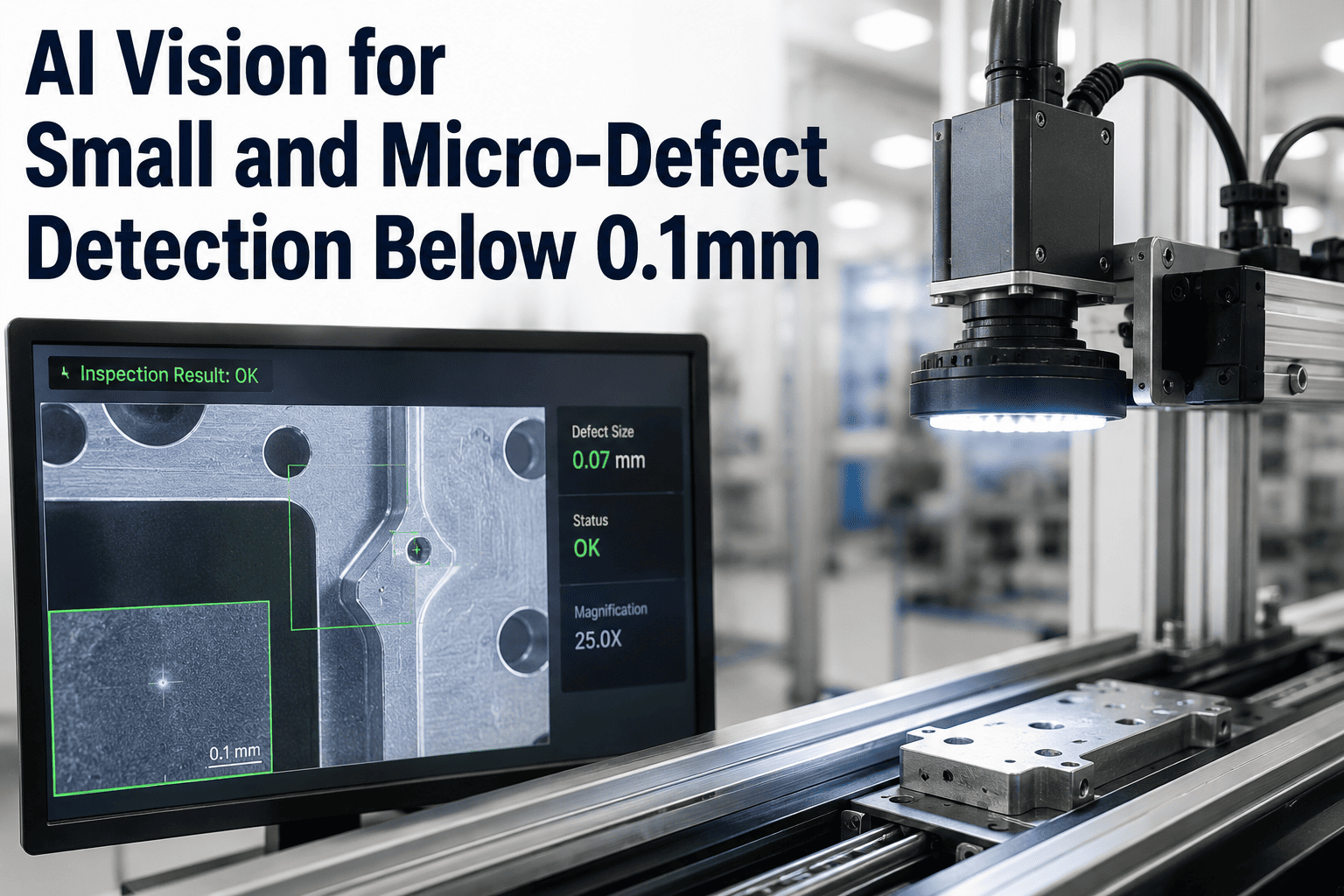
Semiconductor manufacturing operates at the most demanding intersection of precision and volume in any industrial process. Modern fabs work at the 5nm node and below, where particles smaller than 0.1 microns can render an entire die unusable, and where a single undetected pattern deviation in photolithography propagates through every subsequent layer as a yield-destroying defect. Undetected defects cost the global semiconductor industry over $50 billion annually in yield loss — and traditional rule-based automated optical inspection systems, designed for defect types they were explicitly programmed to find, cannot keep pace with the expanding defect taxonomy of advanced nodes. iFactory's AI vision camera system applies deep learning models to wafer surface inspection, edge irregularity detection, contamination identification, die bonding verification, and post-etch pattern analysis — delivering detection accuracy above 95% at fab throughput speeds, on defect types that rule-based AOI consistently misses. Fabs and semiconductor packaging operations that Book a Demo with iFactory's vision engineers are recovering yield they did not know they were losing — and catching excursions before they propagate across a full lot.
Why Rule-Based AOI Is the Bottleneck in Advanced Node Yield Management
Traditional automated optical inspection in semiconductor manufacturing relies on rule-based recipe systems: handcrafted threshold filters and logic gates that define what a defect looks like based on deviation from a golden reference image. This approach worked adequately at 28nm and above, where defect geometries were large enough to be distinguishable by fixed rules and where the defect taxonomy was limited enough to be codified in manageable recipe sets. At 5nm, 3nm, and below, it breaks down. New defect types emerge with every process node change. EUV stochastic defects, line-edge roughness, sub-resolution bridging, and micro-scratch signatures in CMP post-polish surfaces do not conform to pre-written rules — they require a model that learns from data. The financial consequence is direct: according to McKinsey, improving defect detection accuracy by just 1% translates to a 5–10% yield increase, saving millions in production costs per year. A 60% or higher accuracy improvement — the documented gap between rule-based AOI and AI vision on complex defect types — is not a marginal gain. It is a fundamental transformation of yield economics.
Micro Defect Types: What AI Vision Detects That Rule-Based AOI Misses
The defect taxonomy in advanced semiconductor manufacturing spans physical, chemical, and dimensional categories — many of which are defined by subtle signatures that only become visible under specific illumination angles, wavelengths, or imaging modalities. iFactory's AI vision camera system is trained to detect across all major defect categories relevant to wafer fabrication, packaging, and final test inspection. Understanding the defect type determines the imaging configuration, model architecture, and process integration point that maximizes detection value.
Wafer Surface Defect Detection
Surface defects on silicon wafers — scratches, pits, crystal-originated pits (COPs), stacking faults, and CMP-induced micro-scratches — occur at length scales from tens of nanometers to several microns. AI vision models trained on dark-field and bright-field scatterometry imaging data classify these defects by type, size distribution, and spatial location, enabling engineers to trace defect signatures back to specific process steps. The table below defines the primary surface defect categories and their detection requirements.
| Defect Type | Size Range | Primary Process Origin | Detection Method | AI Classification Accuracy |
|---|---|---|---|---|
| CMP Micro-Scratch | 0.1–5 µm width | Chemical mechanical planarization | Dark-field oblique illumination | 96–99% |
| Crystal-Originated Pit (COP) | 50–200 nm | Crystal growth / Czochralski pull | Laser scatterometry + AI classification | 93–97% |
| Stacking Fault | 1–100 µm | Epitaxial deposition, ion implant | Bright-field with phase contrast | 94–98% |
| Hillock / Protrusion | 0.5–10 µm height | Metal deposition, electromigration | 3D confocal + AI height mapping | 95–99% |
| Void / Pit Cluster | 0.2–2 µm | Dielectric deposition, etch | SEM-correlated optical AI | 92–96% |
Edge Irregularity & Pattern Defect Detection
At advanced nodes, line-edge roughness, bridging between adjacent features, and pattern shift defects are yield-limiting categories that grow in frequency as feature pitch shrinks below 10nm. AI vision models distinguish these from process-normal pattern variation without requiring per-layer rule recipe updates — a capability that rule-based AOI cannot replicate at EUV resolution.
Contamination & Foreign Material Detection
Particle contamination on wafer surfaces — from process chemicals, photoresist residue, metal ion deposition, and airborne particulates — is the leading cause of random yield loss in high-volume semiconductor manufacturing. AI vision identifies contamination signatures by type, distinguishing yield-limiting particles from benign residue patterns that would otherwise consume review capacity.
Packaging & Die-Level Inspection
Semiconductor packaging inspection — die bonding accuracy, wire bond geometry, solder bump coplanarity, underfill void detection, and lid seal integrity — requires detection at micron-level tolerances across high-speed pick-and-place and bonding lines. AI vision handles the geometric complexity of advanced packaging formats including flip-chip, wafer-level packaging, and 3D IC stacking.
| Packaging Inspection Type | Defect Category | Tolerance | Detection Modality |
|---|---|---|---|
| Die Bond Placement | Position offset, tilt, rotation | ± 5 µm X/Y, ± 0.1° rotation | High-res coaxial vision + AI |
| Solder Bump Coplanarity | Collapsed, missing, bridged bump | < 15 µm height variation | 3D laser profilometry + AI |
| Wire Bond Geometry | Loop height, bond foot placement | ± 10 µm bond position | Structured light 3D + AI |
| Underfill Void Detection | Internal void, delamination | > 50 µm void flagged | Acoustic / X-ray + AI |
| Lid Seal Integrity | Incomplete seal, gap, misalignment | < 20 µm gap threshold | High-res vision + edge AI |
The AI Vision Detection Workflow: From Wafer Entry to Yield Pareto
Effective micro defect detection in semiconductor manufacturing is not a single inspection event — it is a continuous, multi-stage workflow that captures defect signatures at every process transition where yield-limiting events occur. iFactory's AI vision platform integrates into the fab inspection flow at each critical control point, generating a structured defect record per wafer that feeds the yield management system and the process engineering team's excursion response workflow.
Incoming Wafer & Substrate Baseline Inspection
Before any process steps are applied, AI vision establishes a clean baseline inspection of the incoming wafer or substrate surface. This captures pre-existing scratch maps, edge chip locations, and crystal defect signatures that would otherwise be attributed to downstream process steps. Separating incoming defects from process-induced defects is a prerequisite for accurate process control attribution and prevents engineering resources from being directed at phantom excursions.
In-Line Process Step Inspection (Post-Etch, Post-CMP, Post-Litho)
The highest-leverage AI vision inspection occurs immediately after yield-critical process steps. Post-lithography inspection catches resist bridging, pattern collapse, and focus-exposure matrix drift before etch propagates the defect into a permanent structural failure. Post-CMP inspection identifies scratch clusters and residue patterns attributable to specific platen conditions or slurry lot changes. Post-etch inspection confirms feature geometry against the process design rule targets using AI-driven critical dimension measurement at sample-lot frequency.
Defect Classification & Yield-Limiting Pareto Generation
Every defect detected by the AI vision system is classified by type, size, location on the wafer, and process step attribution. The classified defect Pareto — a ranked list of defect types by yield impact — is the primary engineering tool for directing process improvement resources. iFactory's platform generates a fully classified Pareto within minutes of lot completion, replacing the manual SEM review workflow that delays yield learning by days. Defect classification accuracy above 95% ensures the Pareto is reliable enough to drive process change decisions without additional manual verification sampling.
Spatial Defect Mapping & Process Tool Correlation
Defect location on the wafer surface is not random — it carries systematic signatures that identify the process tool, chuck position, or gas delivery zone responsible for the excursion. AI vision generates die-level spatial defect maps that are automatically correlated against tool ID, lot history, and preventive maintenance records in the CMMS. A ring defect pattern on the wafer edge identifies a specific clamp or spin coater nozzle condition. A column defect pattern identifies a reticle contamination event. Spatial correlation reduces root cause investigation time from days to hours.
Excursion Alert, Lot Disposition & Yield Feedback Loop
When defect density on a wafer or lot exceeds the statistical process control threshold, the AI vision platform triggers an automatic excursion alert to the process engineer and the lot disposition system. Affected lots are held pending engineering review before advancing to the next process step, preventing a single process excursion from propagating through $1M+ of work-in-process inventory. The defect data from each excursion feeds back into the AI model, improving future classification accuracy through continuous learning — a capability that rule-based AOI systems cannot implement without manual recipe engineering effort.
Detection Performance: AI Vision vs. Rule-Based AOI at Advanced Nodes
The performance gap between AI vision and rule-based AOI is not uniform across all defect types — it is largest precisely on the defect categories that matter most for yield at advanced nodes. The comparison below reflects documented performance data from semiconductor inspection deployments, contrasting the two approaches across the parameters that drive yield management decisions. Yield engineers and fab operations teams that Book a Demo see this comparison run live on their specific inspection layers and defect library.
| Inspection Parameter | Rule-Based AOI | iFactory AI Vision | Yield Impact |
|---|---|---|---|
| Complex Defect Classification Accuracy | 60–75% (trained defect types only) | 93–99% (including novel defect types) | 5–10% yield improvement per 1% accuracy gain |
| False Positive (Nuisance) Rate | 15–30% at aggressive sensitivity settings | < 2% with AI anomaly scoring | Eliminates review queue backlog that masks real excursions |
| New Defect Type Detection | Not detected — requires manual recipe update | Flagged as anomaly within same inspection run | Catches novel process excursions at first occurrence |
| Recipe Change for New Node / Layer | 2–6 weeks engineering per layer | 24–72 hours with few-shot retraining | Accelerates new node yield ramp by weeks to months |
| Sub-Resolution Defect Detection (< 0.1 µm) | Not achievable with standard AOI optics | AI-enhanced scatterometry correlation achieves < 0.1 µm sensitivity | Catches EUV stochastic defects invisible to optical AOI |
| Spatial Defect Map Attribution | Manual engineering analysis — days | Automated tool correlation — minutes | Root cause isolation before lot advances to next step |
Yield Economics: The Financial Case for AI Vision in Semiconductor Fabs
The financial return on AI vision inspection in semiconductor manufacturing is driven by a single dominant variable: yield. In a fab running 40,000 wafer starts per month at an average die value of $500, a 1% yield improvement generates $200,000 in additional revenue monthly — $2.4 million annually from a single percentage point. The full financial model incorporates four value streams that compound across the production volume.
The most asymmetric financial return in semiconductor AI vision is excursion prevention — catching a process drift event before it propagates across a full lot. A single undetected excursion that runs through 25 wafers before detection at electrical test scraps $1.5M–$5M in work-in-process inventory at advanced node die values. An AI vision system that catches the same excursion at the first affected wafer — before it advances to the next process step — prevents the entire downstream loss. iFactory's SPC-integrated defect monitoring runs statistical process control limits against defect density per wafer in real time, triggering a lot hold alert within the same inspection run that first detects the excursion signal. This single capability — excursion containment at first wafer rather than at end-of-lot electrical test — justifies the full AI vision deployment cost at most fabs within a single caught event. Teams ready to quantify this value for their operation can Book a Demo for a site-specific yield impact model.
iFactory AI Vision Platform: Semiconductor-Specific Capabilities
iFactory's AI vision camera platform is not a generic machine vision toolkit adapted to semiconductor inspection — it is a purpose-built system for the imaging constraints, defect taxonomies, and integration requirements of semiconductor and advanced electronics manufacturing environments. The four core capabilities below define what the platform delivers beyond standard AOI replacement.
Sub-100ms Edge Processing at Fab Throughput
AI inference decisions are made at the edge — on GPU-enabled compute co-located with the inspection station — in under 100 milliseconds per wafer image frame. This eliminates cloud latency as a throughput constraint on high-speed inspection tools running at wafer-per-minute rates. Edge architecture also keeps wafer image data on-premises, satisfying the data security and IP protection requirements that prevent cloud-dependent inspection systems from being deployed in semiconductor fabs.
Few-Shot Model Training for New Defect Types
When a new defect type is identified — from a process change, a new material introduction, or a novel EUV stochastic signature — iFactory's model retraining requires as few as 20–50 labeled examples to achieve production-grade classification accuracy on the new category. This few-shot capability reduces new node inspection readiness time from weeks of recipe engineering to 24–72 hours of model fine-tuning, directly accelerating yield ramp on new process technology.
YMS & CMMS Integration via OPC-UA and REST API
iFactory integrates with yield management systems (YMS), manufacturing execution systems (MES), and CMMS platforms through OPC-UA, MQTT, and REST APIs — connecting defect data to downstream lot disposition, SPC triggering, and equipment maintenance workflows without custom middleware development. A detected defect cluster automatically generates a structured engineering notification, updates the lot history in the YMS, and creates a work order in the CMMS if the defect pattern correlates with a specific process tool condition.
Continuous Model Improvement from Production Data
Every defect image captured in production — including confirmed defects, false positives identified by engineering review, and novel anomalies flagged for SEM correlation — feeds back into the AI model through a structured active learning pipeline. Classification accuracy improves continuously as production data accumulates, unlike rule-based AOI where performance is static between manual recipe updates. Fabs running iFactory's platform for six months consistently report classification accuracy gains of 3–8 percentage points above the initial deployment baseline.
Expert Perspective: What Leading Fabs Do Differently in Inspection Strategy
The fabs achieving best-in-class yield at advanced nodes share a consistent inspection philosophy that separates them from median performers. First, they treat defect classification as a data quality problem — not a hardware problem. They invest in AI models that produce a reliable, fully classified Pareto, because an inaccurate Pareto drives engineering effort to the wrong root causes. Second, they integrate spatial defect maps with tool maintenance records in real time, so excursion response is measured in hours rather than days. Third, they run AI-powered SPC on defect density per wafer rather than waiting for end-of-lot electrical test — catching excursions at the first affected wafer before the problem propagates into $2M of work-in-process. The jump from 70% classification accuracy on rule-based AOI to 95% on AI vision is not an incremental improvement — it changes the economics of yield management entirely. A 1% yield gain at advanced node die values pays back the entire inspection platform investment within a single production month.
— Semiconductor Yield Engineering Benchmark Review, iFactory AI Vision Reference Data 2026Conclusion
At advanced semiconductor nodes, defect detection is not a quality assurance function — it is the primary lever of yield management and, by extension, the primary driver of fab profitability. The $50 billion annual yield loss from undetected defects across the semiconductor industry is not a fixed cost of manufacturing at advanced nodes — it is a recoverable loss, the majority of which is concentrated in defect types that AI vision detects and rule-based AOI misses. A 3–5% yield rate improvement from early process drift detection, combined with excursion containment at the first affected wafer, generates financial returns that dwarf the total cost of AI vision deployment within a single production quarter.
The AI vision framework in this guide — in-line process step inspection, deep learning defect classification, spatial map tool correlation, and SPC-integrated excursion alerting — reflects what leading fabs achieving best-in-class yield at advanced nodes are already running. The deployment model is straightforward: iFactory's platform integrates with existing YMS, MES, and CMMS infrastructure through standard protocols, requires no production stoppage for installation, and reaches production-grade classification accuracy within 24–72 hours of model training on the target defect library. Fabs that remain on rule-based AOI at advanced nodes are not saving on inspection cost — they are absorbing the yield loss, one misclassified defect at a time.
Frequently Asked Questions
Detection sensitivity depends on the imaging modality deployed. With high-resolution optical imaging and AI-enhanced scatterometry correlation, the platform achieves detection sensitivity below 0.1 microns for surface particles and contamination events — the threshold relevant to advanced node processes at 5nm and below. For pattern defects including line-edge roughness and bridging at sub-10nm feature pitch, AI classification operates on SEM-correlated optical data to achieve classification accuracy above 95% on defect types that cannot be resolved by standard optical AOI alone. Crystal-originated pits at 50–200nm and CMP micro-scratches at 0.1–5µm width are classified at 93–99% accuracy with appropriate dark-field illumination configurations.
Novel defect types — those not present in the training data — are flagged as anomalies by the AI model's unsupervised anomaly detection layer, which scores each defect image against the statistical distribution of known patterns. Anomaly-flagged images are routed to the engineering review queue for SEM correlation and manual classification. Once classified by the engineer, the labeled example is added to the training set and the model is retrained using few-shot learning — requiring as few as 20–50 examples of the new defect type to achieve production-grade classification accuracy. This retraining cycle takes 24–72 hours. The result is a system that catches novel excursions at first occurrence and integrates the new defect type into its classification model within days — a fundamental capability advantage over rule-based AOI that requires weeks of recipe engineering to address new defect types.
iFactory integrates with yield management systems, MES platforms, and CMMS through OPC-UA, MQTT, and REST APIs — connecting to KLA Klarity, Applied Materials process control systems, SAP PM, Oracle EAM, IBM Maximo, and any CMMS platform without custom middleware development. The integration workflow is bidirectional: the AI vision platform reads the active lot recipe and process step from the MES to apply the correct inspection model, and writes defect classification results, spatial defect maps, and SPC signals back to the YMS and CMMS in real time. A defect density excursion automatically triggers a lot hold in the MES and generates a work order in the CMMS linked to the specific process tool identified by spatial defect map correlation. This closed loop between defect detection and maintenance response eliminates the response latency that allows excursions to propagate across multiple lots.
Documented yield improvements from AI vision inspection deployments in semiconductor manufacturing range from 3–5% yield rate improvement from early process drift detection alone — before the additional value of excursion containment and false positive reduction are counted. McKinsey's semiconductor benchmarks show that a 1% improvement in defect detection accuracy translates to a 5–10% yield increase, saving millions in annual production costs. At a fab running 40,000 wafer starts per month at $500 average die value, a 3% yield improvement generates $6M annually from a single process layer. Intel has documented $2M in annual savings from a single AI wafer vision deployment. The specific yield improvement achievable at your fab depends on the current defect escape rate, the ratio of yield-limiting defects that fall outside the current AOI recipe's detection capability, and the volume and die value of affected production. A site-specific yield impact model is part of iFactory's demo engagement.
Integration with existing inspection tool data streams — from optical scanners, SEM review stations, and inline metrology tools — is typically completed in 4–8 weeks without production line interruption. The first 2 weeks involve data connectivity and imaging baseline establishment. Weeks 3–6 cover initial model training on the primary defect library using existing labeled defect image archives from the fab's SEM review database — most fabs have sufficient labeled data to achieve production-grade accuracy without any additional wafer runs. YMS and CMMS integration is completed in parallel with model training. Production-grade defect classification with automated SPC alarming is operational within 6–8 weeks of project start. For packaging inspection lines with simpler defect taxonomies, initial deployment is achievable in 2–4 weeks.