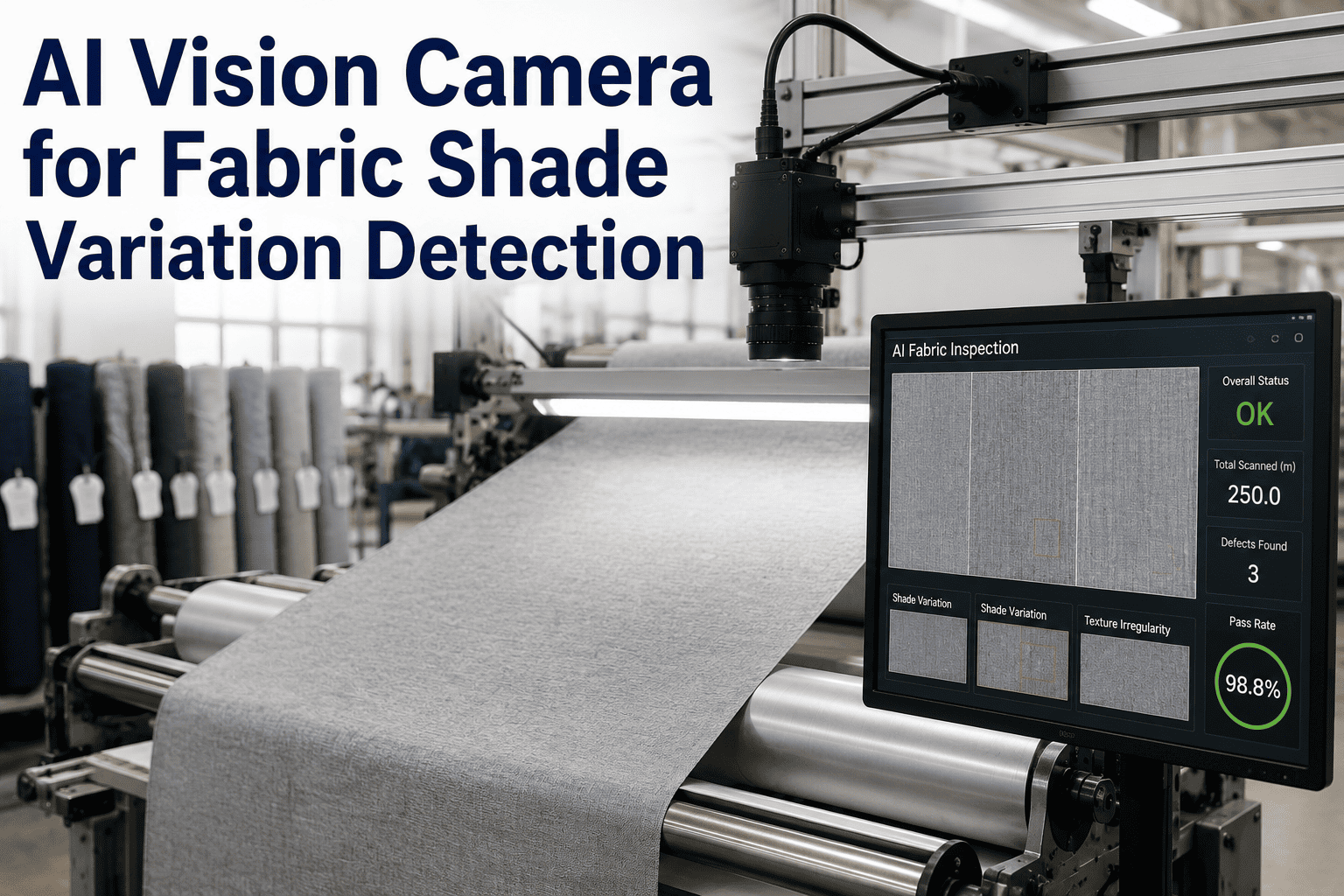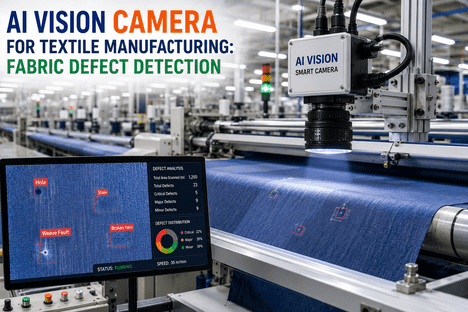
A modern rapier or air-jet loom runs at 600 to 1,000 picks per minute, which means a single defect — a drop stitch, a warp break, a contaminated yarn — can ruin thousands of stitches and hundreds of meters of fabric before a human inspector standing at the end of the line ever notices it. Manual fabric grading was never built for this pace. Research on visual inspection consistently shows that human accuracy drops below 80% after prolonged continuous scanning, and traditional inspection speeds are capped around 15 yards per minute specifically because the human eye cannot reliably judge defects any faster than that — a fraction of what a modern production line actually outputs. AI Vision Camera technology closes this gap entirely by inspecting fabric at full production speed rather than slowing the line down to match human inspection capacity: deep learning models trained on woven, knit, and technical fabric defects analyze every meter of material as it moves, flagging weaving faults, stains, holes, and color variations the instant they appear, with accuracy that holds steady whether it is the first roll of the shift or the last. Book a Demo with iFactory's engineering team to see how AI Vision Camera applies to your specific fabric lines.
Why Manual Fabric Grading Cannot Keep Pace With Modern Production
The Physical Limits of Human Visual Inspection on a Moving Line
Fabric inspection has historically depended on an operator standing at an inspection table or framing station, watching material pass by under controlled lighting and marking defects by hand against a points-based grading standard. This approach made sense when looms ran slowly enough for the human eye to track every section of fabric, but production speeds have outpaced human visual capacity for years. Fabric speed on a manual inspection table is typically capped near 15 yards per minute, not because faster equipment doesn't exist, but because human accuracy degrades sharply beyond that point — and even within that constraint, accuracy is documented to fall below 80% after extended periods of continuous scanning as fatigue sets in.
The financial consequence of this gap is substantial. Industry data consistently shows that undetected surface defects — weaving faults, stains, holes, broken yarns, missing picks, and color inconsistencies — can reduce a fabric roll's resale value by 45 to 65 percent, and a defect that begins at picking speeds of 600 to 1,000 picks per minute can propagate through hundreds of meters of fabric before a manual inspector downstream ever sees it. Post-production inspection at this scale is purely reactive: it identifies the loss after the material has already been produced, rather than preventing it.
How AI Vision Camera Inspects Fabric at Full Production Speed
Line-Scan Imaging and Deep Learning Defect Classification
AI Vision Camera replaces the inspection table bottleneck with high-resolution line-scan cameras positioned directly over the fabric path, paired with deep learning models trained specifically on the defect types that occur across weaving, knitting, dyeing, and finishing operations. Because the system analyzes the fabric surface continuously as it moves rather than requiring the material to slow down for human review, inspection speed scales with the production line itself instead of capping it — meaning the camera can keep pace with looms and finishing equipment running at speeds that would be physically impossible for a manual inspector to grade accurately.
Each captured frame is processed through convolutional neural network models trained to recognize the visual signatures of holes, oil and water stains, broken yarns, missing picks, slubs, color bleeding, shade variation, and weaving irregularities such as misaligned warp or weft threads. Detection happens in near real time, with every flagged defect logged by type, location, severity, and confidence score, building a structured defect record for every meter of fabric produced rather than a single pass/fail judgment made at the end of the roll.
Defect Types AI Vision Camera Detects Across Fabric Production
From Weaving Faults to Color Inconsistencies at Every Production Stage
Fabric defects originate at every stage of textile production, and the visual signature of each defect type differs enough that effective AI inspection requires models trained across the full range of fault categories rather than a single generic anomaly detector. Weaving faults such as broken warp ends, missing picks, and float errors appear as structural irregularities in the weave pattern itself, while dyeing and finishing defects such as shade variation, color bleeding, and uneven dye uptake appear as inconsistencies in color and tone across the fabric surface that can be subtle enough to escape notice under inconsistent inspection-table lighting but are immediately measurable to a calibrated vision system.
Physical surface defects — holes, tears, oil stains, water marks, and foreign yarn contamination — round out the categories that AI Vision Camera is trained to identify, and because the underlying deep learning models continue learning from new defect examples over time, classification accuracy improves as the system accumulates more production data from a specific mill's fabric types and equipment. This adaptability matters in textile manufacturing specifically because fabric construction varies enormously between woven, knit, and technical textiles, and a defect detection model tuned for one fabric category needs to generalize correctly to the texture, weight, and pattern variation of the next.
Replacing Manual Grading With Automated 4-Point System Compliance
How AI Vision Camera Applies Industry-Standard Grading Without Manual Judgment
The 4-Point System, standardized under ASTM D5430, remains the most widely used fabric grading method in the apparel and textile industry, assigning penalty points from one to four based on defect size and severity to determine whether a roll is acceptable, restricted, or rejected. The system was designed around human visual judgment, which means its consistency has always depended on inspector training, lighting conditions, and fatigue levels remaining constant — a difficult standard to guarantee across multiple shifts and inspectors over the life of a production run.
AI Vision Camera applies the same 4-point penalty logic automatically and consistently to every meter of fabric inspected, removing the subjectivity that varies between human graders and shifts. Defects are measured, classified, and scored against the standard's size and severity thresholds the moment they are detected, and the resulting grade for each roll is generated directly from objective measurement data rather than a visual estimate made under whatever lighting happened to be available at the inspection table that day. This consistency becomes particularly valuable when fabric rolls move between mills, garment manufacturers, and international buyers who all rely on the same point totals to make purchasing and acceptance decisions.
| Defect Category | What AI Vision Camera Detects | Production Stage | Detection Method |
|---|---|---|---|
| Weaving Faults | Broken warp ends, missing picks, float errors, misalignment | Loom / weaving | Real-time structural pattern analysis |
| Surface Defects | Holes, tears, oil stains, water marks, foreign yarn | Weaving, finishing | High-resolution line-scan imaging |
| Color Variations | Shade inconsistency, color bleeding, uneven dye uptake | Dyeing, finishing | Calibrated color and tone analysis |
| Yarn Irregularities | Slubs, thick/thin yarn sections, knots, contamination | Spinning, weaving, knitting | Texture and density classification |
| Grading & Scoring | Automated 4-point system penalty scoring per ASTM D5430 | Final inspection | Objective, full-speed measurement |
Deploying AI Vision Camera Without Slowing Down Existing Lines
Integration With Looms, Finishing Equipment, and Existing Quality Workflows
A textile mill considering AI Vision Camera is rarely starting from a blank production floor — most mills already operate looms, knitting machines, and finishing lines with established quality control checkpoints, and the priority for any new inspection technology is that it integrates without becoming a new production bottleneck. iFactory's AI Vision Camera platform mounts directly over the existing fabric path at the inspection stage already built into the production flow, whether that is on-loom monitoring positioned to catch a fault before it propagates, or a finishing-line inspection station replacing the manual grading table at the end of the process.
Because the underlying models are trained on reference samples specific to each fabric type the mill produces, onboarding a new fabric construction typically requires running a short reference roll so the system can extract the defect-free baseline and texture signature before resuming full production-speed inspection. Every detected defect, severity score, and roll grade routes directly into the mill's existing quality reporting workflow, giving quality managers, plant heads, and shift supervisors live visibility into defect rates and grade distribution without requiring a parallel manual inspection process to run alongside it. Book a Demo to see how the platform integrates with your specific loom and finishing line configuration.
Conclusion
Textile manufacturers do not lack quality standards, trained inspectors, or established grading systems — what most mills lack is an inspection method that can actually keep pace with how fast modern looms and finishing lines run. AI Vision Camera technology does not replace the 4-point grading standard or the quality expectations a mill already operates under; it makes those standards enforceable at the speed production actually happens, applying the same objective measurement to every meter of fabric rather than the variable judgment of a fatigued inspector working an extended shift. A weaving fault, a stain, a shade variation — each becomes a detected, classified, and scored event the instant it forms, rather than a discovery made hundreds of meters later when the roll reaches a manual grading table.
The mills making this shift are not eliminating their quality teams — they are giving those teams a measurement tool that never tires, never loses consistency across a shift, and never misses a defect because it happened to blink at the wrong moment. The first weaving fault caught before it propagated across a roll, the first shade mismatch flagged before it reached a customer, and the first fully automated 4-point grade generated without manual review are the proof points that turn a pilot deployment into a mill-wide standard.