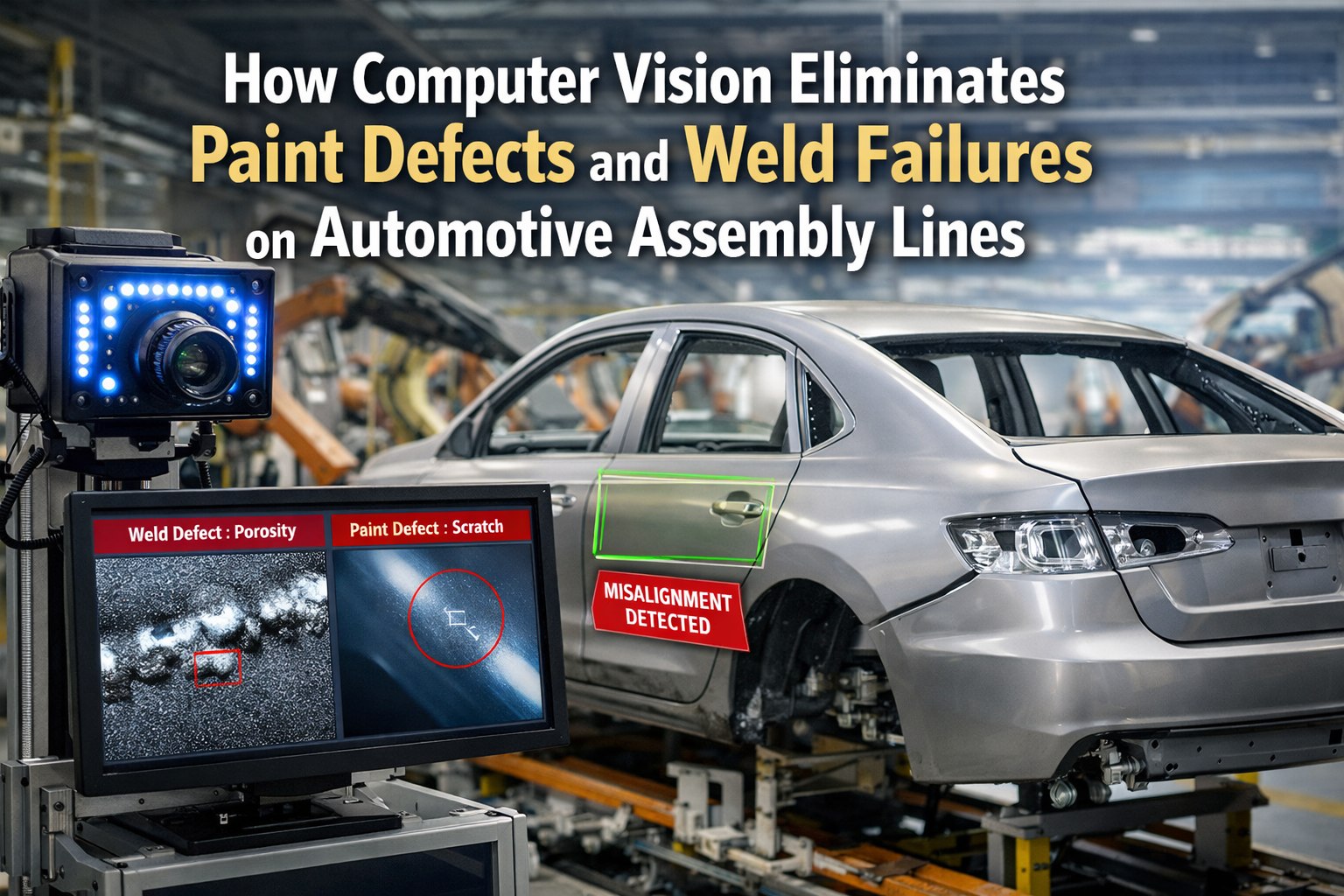
Every automotive paint shop knows the same uncomfortable arithmetic: five to fifteen percent of vehicles leave the booth needing rework, dirt inclusions alone account for the majority of those events, and a single defect that slips through basecoat and gets sealed under clearcoat can multiply its repair cost by five to ten times before it's finally caught downstream. Human inspectors under fixed booth lighting catch seventy to eighty percent of surface defects on a good day and drop noticeably by the tenth hour of a night shift, which is why plants running sixty to ninety vehicles an hour physically cannot inspect every panel of every body with manual visual QC. AI vision inspection at the booth exit changes the economics — every body, every panel, every defect, classified and severity-routed before the clearcoat locks the problem in, giving the plant a chance to fix things when repair is still a touch-up instead of a full panel strip. iFactory's paint shop deployment engineering team helps automotive quality leaders map the sensor stack, defect taxonomy, and MES integration to their specific booth and paint code library.
Automotive · Paint Shop AI Vision
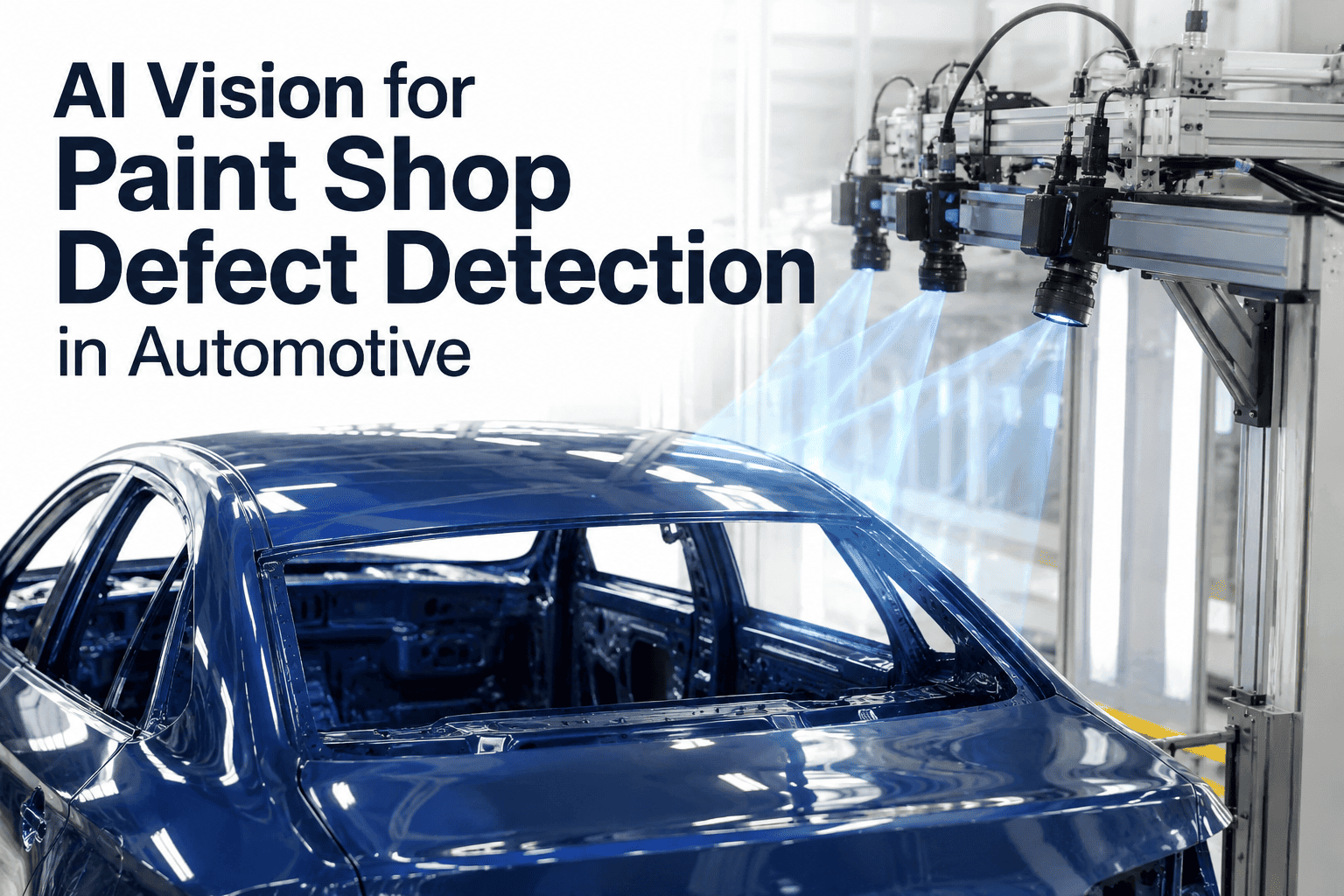
AI Vision for Paint Shop Defect Detection in Automotive
Orange peel, runs, sags, dirt inclusions, color drift, craters — every defect class an automotive paint shop tracks, caught on every panel of every body at line speed. AI vision inspection deployed at the right point in the paint process catches defects when rework is still cheap, before the clearcoat seals them in for good.
Paint Shop Reality Check
5–15%
of vehicles leave the booth needing rework
70–80%
manual inspection catch rate on a good shift
5–10x
rework cost multiplier if defect passes clearcoat
98%+
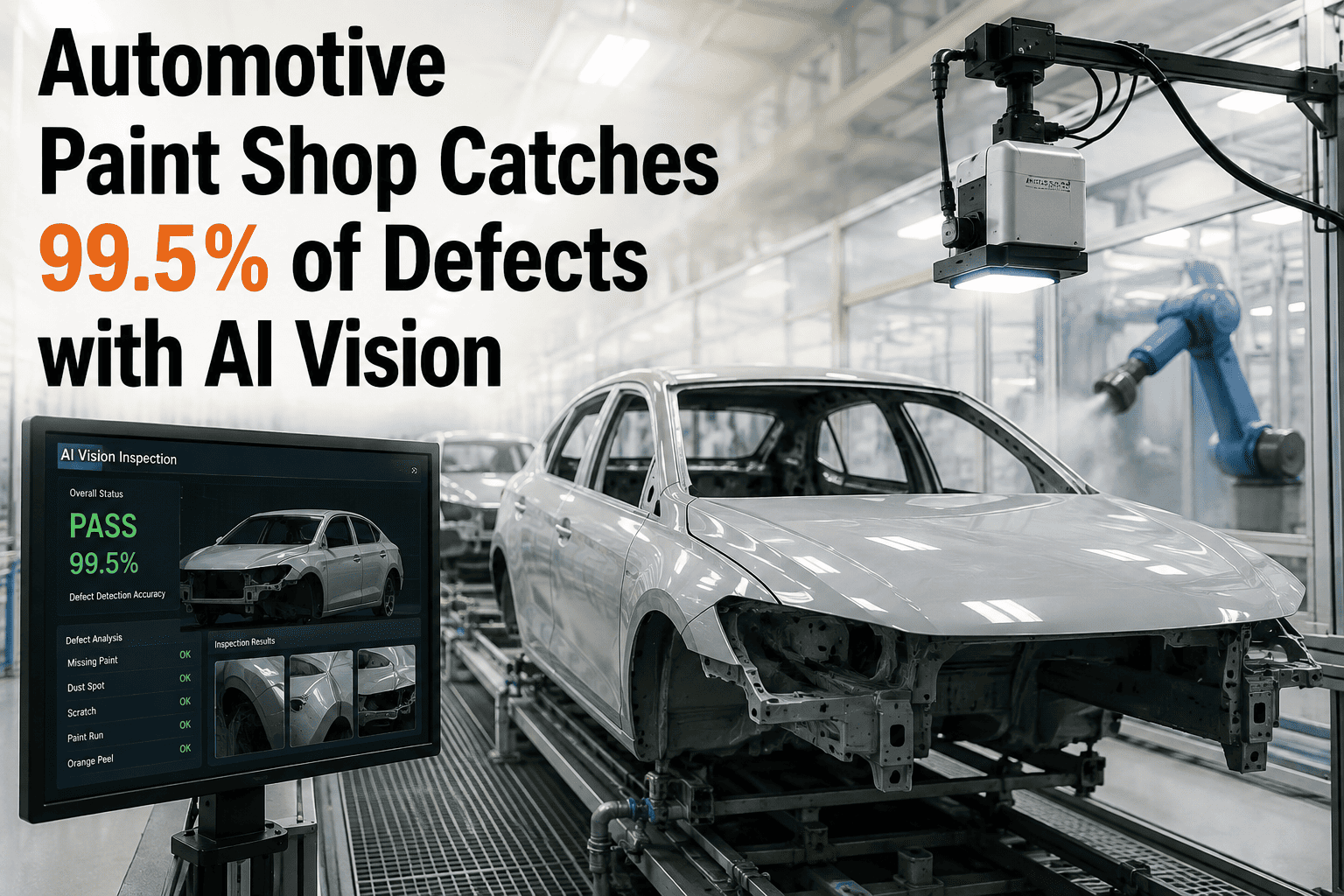
AI vision detection rate on painted surfaces
The Cost Curve
Why the Paint Shop Is the Most Expensive Place to Miss a Defect
Paint is the single most visible quality dimension on a finished vehicle, and it's also the operation where an escaped defect gets exponentially more expensive the longer it takes to find. A dust nib caught on the wet basecoat is a wipe. A dust nib caught on the tacky primer is a light sand and touch-up. A dust nib sealed under fully cured clearcoat is a polish attempt, a partial panel strip, or on a bad day, a full-body re-shoot that pulls a vehicle off the line and consumes six figures of material and labor to correct. The economics don't just favor early detection — they demand it, because the difference between catching a defect at the right layer and catching it after final assembly is often the difference between profit and loss on that unit.
Traditional manual visual inspection samples five to fifteen percent of vehicles at fixed inspection stations, which structurally cannot catch defects on the vehicles it doesn't inspect. Even on sampled units, trained inspectors under booth lighting catch roughly seventy-eight to eighty-four percent of surface defects at the start of shift, and that number drops through the shift as fatigue compounds and the eye adjusts to the fixed lighting. On a line producing sixty to ninety vehicles an hour, missed percentage points become escaped defects that surface as dealer touch-ups, warranty claims, and the far more damaging category of customer perception issues that show up in J.D. Power scores two years later.
The math is what makes AI vision the only economically viable answer for one hundred percent inspection at production speed. Multi-camera arrays paired with structured lighting and deep learning models trained on paint code-specific defect signatures inspect every panel of every body in the seconds it takes to move through the exit tunnel, and the models don't get tired, don't shift baseline between shifts, and don't disagree with themselves about what counts as major versus minor severity. That consistency is where the real value compounds — not just in defects caught, but in defect calls that mean the same thing on Monday morning and Saturday night.
The Defect Taxonomy
The Six Defect Classes AI Vision Catches on Every Body
Every automotive paint control plan traces its defects back to a small number of root categories, and the AI vision system has to reliably classify each one under production conditions — real booth lighting, real conveyor speeds, real paint codes ranging from solid whites to complex tri-coat metallics. The six classes below cover the overwhelming majority of paint shop rework events in modern automotive plants.
D1
Orange Peel
Improper atomization, viscosity drift, or spray distance error
Dimpled, uneven surface texture resembling an orange rind. Caused when paint droplets fail to flow and level before flash-off. AI detects severity through structured light analysis and texture gradient modeling, grading against OEM appearance thresholds and distinguishing acceptable variation from true out-of-spec texture.
D2
Runs and Sags
Excess film build, incorrect spray angle, or wet paint gravity flow
Thick lines, drips, or curtain-like flows on vertical panels caused by paint running under gravity before cure. Frequently missed on curved geometry where the flow blends into panel profile. AI flow-pattern models detect flow signatures that human inspectors miss on complex geometry.
D3
Dirt and Dust Inclusions
Booth air filtration, personnel movement, or vehicle pre-cleaning gaps
The single largest defect category in most paint shops regardless of booth cleanliness. Airborne dust, fibers, or overspray particles settle on tacky paint and cure in place. AI catches inclusions down to sub-millimeter scale and maps them to booth zone for root-cause analysis on filtration or personnel patterns.
D4
Color Mismatch
Batch variation, spray parameter drift, or fascia-to-body match failure
Panel-to-panel or body-to-fascia color variation that fails delta-E tolerance. Especially visible on metallics where flake orientation shifts color perception. AI vision integrated with spectrophotometry measures L*a*b* coordinates continuously and flags drift before the batch produces a train of mismatched bodies.
D5
Craters and Fish-Eyes
Surface contamination — silicone, oil, or wax residue on substrate
Circular depressions where the coating retracts from a contaminant point. Notoriously difficult to catch under standard booth lighting because the crater rim can blend into the surrounding paint. Darkfield illumination and AI shape-recognition models catch craters that manual inspection consistently misses.
D6
Solvent Pops and Pinholes
Trapped gas escaping during cure — bake schedule or film build issues
Small bubbles or pinhole voids that form when volatile compounds escape through a partially cured paint film. Often clustered on horizontal panels where film build is thickest. AI catches the characteristic bubble geometry and maps clusters to specific bake zone temperatures for corrective action.
See Live Defect Classification
Watch AI Vision Catch the Paint Defects Your Booth Is Missing Right Now
Book a walkthrough with iFactory's paint shop engineering team and see live defect detection running against real panel footage — orange peel severity grading, dirt inclusion mapping, color drift monitoring, and conveyor auto-routing based on severity classification.
The Catch Window
Why Catching Defects Before Clearcoat Is the Whole Game
The economics of paint rework are governed by one physical fact: once clearcoat cures, the defect is sealed in. Every layer that goes over an unfixed defect makes the eventual repair harder, more expensive, and more likely to require a full panel strip rather than a targeted touch-up. The catch-window strategy behind serious paint AI deployment is built around inspecting between layers, not just at the end — because inspecting only at the end means catching problems when it's already too late to fix them cheaply.
| Inspection Point |
Defect Layer |
Repair Approach |
Relative Cost |
| Post E-Coat / Pre-Primer |
E-coat coverage, edge coverage gaps, holidays |
Local touch-up, re-dip on failed bodies |
1x baseline |
| Post Primer / Pre-Basecoat |
Primer inclusions, orange peel, edge build |
Denib and light sand before basecoat |
1.5x baseline |
| Post Basecoat / Pre-Clearcoat |
Color drift, dirt inclusions, sag onset |
Wipe, light denib, or panel re-shoot before clear |
2–3x baseline |
| Post Clearcoat / Pre-Cure |
Runs, orange peel, dirt in wet clear |
Wet-sand and polish, limited before flash-off |
4–5x baseline |
| Post-Cure Final Inspection |
All defect classes sealed under cured clearcoat |
Polish, spot repair, or full panel strip-and-reshoot |
6–10x baseline |
| Post Final Assembly |
Any defect discovered after trim and hardware install |
Disassembly, repair, reassembly — worst case |
10x+ baseline |
The pattern is unforgiving: a defect caught one stage earlier costs a fraction of what the same defect costs one stage later, and the multiplier compounds through every layer that goes on top. AI vision inspection deployed between layers — not just at the end — is how modern paint shops actually collapse their rework cost curve, because it moves defect detection from the post-cure inspection point (where repair is expensive) to the pre-clearcoat point (where repair is a wipe or a light denib).
The Technology Stack
How the AI Vision Inspection System Actually Sees
Paint inspection is fundamentally harder than most other computer vision problems because the target surface is designed to be visually uniform — a good paint job looks like nothing at all. The AI vision stack has to combine specialized lighting, high-resolution imaging, and defect-class-specific models to reliably classify anomalies against a background that itself has legitimate texture and reflectivity variation.
01
Multi-Camera Imaging Array
High-resolution area-scan and line-scan cameras positioned to cover every painted surface as the body moves through the exit tunnel. Multi-angle imaging is required for metallics and pearls where color perception depends on viewing geometry. No manual repositioning, no operator-dependent framing.
02
Structured Lighting and Darkfield Illumination
Standard booth lighting is optimized for painters, not inspectors. Structured light projects known patterns onto the panel to reveal orange peel and surface waviness; darkfield illumination catches scratches, craters, and dirt inclusions invisible under diffuse light. The lighting rig is as important as the camera.
03
Deep Learning Defect Classification Models
Convolutional networks trained on hundreds of thousands of labeled defect images across the specific paint codes, panel geometries, and booth lighting conditions of the deploying plant. Models don't generalize across paint suppliers — they have to be trained or fine-tuned on the specific finish system in the specific booth.
04
Spectrophotometry Integration for Color
Color mismatch classification requires actual colorimetric measurement, not just image analysis. Integrated spectrophotometers measure L*a*b* coordinates on defined body zones and validate against delta-E tolerances specific to the paint code, catching color drift before a full batch of mismatched bodies ships.
05
Severity Routing and Conveyor Integration
Detected defects are severity-classified — critical, major, minor — and the classification is fed to conveyor controls to physically route the body. Critical bodies to reject station. Major bodies diverted to rework. Minor bodies proceed with documentation. No manual sort decision, no inspector fatigue in the routing logic.
06
MES and CMMS Integration
Every classification is logged with body ID, defect images, coordinates on a 3D body model, and routing action taken. The data feeds back into the MES to correlate defect spikes with process parameters — booth humidity, paint viscosity, filter age — and closes the loop from defect detection to root-cause process control.
Deployment Timeline
From Kickoff to Live Inspection on the Line
A realistic paint shop AI vision deployment lands in the six-to-twelve-week window from kickoff to live inspection on production bodies, assuming the paint code library is documented and the booth exit tunnel can accommodate the imaging rig without major structural changes. Faster is possible on greenfield installations; longer is common when the paint code library is proprietary and requires new model training from scratch.
Week 1–2
Site Survey and Baseline
Engineering walk-through of the paint shop, booth exit tunnel imaging, defect history pull from current QC records, and paint code library documentation. Baseline rework rate captured to measure improvement against later.
Week 3–4
Rig Installation and Lighting Setup
Multi-camera array and structured lighting rig installed at the booth exit. Cable routing, network integration, and calibration bodies run through the tunnel to validate imaging coverage on every panel of a full-size body.
Week 5–8
Model Training and Validation
Deep learning models trained or fine-tuned on the plant's specific paint codes, defect examples, and lighting conditions. Validation against known-defect bodies to measure precision and recall before switching to production classification.
Week 9–10
Shadow Mode Production Run
System runs in shadow mode alongside existing manual inspection, classifying every body but not yet routing. Comparison against inspector calls identifies model gaps and false-positive patterns that need correction before go-live.
Week 11–12
Go-Live with Conveyor Integration
System takes over primary inspection and conveyor routing. Manual inspection continues at reduced sampling for validation. Quality engineers review edge cases daily and feed corrections back into the model for continuous accuracy improvement.
Month 4+
MES Integration and Root-Cause Loop
Defect classifications correlated with booth process parameters, paint batch data, and filter maintenance records. Root-cause dashboards enable process engineers to fix upstream causes rather than just catching downstream defects.
The Business Case
Where the Paint Shop AI Vision ROI Actually Comes From
The ROI on paint shop AI vision doesn't come from any single source — it compounds across four categories that individually justify the investment and together produce payback that typically lands in the twelve-to-eighteen-month range for a plant running sixty vehicles per hour or more. Understanding which category dominates in a specific plant is how the business case gets built for the specific booth.
R1
Rework Cost Reduction
Catching defects before clearcoat reduces per-defect repair cost by five to ten times compared to post-cure detection. On a plant averaging one hundred fifty rework events per shift, the savings on the shifted defects alone typically pay for the system inside eighteen months.
R2
Escaped Defect Reduction
Defects that reach the customer trigger dealer touch-ups, warranty claims, and long-term brand perception cost through J.D. Power scores. Plants deploying paint AI vision typically see thirty to fifty percent reduction in customer-reported paint complaints within the first year of operation.
R3
Throughput Recovery
Manual inspection stations are throughput bottlenecks — the line slows to inspection pace. AI vision inspects at line speed, which frees the bottleneck and recovers hours of production capacity per week without adding a single additional worker to the paint shop.
R4
Process Control Feedback
The real long-term value is the defect data itself — correlated with booth humidity, viscosity, filter age, and paint batch, it enables process engineers to fix upstream causes instead of just chasing downstream symptoms. That's how the defect rate keeps falling year over year.
Field Perspective
"
The mistake plants make with paint AI vision is treating it as an inspection replacement instead of an inspection transformation. If you deploy the cameras at the same point where your inspectors currently stand — post-cure, at the end of the line — you'll get better data but you won't get better economics, because you're still catching defects at the most expensive place to catch them. The plants that see real payback are the ones that move inspection upstream, between layers, at points where a wipe or a light denib is still a viable fix. That's what changes the numbers. And the second mistake is underestimating how much the defect data itself is worth — six months in, the process engineers stop asking about defect counts and start asking about correlation to viscosity, humidity, and filter age, and that's the point where the plant starts fixing the causes instead of chasing the symptoms. The cameras are the entry point. The data is the actual product.
Miguel Ashworth-Ramírez
Paint Shop Quality Director · 19 years in automotive paint operations, AI vision deployment leadership, and process control integration
Common Questions
Frequently Asked Questions
Can AI vision handle metallic, pearl, and tri-coat finishes reliably?
Yes, but the imaging rig and the models both have to be built for it. Metallic and pearl finishes exhibit flake orientation and angle-dependent color shift that require multi-angle imaging with structured lighting to characterize properly. The classification models also need training data specifically from metallic and pearl paint codes, because a model trained only on solid colors will produce false positives on legitimate effect-flake behavior. Well-built systems measure flop index and basecoat behavior alongside the standard appearance metrics for these codes, and reliably grade them against OEM specifications.
Talk to paint shop engineering about your specific paint code library.
How is AI vision inspection different from a wave-scan instrument?
A wave-scan instrument gives you four numbers — DOI, gloss, short-wave, long-wave orange peel — on a sample area, typically once per body or once per shift. AI vision gives you the same four numbers continuously, on every panel of every body, plus defect classification, severity routing, full traceability with images, and conveyor automation that a single-point instrument cannot do. Wave-scan remains valuable as a calibration reference and for spot-checking, but it fundamentally cannot deliver one-hundred-percent inspection at production speed the way a multi-camera AI vision rig can. The two are complementary rather than competing, and mature paint shops typically deploy both.
What is the smallest defect the system can reliably detect?
Under production conditions with the standard multi-camera imaging rig and structured lighting, defects down to roughly zero-point-two millimeters are reliably detected on glossy painted surfaces. Smaller defects are possible with higher-resolution optics and slower conveyor speed, but the zero-point-two millimeter threshold covers essentially all defect classes that would be visible to a customer under normal viewing conditions. Detection sensitivity below that threshold is usually not worth the imaging cost, because the defects that small are invisible to the end customer and don't drive warranty or perception outcomes.
Does the system work with a proprietary or non-standard defect taxonomy?
Standard practice. Every OEM has its own defect taxonomy, severity thresholds, and control plan structure, and the AI vision models are trained or fine-tuned to match. During deployment, the plant's existing defect taxonomy is mapped to the classification model's output classes, and severity thresholds are configured against the plant's current acceptance criteria. If the plant later revises the taxonomy or tightens thresholds, the models are re-trained on the updated definitions. The system adapts to the plant's standards rather than forcing the plant to adopt a generic external taxonomy.
Book a demo to see taxonomy mapping walked through against your control plan.
How does the system handle edge cases and reduce false positives over time?
Every classification decision is logged with the panel image, defect coordinates, severity call, and routing action taken. Quality engineers review edge cases — bodies where the AI call disagreed with a manual re-inspection, or where a marginal defect was flagged — and feed corrections back into the model as labeled training data. The model retrains on a cadence, typically weekly or biweekly in the first months and monthly once stable, and accuracy improves continuously as more edge cases are labeled. Most plants see false positive rates drop below one percent within the first six months of operation, and the models keep improving as long as the feedback loop is maintained.
Paint Shop Ready for AI Vision
Catch Every Paint Defect Before Clearcoat Locks It In
iFactory's paint shop AI vision platform is designed for the specific realities of automotive booth operations — dust environments, complex geometry, tri-coat metallics, and the tight economics of pre-clearcoat catch windows. Six to twelve weeks from kickoff to live inspection, and the defect data starts driving process improvements from month four onward.