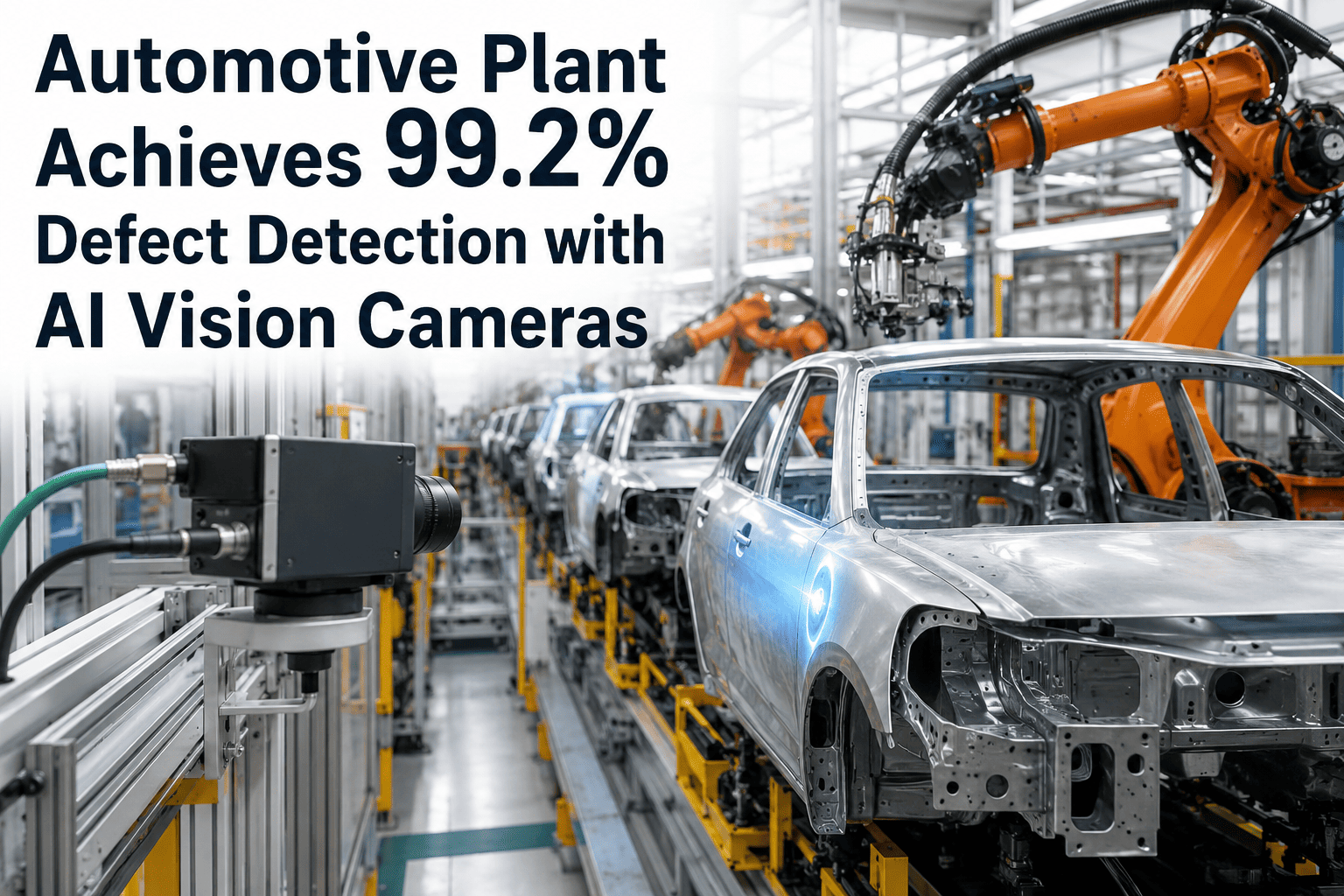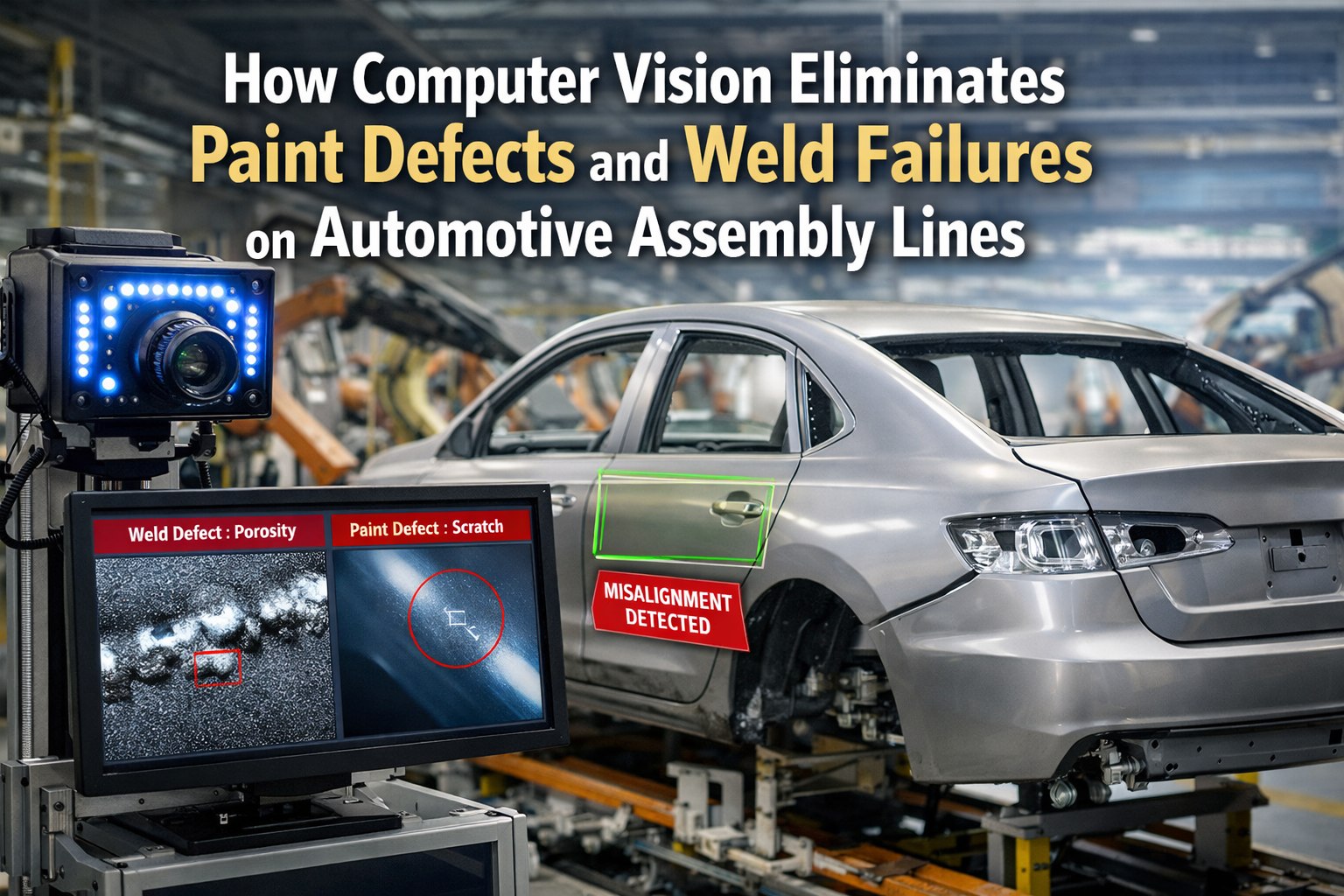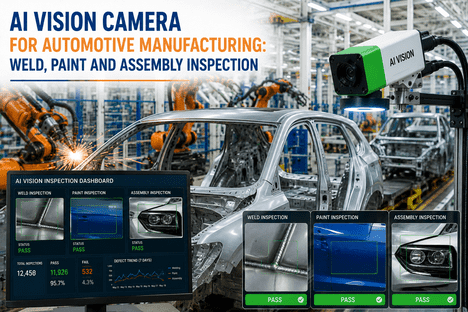
Automotive manufacturing operates at a quality tolerance that almost no other industry matches — a single weld defect, paint adhesion failure, or misassembled component can trigger a recall costing hundreds of millions of dollars and years of brand damage. AI vision cameras are now the production-floor standard for weld inspection, paint defect detection, gap and flush analysis, and assembly completeness verification at full line speed. BMW's AI Quality eXpert (AIQX) program — one of the most extensively documented automotive AI vision deployments — achieved a 37% reduction in defect escape rates across multiple plants by embedding AI cameras directly into body shop, paint shop, and final assembly stations. iFactory's AI Vision Camera platform brings the same class of visual intelligence to automotive manufacturers at any scale — connecting to existing ONVIF infrastructure with NVIDIA edge processing to deliver real-time defect detection without interrupting line throughput. Production quality engineers, plant managers, and procurement teams evaluating automotive AI vision programs are encouraged to Book a Demo with iFactory to assess deployment feasibility across their weld, paint, and assembly operations.
Why Automotive Manufacturing Demands AI Vision Inspection
Automotive quality control has historically depended on a combination of coordinate measuring machines, manual visual inspection, and statistical sampling — all of which share a fundamental limitation: they inspect a fraction of production output and detect defects after they have already propagated downstream. A weld missed at the body shop reaches the paint shop. A paint adhesion failure missed at final cure reaches the customer. Each inspection gap compounds into warranty claims, recall risk, and warranty reserve costs that directly affect vehicle program profitability. AI vision cameras eliminate the sampling constraint by providing 100% inspection coverage at every station where a camera is deployed — analyzing every unit, every cycle, every shift, with consistent detection thresholds that do not degrade with fatigue or shift changes. BMW's AIQX system demonstrated that continuous AI visual inspection at scale reduces defect escape rates by 37% — not by inspecting more units randomly, but by inspecting all units without exception.
Weld Inspection: Detecting Defects That Manual Methods Miss
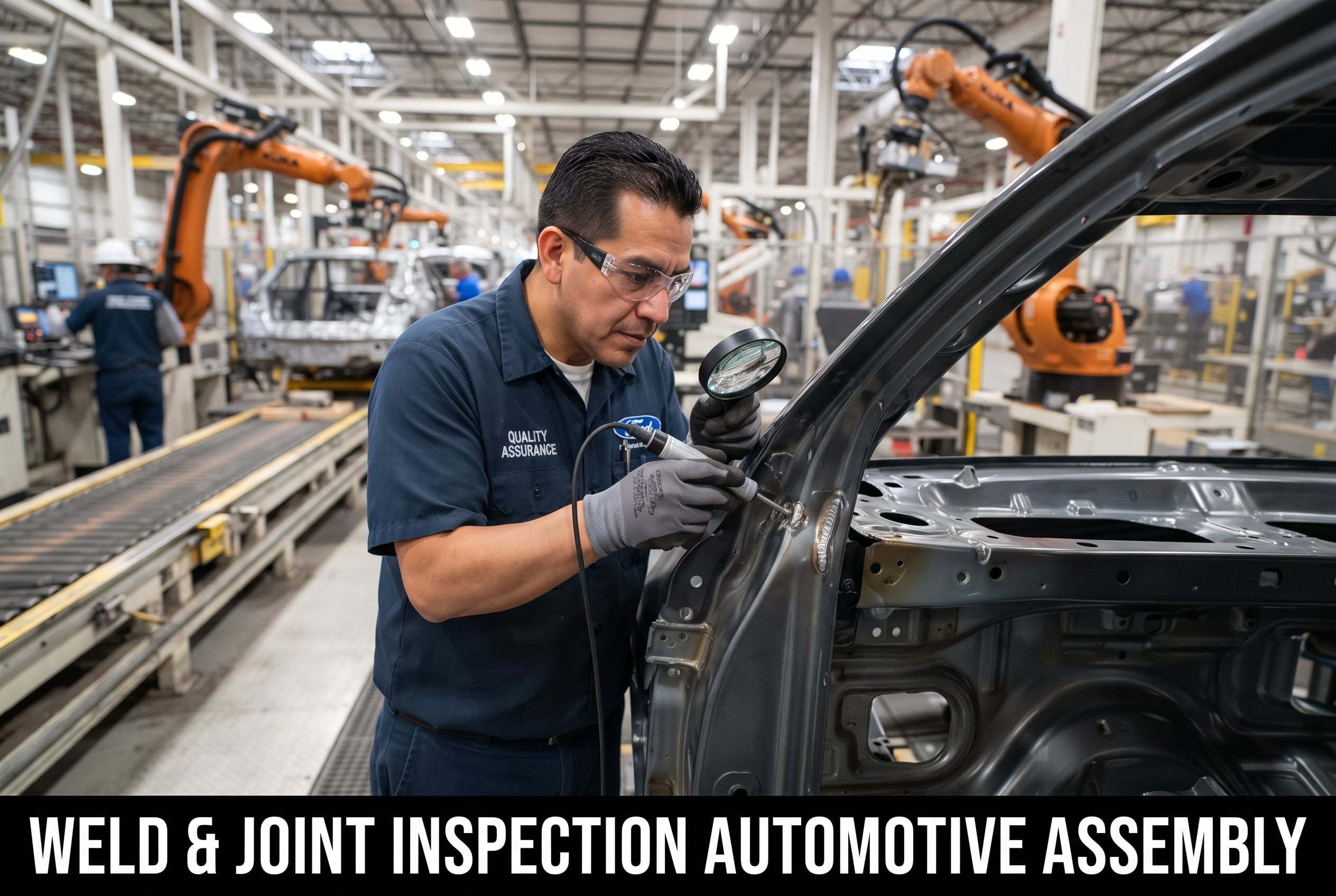
Weld quality is the structural foundation of every vehicle body. Spot welds, MIG welds, laser welds, and structural adhesive bonds must all meet precise geometry, penetration depth, and surface integrity specifications — across thousands of weld points per vehicle body. Human visual inspection cannot reliably detect subsurface porosity, undercut, incomplete fusion, or spatter patterns that indicate process drift before structural failure. iFactory's AI Vision Camera analyzes weld geometry, surface profile, and heat-affected zone characteristics in real time at each weld station, classifying welds against trained acceptance criteria without stopping the line. When the system detects a weld anomaly — spatter above threshold, irregular nugget geometry, or weld skip — it flags the specific weld point, logs the deviation with visual evidence, and triggers a CMMS work order for process review before the body moves to the next station. This early-station defect capture prevents downstream rework costs that multiply as a defective body progresses through paint and assembly.
Paint Defect Detection: From Surface Contamination to Adhesion Failure
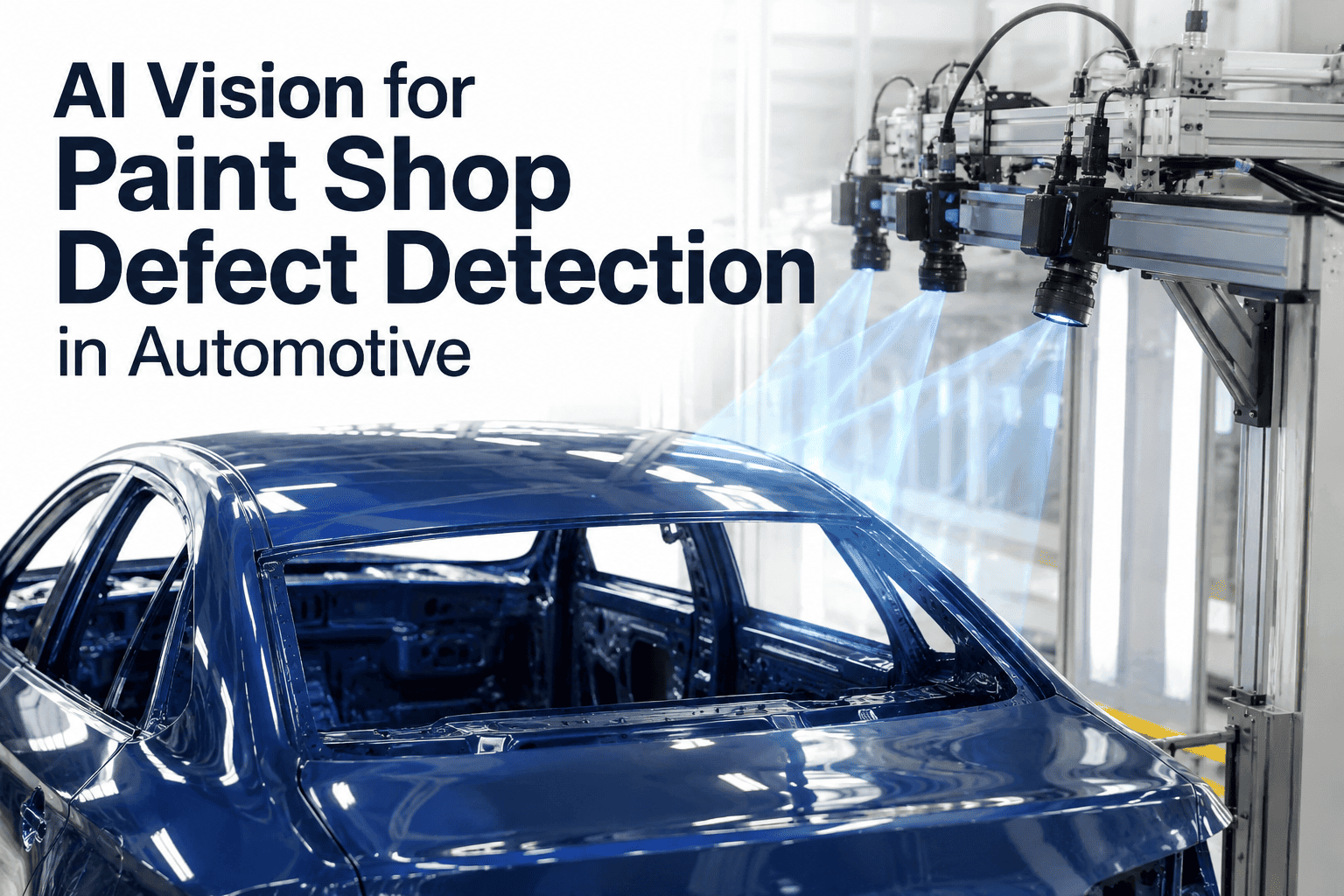
Paint quality failures are among the most visible and expensive defects in automotive manufacturing. Orange peel texture, fish-eye contamination, sag, runs, micro-blistering, and color variation are all difficult to detect consistently under production lighting and at line speed — yet each represents a rework event that can cost hours of labor and materials, or a customer-facing quality escape if it reaches final inspection. iFactory's AI Vision Camera deploys in paint booth exit zones and cure oven exits to analyze every panel surface under calibrated lighting conditions. Trained computer vision models detect surface anomalies down to sub-millimeter scale, classify defect type, and calculate affected surface area — providing paint shop supervisors with actionable data on defect location, severity, and probable cause before the vehicle enters the next build stage. Persistent defect patterns are automatically correlated to process parameters — booth temperature, humidity, spray gun pressure, and material batch — enabling root cause identification that reduces recurrence across future production runs. Quality teams evaluating AI paint inspection can Book a Demo to see defect classification performance benchmarks relevant to their paint process.
Gap and Flush Analysis: Precision Panel Alignment at Line Speed
Panel gap and flush measurement is one of the most quality-critical and time-consuming inspection tasks in automotive final assembly. Door-to-body gaps, hood-to-fender alignment, trunk lid flush, and bumper-to-body transitions must all fall within precise millimeter-range tolerances to satisfy both functional and aesthetic quality standards. Traditional gap and flush measurement requires dedicated CMM stations, skilled operators, and inspection time that creates a line bottleneck. AI vision cameras replace this bottleneck with continuous, non-contact measurement at every panel joint — without removing vehicles from the line. iFactory's platform uses structured-light photogrammetry and trained deep learning models to measure gap width and surface flush deviation in three dimensions, comparing each measurement against the vehicle's nominal specification and flagging values outside tolerance for immediate correction before the vehicle reaches end-of-line audit. This real-time feedback loop allows assembly operators to adjust panel setting parameters within the same production cycle, rather than discovering misalignment at audit and triggering disassembly rework.
Assembly Completeness Verification: Eliminating Missing-Component Escapes
Assembly completeness failures — missing fasteners, absent clips, unconnected harness connectors, and incorrect part variants — are among the most costly defect categories in automotive manufacturing because they are structurally invisible until a functional failure occurs. Standard visual inspection at end-of-line audit is insufficient to catch all completeness issues reliably, particularly in high-complexity vehicle programs where hundreds of components are installed across dozens of stations. iFactory's AI Vision Camera verifies assembly completeness at the station level — comparing the visual state of each assembly zone after operator completion against a trained reference model for the correct vehicle variant and build sequence. The system confirms fastener presence and seating, harness connector engagement, clip installation, and sub-assembly orientation in real time, flagging any deviation before the unit advances. Station-level verification ensures that missing-component defects are identified and corrected at the lowest possible cost point — at the station, not at audit, and not at the customer.
How iFactory AI Vision Camera Compares to Traditional Automotive Inspection
The operational gap between conventional automotive inspection methods and AI vision inspection is measurable across every key quality metric — from defect detection rate and inspection throughput to rework cost and compliance documentation.
| Inspection Area | Traditional Method | iFactory AI Vision Camera | Impact |
|---|---|---|---|
| Weld Quality Inspection | Manual visual and periodic destructive testing on sample welds | 100% weld coverage with real-time anomaly classification at line speed | Eliminates weld escapes; prevents downstream propagation |
| Paint Defect Detection | Human inspectors under booth lighting — subjective and fatigue-dependent | Sub-millimeter surface analysis on 100% of panels at paint exit | Consistent detection independent of shift, lighting, or inspector fatigue |
| Gap and Flush Measurement | CMM station with manual probe — bottleneck, sample-only coverage | Non-contact 3D measurement at every panel joint without line stoppage | Real-time correction within same production cycle; no audit rework |
| Assembly Completeness | End-of-line audit — defects found after full assembly cost maximum to rework | Station-level verification before unit advances to next operation | Missing-component catch at lowest rework cost point |
| Defect Documentation | Manual paper or tablet entry — incomplete, delayed, not traceable to unit | Automatic image capture, classification, and CMMS work order generation per unit | Full traceability per VIN; audit-ready compliance records |