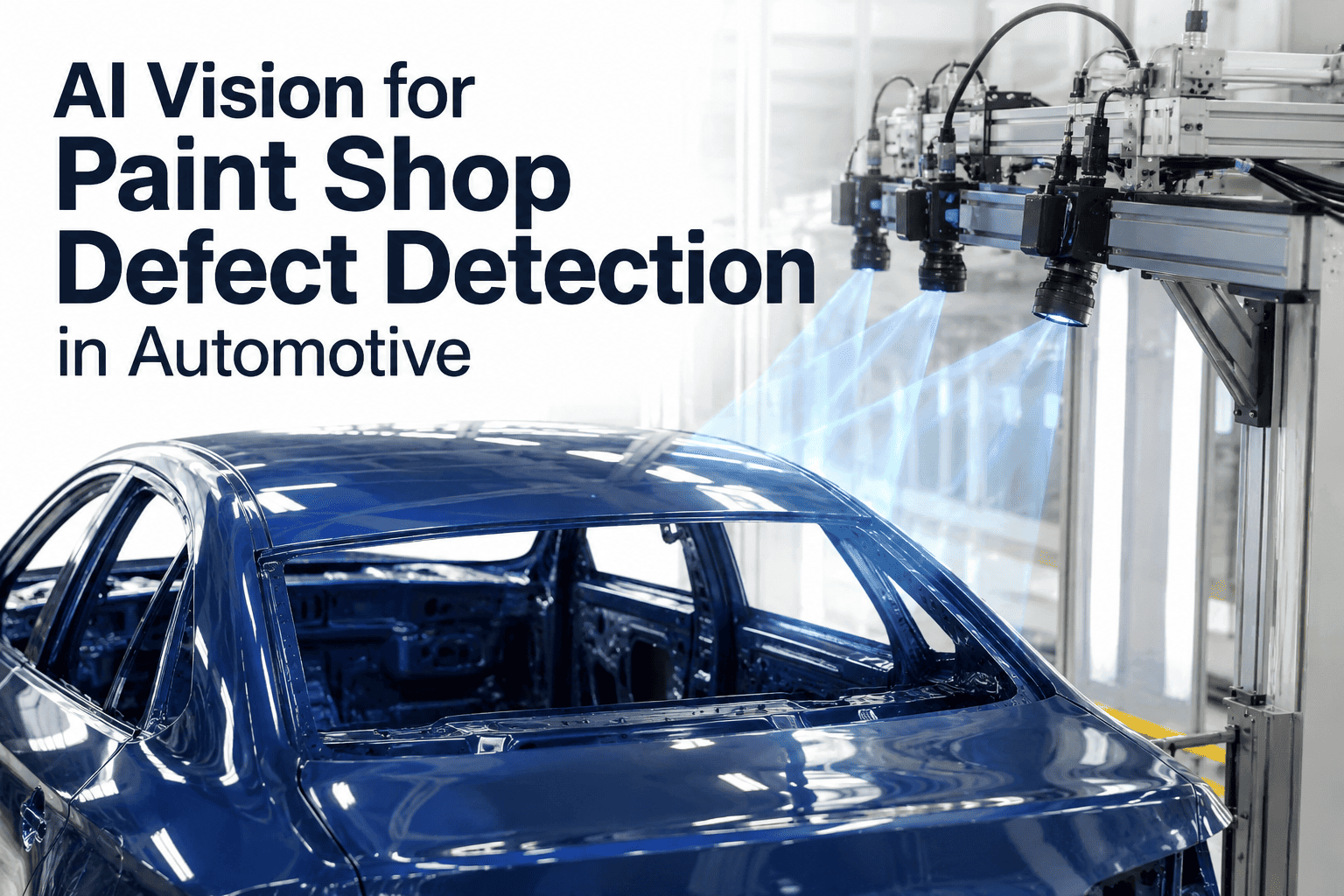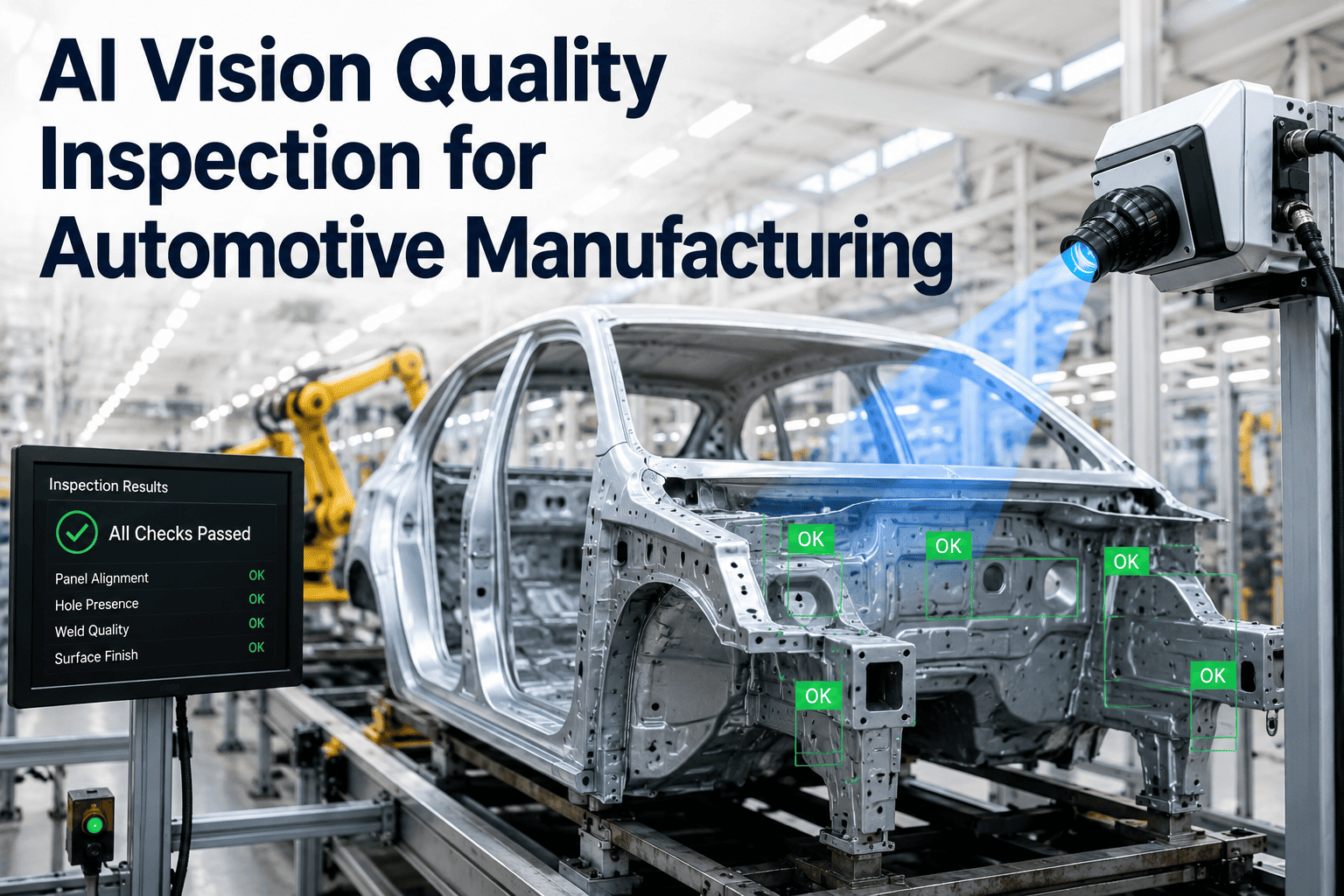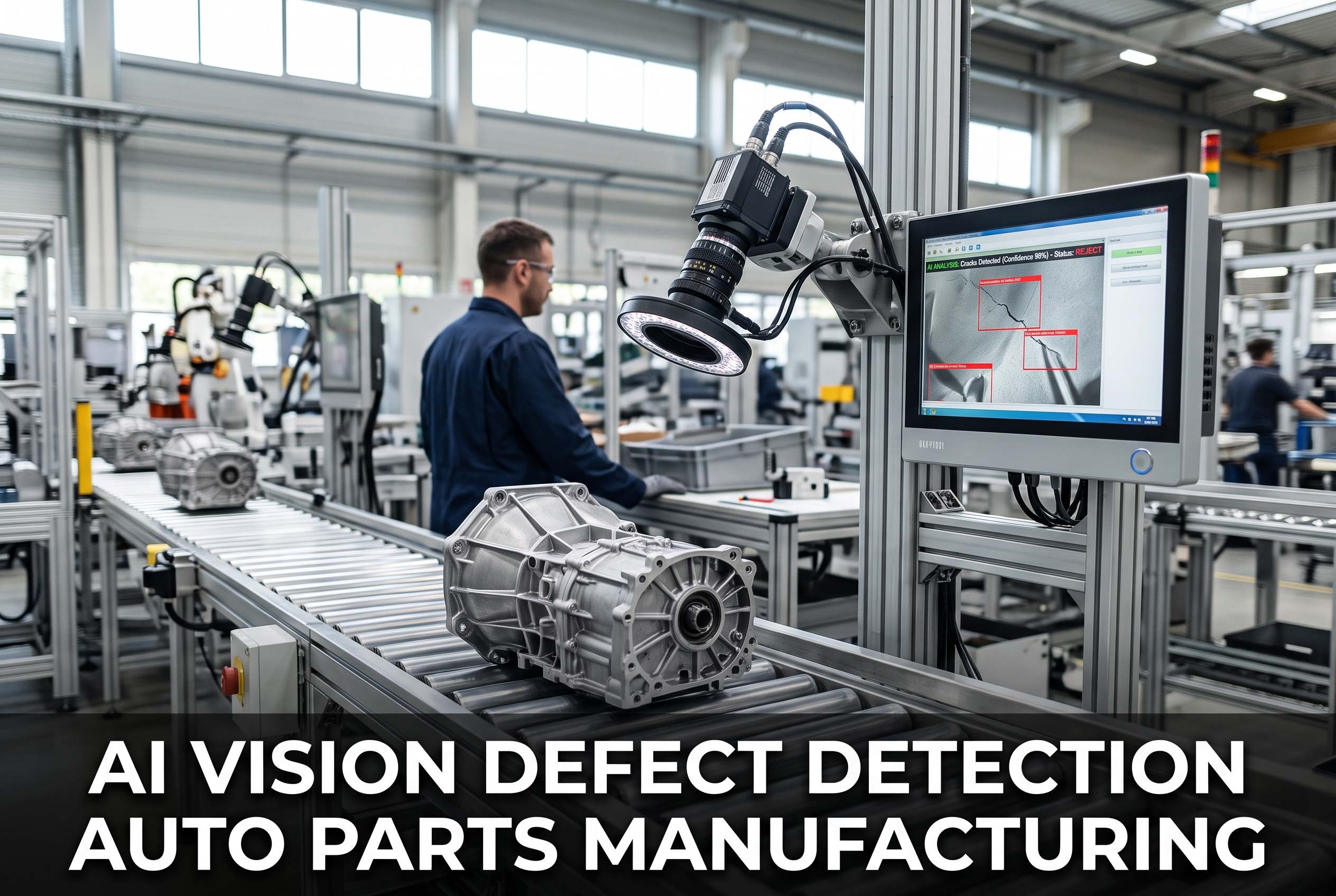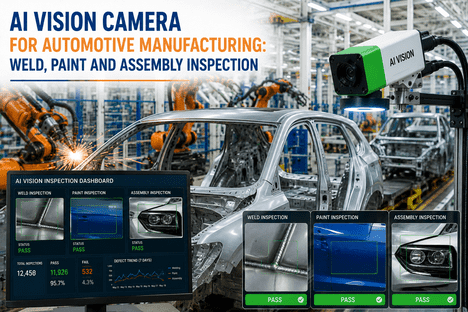
Your body shop runs 58 jobs an hour on the main line and every single car gets a six-second visual once-over by an operator who has been on shift since 5 a.m. By hour four, the miss rate on subtle defects climbs quietly — a door gap that is 1.2 mm out of spec, a missing weld nut behind the B-pillar reinforcement, a paint crater visible only under angled LED lighting. By the time the vehicle hits trim, the rework cost has tripled. AI vision defect detection changes that math by inspecting 100% of items in motion on the conveyor you already have — no slowing the line, no extra stations, no operator-dependent call rates — and routing every fail to pass, rework, or scrap before the next operation begins.
What a Six-Second Manual Inspection Actually Costs You
Manual end-of-line inspection leaks value in four places simultaneously — and most plants only measure one of them.
Defects That Escape to Trim
Subtle paint craters, panel misalignment, and missing fasteners pass manual stations and surface downstream — where rework labor is 3–5× more expensive and blocks trim throughput.
Good Parts Sent to Rework
Operators unsure of a call default to reject to protect themselves. Every false reject burns line time, rework labor, and material handling for a part that was fine.
Time Before a Process Drift Is Caught
A stamping die wearing, a robot weld gun losing calibration, or a paint bell drifting voltage produces a defect signature long before manual QC spots the trend.
No Image-Linked Batch Genealogy
When a field claim surfaces, paper checklists and a green-light stamp cannot tell you which specific units shared a suspect process window — so you recall a broad batch.
Recognize any of these patterns on your line? Book a defect-detection assessment and iFactory will map your escape rate against a single-line AI vision pilot.
What AI Vision Catches on an Automotive Assembly Line
AI vision defect detection on an automotive line is not one camera doing one job — it is a layered inspection architecture where each station is trained on the defect signatures specific to that operation. The system learns from your historical defect images and your rework logs, then inspects every unit at line speed. Below is what each station catches and the tolerance band it holds.
Not sure which defect categories are driving your rework hours? Book a defect-pareto workshop — iFactory will pull your last 90 days of rework tags and map them to the right vision stations.
How Automated Pass / Rework / Scrap Routing Works
The breakthrough is not the camera — it is the closed loop. When AI vision detects a defect, it does not just flag a screen for an operator. It writes a verdict directly to the Level 2 PLC or DCS, which routes the unit physically to the correct destination before the next operation touches it. This three-way routing is what separates a real production-grade vision system from a science-fair demo.
AI Vision Inference Engine
On-prem NVIDIA GPU processes images in under 200 ms. Defect class, severity, and location logged to MES via API.
Proceed to Next Operation
No defect or within tolerance. PLC releases the conveyor to advance. Image archived with unit ID for traceability.
ROUTING=PASSDivert to Rework Loop
Repairable defect identified. System writes defect type, location, and repair instruction to the rework station HMI. Unit re-inspected after repair.
ROUTING=REWORKDivert to Scrap Chute
Critical defect beyond economic repair. Scrap reason code auto-logged to QMS. MES triggers material replacement order to prevent line starvation.
ROUTING=SCRAPWant to see the PLC tag map for three-way routing on your specific line controller? Talk to an iFactory integration specialist about your Allen-Bradley, Siemens, or Mitsubishi PLC environment.
MES, ERP, and PLC Identity Mapping
A vision system that only flashes a red light is a toy. A production-grade AI vision defect detection system ties every image, every verdict, and every defect signature to a specific vehicle identification number, a specific batch of paint, a specific robot cell, and a specific operator shift. That identity chain is what makes automated root-cause analysis possible — and what turns inspection data into process improvement.
ERP — Business Identity
Production order number, VIN, build sequence, option content, and supplier lot for key materials. iFactory pulls this via REST API so every image is tagged to the correct build order.
MES — Execution & Genealogy
Batch genealogy, routing rules, work instructions, and operator assignments. Vision verdicts write back here, triggering rework routings and QMS nonconformance reports automatically.
PLC / DCS — Real-Time Control
Conveyor position, robot cycle status, oven temperature, paint bell voltage. iFactory captures these tags synchronously with each image so a defect can be traced to the exact process parameter that produced it.
AI Vision — Inspection & Inference
On-prem NVIDIA GPU inference, edge image capture, defect classification, and verdict publishing. No cloud round-trip — every decision is made in under 200 ms on the factory floor.
Running a legacy MES or a homegrown execution system? Book an integration scoping call — iFactory connects to SAP, Oracle, Plex, Epicor, and custom MES via standard APIs.
Measured Impact on First-Time-Through and Scrap Cost
The metrics that justify an AI vision investment are not abstract AI accuracy percentages — they are first-time-through (FTT) rate, scrap cost per unit, rework labor hours, and warranty claim exposure. Below is a before-and-after comparison drawn from typical automotive assembly deployments where iFactory AI vision was retrofitted to an existing body or paint line.
Manual Inspection + End-of-Line Audit
- 82% first-time-through rate
- 2.1% scrap rate at end of body shop
- 14% of units needing some form of rework
- 4.2 hr average detection lag for process drift
- 1–2% sampling rate for audit traceability
- $3.40 rework cost per unit (blended average)
100% Inline AI Inspection + Auto-Routing
- 94% first-time-through rate
- 0.6% scrap rate at end of body shop
- 5% of units needing rework (caught early)
- < 5 min detection lag for process drift
- 100% unit-level image traceability
- $1.10 rework cost per unit (blended average)
first-time-through improvement within 90 days of go-live on a retrofitted body shop line
reduction in scrap cost per unit when defects are caught at the source station vs. end-of-line
inference latency on-prem NVIDIA GPU — no cloud round-trip, no line-speed compromise
inspection coverage vs. 1–2% manual audit sampling — every unit, every station, every shift
Want an ROI worksheet built from your line's actual JPH, rework hours, and scrap cost? Book a 30-minute ROI scoping call and iFactory will deliver a fixed-price pilot proposal.
Retrofit AI Vision to Your Existing Line in 8 Weeks
iFactory deploys on-prem NVIDIA GPU inference, cameras, lighting, and PLC integration on a single body or trim line — with full MES/ERP identity mapping and automated pass/rework/scrap routing. Fixed price. Fixed timeline. Measurable FTT improvement before you scale.
The 8-Week Single-Line Pilot: What Happens and When
A fixed-price pilot is how you prove AI vision defect detection works on your line, with your defect signatures, at your throughput — before committing to a plant-wide rollout. iFactory scopes the pilot to one line, one or two inspection stations, and a defined set of defect classes. Here is the week-by-week breakdown.
Defect Discovery & Line Walk
iFactory engineers walk the line, pull 90 days of rework and scrap data, and identify the top defect classes driving cost. Camera positions, lighting angles, and conveyor speed constraints documented.
Image Capture & Model Training
Temporary cameras capture 5,000–10,000 images of good and defective units. Deep learning model trained on your specific defect signatures — not a generic library. Baseline accuracy validated offline.
Hardware Install & GPU Deployment
Permanent cameras, LED lighting, and on-prem NVIDIA GPU inference cabinet installed during scheduled maintenance windows. No line stoppage required. Network and PLC tag mapping configured.
MES/ERP Integration & Shadow Mode
API connections to MES and ERP established. System runs in shadow mode — inspecting and logging verdicts alongside manual QC without controlling routing. Accuracy benchmarked against manual calls.
Live Routing Activation
Three-way pass/rework/scrap routing goes live to the PLC. Operators trained on rework station HMI. Daily accuracy and escape-rate reviews with quality team for the first five production days.
Impact Report & Scale Plan
iFactory delivers a measured impact report — FTT delta, scrap cost delta, rework hours delta, and detection-lag improvement — plus a fixed-price proposal to scale to additional lines or stations.
Ready to scope a pilot on your highest-rework line? Book a pilot scoping session or talk to a specialist about your line's constraints.
Expert Perspective
We spent three years trying to fix body-shop escapes with more inspectors and tighter SPC charts. The problem was never inspection effort — it was that a manual call at station 4 does not tell the robot at station 12 that its weld gun is drifting. Once the vision system started writing defect data back to the PLC tags, our maintenance team started fixing the root cause before the next shift started. That is the real ROI. The scrap reduction is just the bonus.
— Plant Manager, Tier 1 automotive body & assembly facility (Ohio, 240,000 units/year)
from line walk to live routing on a single-station pilot — no line stoppage required
first-time-through rate achieved within 90 days of pilot go-live on a retrofitted body shop
rework cost saved per unit when defects are caught at source vs. end-of-line discovery
Stop Leaking Margin to End-of-Line Rework
AI vision defect detection from iFactory inspects 100% of units in motion, routes every fail automatically, and writes every verdict to your MES — so your quality team fixes root causes instead of chasing symptoms. Start with one line. Prove the ROI. Then scale.
Frequently Asked Questions
Can AI vision defect detection be retrofitted to an existing automotive assembly line without replacing conveyors or robots?
Yes. iFactory designs camera brackets, LED lighting enclosures, and GPU inference cabinets to fit your existing conveyor structure, skillet line, or robot cell — no conveyor replacement or line redesign required. Hardware installation is typically completed during scheduled maintenance windows over two to three shifts, with no production stoppage. The system reads your existing PLC tags for conveyor position and part identity, so integration is additive rather than disruptive.
How does the system handle three-way pass, rework, and scrap routing on the plant floor?
When the AI inference engine reaches a verdict, it writes a routing command directly to the Level 2 PLC or DCS via OPC-UA or EtherNet/IP. The PLC controls the physical diverter, reject arm, or rework loop conveyor. Pass units proceed to the next operation, rework units are diverted to a repair station with defect-specific instructions displayed on the HMI, and scrap units are routed to a scrap chute with an automatic reason code logged to the QMS. The entire decision loop takes under 200 milliseconds — fast enough for lines running 60–120 jobs per hour.
What defect types can AI vision detect on automotive body and paint lines?
On paint lines, the system detects craters, orange peel, runs, sags, dirt inclusions, color mismatch, mottling, and scratches as small as 0.3 mm. On body lines, it measures gap and flush to ±0.5 mm accuracy, detects missing or undersized welds, missing fasteners, weld spatter, and sealer bead deviations. On trim lines, it verifies glass positioning, clip engagement, label presence, VIN readability, and interior trim defects. Models are trained on your specific defect images — not a generic library — so accuracy is benchmarked against your real production signatures.
Does the system require cloud connectivity, or does inference run on-premises?
All inference runs on-premises on NVIDIA GPU hardware installed in your facility. No images leave the plant, and no cloud round-trip is required for any inspection decision. This keeps latency under 200 milliseconds, eliminates network-dependency risk on the production line, and satisfies IT security and data-residency requirements common in automotive OEM and Tier 1 environments. Cloud connectivity is optional — used only for remote model updates and aggregated reporting if your IT policy permits it.
How does iFactory integrate AI vision with our existing MES, ERP, and QMS systems?
iFactory connects to your MES (SAP DM, Plex, Epicor, Epicor Mattec, or custom), ERP (SAP, Oracle, Dynamics), and QMS via standard REST APIs, OPC-UA, or direct database integration depending on your architecture. Every inspection verdict is tagged with the vehicle identification number, production order, batch genealogy, and PLC process parameters active at the moment of inspection. This enables automated root-cause analysis — when a defect spikes, the system can trace it to a specific robot cell, paint bell voltage, or material lot within minutes. Book an integration scoping call to map iFactory against your specific system stack.