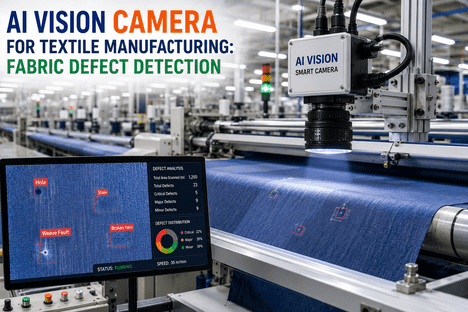
Textile manufacturers in 2026 operate in a margin environment where a single percentage point of defect-driven fabric loss can determine whether a production run is profitable. Grading labor remains one of the largest controllable cost centers on a weaving or knitting floor, manual inspectors fatigue within hours and miss defects that a fresh set of eyes would catch, and every roll that ships with an undetected hole, stain, or weaving fault converts into a customer claim that costs far more to resolve than the original defect would have cost to catch. Traditional black-light and stroboscopic inspection frames have not changed meaningfully in decades, while production speeds, fabric variety, and buyer quality expectations have all increased. AI Vision Camera systems purpose-built for fabric and textile defect inspection are the technology infrastructure that mills, garment manufacturers, and technical textile producers are deploying in 2026 to close this gap — detecting weaving faults, stains, holes, and color variation at full production speed, with the consistency that human grading cannot sustain across an eight-hour shift. Textile producers ready to see what continuous AI-driven fabric inspection looks like on their own looms can Book a Demo of iFactory's Vision Defect Detection platform today.
Why Manual Fabric Grading Cannot Keep Pace With Modern Textile Production
The Structural Limits of Human Visual Inspection on the Production Floor
Fabric grading has historically depended on human inspectors standing at backlit or strobe-lit inspection frames, scanning rolls for defects as they pass at line speed. The method is fundamentally limited by human visual endurance: attention quality measurably declines within the first two hours of a shift, and the defects most likely to be missed are exactly the ones that matter most to buyers — subtle color shading, faint stains, and small holes that blend into pattern or texture. Traditional inspection practice compounds this by sampling rather than fully covering every roll, accepting statistical risk because 100% manual coverage is not economically viable at production speed. The result is a quality control gap that surfaces downstream as customer claims, markdowns, and second-quality designations — each of which costs a multiple of what catching the defect at the loom would have cost. AI vision inspection eliminates the fatigue curve entirely: a camera system inspects roll one and roll one thousand with identical attention, at line speed, with full-width coverage rather than sampled coverage.
The Defect Categories AI Vision Detects Across the Textile Production Chain
From Weaving Faults to Finishing-Stage Defects — Full Production Chain Coverage
How AI Vision Defect Detection Fits Into the Textile Production Workflow
Continuous Inspection From Loom to Finished Roll — Not a Separate Inspection Station
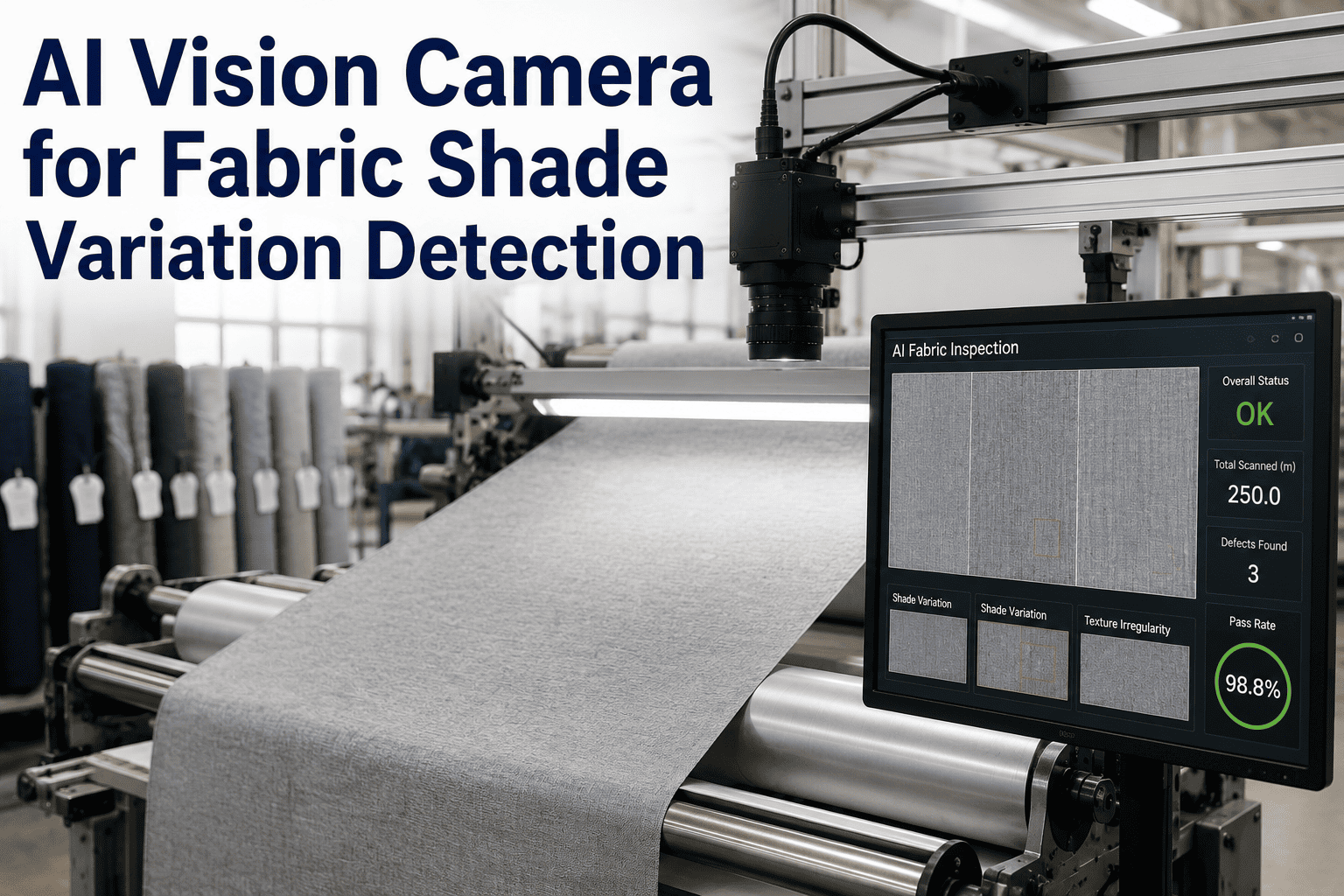
The most significant limitation of traditional fabric inspection is that it happens as a discrete, separate step — fabric is produced, then later transported to an inspection frame, then graded by a human inspector working through accumulated rolls. Every hour between production and inspection is an hour during which a defect-producing fault on the loom continues generating defective fabric undetected. iFactory's AI Vision Monitoring module is deployed directly at the point of production — mounted at the loom, knitting machine, dyeing line, or finishing line — delivering continuous, full-width visual coverage that generates a defect alert and roll-position record the moment a fault occurs, not hours or shifts later. This shifts fabric inspection from a downstream quality gate to a real-time production control signal, allowing operators to correct a weaving fault before it propagates across the remaining length of a roll rather than discovering it only after the entire roll has been woven. Mills and finishing operations evaluating how continuous inline inspection compares to their current end-of-line grading process regularly Book a Demo to see iFactory's AI vision system running against representative fabric samples from their own production.
The 5 Ways AI Vision Is Changing Fabric Quality Control in 2026
What Modern Textile Quality Programs Expect From an Inspection Platform
iFactory AI Vision Coverage Across the Textile Production Chain
What iFactory Detects Per Production Stage — Inline, Continuous, Full-Width
| Production Stage | Common Defect Risk | iFactory AI Vision Capability | Quality Outcome |
|---|---|---|---|
| Weaving / Knitting | Broken ends, missing picks, slubs, misaligned threads | Real-time thread-level fault detection with exact roll-position flagging | Fault correction before propagation |
| Dyeing | Shade banding, lot-to-lot color drift, uneven dye uptake | Continuous colorimetric analysis across full fabric width | Shade consistency verified in real time |
| Printing | Registration error, print smearing, pattern misalignment | Live comparison against intended pattern geometry | Print defects flagged before lot completion |
| Finishing | Surface contamination, stains, oil marks, texture faults | Full-width stain and contamination detection at line speed | 100% surface coverage, not sampled checks |
| Final Roll Inspection | Holes, tears, accumulated defects across roll length | Automated full-roll grading with defect map and severity log | Defensible, timestamped grading record |
What iFactory's AI Vision Architecture Delivers for Textile Quality Programs
Edge-Deployed, Full-Width Coverage, Built for Production Floor Conditions
Textile production environments place specific demands on a vision inspection system that differ from quality inspection in other manufacturing sectors. Fabric moves continuously at high speed, surface texture and pattern variation make defect detection against a moving, non-uniform background inherently more difficult than static part inspection, and the sheer variety of fabric types, weights, weaves, and colors that a single mill may run across a production week requires a platform that can switch between inspection profiles without engineering involvement at every changeover. iFactory's AI vision architecture is built around these constraints directly — edge-deployed processing analyzes every frame on local hardware without cloud latency in the defect-alert path, full fabric-width camera coverage eliminates the blind spots inherent in single-point or sampled inspection, and a multi-profile model library allows quality teams to switch between fabric types and defect specifications as production changes over, without requiring AI engineering support for every new style or color run.
Conclusion: Fabric Quality Control Is a Production Control Problem, Not Just an Inspection Problem
The textile mills and finishing operations carrying the lowest claim rates and the lowest grading labor cost per meter in 2026 are not the ones with the most inspectors — they are the ones that have moved defect detection upstream, to the point of fault occurrence, rather than downstream to a separate grading station working through accumulated production. Weaving faults, stains, holes, color variation, and print defects are all visually detectable conditions; the limiting factor has never been whether the defect is detectable, but whether the inspection method can catch it consistently, at full production speed, across every meter of every roll. iFactory's AI Vision Camera platform closes exactly this gap — converting fabric inspection from a labor-intensive sampling exercise into a continuous, full-coverage production control signal that catches defects at the source and generates the documented grading record that both internal quality teams and buyers require. For mills and textile manufacturers ready to reduce grading labor and claims exposure simultaneously, the most effective next step is to Book a Demo and walk through a pilot scope on your own production lines.
Frequently Asked Questions
What fabric defect types can iFactory's AI vision system detect?
iFactory's Vision Defect Detection platform identifies weaving and knitting structural faults including broken ends, missing picks, and slubs; holes, tears, and surface punctures; stains, oil marks, and contamination; color variation and shade banding across roll width; and pattern misalignment or print registration errors. Each defect type uses a model trained on the specific visual signature of that fault category, with detection thresholds calibrated to the fabric type and buyer quality specification in use.
Can iFactory's AI vision system handle the fabric variety typical in a mill running multiple product lines?
Yes — high-mix fabric production is directly addressed in iFactory's deployment architecture. The multi-fabric model library supports multiple simultaneously active inspection profiles, with production-order-triggered automatic switching that activates the correct inspection configuration — weave type, color reference, defect specification — for each fabric style without requiring quality engineer or AI specialist involvement at every changeover.
Where in the production line is iFactory's AI vision system typically deployed?
iFactory's AI vision cameras are deployed directly at the point of production — mounted at the loom or knitting machine, the dyeing line, the printing line, and the finishing line — rather than only at a separate end-of-line inspection station. This inline placement allows defects to be flagged the moment they occur, giving operators the opportunity to correct the underlying cause before additional defective fabric is produced, in addition to generating a complete defect map for the finished roll.
How does AI vision inspection reduce customer claims compared to manual grading?
Manual grading relies on sampled coverage and is subject to inspector fatigue, both of which allow defects to reach the customer undetected. iFactory's AI vision system inspects every meter of every roll at consistent detection thresholds regardless of shift length, eliminating the coverage gaps and fatigue-driven misses that are the most common root cause of claims discovered after shipment. The automated defect map and grading record generated for each roll also gives quality teams the documented evidence needed to resolve disputed claims quickly when they do occur.
What does a turnkey AI vision pilot for textile inspection typically involve?
A turnkey pilot covers imaging environment assessment at the selected production line, camera and lighting configuration for the specific fabric types being run, model development and validation against representative defect samples, shadow-mode validation alongside existing manual grading, and live defect-alert commissioning. The pilot can be scoped to the single production line or fabric type generating the highest current claim volume, with results used to define the rollout plan for additional lines. Book a Demo to discuss the pilot scope appropriate for your mill or finishing operation.