Traditional machine vision has powered factory inspection for three decades, relying on pixel-counting algorithms, edge detectors, and hardcoded rules written by engineers for every specific defect. The approach works when the environment is perfectly controlled and the defect is precisely predictable. The moment lighting shifts, texture varies, or a new type of flaw appears, the rules break down and the system needs a programmer to write new ones. Deep learning AI vision learns from images instead of rules, generalizes across natural variation, and adapts to new defect types by retraining on examples rather than rewriting code. The performance gap between these two approaches has reached a point where the economics and accuracy advantages of AI are no longer debatable — and understanding why that gap exists is the first step to deciding whether your inspection system is ready for an upgrade.
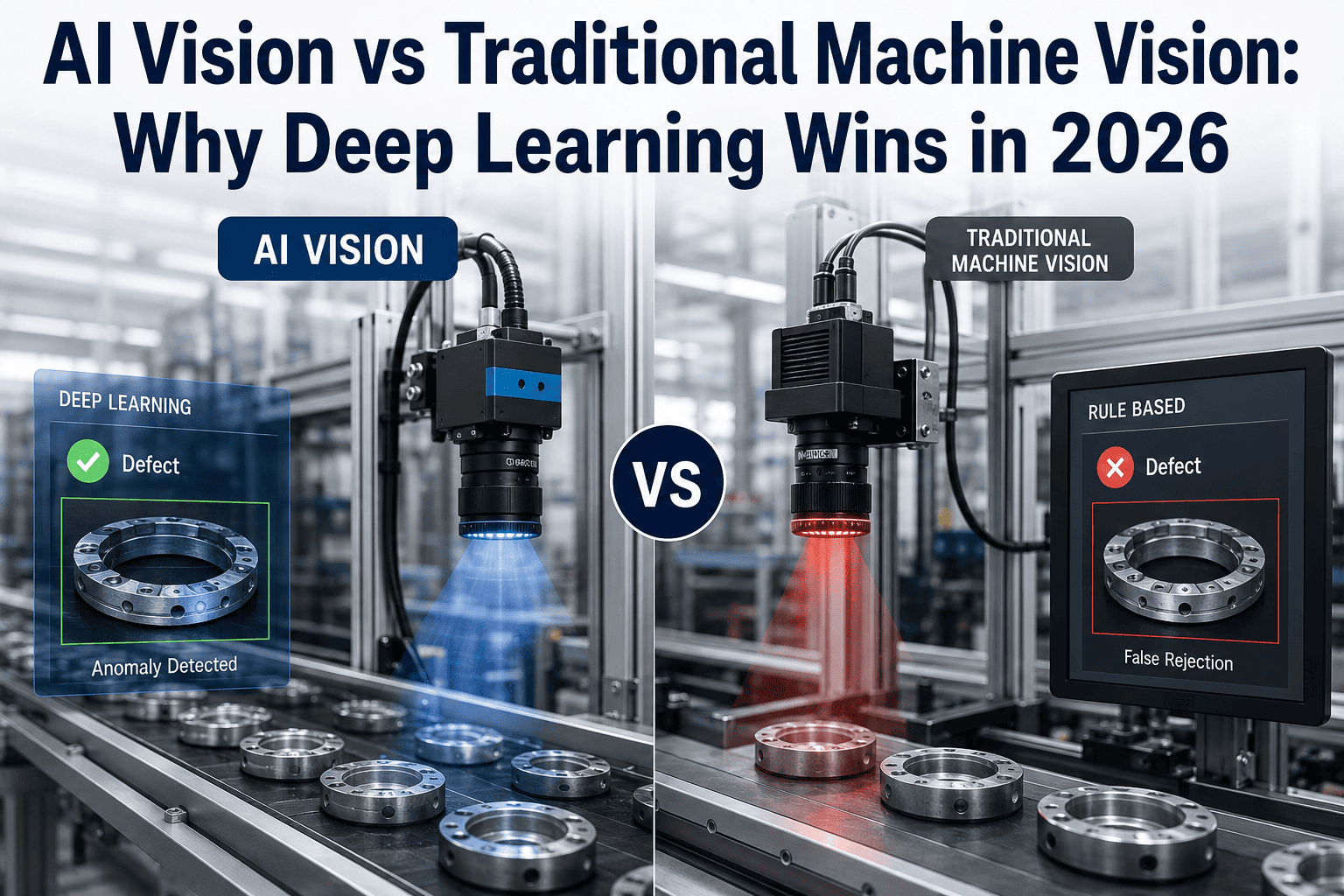
Traditional Machine Vision
Rules, Filters, and Thresholds
Hardcoded algorithms that match exact patterns, measure fixed dimensions, and apply rigid pass-fail thresholds programmed by engineers.
New defect setup2-6 weeks
Accuracy with variation55-78%
Maintenance per year80-160 hrs
Adaptability scoreLow
AI Deep Learning Vision
Examples, Training, and Inference
Neural networks that learn defect patterns from image examples, generalize across variation, and improve with more data.
New defect setup1-3 days
Accuracy with variation94-99%
Maintenance per year20-40 hrs
Adaptability scoreHigh
The Core Difference: How Each System Decides
The fundamental distinction is not speed or hardware — it is how the system arrives at a pass or fail decision. Traditional vision runs a sequence of programmed steps: apply a filter, find an edge, measure a distance, compare to a threshold. Each step is explicit and deterministic, which means the engineer must anticipate every possible variation and write a rule for it. Deep learning vision feeds the image through a neural network that has learned statistical patterns from thousands of labeled examples. The network does not follow explicit rules — it recognizes patterns the way a trained inspector does, by experience rather than by checklist. This difference in decision-making architecture is what makes AI vision dramatically more flexible and more accurate in real-world factory conditions.
Decision Flow: Rules vs Neural Networks
Traditional Rule-Based
1
Engineer writes explicit rules for each defect type
2
Camera captures image and applies pixel-level filters
3
Edge detection, blob analysis, template matching executed
4
Measurements compared to fixed thresholds
5
Pass or fail — fails if any rule triggers
AI Deep Learning
1
Model trained on thousands of labeled defect images
2
Camera captures image with no preprocessing needed
3
Neural network extracts features across multiple layers
4
Pattern recognition produces confidence scores per class
5
Pass or fail with confidence level and defect classification
Where Traditional Vision Still Has a Role
Deep learning is not universally superior in every single inspection task. Traditional rule-based vision remains the right tool for highly deterministic, low-variation applications where the inspection criterion is a simple measurement or binary presence check. Reading a 1D barcode, verifying that a cap is on a bottle, or checking that a hole exists at a fixed coordinate — these are tasks where a few lines of code outperform a neural network in speed, simplicity, and transparency. The breakdown happens when the task involves surface quality judgment, complex defect patterns, or any environment where variation is the norm rather than the exception. The visual below maps which approach fits which type of inspection task, so you can see where your current system falls on the spectrum.
Task-to-Technology Fit Map
Traditional Vision Fits
Barcode and 2D code reading
Presence/absence verification
Fixed-dimension measurement
Color matching in controlled light
Alignment checks with fixed reference
AI Vision Fits
Surface scratch and defect detection
Foreign object identification
Weld and solder joint quality
Texture and pattern variation
Complex assembly verification
If your inspection involves any judgment call that a human would describe as "it looks wrong" rather than "it measures wrong," AI vision is the correct technology.
Six Dimensions Where Deep Learning Surpasses Rules
The advantage of AI over traditional vision is not a single factor — it is a combination of capabilities that compound in real-world deployment. Each dimension below represents a measurable gap between the two approaches, drawn from published benchmark studies and documented industrial deployments of deep-learning inspection systems between 2022 and 2025.
Handling Natural Variation
Lighting shifts, texture changes, and position drift cause rule-based thresholds to fail. Neural networks trained on varied examples maintain accuracy across all of these.
New Defect Onboarding Speed
Adding a new defect type to rules requires weeks of programming and testing. Adding it to a neural network requires collecting images and retraining — typically 1 to 3 days.
Complex Surface Defect Detection
Scratches on brushed metal, subtle discoloration, and overlapping defect patterns defy pixel-level rules but are exactly the patterns deep learning excels at recognizing.
Ongoing Maintenance Effort
Rule systems need constant threshold tuning as conditions drift. AI models need periodic retraining with new data, but the effort is 60 to 75 percent lower on an annual basis.
Scalability Across Product Variants
Each new product variant on a rule system often means a new recipe with new thresholds. AI models generalize across variants and need only incremental training data.
False Positive Management
Rigid thresholds either over-reject good parts or under-reject bad ones. Confidence-scored AI classification allows precise tuning of the accept-reject boundary.
Every dimension where traditional vision struggles is a dimension where your defective parts escape inspection, your good parts get falsely rejected, or your engineers spend weeks tuning thresholds that drift again next month. See what deep learning catches that your current system misses.
Book a 30-minute demo and bring your hardest inspection challenge.
Accuracy Under Real-World Factory Conditions
Laboratory benchmarks consistently show traditional vision achieving 95 percent or higher accuracy. Factory floors tell a different story. The moment you introduce variable ambient light, slight part positioning differences, surface texture variation from batch to batch, or the gradual degradation of lighting fixtures, rule-based accuracy deteriorates. Deep learning models trained on images captured under those real conditions maintain their accuracy because they have learned to separate defect features from background variation. The chart below maps detection accuracy for both approaches across the conditions that actually exist on production lines.
Detection Accuracy by Factory Condition
Slight lighting variation
Texture and surface variation
Completely new defect type
Low-contrast surface defects
The gap widens as conditions move away from the ideal — exactly the conditions where defects are most likely to occur and most costly to miss.
Total Cost of Ownership: Three-Year Projection
Comparing the purchase price of a vision system misses the full picture. The real cost includes engineering time to set up and tune, ongoing maintenance as conditions drift, the cost of false rejects that waste good parts, and the opportunity cost of delayed production when a new product or defect type requires weeks of reprogramming. Deep learning systems have a higher initial training investment but dramatically lower ongoing costs because adaptation is faster, maintenance is lighter, and false reject rates are lower. The table below models the three-year total cost for a typical multi-line deployment, based on documented industry cost data from vision system integrators.
| Cost Category |
Traditional Vision |
AI Deep Learning |
| Initial hardware and software |
$45,000 - $80,000 |
$50,000 - $90,000 |
| Engineering setup and programming |
$30,000 - $60,000 |
$15,000 - $30,000 |
| Annual maintenance and tuning |
$25,000 - $50,000/yr |
$8,000 - $18,000/yr |
| New product onboarding (per variant) |
$5,000 - $15,000 |
$1,000 - $3,000 |
| False reject cost (annual waste) |
$20,000 - $80,000/yr |
$5,000 - $20,000/yr |
| 3-Year Total Cost of Ownership |
$195,000 - $430,000 |
$94,000 - $204,000 |
Real-World Scenarios: Side by Side
Abstract comparisons become concrete when you look at specific inspection tasks. The following scenarios are drawn from common manufacturing applications where facilities have evaluated or deployed both approaches. In each case, the inspection challenge involves the kind of variation that separates a controlled lab from a real factory floor — and the results show why the industry is shifting toward deep learning for any task that involves visual judgment rather than pure measurement.
Scratch Detection on Brushed Aluminum
Traditional
High false-reject rate
Edge detectors cannot distinguish between the brushed texture pattern and an actual scratch. Thresholds set to catch real scratches also flag normal texture, causing 15-25% false rejects that waste good parts.
AI Vision
99.2% accuracy, 1.5% false reject
Model trained on both normal brushed texture and actual scratches learns the difference intuitively. Distinguishes defect from background pattern regardless of lighting angle or brush direction variation.
Foreign Object in Bulk Material Flow
Traditional
Misses 40-60% of objects
Color and size filters fail when the foreign object is similar in color to the bulk material or partially buried. Metal detectors miss non-metallic objects like wood and plastic.
AI Vision
94-98% detection rate
Object detection model trained on varied foreign objects in material context recognizes shape, texture, and contextual anomalies that filters cannot define, even when partially obscured.
Solder Joint Quality on PCB Assembly
Traditional
Requires reprogramming per board
Template matching works for one board layout but fails when component placement shifts, solder paste volume varies, or board reflectivity changes. Each new PCB design needs a new inspection program.
AI Vision
Generalizes across board designs
Model learns what a good and bad solder joint looks like regardless of board layout. New designs need only representative images for fine-tuning, not a full reprogramming cycle.
The Migration Path: From Rules to Learning
Moving from traditional vision to AI does not require ripping out existing infrastructure. Most facilities migrate incrementally, starting with the inspection tasks where rule-based systems are failing most visibly and expanding from there. The typical migration follows a structured path from audit to full deployment, with each stage producing measurable improvement before the next begins.
Five-Stage Migration from Rules to AI
1
Audit
Week 1-2
Map all current vision tasks, identify where rules are failing, and rank by impact on quality and cost
2
Pilot
Week 3-6
Deploy AI vision on the single highest-impact checkpoint, running in parallel with existing rules for validation
3
Validate
Month 2-3
Compare AI detection rate against manual inspection baseline, measure false positive and false negative rates
4
Replace
Month 3-4
Switch the pilot checkpoint fully to AI, decommission the rule-based recipe, document the performance delta
5
Scale
Month 4-12
Expand AI vision to additional checkpoints and lines, building a shared model library across the facility
Frequently Asked Questions
Is deep learning vision really more accurate, or is it just marketing?
The accuracy advantage is well-documented in peer-reviewed research and industrial benchmark studies. In controlled conditions with zero variation, traditional vision and AI vision both achieve high accuracy. The gap appears the moment you introduce the kind of variation that exists on every real factory floor: lighting changes, surface texture differences, part positioning drift, and new defect types that were not anticipated during setup. Published benchmarks consistently show traditional vision accuracy dropping to 55 to 78 percent under realistic variation, while deep learning maintains 94 to 99 percent accuracy under the same conditions. The reason is structural — neural networks learn to separate defect features from background variation during training, while rule-based systems have no mechanism to handle variation they were not explicitly programmed for.
We can demonstrate this gap on your own production images in a demo session.
Do we need to be a machine learning expert to use AI vision?
No. Modern AI vision platforms are designed for quality engineers and plant managers, not data scientists. The workflow involves collecting images of defects and good parts, labeling them through a simple interface, and triggering model training with a button click. The platform handles the neural network architecture, hyperparameter tuning, and optimization automatically. What the operator needs is domain expertise — knowing what a defect looks like and being able to label images correctly — not machine learning expertise. The platform manages the complexity of training and deployment behind the scenes, and the resulting model runs on edge hardware at the checkpoint without any ongoing data science involvement.
Talk to our team about how the training workflow works in practice.
How long does it take to get AI vision running on a production line?
For a single checkpoint, the typical timeline is three to six weeks from camera installation to validated production deployment. Week one covers hardware mounting, network connection, and lighting assessment. Weeks two and three focus on collecting production images, labeling defect classes, and training the initial model. Weeks four through six are dedicated to parallel running alongside the existing inspection system, comparing AI detection results against the baseline, tuning the confidence threshold, and validating performance before the switch to live AI-only inspection. For facilities with existing camera infrastructure, the timeline can be shorter since the hardware step is already complete. The key variable is image collection — the more representative the training data, the faster the model reaches production-grade accuracy.
What happens when a new type of defect appears that the model has never seen?
This is where the architectural advantage of deep learning over rules becomes most visible. With a traditional system, a new defect type requires an engineer to analyze the defect, design a new detection algorithm, write and test the code, and deploy the updated recipe — a process that typically takes two to six weeks. With an AI system, the process is to collect images of the new defect type, add them to the training set with the correct label, and retrain the model — typically completed in one to three days. The existing model knowledge is preserved during retraining, so previously learned defect classes are not forgotten. In many cases, the model will actually flag the novel defect as an anomaly even before it is explicitly trained, because the anomaly detection capability identifies anything that does not match the learned distribution of normal appearances.
Can AI vision run on our existing cameras and hardware, or do we need to replace everything?
In most cases, existing industrial cameras can be reused. AI vision inference does not require specialized sensors — it works with standard area-scan cameras that are already installed at most inspection checkpoints. What typically needs to be added or upgraded is the edge computing device that runs the neural network inference, since traditional vision systems often use older processing hardware that cannot execute deep learning models at production speed. The edge device is a compact industrial PC or GPU appliance that sits beside the camera and processes the video stream locally. Existing lighting, mounting, and network infrastructure usually carry forward without modification. The total hardware addition for a single checkpoint is typically limited to the edge inference device and any camera replacement only if the existing camera resolution or frame rate is insufficient for the detection task.
Schedule a hardware compatibility assessment with our engineers.
Stop Tuning Rules That Drift Next Month
See AI Vision Outperform Your Rule-Based System — on Your Own Images
Bring the inspection images where your current vision system struggles — the scratches it misses, the texture variation that triggers false rejects, the new defect type that needs weeks of programming. We will run deep learning detection on those same images and show you the accuracy gap in real time, with no obligation and no sales pressure.
94-99%
AI accuracy in real conditions
1-3 days
New defect onboarding
60-75%
Less maintenance effort
2-6x
Faster than reprogramming