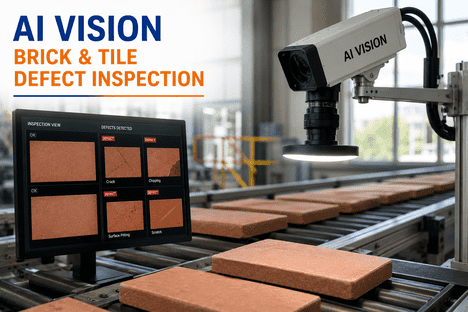
Most brick and tile manufacturers are still grading their finished product the same way they did thirty years ago: a line worker standing at the end of the kiln car, eyeballing each unit for cracks, chips, and shade variation before it gets palletized. That approach made sense when production speeds were slower and labor was cheap relative to scrap cost. It does not hold up against modern firing schedules, where thousands of units pass a single inspection point every hour, where facing brick and porcelain tile carry tight color-match and dimensional expectations from architects and distributors, and where a single mis-graded pallet shipped to a job site becomes a costly return, a credit claim, or a damaged customer relationship. AI vision inspection replaces subjective, fatigue-prone visual grading with deep learning models trained specifically on brick and tile defect signatures — cracks, chips, spalling, color and glaze deviation, and dimensional or warpage variation — inspecting every unit at full line speed and routing defective product to the correct grade or reject stream automatically, so a turnkey pilot can prove the case on your own production line before a single hour of manual grading is replaced.
Why Manual Visual Grading Falls Short on Modern Brick and Tile Lines
The Gap Between Production Speed and Human Inspection Capacity
Manual visual grading depends on a person standing at a fixed inspection point, scanning units one at a time, under whatever lighting the plant floor provides, for an entire shift. Even a skilled inspector's accuracy drops measurably over an eight-hour shift as attention fatigues, and judgment on borderline cases — a hairline crack that may or may not propagate, a shade variation that may or may not fall within the customer's tolerance — varies from one inspector to the next and from one shift to the next. Standards bodies recognize this variability directly: brick classification systems define distinct appearance and dimensional tolerance classes precisely because manufacturing and grading variation is expected, and tile dimensional standards specify allowable deviation bands for length, thickness, and rectangularity that are difficult to verify consistently with a tape measure or caliper at production speed.
The economic exposure compounds from there. A chipped or cracked unit that passes manual grading does not get caught until it reaches a distributor, a mason, or a job site — at which point the cost is not just the unit itself but freight, restocking, claims processing, and in some cases a strained relationship with a builder or architect who specified that product by name. Color and shade inconsistency carries the same risk for facing brick and glazed tile, where architectural specifications often call out a tight visual match across an entire building elevation. None of these failure modes require a complex defect — they require only that a defect was missed at the one inspection point where catching it was cheap.
The AI Vision Architecture Behind Automated Brick and Tile Inspection
From Image Capture to Automated Grade Assignment
iFactory's Vision Defect Detection module is built as a connected inspection pipeline rather than a single camera bolted onto the line. Each layer of the architecture has a specific job, and together they convert a raw image of every brick or tile into an automated grading and sorting decision in real time.
AI Vision vs. Manual Visual Inspection: The Performance Comparison
What Changes When Every Unit Is Inspected Instead of a Sample
The gap between manual visual grading and AI vision inspection is not a matter of degree — it is a difference in what gets inspected at all. Manual grading is inherently sample-based and single-face by practical necessity; AI vision inspects every unit, on multiple faces, against the same criteria every time, regardless of shift, lighting, or inspector fatigue.
| Performance Dimension | Manual Visual Grading | AI Vision Inspection | Improvement Delta |
|---|---|---|---|
| Defect Detection Accuracy | 70–85%, inspector and fatigue dependent | 95–99% across crack, chip, and surface defect classes | +15–25 percentage points |
| Inspection Coverage | Sample-based, typically single visible face | 100% of units, multiple faces and edges | Full lot coverage |
| Color & Shade Consistency | Subjective visual match under variable lighting | Calibrated colorimetric measurement against reference standards | Objective, repeatable grading |
| Dimensional & Warpage Accuracy | Periodic caliper spot checks | Continuous sub-millimeter measurement on every unit | Full-lot dimensional verification |
| Grading Consistency Across Shifts | Varies by inspector, shift, and time of day | Identical grading criteria applied 24/7 | Eliminates shift-to-shift variability |
| Throughput at Line Speed | 60–120 units per minute per inspector | 500+ units per minute at full line speed | 4–8x inspection throughput |
| ROI Timeline | Not applicable — labor cost only | Positive within 6–12 months of pilot deployment | Rapid payback from claims and scrap reduction |
What AI Vision Detects on the Brick and Tile Line
The Four Defect Categories That Drive Grading and Claims
Effective AI vision inspection is built around the defect modes that actually drive grading decisions and customer returns in brick and tile manufacturing — not a generic anomaly detector applied without context for the material or the process.
This defect coverage runs on the iFactory AI Vision Camera, a deep learning inspection camera purpose-built for high-speed industrial lines. It mounts at existing inspection points without re-engineering your kiln car, press, or packaging conveyor, and connects detection events directly into automated grading, sorter control, and your quality reporting system. Explore the iFactory AI Vision Camera to see the hardware and model configuration built for brick and tile inspection specifically.
From Manual Grading to Automated AI Vision Inspection
What Changes on the Floor When AI Vision Replaces Visual Sorting
The shift from manual visual grading to AI vision inspection is not a hardware swap — it changes how defects are caught, how grading decisions are made, and how quality data is captured across every shift.
Most plants start with a turnkey AI vision pilot on a single kiln car, press line, or packaging inspection point rather than a full-facility rollout. A focused pilot can be installed and tuned to your specific grading classes in a matter of weeks, producing a documented defect detection record and a quantified comparison against your current manual grading reject rate before any decision is made to expand coverage to additional lines or product types.
Conclusion
Brick and tile manufacturing has not lacked the demand for consistent grading — it has lacked an inspection method that can keep pace with production speed without depending on a single inspector's eyes for eight hours at a stretch. AI vision closes that gap by inspecting every unit, on every face, against the same calibrated criteria, and converting each detection directly into a grading and sorting decision instead of a note for someone to act on later. For facing brick, paving brick, and glazed or porcelain tile alike, that shift turns quality control from a periodic spot check into a continuous, documented process — one that catches the chipped corner, the off-shade batch, or the warped unit before it becomes a customer claim. A focused pilot on one line is enough to put that comparison in front of your own quality and operations teams with real production data behind it.