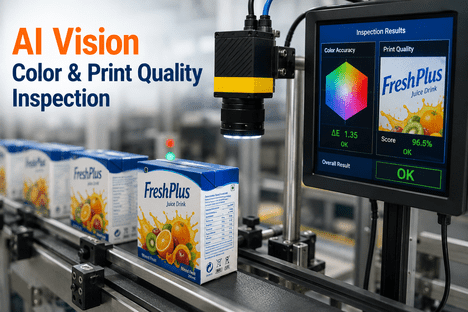
Color accuracy and print quality are the visual fingerprints of brand integrity. When packaging colors drift, print registration slips, or graphics contain subtle defects, the cost extends beyond scrap — it erodes consumer trust and undermines shelf impact. Traditional machine vision systems struggle with the variability of real-world production: lighting changes, substrate differences, and the sheer complexity of decorative patterns. AI vision inspection solves these challenges through deep learning models that learn the acceptable variation range for each product SKU, then flag only the deviations that matter. iFactory's AI vision camera platform brings this capability to packaging lines, label printers, and product finishing stations — detecting color shifts as small as Delta E 1.5, identifying misregistration at 0.1 mm resolution, and catching graphics defects that conventional rule-based systems miss. The result is consistent brand presentation across every unit shipped, backed by inspection data that connects directly to your quality management system for closed-loop process correction.
Why AI Vision for Color and Print Quality Inspection Matters
Brand owners invest millions in color specification, print plate creation, and substrate selection — only to rely on human visual inspection or traditional machine vision at the point of production. Human inspectors fatigue within minutes when judging subtle color differences across thousands of units per hour. Conventional machine vision requires explicit programming for every defect type and struggles when lighting or material variation falls outside the programmed tolerance band. AI vision inspection addresses both limitations. Deep learning models are trained on acceptable and rejectable product examples, learning the natural variation inherent in the production process. Once deployed, the model evaluates every unit at line speed against the learned quality standard, flagging color deviations, registration errors, missing print elements, smears, streaks, and contamination with consistent accuracy. The inspection results are repeatable, auditable, and quantifiable — every rejection includes a defect image and measurement data that can be fed back into process control systems. Organizations deploying iFactory's AI vision camera system for color and print inspection report defect escape rates below 0.1% and inspection consistency that eliminates subjective quality disputes between production and quality teams.
Applications Across Packaging and Print Production
Color and print quality inspection powered by AI vision applies across the full range of packaging formats and print processes. On flexible packaging lines, the system detects color drift on pouches and films caused by ink viscosity changes, anilox roll wear, or substrate tension variation. On folding carton lines, it verifies that spot colors, brand logos, and barcodes are printed in register and within color tolerance. On label printing presses — digital, flexographic, or gravure — the system inspects every repeat for missing dots, ink splatter, hickeys, and die-cut registration. On corrugated packaging lines, it validates that preprint or direct print matches the approved proof, catching graphics defects before blanks are converted into finished boxes. The same platform extends to product decoration: branded consumer goods with direct-print, pad-print, or heat-transfer decoration can be inspected for color accuracy, print placement, and surface defects at the final assembly or packaging station. Rather than requiring a separate inspection camera for each application, iFactory's AI vision camera platform adapts to each inspection point through model configuration, reducing hardware duplication and simplifying maintenance across the plant floor.
The Five Defect Categories AI Vision Inspects for Print Quality
The content of AI vision inspection for color and print quality covers five primary defect categories. Each category requires a distinct detection approach within the deep learning model architecture, and the training data set must include representative examples of each defect type to achieve reliable detection.
| Defect Category | Examples | Detection Method | Inspection Metric |
|---|---|---|---|
| Color Deviation | Delta E shift, hue drift, saturation loss, metamerism | AI color matching against trained reference per SKU | Delta E threshold — target < 2.0 from standard |
| Print Registration | Misregistered colors, out-of-register graphics, halo effects | Edge detection model comparing color plane alignment | Registration tolerance — target < 0.2 mm |
| Graphics Defects | Missing print elements, streaks, voids, smears, hickeys | Anomaly detection model on trained print pattern | Defect area threshold — target > 0.5 mm² reject |
| Surface Contamination | Ink splatter, debris, foreign material on printed surface | Semantic segmentation identifying non-print artifacts | Contamination count & size per inspection unit |
| Barcode & Text Quality | Unreadable barcodes, missing characters, reversed text | OCR and barcode verification with AI quality scoring | Barcode grade A or B per ISO 15416; text legibility |
Each defect category is trained incrementally, with the model learning to distinguish between acceptable process variation and true quality defects. Organizations that sequence inspection model training by defect priority — starting with color deviation and registration, then adding graphics defects, then contamination and text quality — achieve production-ready inspection within two to four weeks per SKU family. Model validation at each stage uses a holdout data set of known-good and known-defective units to confirm that false reject rates remain below 0.5% before the model is deployed to production.
Overcoming Common Color and Print Inspection Challenges
The most common objection to automated color inspection is substrate variability. Packaging materials — metallized films, translucent plastics, textured papers, corrugated board — all affect how color appears to a camera. Traditional color sensors calibrated to a single surface type fail when the substrate changes gloss level, opacity, or surface texture. AI vision overcomes this by training on the actual substrate in production conditions. The model learns not just the target color but the expected appearance of that color on that specific material under that lighting configuration. When the substrate changes — a different batch of film, a new roll of paper — the model adapts if retrained, or a pre-trained model for the new substrate is deployed in minutes. Another challenge is line speed. Print and packaging lines operate at speeds from 50 to 600 meters per minute, requiring inspection systems that can capture and evaluate images at hundreds of frames per second. iFactory's edge AI architecture processes each image locally on the camera module, eliminating the latency of sending images to a central server for analysis. This architecture supports inspection at full production speed with no bottleneck, and defect events are time-stamped and correlated with production data for root cause analysis. For teams evaluating AI vision inspection for their color and print quality applications, the system's Book a Demo option provides a live walkthrough of model training, deployment, and ongoing model management on actual production samples.
Measuring AI Vision Inspection Performance
Inspection system performance is measured by defect detection rate, false reject rate, and inspection throughput. Leading AI vision deployments for color and print quality achieve defect detection rates above 99.5% for trained defect categories while maintaining false reject rates below 0.5%. These metrics should be validated per SKU and per defect category during the model validation phase and monitored continuously in production. Model performance drift — a gradual decline in detection accuracy as production conditions change — is detected through periodic holdout testing and automated performance dashboards. Organizations using iFactory's AI vision camera system track mean time between false rejects, defect escape rate at the next inspection point or customer, and model retraining frequency as leading indicators of inspection system health. When detection rate drops below threshold or false reject rate exceeds target, the model is retrained on recent production data that includes the new variation. This continuous improvement loop ensures that inspection accuracy improves over time rather than degrading, as the model encounters more examples of the production process's natural variation range.
Connecting AI vision inspection data to downstream systems — CMMS work order generation, ERP quality holds, SPC charting — transforms inspection from a gate function into a process improvement engine. When a color drift trend is detected, the system can automatically trigger a preventive maintenance notification on the print station or generate a quality hold on affected inventory. iFactory's AI vision camera platform supports OPC-UA and REST API integration with plant systems, enabling this closed-loop workflow without custom middleware. Teams that deploy inspection with integrated response workflows contain excursions 60% faster than teams that rely on manual defect review and disposition. A Book a Demo with iFactory's engineering team shows how inspection data flows from edge camera to plant system and triggers the right response in seconds.
Best Practices for Sustaining AI Vision Inspection Accuracy Long Term
Model accuracy degrades over time as production conditions evolve — new ink formulations, different substrate lots, press wear, seasonal humidity changes. Sustaining inspection performance requires a deliberate model management strategy. Weekly model performance reviews comparing defect detection rate and false reject rate against targets identify drift before it affects production quality. Monthly model retraining on recent production data — including images of new defect types or variation patterns — keeps the model current. A designated model champion within the quality or maintenance team monitors model health and coordinates retraining cycles. Annual model architecture reviews assess whether the inspection model still matches the defect profile of the production line. Organizations that treat AI vision model management as a continuous process — not a one-time deployment — sustain detection rates above 99% year over year. The principles of sustained model accuracy apply to all AI vision deployments. iFactory offers dedicated model management support for teams deploying its AI vision camera system, covering model performance monitoring, retraining coordination, and integration troubleshooting — ensuring that inspection accuracy remains at production-ready levels from deployment day one. Book a Demo to discuss how iFactory's model management programs support sustained inspection accuracy in packaging and print production environments.
Frequently Asked Questions About AI Vision Color and Print Quality Inspection
A production-ready AI vision model for color and print quality inspection can be trained within two to four weeks for most SKU families. The process begins with collecting 500 to 2000 images of acceptable product and 200 to 500 images of defective product covering the defect types to be detected. Image annotation labels the defect regions and assigns severity levels. The deep learning model is trained on this data set, then validated against a holdout sample of images not used in training. Model accuracy at validation determines whether additional training data is needed. Once validation passes the target thresholds for detection rate and false reject rate, the model is deployed to the edge camera module and tested on the live production line with operator oversight. Most organizations have their first SKU model in production within three weeks of starting the image collection phase.
Under controlled production lighting conditions with a calibrated camera, iFactory's AI vision platform detects color differences as small as Delta E 1.5. For context, Delta E 1.0 is the approximate threshold of human visual perception under ideal viewing conditions, and Delta E 3.0 is typically noticeable to most viewers in side-by-side comparison. A detection threshold of Delta E 1.5 means the system catches color drift before it becomes visible to the human eye, enabling proactive correction before defective units are produced. The achievable sensitivity depends on lighting stability, camera sensor quality, and substrate reflectivity. For high-gloss metallized films or translucent materials, the practical detection threshold may shift to Delta E 2.0-2.5. The model training process identifies the optimal threshold for each SKU by balancing detection rate against false reject rate on actual production samples.
Yes. The AI vision platform includes integrated optical character recognition and barcode verification modules that assess print quality for variable data elements. The system verifies that barcodes meet ISO 15416 grade A or B, that human-readable text matches the expected content, and that all required print elements are present and legible. Text legibility assessment goes beyond simple OCR matching — the model evaluates character completeness, contrast against the substrate, and freedom from distortion or void defects. This is particularly valuable for pharmaceutical serialization, food traceability codes, and product labeling where unreadable barcodes or missing text characters can trigger costly rework or regulatory non-compliance. The same edge AI camera that inspects color and graphics defects also performs text and barcode inspection, eliminating the need for a separate camera station.
AI vision color inspection ROI is measured through four primary metrics: defect escape rate reduction, scrap reduction, customer claim reduction, and inspection labor productivity. A typical deployment on a high-speed label printing press achieving 99.5% defect detection reduces escaped defects by 90% compared to human inspection, cutting customer claims for color and print defects proportionally. Scrap is reduced by 20-40% because color drift is detected at the point of deviation rather than at the end of the roll, preventing production of an entire reel of off-color material. Inspection labor is reallocated from 100% visual inspection to exception-based review of AI-flagged units, improving productivity by 3-5x. The total ROI calculation compares these savings against the system hardware cost, model training investment, and ongoing model management. Most organizations report payback within 6 to 12 months of deployment on a single high-speed production line.
The standard retraining cadence is monthly for production models, with additional retraining triggered by significant process changes — new substrate supplier, new ink formulation, press maintenance event, or seasonal humidity shift. Monthly retraining incorporates images collected during production, including any new defect types or variation patterns that appeared. The retraining process typically takes one to two hours of compute time and is managed through iFactory's model management dashboard. Model performance is monitored continuously through automated dashboards showing detection rate and false reject rate trends. When performance degrades below configured thresholds, an alert triggers a retraining cycle. Organizations with stable production processes and consistent materials may extend the retraining interval to quarterly, while those with frequent material or process changes benefit from weekly or bi-weekly retraining.