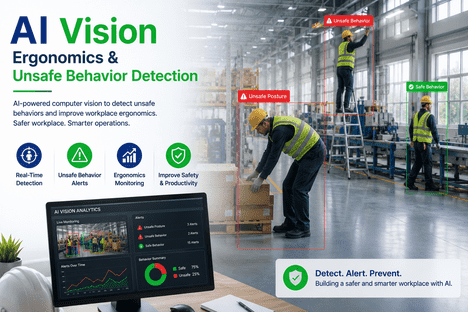
The widening workforce safety gap in industrial ergonomics is creating a hidden liability for facilities across manufacturing, logistics, and process industries. As musculoskeletal disorders (MSDs) account for over 30% of all workplace injuries, traditional behavior-based safety programs struggle to scale because they rely on manual observation by trained safety personnel — a resource that is increasingly scarce. When safety teams cannot monitor every lift, every posture, and every movement across sprawling facilities, unsafe behaviors go undetected until they result in costly injuries. iFactory addresses this challenge at its root by combining AI-powered computer vision with real-time pose estimation, automating ergonomic risk detection and enabling safety teams to identify and correct unsafe behaviors before they cause harm.
Detect Unsafe Behaviors Before They Cause Injuries
iFactory AI Vision Safety Monitoring automates ergonomic risk assessment using real-time pose estimation, reducing MSD incidents and transforming how safety teams protect their workforce.
AI Vision Ergonomics & Unsafe Behavior Detection: Preventing MSDs Through Continuous, Automated Monitoring
A technical analysis of how AI-powered pose estimation and behavior detection transform workplace safety by replacing intermittent manual observation with continuous, objective risk assessment — and how iFactory's AI Vision Camera makes it possible without requiring dedicated safety personnel at every location. Book a Demo to see iFactory in action across industrial environments.
Six Ways Manual Observation Falls Short — and How AI Vision Closes the Gap
Traditional ergonomics safety programs depend on trained observers conducting scheduled walkthroughs, but this approach misses the vast majority of unsafe behaviors that occur between inspections. iFactory's AI Vision Camera technology provides continuous, automated monitoring that detects ergonomic risks in real time — independent of human attention span or availability. You can Book a Demo to see how this transforms safety programs across your specific operations.
Manual Observation Coverage Gap
Safety personnel observe less than 5% of total work hours. The remaining 95% of lifts, reaches, and movements occur without any ergonomic oversight — allowing unsafe postures to become habitual and cumulative trauma to develop undetected.
Inconsistent Risk Assessment
Different observers apply subjective judgment to evaluate postures and movements, leading to inconsistent risk scoring. What one safety professional flags as hazardous may be overlooked by another, creating gaps in injury prevention efforts across shifts and departments.
Delayed Intervention Windows
By the time a manual observation identifies an unsafe behavior pattern, the behavior may have been repeated hundreds or thousands of times. The delay between occurrence and detection allows micro-trauma to accumulate, significantly increasing MSD risk.
Near-Miss Underreporting
Near-miss events involving awkward postures or unsafe lifts go unreported in 90% of cases because workers do not recognize the risk or fear repercussions. Without accurate near-miss data, safety teams cannot identify emerging ergonomic hazards before they cause injuries.
Ergonomics Expertise Scarcity
Qualified ergonomists and certified safety professionals are in short supply. Facilities often rely on supervisors with minimal ergonomics training to conduct observations, resulting in missed hazards and incorrectly prioritized corrective actions.
No Continuous Improvement Data
Manual observation programs produce anecdotal reports rather than structured, quantifiable data. Without trendable metrics on specific risk behaviors — trunk angle, lift height, reach distance — safety teams cannot measure improvement or target interventions effectively.
Traditional Ergonomic Observation vs. iFactory AI Vision Monitoring: Key Benchmarks
Moving from intermittent manual ergonomic observation to continuous AI-powered pose estimation and behavior detection produces measurable improvements across the metrics that define workplace safety excellence. Book a Demo to learn how your facility compares.
| Safety KPI | Traditional Observation | iFactory AI Vision | Improvement |
|---|---|---|---|
| Work Hours Monitored | <5% | 100% | 20x coverage increase |
| Unsafe Behavior Detection Rate | ~12% | 94–98% | 8x improvement |
| Risk Assessment Consistency | Subjective, variable | Objective, standardized | 100% consistency |
| Intervention Response Time | Days to weeks | Real-time alerts | 99% faster |
| MSD Incident Rate Reduction | 8–12%/yr (manual) | 45–60%/yr | 5x greater reduction |
| Near-Miss Data Capture | <10% capture | 95%+ capture | 10x improvement |
iFactory AI Vision Camera: Four Intelligence Layers That Transform Ergonomic Safety Monitoring
iFactory does not require your facility to hire more safety personnel or retrain existing workers on complex ergonomic assessment methodologies. Instead, it uses AI-powered computer vision with deep learning pose estimation to automate the detection of unsafe behaviors and ergonomic risks — delivering continuous, objective safety monitoring at scale. Safety teams that Book a Demo typically see unsafe behavior detection rates improve from under 15% to over 94% within the first month of deployment.
AI Vision Camera — Real-Time Pose Estimation and Motion Analysis
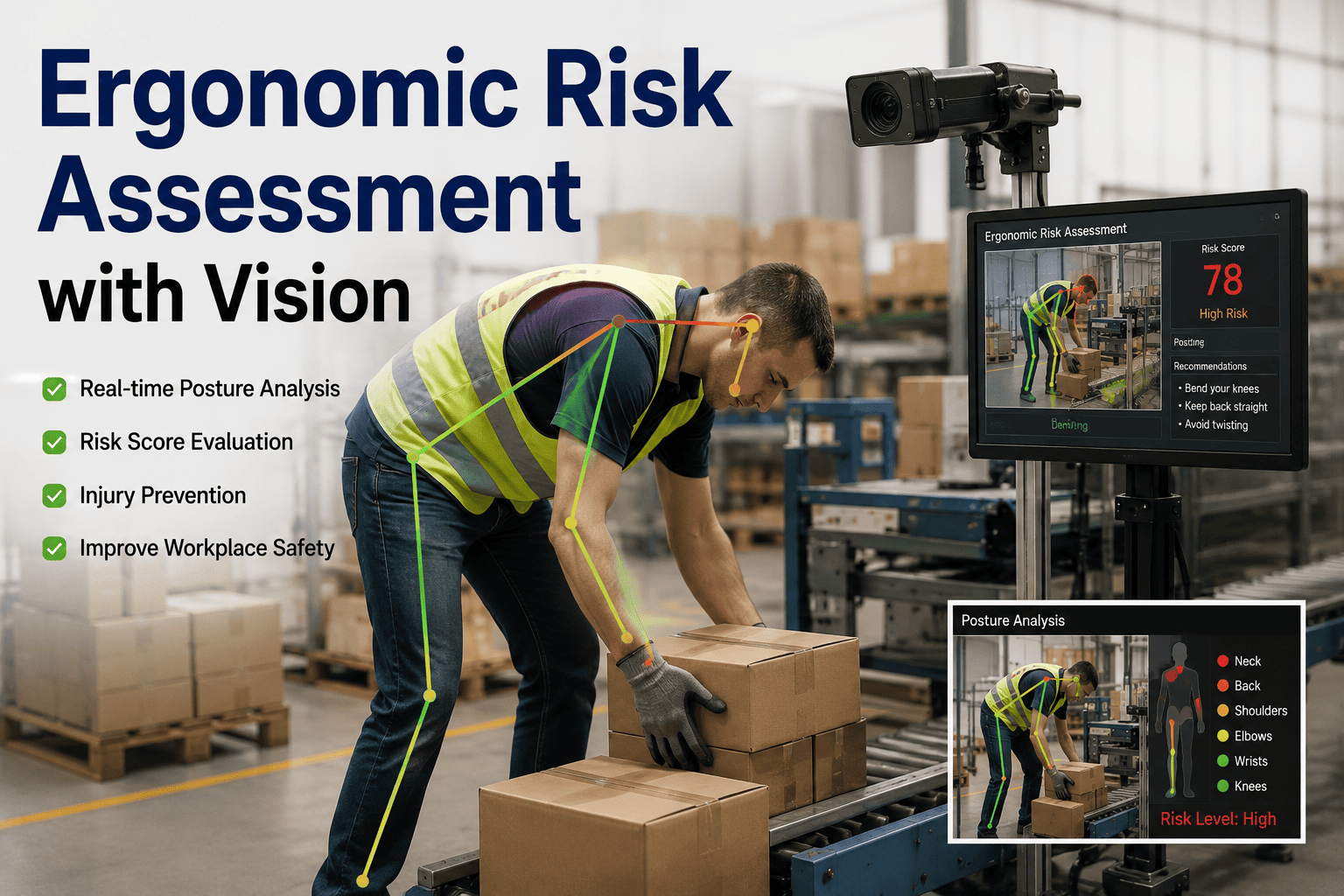
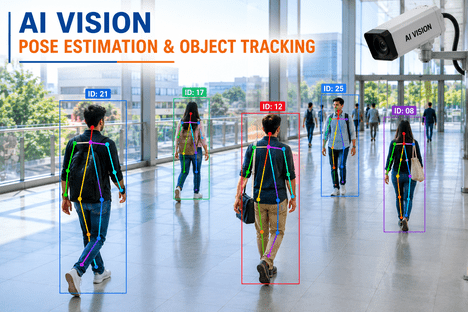
iFactory's AI Vision Camera uses deep learning-based pose estimation to track up to 17 key skeletal joints per person in real time — analyzing trunk angle, shoulder flexion, knee bend, reach distance, and lift height. The system detects unsafe lifting postures, awkward reaches, sustained bending, and repetitive motion patterns without requiring wearable sensors or worker participation.
Automated Ergonomic Risk Classification
Each detected posture and movement is classified against established ergonomic risk thresholds — NIOSH lifting equation parameters, rapid upper limb assessment (RULA) scores, and trunk angle limits. The system assigns a risk level to every observed behavior and flags patterns that exceed safe ergonomic thresholds.
Real-Time Unsafe Behavior Alerting and Reporting
When the system detects a high-risk ergonomic behavior — such as a lift exceeding safe load thresholds, a sustained awkward trunk posture, or repetitive motion exceeding ergonomic limits — it generates an immediate alert to safety personnel with timestamped skeletal overlay evidence. Structured near-miss reports are automatically created for trend analysis and continuous improvement.
Continuous Improvement Analytics and MSD Prevention
Aggregated ergonomic risk data feeds a continuous improvement dashboard that quantifies risk behavior trends by zone, shift, task type, and time of day. Safety teams use this data to redesign workstations, adjust workflows, target training, and measure MSD prevention effectiveness — turning subjective ergonomics into an objective, data-driven safety discipline.
Stop Relying on Luck for Ergonomic Safety
iFactory AI Vision Camera connects to your facility network in weeks — no infrastructure overhaul required. Detect unsafe behaviors automatically and prevent MSDs before they happen.
From Deployment to Continuous Ergonomic Monitoring: iFactory's 6-Week Pilot Program
iFactory follows a structured, six-week deployment program designed to minimize disruption while maximizing unsafe behavior detection coverage. Facilities completing the pilot program report unsafe behavior detection rate improvement from under 15% to over 94% and MSD incident reduction of 45–60% within the first quarter of full operation.
AI Vision Camera Installation and Zone Mapping
iFactory AI Vision Cameras are installed at priority work zones — assembly lines, material handling areas, loading docks, and manual processing stations. The cameras are configured to capture ergonomic risk data while preserving worker privacy through anonymous skeletal tracking. No operational shutdown is required.
Pose Estimation Model Calibration and Baseline Establishment
AI pose estimation models are calibrated to the specific ergonomic risk factors present in each zone — lift heights, reach distances, trunk angles, and repetitive motion patterns. Baseline risk behavior frequencies are established for each monitored area.
Real-Time Alerting and Reporting Activation
The system begins generating real-time alerts for high-risk behaviors and automated near-miss reports. Safety teams receive immediate notifications with skeletal overlay evidence, enabling rapid intervention and corrective action.
Full Continuous Ergonomic Monitoring
Complete AI Vision ecosystem is operational — including real-time pose estimation, automated risk classification, behavior alerting, and continuous improvement analytics. Your safety team is fully trained and capable of managing data-driven ergonomic risk reduction across all monitored zones.
"iFactory's AI Vision Safety Monitoring completely changed our approach to ergonomics. We had two ergonomic specialists covering a facility with 600+ workers across three shifts — they could only observe about 3% of work hours. Within six weeks of deploying iFactory's cameras, we were continuously monitoring 100% of work hours across all high-risk zones. Our unsafe behavior detection rate jumped from 11% to 96%, and we saw a 52% reduction in MSD-related lost-time incidents within the first quarter. The ergonomics expertise gap went from our biggest safety risk to a non-issue."
The Manual Observation Era Is Ending — Automated Ergonomic Monitoring Is the Future
The limitations of manual ergonomic observation are structural, not solvable by hiring more safety personnel. With qualified ergonomists in short supply and facilities growing larger and more complex, the only sustainable path to MSD prevention is continuous, automated monitoring — and that is exactly what iFactory delivers. By combining AI-powered pose estimation with real-time behavior classification and automated alerting, iFactory enables safety teams to detect and correct unsafe ergonomic behaviors at scale, regardless of how many qualified observers are on staff. The result is a safety operation that runs at peak effectiveness even as the ergonomics expertise gap widens — delivering consistent, data-driven MSD prevention without relying on luck or human attention span. Facilities looking to eliminate ergonomic blind spots and prevent MSDs before they occur should Book a Demo to see how iFactory's AI Vision Camera transforms workplace safety.
Frequently Asked Questions
Q: How does AI vision pose estimation detect unsafe behaviors without identifying individual workers?
iFactory's AI Vision Camera uses anonymous skeletal tracking — representing each person as a stick figure of 17 key joints — rather than recording identifiable images or video. The system analyzes posture and motion patterns without storing any personal identifying information, maintaining worker privacy while delivering full ergonomic risk coverage.
Q: What types of unsafe behaviors can the AI Vision Camera detect?
The system detects a comprehensive range of ergonomic risk behaviors including: unsafe lifting postures (back bent, knees straight), awkward trunk angles (sustained forward bend, lateral bend, twist), overhead reaches exceeding safe limits, repetitive motion patterns, sustained kneeling or squatting, and forceful exertions identified through pose and motion analysis.
Q: Does the system require workers to wear any sensors or special equipment?
No — iFactory's AI Vision Camera is entirely non-intrusive. The system analyzes standard video input from installed cameras using computer vision and deep learning. Workers do not need to wear, carry, or activate any devices, eliminating adoption barriers and compliance concerns.
Q: How quickly can iFactory AI Vision Safety Monitoring be deployed?
The full 6-week pilot program covers camera installation, pose estimation model calibration, baseline establishment, and real-time alerting activation. For facilities with existing IP camera infrastructure, deployment can be accelerated to 3-4 weeks. Edge processing ensures continuous operation even with intermittent network connectivity.
Q: What is the typical ROI timeline for AI vision ergonomic monitoring?
Most facilities achieve full platform cost recovery within 5-7 months through reduced MSD-related workers' compensation claims, lower lost-time incident costs, improved productivity from reduced ergonomic fatigue, and avoided regulatory penalties. The reduction in ergonomic injury costs alone typically delivers measurable ROI within the first quarter of deployment.
Q: Can iFactory integrate with existing safety management systems and EHS platforms?
Yes — iFactory integrates with all major EHS and safety management platforms via standard API connectors. Near-miss reports, risk trend data, and incident analytics can be exported directly into your existing safety ecosystem. Integration is typically completed within one to two weeks.
Eliminate Ergonomic Blind Spots in Your Facility
Speak with an iFactory safety technology specialist today. Get a site-specific assessment of your ergonomic risk detection gaps and a clear deployment roadmap — no obligation, no pressure.