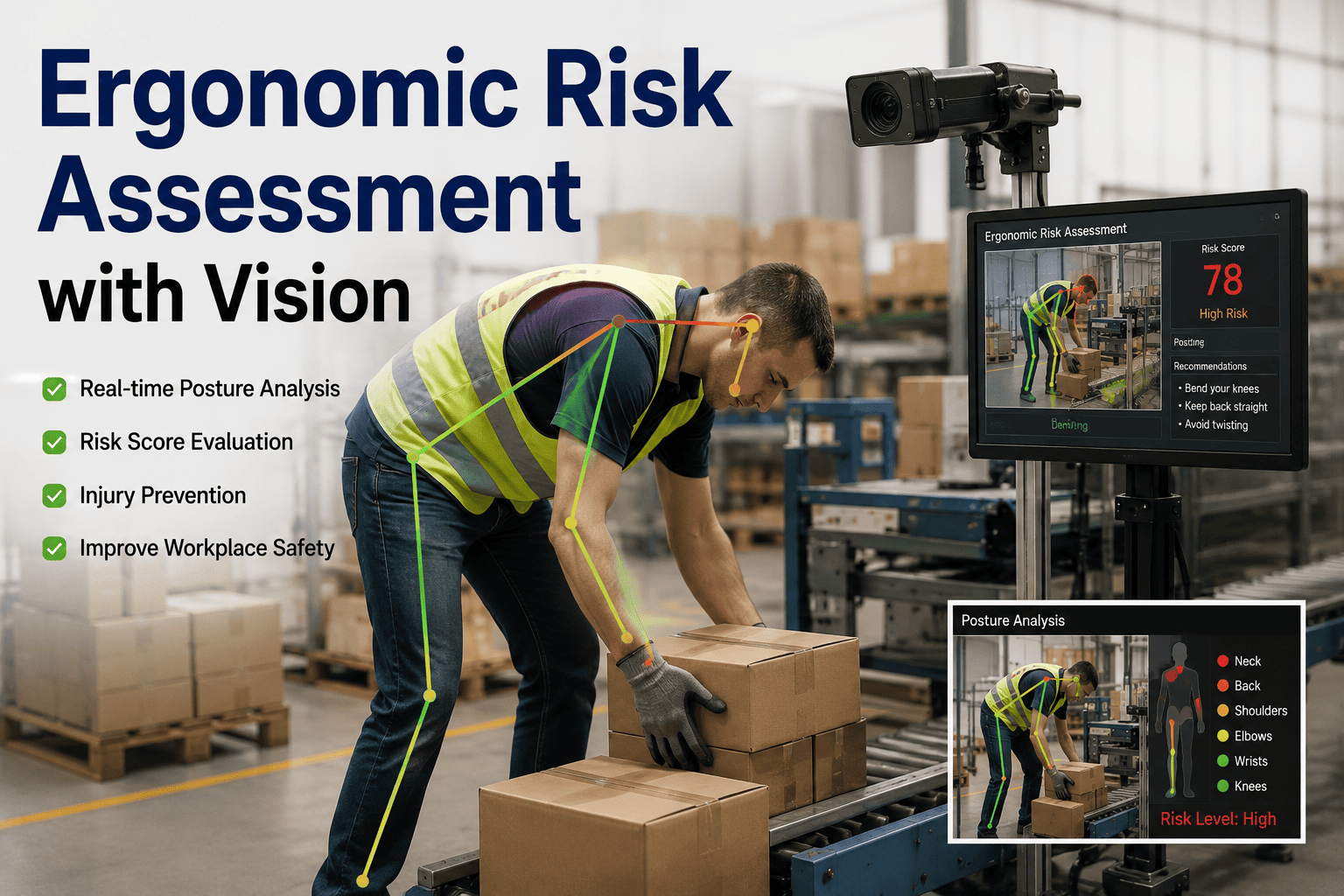
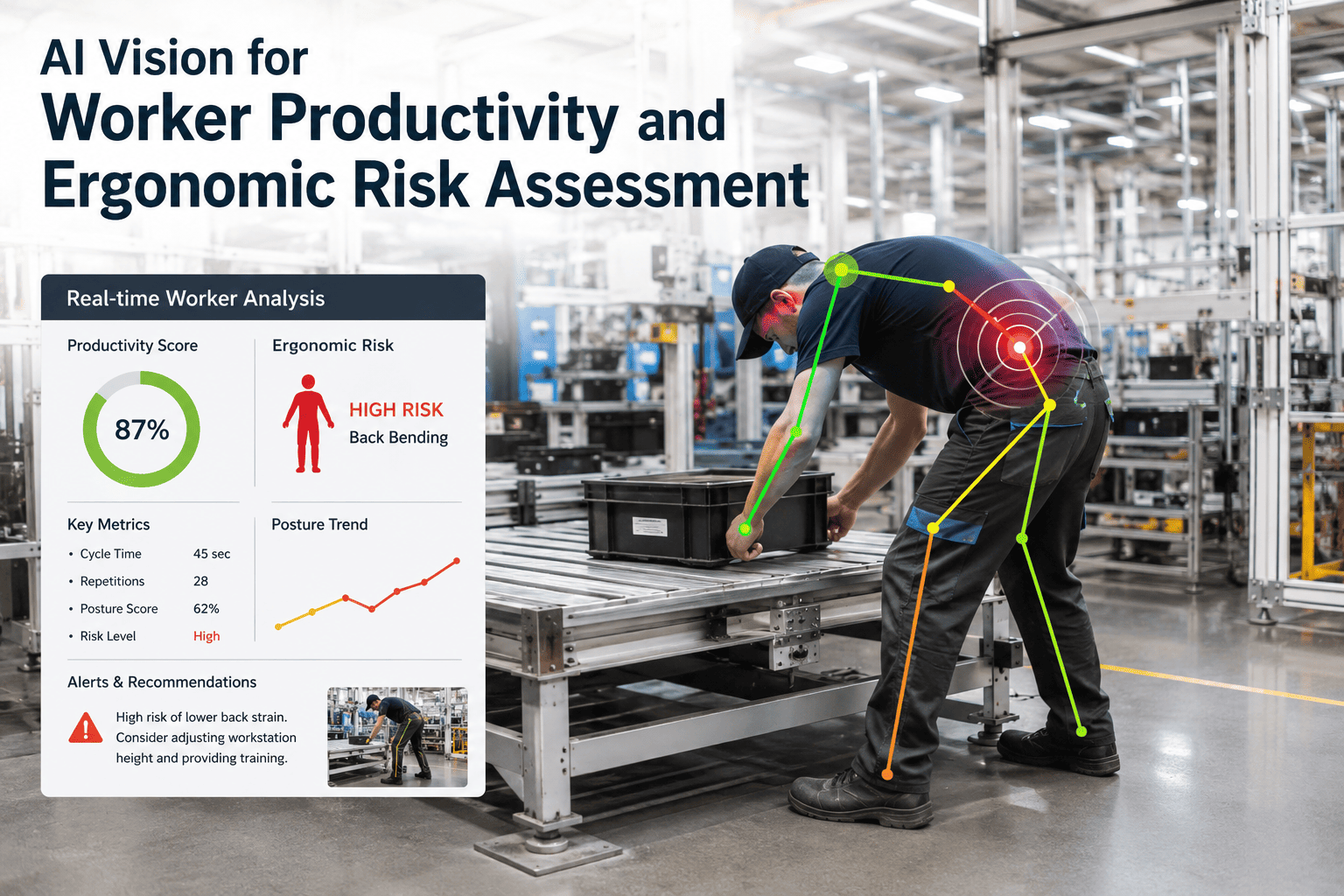
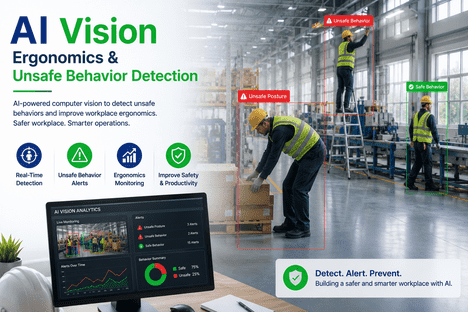
Musculoskeletal disorders account for roughly a third of all workplace injuries in manufacturing, and the single largest predictor of an MSD claim is sustained exposure to awkward postures, repetitive motions, and forceful exertions — the exact conditions that define most manual assembly tasks. Despite that, the standard approach to ergonomic risk assessment at most plants still relies on periodic observation: an ergonomist or safety engineer watches a worker perform a task for a few minutes, assigns a RULA or REBA score based on that snapshot, and documents the finding in a report that might not be revisited for months. AI vision changes this by turning every camera frame into a posture measurement, building a continuous risk profile for every task at every station, and ranking the highest-risk jobs with data that engineering teams can actually use to prioritize fixture redesign, tool changes, or cobot deployment — a demo can show how that continuous scoring feeds directly into your intervention planning.
Ergonomic Risk AI
Ergonomic Risk Assessment with Vision AI: Continuous Posture Scoring for Assembly Operations
AI vision tracks joint angles, repetition counts, and sustained postures across every cycle — replacing periodic snapshots with a continuous risk profile that drives real engineering change.
The Injury Numbers That Checklists Do Not Fix
Ergonomic injuries are not rare, unpredictable events — they are the cumulative result of daily exposure to physical demands that exceed what the human body can sustain without degradation. The data on this is consistent across industries and geographies, and it points to a clear conclusion: the current approach of periodic assessment and checklist-driven compliance is not reducing injury rates at a pace that matches the scale of the problem.
33%
of all workplace injuries and illnesses in manufacturing are musculoskeletal disorders, making MSDs the single largest injury category
$54B+
annual direct cost of MSDs in the United States alone, including medical care, lost wages, and workers compensation
12 Days
median days away from work per MSD incident, compared to 8 days for all other injury types combined
70%
of manufacturing MSDs are caused by repetitive motion and awkward posture, both of which are measurable with vision AI
Why Periodic Assessments Miss the Real Risk Pattern
A formal ergonomic assessment captures what an observer sees during a scheduled visit — typically a few minutes of observation at one station, on one shift, performed by one assessor. That snapshot is then treated as representative of every subsequent shift, every operator, and every production variation until the next assessment cycle. The structural problem is not that the assessor is unskilled — it is that the method cannot capture the variation that actually determines injury risk.
Most plants conduct formal ergonomic assessments on an annual or semi-annual cycle, driven by audit requirements or incident response rather than continuous monitoring. Between assessments, operators may change their technique, production rates may increase, tooling may wear, or workstation heights may be adjusted informally — none of which is captured until the next scheduled review. The risk profile of a task is treated as static when it is actually dynamic, and the gaps between assessments are precisely where unmonitored exposure accumulates.
1x Per Year
Typical frequency of formal ergonomic assessment at most manufacturing facilities
Even when two trained ergonomists observe the same task, their RULA or REBA scores can differ by 2-3 points on a scale where a single point change can shift a task from "acceptable" to "high risk." This subjectivity is not a training failure — it is a limitation of human visual estimation of joint angles, force application, and repetition rate under real production conditions. The result is that risk rankings are partially determined by which assessor happened to visit, which undermines the credibility of the data when it is used to justify capital spending on engineering controls.
40% Variance
Score difference between trained assessors evaluating the identical task on the same day
On a line running 8-12 second cycles, an operator performs over 3,000 repetitions per shift. A manual observer watching for five minutes sees roughly 25-35 of those cycles and extrapolates. But cycle-to-cycle variation in posture, grip, and timing means the sample may not represent the true exposure distribution — a few cycles with extreme wrist deviation or deep trunk flexion can drive injury risk even if the majority of cycles fall within acceptable ranges. Without per-cycle data, these high-exposure outliers are invisible.
3,000+
Repetitions per shift on a typical 10-second assembly cycle that manual observation cannot individually score
How AI Vision Converts Movement into an Ergonomic Score
An AI vision system for ergonomic assessment uses standard industrial cameras positioned at workstations to capture video of operators performing their tasks. A pose estimation model processes each frame to extract a skeleton representation — a set of joint coordinates for shoulders, elbows, wrists, hips, knees, and ankles — and then maps those joint angles to the scoring criteria defined in established ergonomic assessment methods. The output is not a video annotation — it is a numerical risk score updated continuously as the operator works.
1
Capture
Industrial cameras record operators at workstations during normal production, no wearables or markers required
2
Skeleton Extract
Pose estimation model identifies joint positions and calculates angles for upper limbs, trunk, and lower body per frame
3
Score Mapping
Joint angles, force proxies, and repetition counts are mapped to RULA, REBA, or Strain Index scoring criteria
4
Risk Output
Per-task, per-station, per-shift risk scores with contributing factor breakdowns for engineering prioritization
Risk Categories AI Vision Actually Catches on the Line
The value of continuous posture tracking is that it catches risk factors that are difficult to observe in a snapshot but drive injury when repeated thousands of times. The six categories below represent the most common high-risk movement patterns in assembly operations, and each one produces a measurable signal in the joint angle data that an AI model can flag automatically.
1
Overhead Reaching
Shoulder flexion above 90 degrees sustained for more than one second per cycle, detected through shoulder joint angle tracking and cumulative exposure time measurement.
2
Repetitive Trunk Flexion
Forward bend at the waist exceeding 20 degrees from vertical, counted per cycle and aggregated into a repetition exposure score that flags tasks exceeding safe frequency thresholds.
3
Static Muscle Loading
Postures held without movement for more than four seconds — common during fixture loading, torque application, or visual inspection — detected by measuring joint angle stability over time.
4
Forceful Exertion
High-force pushing, pulling, or lifting inferred from upper body kinematics and acceleration patterns when direct force measurement is not available at the workstation.
5
Wrist Deviation Patterns
Ulnar and radial deviation of the wrist during tool use or part manipulation, measured in degrees and flagged when deviation exceeds neutral range for a defined percentage of cycle time.
6
Asymmetrical Loading
Uneven weight distribution or one-sided reaching patterns detected through bilateral comparison of shoulder and hip angles, indicating tasks that load one side of the body disproportionately.
Continuous Scoring
See Every Posture Scored in Real Time Across Your Line
A live demo shows how AI vision scores ergonomic risk per task, per shift, and ranks your highest-priority intervention targets automatically.
From Risk Score to Engineering Control and Cobot Support
An ergonomic risk score without a path to intervention is just a more precise way of documenting a problem you already knew existed. The systems that deliver real value are the ones that connect the risk output to an intervention workflow — ranking tasks by severity, identifying the specific posture or motion driving the score, and giving the ergonomics team the evidence needed to justify engineering changes, tool substitutions, or cobot and humanoid support for the highest-risk stations.
1
AI ranks all monitored tasks by composite ergonomic risk score, identifying the top 10-15% of stations that account for the majority of cumulative exposure across the line.
2
Ergonomics team reviews scored footage for the highest-risk tasks, confirming the AI-identified risk factors and understanding the specific task elements — part presentation, fixture design, tool type — that drive them.
3
Engineering evaluates the full control hierarchy: elimination through process redesign, substitution with lower-force tools or lighter components, engineering controls through fixture modification or part orientation changes.
4
For tasks where engineering controls alone cannot reduce risk below acceptable thresholds — typically heavy lifting, sustained overhead work, or high-repetition fine manipulation — cobot or humanoid deployment is scoped using the AI risk data to define payload, reach, and cycle requirements.
5
Post-intervention, the same AI system re-scores the modified task, producing a before-and-after comparison that documents risk reduction and validates the capital investment for leadership review.
How AI Scoring Maps to Established Ergonomic Standards
One of the barriers to adopting AI-based ergonomic assessment has been uncertainty about how its outputs relate to the established methods that auditors, regulators, and safety professionals already use. The table below shows how an AI vision system maps to four widely recognized ergonomic assessment methods — not replacing them, but automating the measurement inputs that assessors currently estimate visually.
| Assessment Method | What It Measures | How AI Automates the Input | Limitation AI Addresses |
| RULA |
Upper limb posture, muscle use, force, repetition |
Continuous shoulder, elbow, wrist angle measurement per frame |
Eliminates angle estimation from periodic visual observation |
| REBA |
Whole-body posture, load, coupling, activity |
Full skeleton tracking including trunk, legs, and neck |
Captures posture variation across shifts and operators |
| Strain Index |
Hand/wrist posture, speed, duration, force |
Wrist deviation angles and repetition counting per cycle |
Provides objective repetition measurement instead of estimates |
| NIOSH Lifting Equation |
Lift origin, destination, distance, frequency, load |
Body position tracking during lift plus load identification |
Calculates per-lift values instead of task averages |
Where Ergonomic AI Deployments Lose Value
The technology for AI-based ergonomic assessment is mature enough that most underperformance is not a model accuracy problem — it is a deployment and integration problem. The gaps below are the most common reasons an installed system fails to deliver the risk reduction and ROI that justified the investment, and each one reflects a disconnect between the AI output and the human workflow it was supposed to support.
A
Cameras Too Far From the Work Plane
Joint angle accuracy degrades rapidly with distance. Cameras mounted on high ceilings for security coverage cannot resolve the wrist and elbow angles needed for reliable RULA scoring, producing noisy data that erodes trust in the system.
B
No Path From Score to Action
Risk scores displayed in a dashboard without connecting to the engineering change request process or capital planning workflow means the data is consumed by the ergonomics team but never reaches the people who can actually modify the workstation.
C
Scoring Without Task Context
AI that measures posture but ignores tool weight, PPE constraints, part geometry, or required force will over-score or under-score tasks because it is evaluating body position in isolation from the physical demands that modify risk at that station.
Frequently Asked Questions
Does AI vision for ergonomic assessment require workers to wear sensors or special clothing?
No. AI pose estimation works with standard video from fixed industrial cameras, meaning operators do not need to wear markers, IMU sensors, suits, or any specialized equipment. This is a significant practical advantage because wearable-based systems create compliance burden, can interfere with task performance, and only capture data from workers who are actually wearing the devices. Camera-based systems capture every operator who passes through the field of view without any individual setup or cooperation required, which eliminates the selection bias that undermines wearable-based studies.
A demo can show how pose estimation works on standard factory camera feeds.
How accurate are AI-generated RULA or REBA scores compared to a trained ergonomist?
AI systems consistently match or exceed inter-rater reliability among trained human assessors for joint angle measurement, which is the primary input to both RULA and REBA scoring. Where human assessors disagree most is in estimating angles from visual observation — distinguishing between 45 and 60 degrees of shoulder flexion, for example — and this is precisely where AI measurement is most precise because it calculates angles from coordinate data rather than visual estimation. The remaining gap is in force estimation, which AI infers from movement patterns rather than measuring directly, and this is an area where combining AI posture data with known task force data produces the most reliable scores.
Talk to a specialist about scoring accuracy for your specific task types.
How does this system handle worker privacy and surveillance concerns?
The AI system processes video to extract skeleton joint coordinates — a stick figure representation — and does not store or transmit raw video frames as part of the scoring output. The data that reaches the ergonomics team is joint angles, risk scores, and aggregated statistics, not identifiable video of individual workers. This architectural distinction is important for labor relations and regulatory compliance in jurisdictions where workplace surveillance is regulated, because the system is measuring task risk, not monitoring individual behavior. Implementation should still involve clear communication with the workforce about what the system measures, why it is being deployed, and what data is and is not retained.
Book a demo to review the data privacy architecture in detail.
Can the risk data directly justify cobot or humanoid investment to leadership?
This is one of the strongest use cases for continuous ergonomic scoring. A capital request for a cobot cell that is supported by six months of per-cycle risk data showing a specific station consistently scoring in the high-risk range across all shifts and operators is fundamentally different from a request based on a single ergonomic assessment report. The continuous data proves that the risk is not an outlier observation but a sustained condition, it quantifies the exposure in terms that finance and operations leadership can weigh against the investment cost, and it provides a pre-intervention baseline that makes post-deployment verification straightforward.
Support can help structure a business case using ergonomic risk data for cobot justification.
What happens when operators perform the same task differently from each other?
This variation is actually one of the strongest arguments for AI-based assessment, because it reveals exactly what manual observation cannot: how different operators performing the same task have different risk profiles based on their technique, body proportions, or learned habits. The system scores each operator independently, which means the ergonomics team can see whether a high average risk score for a station is driven by one operator with poor technique or by a workstation design that puts every operator at risk regardless of individual approach. That distinction determines whether the right intervention is training and standardization or a physical change to the workstation itself.
A demo shows how per-operator scoring works on a multi-operator station.
Data-Driven Ergonomics
Stop Estimating Risk. Start Measuring It.
See how iFactory turns standard camera feeds into continuous ergonomic risk scores that drive real engineering change and cobot deployment decisions.