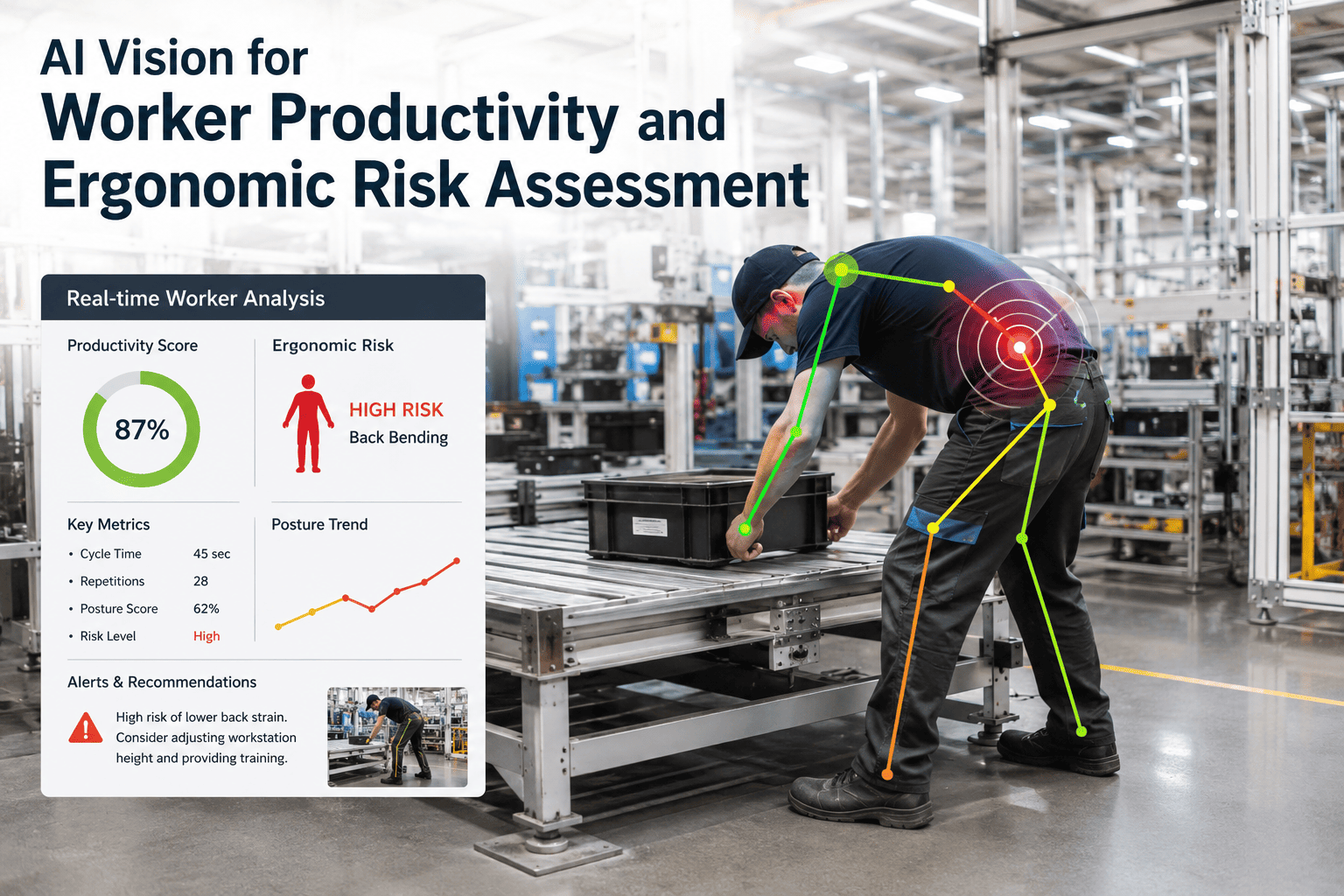
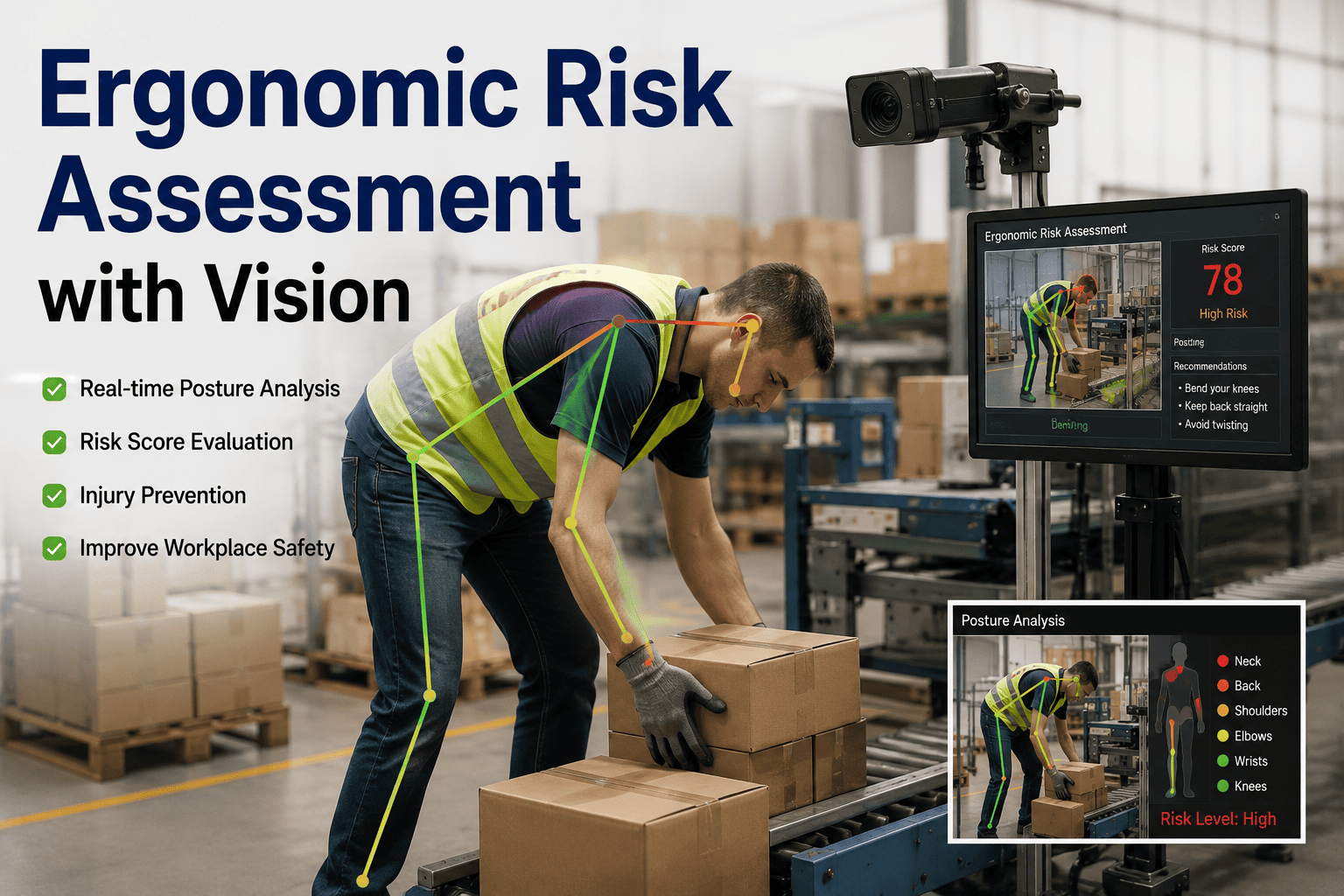
The average warehouse picker spends about 55% of their shift walking, not picking, and much of that walking is avoidable. At the same time, musculoskeletal disorders cause nearly a third of all serious workplace injuries and cost U.S. businesses billions a year. Most operations track one of these numbers, rarely both from the same source. A camera watching the floor can see travel-path waste and posture risk in the same frame, often on the same worker. Book a demo to see it against your own floor.
LOGISTICS INTELLIGENCE · WORKER PRODUCTIVITY & ERGONOMICS
One Camera Feed, Two Problems Solved
iFactory's AI vision analyzes worker movement patterns to flag inefficient travel paths and repetitive-stress postures at the same time, turning a single camera feed into both a productivity map and an injury-prevention system.
THE NUMBER MOST OPERATIONS DON'T TRACK
Where the Shift Actually Goes
Ask most warehouse managers how their team spends the shift and you'll get a picks-per-hour number. Ask where the rest of the time goes and the answer gets vague. Time and motion research across order picking operations consistently finds that walking, not picking, is the largest single component of a picker's day, and a meaningful share of that walking is avoidable.
55%
Of a picker's shift is spent traveling between locations, not picking
30-40%
Of that travel time is attributable to poorly slotted SKUs, not order volume
That second number is the one worth sitting with. It means a meaningful share of every picker's shift is spent walking to fetch items that could have been placed closer to the pack-out point. No amount of individual worker speed fixes a layout problem, and no manager watching the floor for an hour can reliably see which paths repeat across a thousand picks a day. A camera that tracks movement continuously can.
THE COST HIDING IN PLAIN SIGHT
What Ergonomic Risk Actually Costs a Warehouse
Musculoskeletal disorders aren't a background risk in logistics operations, they're the dominant one. General warehousing carries a serious injury rate of 4.8 cases per 100 workers, and MSDs account for roughly 49% of those serious injuries, nearly double the rate seen across the average U.S. workplace.
$45-54B
Total annual U.S. cost of work-related musculoskeletal disorders, direct and indirect combined
4.8/100
Serious injury rate in general warehousing, above the average across other sectors
49%
Share of serious warehouse injuries that are musculoskeletal disorders specifically
2-3x
MSD rate for warehouse and logistics workers compared to the average U.S. worker
A single serious MSD claim runs tens of thousands of dollars once lost work time, modified duty, and claims costs are added up, and that's before the disruption of losing an experienced picker to a multi-week recovery. OSHA doesn't have a federal ergonomics standard, but it can and does cite employers under the General Duty Clause when a known ergonomic hazard goes unaddressed, and several states have moved toward their own ergonomics rules directly.
HOW POSTURE GETS SCORED
From REBA and RULA to a Continuous Score
Ergonomists have used two standard observational tools for decades to score posture-related injury risk: REBA, which evaluates the entire body across posture, force, and repetition, and RULA, which focuses specifically on the neck, trunk, and upper limbs during repetitive tasks. Both are well validated. Both also depend on a trained observer watching a worker, scoring a handful of moments by hand, and moving on to the next workstation, which means the assessment that results is a snapshot, not a record of the actual shift.
Traditional REBA/RULA
A trained ergonomist observes a worker, in person or on video, and manually estimates joint angles for the neck, trunk, shoulders, and limbs to produce a risk score for that captured moment.
AI Vision Pose Estimation
Camera-based pose estimation tracks joint positions continuously across every rep of a task, applying the same REBA or RULA scoring logic automatically rather than sampling a handful of observed moments.
Peer-reviewed validation work has confirmed that markerless, camera-based pose estimation can recover joint angles accurate enough for standard ergonomic scoring without wearable sensors or instrumented garments, which is what makes continuous coverage practical on a real production floor rather than a lab bench. The tool doesn't change, REBA and RULA stay the standards. What changes is how often the assessment actually happens.
WHAT THE CAMERA IS ACTUALLY WATCHING FOR
Four Patterns That Predict Both Injury and Inefficiency
The same movement patterns that raise injury risk tend to also waste time, which is why productivity and ergonomics show up together on the same feed rather than requiring two separate monitoring systems.
TRUNK FLEXION
Repeated Bending Below Waist Height
Reaching into low shelving or floor-level totes repeatedly loads the lower back and is one of the strongest predictors of lifting-related injury, while also usually signaling a slotting problem that a shelf-height fix would solve.
OVERREACH
Extended Arm Reach Above Shoulder Height
Reaching above shoulder height to retrieve items strains the shoulder and rotator cuff over repeated cycles, and it's frequently a sign that fast-moving SKUs have drifted into a slot they were never meant to sit in.
TRAVEL PATH
Repeated Routes That Cross the Same Ground
A worker retracing the same aisle segment multiple times per shift is walking distance that adds no value, and mapping that path over a week reveals exactly which locations are driving the extra steps.
REPETITION RATE
High-Frequency Motion Without Recovery
A task repeated at high frequency without adequate micro-breaks compounds even a moderate-risk posture into a high cumulative-exposure score over the course of a full shift.
See what your floor's movement data actually shows
iFactory can run a pilot against one zone of your operation, mapping both travel-path waste and posture risk from the same camera feed, so you see the combined picture before committing to anything.
PERIODIC AUDIT VS CONTINUOUS MONITORING
What Changes When the Assessment Never Stops
The gap between a quarterly ergonomic walk-through and continuous vision monitoring isn't about accuracy on the moments that get observed, it's about everything that happens in between those moments.
| Factor |
Periodic Manual Audit |
AI Vision Monitoring |
| Coverage |
A handful of observed tasks, once per quarter or less |
Every shift, every task, continuously |
| Data Type |
Subjective angle estimation by an observer |
Measured joint-angle tracking via pose estimation |
| Travel Insight |
Not typically captured alongside posture data |
Same feed maps travel paths and posture risk together |
| Trend Detection |
No visibility between audit dates |
Rising-risk trend flagged before it becomes an injury |
| Consistency |
Varies by observer and by which moment gets watched |
Same scoring criteria applied to every worker, every shift |
Organizations that have moved to continuous AI-based ergonomic monitoring report substantial reductions in ergonomic incidents within months of deployment, not years, because the system surfaces risk while it's still a pattern rather than after it's already become an injury claim.
TURNKEY DELIVERY
How iFactory Deploys Worker Analytics
iFactory installs a camera array covering your picking, packing, and travel zones, calibrates pose-estimation models against your actual task set, and connects both the productivity map and the ergonomic risk dashboard to the tools your operations and safety teams already use.
What Gets Built
Camera array covering pick zones, pack stations, and primary travel aisles
REBA/RULA-aligned posture scoring per worker, per task, continuously
Travel-path heat mapping tied to slotting and layout data
Real-time alerts when repetition or posture risk crosses threshold
24×7 remote monitoring with weekly trend reporting to safety and ops
Deployment Timeline
Weeks 1-4: Zone audit, camera placement, task and layout data intake
Weeks 5-8: Model calibration against your task set, baseline scoring
Weeks 9-12: Dashboard go-live, threshold tuning, team training
FREQUENTLY ASKED QUESTIONS
What Operations Teams Ask About Worker Vision Analytics
Is this the same thing as watching individual workers for performance discipline?
No, and that distinction shapes how the system is actually configured. The goal is pattern-level insight, which zones and task types generate the most repeated bending, overreach, or wasted travel, not a per-worker scorecard used for discipline. Most deployments aggregate data at the task or zone level for exactly this reason, and dashboards can be configured to surface trends rather than individual identity.
Contact our support team to discuss privacy and aggregation options for your workforce.
Does the system replace REBA and RULA, or work alongside them?
It applies the same REBA and RULA scoring logic your ergonomics team already trusts, it just applies that logic continuously instead of during a periodic walk-through. The underlying methodology doesn't change, and validation studies have confirmed camera-based pose estimation can recover joint angles accurate enough for standard ergonomic scoring without wearable sensors. Your ergonomics program stays intact, it just gets fed a continuous data stream instead of a quarterly snapshot.
Book a demo to see the scoring methodology applied to your own task set.
Can the same camera setup really catch both productivity waste and injury risk?
Yes, because the two are frequently the same event viewed from different angles. A worker retracing a slotting-driven path is both walking wasted distance and, depending on the reach and lift involved along that path, potentially accumulating posture risk at the same time. Pose-estimation tracking and travel-path tracking run off the same skeletal keypoint data extracted from the video feed, so a single camera array produces both outputs rather than requiring separate systems for each concern.
Contact our support team to walk through how the two data streams connect on a dashboard.
How quickly do operations typically see measurable results?
Organizations that have deployed continuous AI-based ergonomic monitoring have reported substantial reductions in ergonomic incidents within a matter of months, not years, largely because the system surfaces a rising-risk pattern while it's still a trend rather than after it has already produced an injury claim. Productivity gains from travel-path insight tend to show up faster still, since a slotting fix identified from heat-map data can often be implemented within days of the finding.
Book a demo to set a realistic baseline-to-results timeline for your operation.
Does this only work in warehouses, or does it apply to manufacturing floors too?
The underlying approach applies anywhere a worker performs repetitive physical tasks, which covers manufacturing assembly, kitting, packaging lines, and distribution operations just as much as warehouse picking. The specific patterns tracked shift by environment, an assembly line cares more about repetition rate and reach at a fixed station, while a warehouse cares more about travel path across a large floor, but the same camera-based pose-estimation approach underlies both.
Contact our support team to scope which patterns matter most for your specific floor.
EVERY WORKER, EVERY SHIFT, ONE FEED
Find the Waste and the Risk Before Either One Costs You
iFactory's AI vision analyzes worker movement continuously, mapping travel-path inefficiency and posture-related injury risk from the same camera feed so you can fix a layout problem and prevent an MSD claim from the same finding.