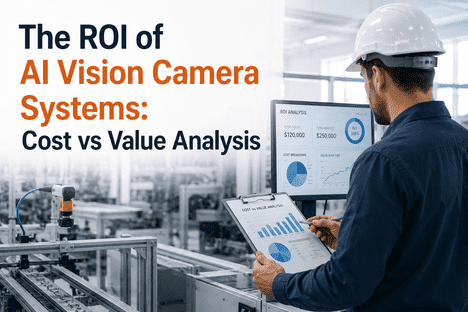
AI vision camera systems are no longer a futuristic investment reserved for large-scale automotive or semiconductor operations. For manufacturers across the U.S. running high-volume production lines, the question is no longer whether AI vision delivers ROI — it is how fast and how much. A deployment that catches defects at sub-100ms inference speed, runs 24 hours a day without fatigue, and feeds inspection data directly into a CMMS creates financial returns that compound across four simultaneous value streams: labor savings, scrap reduction, warranty avoidance, and throughput improvement. This guide breaks down the full cost structure of an AI vision camera system deployment, maps the value against each cost component, and provides the ROI framework U.S. manufacturers are using to justify and track their investment. Book a Demo.
Why the ROI Conversation Starts with the Cost of Poor Quality
The Cost of Poor Quality — the aggregate financial burden of defective product rework, scrap, customer returns, warranty claims, and production downtime — averages 20% of total revenue for manufacturers operating without automated inspection. That figure is the baseline against which any AI vision investment must be measured. For a manufacturer with $10 million in annual revenue, the COPQ floor is $2 million per year before a single AI camera is installed. A 25% reduction in that cost through early defect detection saves $500,000 annually — a payback that arrives before most single-station deployments reach their first anniversary. McKinsey estimates AI-driven quality control can reduce inspection costs by 30–50%, and industry deployment data consistently places full ROI inside 6 to 14 months. The financial argument is not marginal. It is structural.
Full Acquisition Cost Structure: What an AI Vision System Actually Costs
Transparent cost analysis is the foundation of a credible ROI model. AI vision system deployment costs fall into four categories: hardware acquisition, software licensing, integration, and ongoing operational costs. Each category carries a realistic range that varies by line speed, inspection complexity, number of camera stations, and the degree of integration required with existing MES, SCADA, or ERP systems. The table below provides the cost structure used by U.S. manufacturers conducting formal capital justification for AI vision investments.
| Cost Category | Single-Station Range | Multi-Line Range | Notes |
|---|---|---|---|
| Camera Hardware & Lighting | $8,000–$30,000 | $25,000–$90,000 | Industrial-grade cameras, structured lighting, mounts; existing IP cameras usable via ONVIF/RTSP |
| Edge Compute Hardware | $5,000–$20,000 | $15,000–$60,000 | GPU-enabled edge servers for sub-100ms inference; scales with line count |
| AI Platform Software License | $10,000–$40,000/yr | $30,000–$100,000/yr | Includes model training, dashboard, historian integration, and version updates |
| Installation & Commissioning | $5,000–$20,000 | $15,000–$50,000 | Camera positioning, lighting calibration, model training on initial defect library |
| MES/ERP/CMMS Integration | $5,000–$15,000 | $10,000–$40,000 | OPC-UA, MQTT, REST API connectivity to SAP, Oracle, Maximo, or CMMS platforms |
| Training & Model Updates | $2,000–$8,000/yr | $5,000–$20,000/yr | New part numbers or design changes require model update; typically completed in 24–48 hours |
| Total Year-One Deployment | $30,000–$130,000 | $80,000–$350,000 | Multi-line deployments benefit from shared platform infrastructure reducing per-line costs 30–40% |
The Four Value Streams That Drive AI Vision ROI
AI vision camera systems generate financial returns through four simultaneous and compounding value streams. Each operates independently — meaning a partial deployment, or a single-station pilot, still generates positive returns across multiple levers. The following breakdown maps each value stream to quantified outcomes drawn from documented manufacturing deployments running iFactory's AI vision platform.
Labor Cost Reallocation
Manual visual inspection is one of the most labor-intensive and fatigue-limited quality functions in any plant. A single trained inspector covering one shift costs $45,000–$75,000 annually in fully-loaded labor cost. Three-shift coverage on one line runs $135,000–$225,000 per year — for an inspection function that delivers 80–90% detection accuracy on a good day and deteriorates over an 8-hour shift. AI vision replaces this with 24/7 inspection at 99%+ detection accuracy and sub-100ms per-part decision speed. Documented per-line labor savings average $691,200 annually across Forrester-tracked deployments, not including the freed headcount that can be redeployed to higher-value quality engineering and process improvement roles.
Scrap and Rework Cost Reduction
Defects caught at the inspection station cost approximately $100 to address. The same defect caught at the customer costs $10,000 or more in warranty processing, field service, expediting, and relationship damage. AI vision catches defects at the earliest and cheapest point in production by detecting surface cracks, porosity, misalignment, scratches, and dimensional non-conformances at the micron level — defect types that both human inspectors and rule-based legacy vision systems routinely miss. Documented outcomes include a 37–85% reduction in defect escape rates and 40–70% reduction in quality-related scrap costs. For operations with $500,000 or more in annual scrap expense, this single value stream alone justifies the deployment cost.
Warranty and Recall Cost Elimination
Product recalls and warranty claims represent the most asymmetric cost risk in manufacturing. A single field recall can exceed the total cost of a plant-wide AI vision deployment by an order of magnitude. An electronics manufacturer that reduced its defect escape rate from 2.3% to 0.1% using AI vision eliminated $1.8 million of annual warranty exposure — from a single production line. Intel reports $2 million in annual savings from a single AI vision wafer inspection deployment. Medical device manufacturers have documented $18 million in annual savings from AI vision-driven defect elimination. The pattern is consistent: when AI vision prevents a defect from reaching the customer, it prevents not just the cost of that part but the multiplied cost of discovery, logistics, regulatory response, and customer attrition.
Throughput and OEE Improvement
Manual inspection stations create production bottlenecks because human throughput is limited by inspection time per part, fatigue, and shift changeover. AI vision inspects at line speed — processing each part in under 100 milliseconds and generating a pass/fail decision without slowing the production cycle. Removing the inspection bottleneck directly increases effective throughput on lines where manual inspection was the rate-limiting step. A semiconductor manufacturer increased throughput by 50% after AI vision deployment. Automotive deployments consistently report 20–35% throughput gains on high-speed lines. PwC projects that AI-driven manufacturing quality improvements will boost production efficiency by 40% by 2035 across the manufacturing sector. OEE improvement from eliminating unplanned downtime caused by defect-driven line stops and rework loops adds a further layer of measurable financial value that conventional ROI models often undercount.
Cost vs. Value: The ROI Calculation Framework
A structured ROI model for an AI vision camera deployment uses six inputs that every plant quality manager already tracks. The calculation does not require assumptions about market prices or macroeconomic conditions — it uses plant-specific cost data against documented value benchmarks from similar deployments. The comparison below contrasts what a manufacturer with $15 million in annual revenue, operating with industry-average COPQ of 20%, can expect from a single-line AI vision deployment versus continued manual inspection over a three-year period.
Payback Period by Industry and Deployment Type
Payback period — the point at which cumulative savings equal total deployment cost — is the metric plant finance teams use most frequently in capital justification reviews. The table below presents documented payback ranges by industry sector and deployment configuration, derived from iFactory platform deployment data and published industry case studies. Operations with high scrap rates or significant warranty exposure consistently reach payback faster than operations with lower baseline quality costs, because the savings denominator is larger from day one.
| Industry / Application | Typical Deployment Cost | Primary Value Driver | Payback Period | 3-Year ROI Range |
|---|---|---|---|---|
| Automotive — Surface Inspection | $80,000–$180,000 | Scrap reduction + warranty avoidance | 6–9 months | 300–500% |
| Electronics — PCB / Component | $50,000–$130,000 | Defect escape elimination | 4–8 months | 400–600% |
| Metal / Steel — Weld & Surface | $60,000–$150,000 | Labor savings + rework reduction | 6–12 months | 250–400% |
| Food & Beverage — Label / Fill | $30,000–$80,000 | Throughput + recall avoidance | 5–10 months | 200–350% |
| Medical Device — Critical Parts | $100,000–$250,000 | Regulatory compliance + warranty | 8–14 months | 400–700% |
| Semiconductor — Wafer / Die | $120,000–$300,000 | Yield improvement + scrap avoidance | 4–8 months | 500–800% |
Hidden Value: What Standard ROI Models Consistently Undercount
Standard capital justification models for AI vision systems typically capture labor savings, scrap reduction, and warranty exposure — the three most quantifiable value streams. What they consistently miss are the secondary financial benefits that accumulate as the inspection data platform matures. Understanding these sources of value explains why three-year ROI figures regularly exceed initial project models.
Every defect image captured by an AI vision camera system is a structured data record — timestamped, geo-referenced to the line station, tagged with defect type, and linked to the production batch and machine parameters at the moment of detection. When this data feeds into a CMMS or MES, it enables root cause analysis at a specificity that manual inspection logs cannot approach. Predictive maintenance models built on vision-detected defect patterns identify upstream process drift — a worn forming die, a miscalibrated weld parameter, a cooling circuit temperature anomaly — before the process produces out-of-specification product at scale. iFactory's AI vision platform integrates defect detection data with CMMS work order generation, creating a closed-loop quality and maintenance system where a detected surface defect automatically triggers an inspection work order on the upstream process asset. This integration eliminates the gap between quality event detection and maintenance response that manual systems cannot close. Book a Demo to see the full platform integration.
iFactory AI Vision Camera: What the Platform Delivers
iFactory's AI vision camera system is purpose-built for production manufacturing environments — not a generic computer vision framework adapted to the factory floor. The platform combines industrial-grade camera hardware with deep learning defect detection models, an edge compute architecture that processes inspection decisions in under 100 milliseconds at line speed, and native integration with the CMMS, MES, and ERP systems already running in U.S. plants. The result is a system that deploys in days, not months, reaches 99%+ detection accuracy on the target defect library, and generates structured quality data that feeds every downstream analytics and maintenance function.
Defect Detection at Micron Resolution
Deep learning models trained on your specific defect library detect surface cracks, porosity, dimensional non-conformances, misalignment, scratches, and color inconsistencies at the micron level — defect types that traditional rule-based vision systems and human inspectors consistently miss, particularly at high line speeds and under variable lighting conditions. Detection accuracy of 95–99% is documented across production deployments, with false reject rates below 0.3%.
Edge Processing at Line Speed
Inspection decisions are made at the edge — on compute hardware co-located with the camera station — in under 100 milliseconds per part. This eliminates cloud latency as a rate-limiting factor on high-speed lines and ensures the system operates independently of network availability. Edge architecture also keeps production data on-premises, satisfying IT security and data governance requirements that prevent cloud-dependent systems from reaching the production floor.
CMMS and MES Integration
iFactory integrates with existing production systems through OPC-UA, MQTT, and REST APIs — connecting to SAP PM, Oracle EAM, IBM Maximo, and any CMMS platform without custom middleware development. A defect detection event at the inspection station automatically generates a structured work order in the CMMS, routes it to the responsible technician, and updates the asset quality record. This closes the loop between defect detection and root cause correction that standalone inspection systems leave open.
Rapid Deployment and Model Training
Initial deployment — camera positioning, lighting calibration, and baseline model training — is completed in days, not months. Pre-configured models for common defect types can be fine-tuned with as few as five reference images per defect category. New part numbers require a new trained model; design changes that affect the inspection surface are updated in 24–48 hours. Organizations following iFactory's structured deployment approach achieve full ROI 40% faster than improvised implementations.
Industry Benchmark: What Top-Performing Manufacturers Achieve
The manufacturers achieving the fastest AI vision ROI share a consistent deployment pattern: they start with the single highest-impact inspection point — the station where defect escapes are most costly, where manual inspection creates the largest bottleneck, or where scrap rates are highest — prove ROI on that station in the first quarter, and then scale the platform across additional lines using the shared infrastructure that is already paid for. The compounding effect is significant. By the time a three-line deployment is running, the per-line economics are 30–40% better than the pilot station, and the quality data from three lines is feeding a predictive maintenance model that is generating its own independent ROI from upstream process improvement. The plants still running fixed-schedule inspection or legacy rule-based vision systems are not saving money — they are deferring the cost of every defect they miss until it shows up at the customer.
— iFactory Platform Deployment Data & Industry ROI Benchmarks, 2026Conclusion
The ROI of an AI vision camera system is not speculative. It is a direct function of the gap between your current Cost of Poor Quality — averaging 20% of revenue across U.S. manufacturers — and the detection accuracy, throughput capability, and data integration that AI vision delivers. The four value streams that drive the financial return — labor savings, scrap reduction, warranty elimination, and throughput improvement — operate simultaneously from the day the system is commissioned. Documented three-year ROI of 374% and average payback periods of 7–8 months place AI vision among the highest-return capital investments available to manufacturing operations today.
The cost structure is transparent: a single-station deployment runs $30,000–$130,000 all-in, with multi-line scaling reducing per-station costs by 30–40% as the shared platform infrastructure amortizes. iFactory's AI vision camera platform adds CMMS integration, edge processing at line speed, and a structured deployment approach that delivers full ROI 40% faster than improvised implementations. The manufacturers who remain on manual inspection or legacy rule-based vision systems are not avoiding the cost of AI vision — they are paying the cost of every defect that escapes to the customer, multiplied by $10,000 or more per field occurrence. Book a Demo to model the ROI for your specific operation.
Frequently Asked Questions
A single-inspection-station deployment — covering camera hardware, industrial lighting, edge compute, AI platform software, installation, commissioning, and initial model training — typically runs $30,000 to $130,000 all-in for the first year, depending on line speed, part complexity, and integration requirements. Facilities that already have compatible IP cameras can reduce hardware costs significantly by connecting existing cameras via ONVIF or RTSP protocols. Multi-line deployments benefit from shared platform infrastructure that reduces per-line costs by 30–40% compared to the pilot station cost, which is why most ROI models that account for scale expansion show accelerating returns from year two onward.
Documented payback periods across U.S. manufacturing deployments average 7–8 months, with a range of 4–14 months depending on the baseline scrap rate, manual inspection headcount being replaced, and warranty exposure at the target inspection point. Operations with high defect escape rates or expensive customer returns reach payback fastest because the savings denominator is largest. For a plant with $10 million in revenue and a 20% Cost of Poor Quality, a 25% reduction in quality costs from AI vision saves $500,000 annually — full payback on a $100,000 deployment in under three months from scrap reduction alone, before labor savings or warranty avoidance are counted. Forrester Research documents a 374% average three-year ROI across AI visual inspection deployments.
Yes. iFactory integrates with existing production and maintenance systems through OPC-UA, MQTT, and REST APIs — connecting to SAP PM, Oracle EAM, IBM Maximo, and any CMMS or MES platform without custom middleware development. The integration transforms AI vision from a standalone inspection tool into a quality intelligence platform: a defect detection event at the inspection station automatically generates a structured work order in the CMMS, routes it to the responsible technician, and updates the asset quality record in the historian. iFactory also works with existing IP cameras via ONVIF and RTSP protocols, so facilities with installed camera infrastructure can accelerate deployment timelines and reduce hardware acquisition costs significantly.
Initial deployment — camera positioning, lighting calibration, and baseline model training on the target defect library — is completed in days, not months. iFactory's pre-configured models for common defect types (surface cracks, porosity, dimensional non-conformances, misalignment, scratches) can be fine-tuned with as few as five reference images per defect category. New part numbers require a dedicated trained model; design changes that affect the inspection surface are updated in 24–48 hours using images of the modified part. New part variants using the same base geometry can often transfer from the existing model with 50–100 additional training images. Organizations following iFactory's structured deployment approach achieve full production-grade accuracy 40% faster than unstructured implementations.
AI vision systems running iFactory's platform achieve 95–99% detection accuracy in documented production deployments, with false reject rates below 0.3% — meaning the system is not creating scrap by over-rejecting good product. By comparison, trained human inspectors deliver 80–90% detection accuracy on a best-case basis, with accuracy degrading measurably over an 8-hour shift due to fatigue, inconsistent lighting judgments, and inter-inspector variability. An electronics manufacturer using iFactory's platform reduced its defect escape rate from 2.3% to 0.1%, eliminating $1.8 million in annual warranty exposure. The detection comparison is not marginal — it is a 10–20 percentage point accuracy improvement that is consistent 24 hours a day, seven days a week, without shift changeover gaps or fatigue-driven variance.