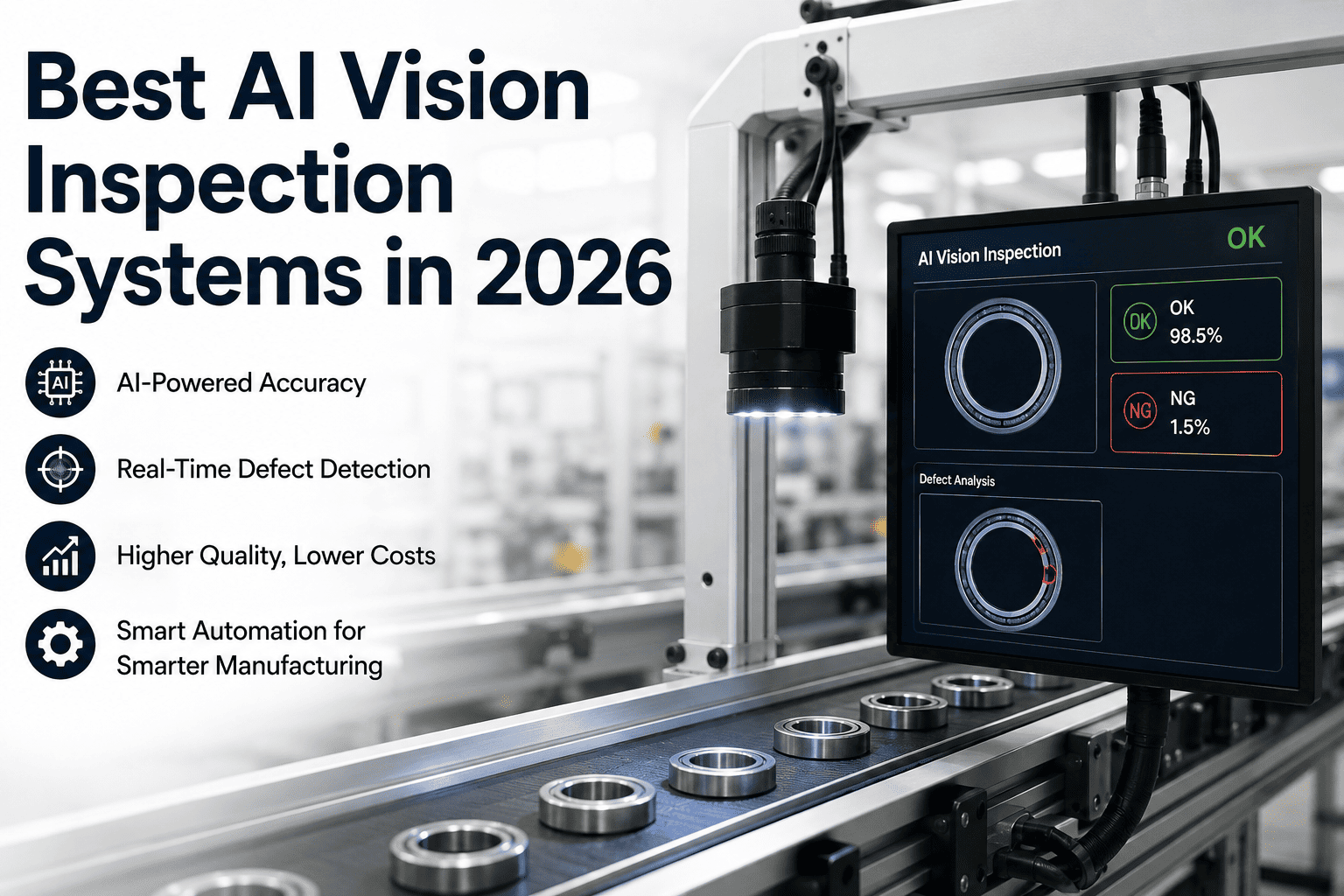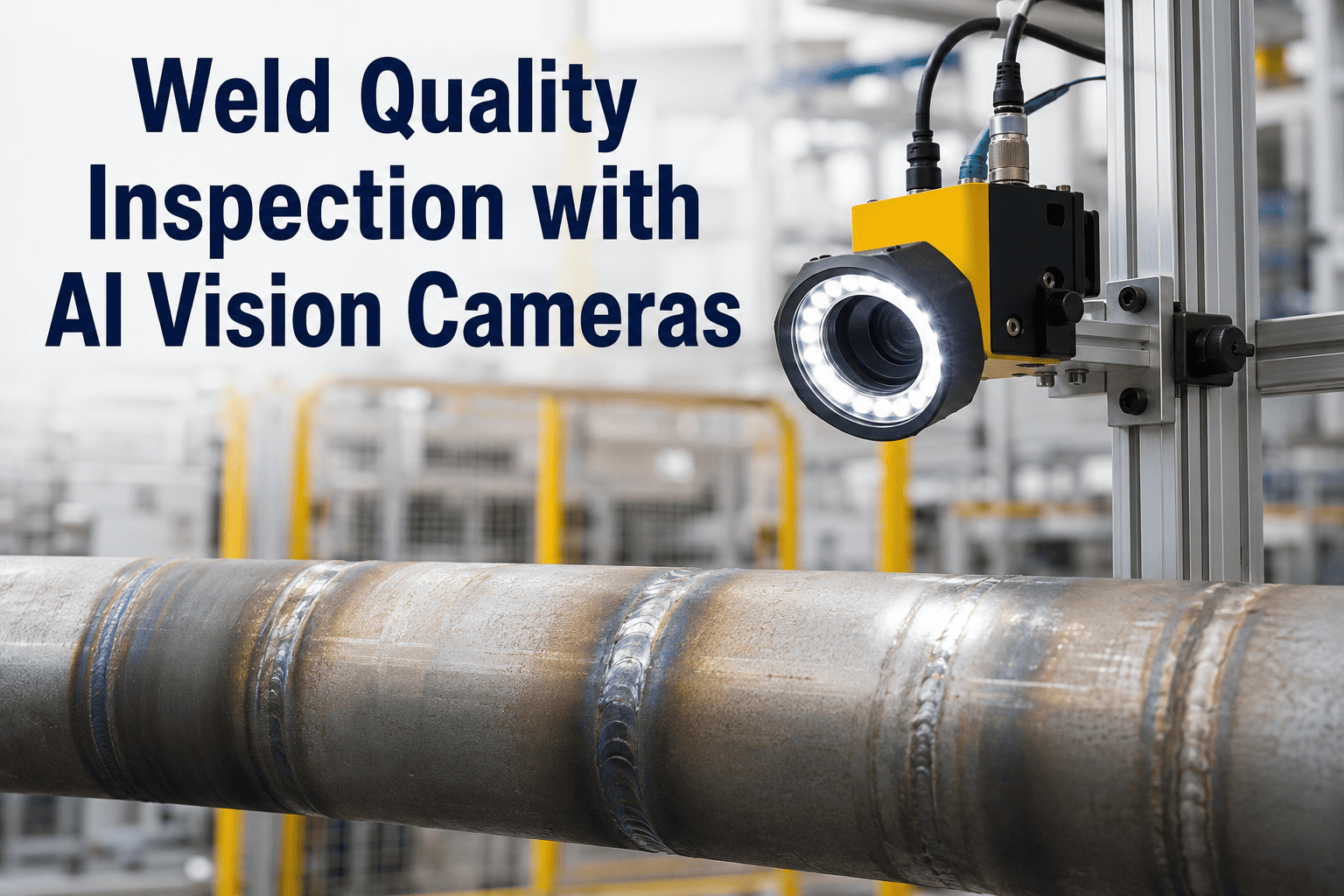
Choosing the right AI vision camera for your manufacturing operation in 2026 is no longer just a technology procurement decision — it is a strategic investment that directly determines product quality outcomes, production throughput, and overall equipment effectiveness. With hundreds of inspection cameras, smart sensors, and machine vision systems flooding the market, manufacturing engineers face the challenge of identifying which system actually delivers the resolution, processing speed, and AI inference capability their specific production environment requires. This buyer's guide cuts through marketing claims to provide a structured comparison framework — covering resolution specifications, frame rate requirements, AI processing architecture, environmental ratings, and integration compatibility — so you can select the vision system that matches your actual production conditions, not just your budget range. Manufacturing and reliability engineers evaluating vision system upgrades who Book a Demo with iFactory before finalizing their camera specifications consistently achieve faster deployment timelines and lower total integration costs than teams that select hardware without first validating against their production line conditions. iFactory's is purpose-built for these demanding production environments, combining edge inference with adaptive defect classification that traditional machine vision cannot match.
Compare and Select the Best AI Vision Camera for Your Production Line
iFactory helps manufacturing engineers evaluate AI vision cameras against real production conditions — reducing integration risk and accelerating deployment timelines.
Why AI Vision Cameras Matter in 2026 Manufacturing
The manufacturing landscape in 2026 is defined by increasingly tighter quality tolerances, higher production line speeds, and persistent labor shortages in quality inspection roles. Traditional machine vision systems — programmed with fixed rules and thresholds — cannot adapt to product variation, lighting changes, or surface anomalies the way AI-powered vision cameras can. Modern AI vision cameras embed neural network inference directly on the camera processor, enabling real-time defect detection, classification, and decision-making at the edge without sending every frame to a central server. This on-camera AI processing reduces latency from hundreds of milliseconds to single-digit milliseconds, making it possible to inspect 100 percent of products at full line speed rather than sampling a fraction. Manufacturers deploying AI vision cameras in 2026 report 30 to 50 percent reduction in escaped defects, 40 percent faster changeover times between product runs, and significantly lower false rejection rates compared to traditional vision systems. Production and quality engineers who Book a Demo with iFactory can see how the platform integrates with existing production line architectures to deliver these outcomes from the first production run.
Real-Time Edge Inference
AI vision cameras process neural network models directly on the camera hardware, eliminating the round-trip latency to a central server. This enables real-time defect detection at full production line speeds, catching dimensional errors, surface defects, and assembly faults the instant they occur.
Edge AI · Real-Time Processing · Low LatencyAdaptive Defect Classification
Unlike fixed-threshold vision systems, AI-powered cameras learn from production data and adapt to acceptable process variation. This dramatically reduces false rejection rates while maintaining or improving true defect capture — critical for high-volume food and consumer goods manufacturing lines.
Machine Learning · Adaptive Thresholds · False RejectionMulti-Spectral Inspection Capability
Modern AI vision cameras support visible light, infrared, hyperspectral, and 3D depth sensing within a single hardware platform. This allows a single camera station to perform tasks that previously required multiple specialized inspection systems — from label verification to seal integrity to foreign material detection.
Multi-Spectral · 3D Depth · HyperspectralPredictive Maintenance Integration
AI vision cameras monitor not just product quality but also equipment condition — detecting conveyor belt wear, nozzle clogging, tool degradation, and packaging material inconsistencies before they cause production stops. This dual-purpose capability delivers ROI from both quality and reliability improvement.
Predictive Maintenance · Equipment Monitoring · Dual ROIAI Vision Camera Specifications Comparison for 2026
Selecting the right AI vision camera requires understanding the key specification parameters that determine real-world inspection performance. Resolution, frame rate, AI inference capability, environmental protection, and communication protocol compatibility all factor into the final decision. The comparison table below maps the critical specification categories against the production conditions they support, helping manufacturing engineers match camera capabilities to their actual line requirements. Engineers developing camera specification documents who Book a Demo with iFactory can access detailed specification templates and integration validation checklists before finalizing vendor selections.
| Camera Specification | Entry Level | Mid Range | High Performance | Best Application | Critical Selection Note |
|---|---|---|---|---|---|
| Resolution | 2–5 MP | 5–12 MP | 12–50 MP | Fine defect detection requires 12 MP minimum | Higher resolution reduces field of view — balance against line speed |
| Frame Rate | 30–60 fps | 60–200 fps | 200–1000+ fps | High-speed packaging lines require 200+ fps | Frame rate and resolution are inversely related — verify both at full AI inference load |
| AI Processing | Cloud-based | Edge NPU to 2 TOPS | Edge NPU 4–20 TOPS | Real-time 100% inline inspection requires on-camera inference | TOPS rating alone does not determine inference speed — verify model compatibility |
| Sensor Type | CMOS Visible | CMOS + NIR | Multi-Spectral or 3D | Foreign material detection requires hyperspectral capability | Select sensor type based on defect characteristics, not cost |
| IP Rating | IP54 | IP65 | IP67 / IP69K | Washdown food environments require IP69K minimum | Housing cooling must be verified for high-temperature production zones |
| Connectivity | GigE Vision | GigE + USB3 | 10GbE / Fiber / Wireless | High-resolution multi-camera systems require 10GbE backbone | Verify cable length limits — 10GbE over copper is limited to 100 m |
| Software Ecosystem | Proprietary SDK | OpenCV / HALCON | Full AI Training Platform | Frequent product changeovers require onboard retraining capability | Verify retraining workflow does not require data science team |
Top Manufacturing Applications for AI Vision Cameras in 2026
AI vision cameras are transforming quality inspection and process monitoring across virtually every manufacturing sector. The most impactful applications combine high inspection speed with adaptive defect classification that traditional vision systems cannot achieve. Understanding the primary application categories helps manufacturing engineers identify where AI vision investment delivers the fastest return.
In-line Quality Defect Detection
AI vision cameras inspect 100 percent of products at full line speed, identifying dimensional deviations, surface defects, color inconsistencies, contamination, and assembly errors in real time. The neural network adapts to acceptable process variation while flagging true defects, reducing false reject rates by up to 60 percent compared to traditional rule-based vision systems.
Defect Detection · 100% Inspection · Real-Time QualityPackaging and Label Verification
Packaging inspection — including label position, barcode readability, seal integrity, fill level, and date code accuracy — is one of the highest-volume vision inspection applications. AI vision cameras handle multiple package formats on the same line without reprogramming, automatically adjusting inspection criteria when packaging format changes are detected.
Packaging Inspection · Label Verification · Format AdaptabilityAssembly and Component Verification
In assembly operations, AI vision cameras verify that all components are present, correctly oriented, and properly assembled before the product moves to the next station. The system learns the correct assembly pattern from a small set of known-good samples and detects deviations including missing components, incorrect fasteners, misaligned parts, and foreign objects.
Assembly Verification · Component Detection · Foreign Object DetectionEquipment Condition and Process Monitoring
Beyond product inspection, AI vision cameras monitor equipment condition indicators — belt tracking, nozzle spray patterns, tool wear, conveyor component degradation, and material flow inconsistencies. When integrated with a facility management platform like iFactory's AI vision camera platform, vision-based equipment monitoring feeds condition data directly into predictive maintenance workflows, enabling maintenance teams to address developing issues before they cause production stops.
Condition Monitoring · Predictive Maintenance · Equipment HealthSee How iFactory's AI Vision Cameras Perform on Your Production Line
Schedule a live demonstration with our engineering team to evaluate iFactory's AI vision camera platform against your actual production conditions and defect types.
How to Select the Right AI Vision Camera for Your Production Line
Selecting the optimal AI vision camera requires a structured evaluation process that begins with production line requirements — not camera specifications. Manufacturing teams that start with a clear defect catalog, line speed profile, and environmental condition survey consistently select systems that deliver full ROI within 12 months, while teams that begin with camera brochures frequently over-specify or under-specify critical parameters.
Defect Cataloging and Classification
Document every defect type that must be detected, including dimensional tolerance, surface characteristics, color variation, and contamination. Classify defects by detection difficulty, occurrence frequency, and severity impact. This catalog drives resolution, sensor type, and AI model architecture decisions more directly than any other input.
Line Speed and Field of View Calculation
Calculate the maximum allowed inspection time per product based on line speed and product spacing. This determines the minimum required frame rate and, when combined with the required field of view, establishes the resolution specification. A system that cannot complete inference within the available time window will miss defects regardless of camera quality.
Environmental Condition Assessment
Document ambient temperature range, washdown exposure, airborne particulate levels, vibration amplitude, and lighting conditions in the proposed camera mounting location. Camera housing, lens selection, cooling requirements, and connector specifications are all determined by these environmental factors — and selecting hardware that does not match the installed environment remains the most common cause of field failure in vision system deployments.
Integration Architecture and Data Flow Planning
Define how inspection results are communicated to downstream systems — rejection mechanisms, alarm escalation, data logging to the analytics platform, and model retraining workflow. The integration architecture must be defined before camera procurement because communication protocol compatibility and data throughput requirements directly influence camera selection. Quality and reliability engineers who Book a Demo with iFactory receive integration architecture templates that map vision data flows to existing plant systems.
AI Vision Cameras for Manufacturing — Frequently Asked Questions
What makes an AI vision camera different from a traditional machine vision camera?
An AI vision camera embeds neural network inference processing directly on the camera hardware, allowing it to classify defects, adapt to process variation, and make inspection decisions without sending image data to an external computer. Traditional machine vision cameras require separate processing hardware and use fixed rule-based algorithms that cannot adapt to product variation without manual reprogramming.
What resolution do I need for manufacturing defect detection?
Required resolution depends on the smallest defect that must be detected and the field of view required. A general guideline is that the smallest defect must be covered by at least 3 to 5 pixels in the captured image. For typical manufacturing applications with moderate field of view, 5 to 12 megapixel cameras are most common. Fine defect detection or large field of view applications may require 20 to 50 megapixel sensors.
Can AI vision cameras operate in washdown food processing environments?
Yes, when specified with appropriate IP ratings and housing materials. AI vision cameras with IP67 or IP69K-rated stainless steel housings and M12 sealed connectors are designed for high-pressure washdown environments. Camera housing cooling must be verified for applications where washdown water temperature and ambient process heat combine to exceed camera operating temperature limits.
How long does it take to train an AI vision model for a new product?
Modern AI vision camera platforms with onboard retraining capability can be trained on 50 to 200 good-product images and a similar number of defect images. Training time ranges from 30 minutes to 4 hours depending on model complexity and available compute, with inference deployment occurring immediately after training completion without manual model conversion steps.
How does iFactory's AI vision camera platform integrate with existing plant systems?
iFactory's AI vision camera platform provides native integration with major MES, SCADA, and CMMS platforms through REST API, MQTT, and OPC UA protocols. Inspection results are automatically logged with timestamps and product identifiers, rejection events trigger configured outputs, and quality trend data feeds into the facility's analytics dashboard for continuous process improvement. Manufacturing teams evaluating integration options can Book a Demo to see the integration workflow on their system architecture.
Select the Right AI Vision Camera for Your Manufacturing Line
iFactory's engineering team works with manufacturing and quality engineers to evaluate AI vision cameras against real production conditions — providing specification guidance, integration validation, and deployment support that ensures your vision system delivers full ROI from the first production run.