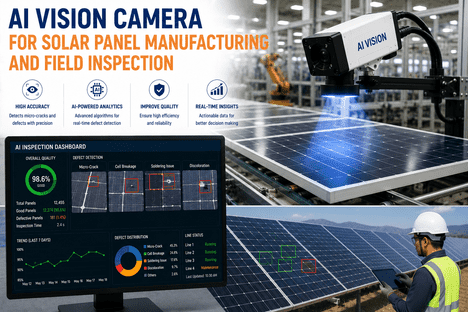
Solar panel manufacturing and field inspection sit at opposite ends of the photovoltaic value chain, but they share a single underlying problem: defects that are invisible to the naked eye under normal lighting conditions are responsible for the majority of long-term yield losses and warranty claims. A micro-crack introduced during wafer handling, an encapsulant void left by a lamination process deviation, or a busbar misaligned beyond 50-micron tolerance at the stringer — none of these are detectable by a production line operator during normal observation, yet each can reduce panel output by 5–30% across a 25-year service life. In the field, the same invisibility problem plays out at scale: a 100 MW solar farm contains tens of thousands of panels, and a trained technician with a handheld thermal camera can inspect only 1–2 MW per day. AI vision camera technology closes both gaps simultaneously — delivering sub-100ms defect detection in the manufacturing environment at full line throughput, and enabling drone-mounted AI inspection of utility-scale farms that covers in hours what ground crews need months to achieve. The iFactory AI Vision Camera is built for exactly this dual-application environment: providing on-premise edge inference for manufacturing floor EL and visual inspection, and generating the per-panel defect records that field maintenance teams need to prioritize repair actions across large installed portfolios.
See How iFactory AI Vision Camera Works in Solar Panel Inspection
iFactory's AI Vision Camera delivers real-time defect detection on the manufacturing line and supports field inspection workflows — with automated anomaly classification and CMMS-ready records for PV facilities of every scale.
Defects That AI Vision Detects During Solar Panel Manufacturing
Solar panel manufacturing combines fragile semiconductor materials with high-speed production economics that push wafer handling above 3,000 cells per hour. At that throughput, human visual inspection is structurally incapable of catching the defect types that determine long-term panel performance. AI vision camera systems — operating across visible light, electroluminescence, and thermal imaging modalities — detect the full range of manufacturing defects that human inspectors and legacy rule-based vision systems consistently miss. Deep learning models trained on cell crack morphologies, busbar misalignment signatures, and encapsulant void patterns achieve detection accuracy above 95% on curated manufacturing datasets, with the best systems exceeding 99% mean average precision on defect classification tasks in controlled production environments.
Micro-Crack Detection
Wafer handling at production speed introduces micro-cracks that are invisible under standard illumination. Electroluminescence imaging — where cells are forward-biased and emitted light is captured in darkness — reveals crack morphologies, inactive cell regions, and resistive shunts at sub-cell resolution. AI models classify crack type, extent, and likely propagation trajectory under thermal cycling and mechanical load.
Busbar & Finger Defects
Stringer machines must place silver contacts within 50-micron tolerances. Broken busbars, missing fingers, silver paste smearing, and misregistration are detected through high-resolution visible-light imaging with AI models that distinguish acceptable printing variation from genuinely defective contact formation — reducing false positive rates that plague rule-based threshold systems.
Encapsulation Flaws
Lamination must eliminate all EVA encapsulant voids and bubbles without creating stress concentrations that later admit moisture. UV fluorescence imaging detects delamination, encapsulant yellowing, and photochemical degradation signatures by exciting different fluorescence intensities across degraded and intact regions — defect types that are completely invisible to standard visible-light imaging.
Wafer & Cell Surface Defects
Chips, pinholes, contamination, colour variation, edge isolation failures, and shunts introduced during diffusion and cell processing are detected at wafer level before stringing. AI vision inspection at this stage prevents defective wafers from continuing into more costly downstream processes, improving overall manufacturing yield efficiency across the production sequence.
AI Vision for Installed Solar Farm Inspection: Defects, Methods & Scale
The solar industry added a record 452 GW of new capacity in 2024 alone — and with that growth comes a maintenance problem that scales far faster than the ground inspection workforce can follow. Equipment-driven underperformance across the global fleet translated to an estimated $10 billion in unrealized revenue in 2024, with the majority of yield losses attributable to defects that are invisible to visual inspection but clearly detectable with thermal imaging and AI classification. A drone capturing thermal and RGB data can cover a 1 MWp solar site in approximately 8 minutes; AI-powered analysis then processes thousands of images in hours rather than the days that panel-by-panel manual review demands. The resulting output is a geo-referenced defect map — every anomaly located by panel ID, classified by fault type, and ranked by severity — that maintenance teams can act on the same day the inspection is completed. Book a Demo to see how iFactory's AI Vision Camera integrates with drone inspection data workflows.
Hotspot Detection
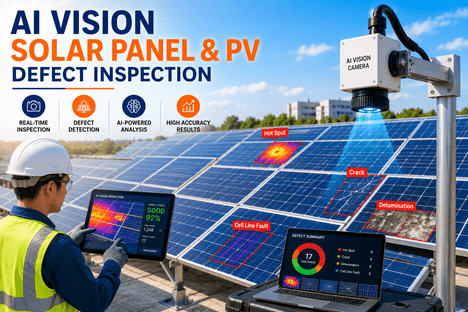
Defective cells, poor solder joints, and bypass diode failures generate localised overheating that thermal AI detects when the temperature differential exceeds 20°C above adjacent cells — the IEC TS 62446-3:2017 threshold that eliminates false positives from shading and angle artifacts. A single hotspot can reduce a panel's output by 10–30% and represents a fire risk if left unaddressed.
PID & String Faults
Potential Induced Degradation results from ion migration driven by voltage potential between the module frame and cells — and can cause 20–30% power loss across entire strings within a single year if not caught early. AI models trained on PID thermal signatures detect the characteristic patterns across panel groups, enabling grounding corrections before degradation accelerates to a point of irreversible loss.
Delamination & Snail Trails
Moisture ingress through encapsulant delamination and mechanical stress micro-cracks produce the irregular warm signatures and snail-trail heat patterns visible in thermal imaging. These field defects are the downstream manifestation of manufacturing-stage encapsulation failures, making cross-referencing of manufacturing records with field inspection data a high-value traceability workflow.
Soiling & Physical Damage
Dust accumulation, bird droppings, vegetation overgrowth, and broken glass are detected through RGB visual imaging in the same drone pass as thermal data collection. Soiled panels run cooler under thermal imaging because less light reaches the cells — a thermal signature that AI distinguishes from electrical fault patterns, enabling separate cleaning and repair work order streams.
Manual vs. AI Vision Inspection: Solar Manufacturing & Field
The performance gap between manual inspection and AI vision inspection in solar applications is not a matter of degree — it is a structural difference in what each method is physically capable of detecting and at what throughput. The table below maps the comparison across both the manufacturing floor and field inspection contexts.
| Inspection KPI | Manual / Traditional | AI Vision Camera | Improvement |
|---|---|---|---|
| Micro-crack detection (manufacturing) | Not detectable under standard lighting | Sub-cell resolution via EL imaging AI | Entirely new capability |
| Manufacturing defect classification accuracy | Subjective — operator-dependent | 95–99% mAP on trained defect classes | Consistent, operator-independent |
| Field inspection coverage (thermal) | 1–2 MW/day (manual ground crew) | 1 MWp in ~8 minutes (drone + AI) | ~60× faster coverage |
| Hotspot detection accuracy (field) | Visible hotspots only; misses early-stage | 98.5% with <2% false positive rate | Early-stage detection enabled |
| PID detection | Not detectable visually; caught by output loss | Thermal pattern recognition at string level | Preventive — before output loss |
| Per-panel traceability records | Manual logs; incomplete; no image evidence | Automated, timestamped, geo-referenced | Complete audit trail |
How iFactory AI Vision Camera Operates Across Manufacturing and Field
The iFactory AI Vision Camera platform is designed to operate across both the controlled environment of a solar panel manufacturing line and the variable conditions of a utility-scale field installation. In both contexts, the core architecture is identical: edge inference on NVIDIA GPU hardware, zero cloud dependency for real-time decisions, and automatic generation of structured inspection records that feed directly into maintenance work order queues. For solar manufacturing, the platform integrates with existing line PLCs and SCADA systems via OPC-UA and Modbus protocols — adding EL imaging analysis, UV fluorescence inspection, and visible-light cell defect detection to the production sequence without requiring infrastructure overhaul or line shutdown. For field applications, iFactory's AI engine processes drone-captured thermal and RGB imagery to generate geo-referenced defect maps, panel-level anomaly classifications, and severity-ranked repair priority lists within hours of data capture. In both applications, the output is the same: actionable inspection intelligence with zero manual image review required.
Multi-Modality Image Acquisition
Industrial cameras capture each cell or panel under the appropriate imaging modality — visible light for surface and contact defects, EL for internal crack and shunting detection, UV fluorescence for encapsulant condition, and thermal IR for hotspot and PID identification. In manufacturing, all modalities run in-line at production speed. In the field, thermal and RGB data are captured in a single drone pass per IEC TS 62446-3:2017 irradiance and wind speed requirements, producing the radiometric temperature values needed for warranty-grade defect documentation.
Edge AI Defect Classification
Deep learning models running on-premise classify every detected anomaly by defect type, severity, and location. In manufacturing, this means distinguishing a genuine busbar break from acceptable silver paste variation, or a propagating micro-crack from a stable surface mark. In the field, the model applies trained hotspot, PID, string outage, delamination, and soiling classifications — assigning each anomaly a severity tier and panel ID before any human reviews a single image. Processing runs at sub-100ms inference latency per frame, with no data leaving the facility or field gateway.
Automated Work Order & Traceability Generation
Every classification event automatically generates a structured record: defect type, severity score, panel or cell ID, GPS coordinate (field) or production batch reference (manufacturing), timestamped image evidence, and recommended action. In manufacturing, this triggers an immediate quality hold or CMMS work order for the affected panel. In the field, the output is a geo-referenced report with fault counts by type, severity-ranked repair priority list, and annotated defect maps — ready for maintenance scheduling without any manual report assembly. Book a Demo to see how this workflow integrates with your existing CMMS or O&M platform.
Continuous Performance Monitoring & Warranty Documentation
Repeated inspection cycles — quarterly or post-storm for field sites — build a time-stamped performance archive that identifies slow-burn degradation patterns like PID spread, soiling trends, and vegetation encroachment well before they trigger output losses detectable by SCADA monitoring. For warranty claim purposes, radiometric thermal imagery captured under IEC-compliant conditions provides the precise Delta T measurements that manufacturers and insurers require for claim validation and repair reimbursement approvals.
AI Vision Inspection by Solar Application Type
AI vision inspection requirements differ significantly across solar manufacturing stages and field installation types. The table below maps the primary defect detection priorities, imaging modalities, and applicable inspection standards to each application context.
| Application | Primary Defects Detected | Imaging Modality | Standard / Reference |
|---|---|---|---|
| Wafer & Cell Manufacturing | Chips, pinholes, contamination, edge isolation failures, shunts, colour variation | Visible light + photoluminescence | IEC 60904 series; manufacturer process specs |
| Stringing & Busbar Inspection | Broken busbars, missing fingers, paste smearing, misregistration, cross-cracks | High-resolution visible + EL imaging | IEC 61215; 50-micron placement tolerance |
| Lamination & Encapsulation | EVA voids, bubbles, delamination, yellowing, photochemical degradation | UV fluorescence imaging | IEC 61730; encapsulant adhesion standards |
| Module Final Inspection (EL) | Micro-cracks, inactive cell regions, finger interruptions, resistive shunts | Electroluminescence (EL) imaging | IEC 60904-13; EL imaging factory protocols |
| Utility-Scale Field Inspection | Hotspots, PID, string faults, bypass diode failure, soiling, delamination, snail trails | Thermal IR + RGB (drone-mounted) | IEC TS 62446-3:2017; ΔT ≥20°C threshold |
| Rooftop & C&I Installations | Cracked glass, junction box overheating, connector faults, vegetation shading | Thermal IR + visible RGB | IEC TS 62446-3; site-specific O&M protocols |
The Financial Case for AI Vision in Solar Manufacturing and Field Operations
The business case for AI vision inspection in solar operates through three distinct financial mechanisms that apply independently in manufacturing and field contexts. In manufacturing, the primary driver is defect containment cost: a panel that is caught at the cell inspection stage costs a fraction of one that fails after lamination, and a fraction again of one that is shipped, installed, and generates a warranty claim in the field. Catching micro-cracks before stringing eliminates not just the cell cost but the downstream lamination, framing, and logistics cost of rework. In the field, the mechanism is yield recovery: a single hotspot reduces a panel's output by 10–30%, and on a 10 MW site generating $800,000 per year, a 5% undetected yield loss represents $40,000 annually — against a comprehensive drone inspection cost of roughly $3,000 for the same site. The third mechanism is warranty claim documentation: radiometric thermal data captured under IEC TS 62446-3:2017 conditions provides the precise Delta T measurements that manufacturers and insurers require for warranty validation. AI vision inspection systems in solar manufacturing and field applications typically achieve full cost recovery within six to twelve months through combined defect containment savings, yield recovery, and warranty claim acceleration. Book a Demo to receive a site-specific ROI estimate for your manufacturing line or installed portfolio.
"We were shipping panels with micro-crack rates we could not see during production. After deploying iFactory's AI Vision Camera on our EL inspection line, we identified an entire batch category with systematic stringing-stage cracks within the first week. The quality hold prevented those modules from reaching installation. In the same quarter, our field operations team used the inspection records to cross-reference with site thermal data — and we reduced our warranty claim processing time significantly because the documentation was already complete and IEC-compliant."
AI Vision Camera for Solar Inspection: Common Questions
Can AI vision detect micro-cracks that are invisible under standard production line lighting?
Yes. Micro-cracks are not detectable under standard visible illumination — they require Electroluminescence imaging, where cells are forward-biased and emitted light is captured in darkness. iFactory's AI Vision Camera platform processes EL images with deep learning models trained on cell crack morphologies, classifying crack type, extent, and likely propagation trajectory. This EL inspection can be integrated into the production line and run at throughput speeds without requiring a separate offline inspection station.
What imaging modalities does the iFactory platform support for solar panel inspection?
The platform supports visible light, Electroluminescence (EL), UV fluorescence, and thermal infrared imaging modalities — covering the full defect taxonomy from wafer surface contamination and busbar misregistration through encapsulant delamination and field hotspot detection. Different modalities are deployed at the appropriate point in the manufacturing sequence or field inspection workflow, with AI models trained on each modality's specific defect signatures.
How does the system integrate with an existing solar manufacturing line?
iFactory integrates with existing manufacturing line PLCs and SCADA systems via standard OPC-UA and Modbus protocols. Camera hardware is installed at the inspection point — inline with the production conveyor — without requiring line shutdown. AI model training on facility-specific cell types, defect classes, and acceptable variation is completed during a baseline period before live classification begins. Full integration is typically complete within four to five weeks.
Does iFactory support drone inspection data processing for field solar farm applications?
Yes. iFactory's AI engine processes drone-captured thermal and RGB imagery to produce geo-referenced defect maps, panel-level anomaly classifications, and severity-ranked maintenance priority lists. The output satisfies IEC TS 62446-3:2017 documentation requirements for warranty-grade inspection records, including the Delta T measurements insurers and manufacturers require for claim validation. Book a Demo to discuss your field inspection data workflow requirements.
What is the typical deployment timeline for a solar panel manufacturing facility?
Most solar manufacturing facilities complete camera installation, PLC integration, AI baseline training, and full live inspection within five weeks. Weeks one and two cover hardware installation and system integration. Week three establishes the AI baseline for the specific cell type, imaging conditions, and defect classes in use. Live automated defect classification with quality hold integration is operational by week four, with complete analytics, batch traceability, and compliance dashboards live by week five.
AI Vision Inspection Is Now the Quality Baseline for Solar Manufacturing and O&M
The structural limitations of manual solar panel inspection — inability to detect EL-only defects, throughput constraints on manufacturing lines, inspection coverage rates measured in megawatts per day rather than per hour, and the inconsistency inherent in shift-dependent human observation — cannot be resolved by adding inspection staff or improving inspector training. They are physical constraints on what human visual inspection can achieve in a photovoltaic production and field maintenance context. AI vision camera technology removes each constraint at its root: detecting micro-cracks, busbar defects, and encapsulation flaws in-line during manufacturing at full production throughput, and enabling drone-mounted inspection that covers utility-scale farms in hours with anomaly classification accuracy above 95%. The iFactory AI Vision Camera is deployable in five weeks on the manufacturing floor without production shutdown, and its AI engine processes field inspection data to deliver geo-referenced, IEC-compliant defect records the same day a drone survey is completed. For solar manufacturers competing on panel quality and warranty cost management, and for O&M teams responsible for yield performance across large installed portfolios, AI vision inspection is no longer a future technology investment — it is the operational standard the industry has already moved to.
Ready to Deploy AI Vision Inspection Across Your Solar Manufacturing Line or Field Portfolio?
Connect with an iFactory specialist today. Get a site-specific ROI estimate, a defect detection capability assessment, and a clear five-week deployment roadmap for your facility — no obligation, no pressure.