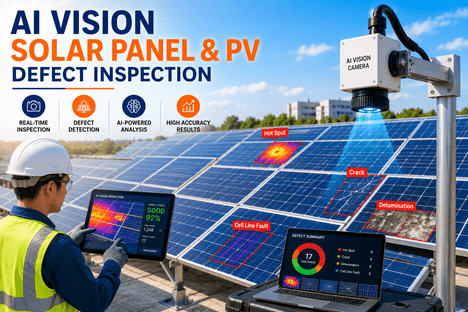
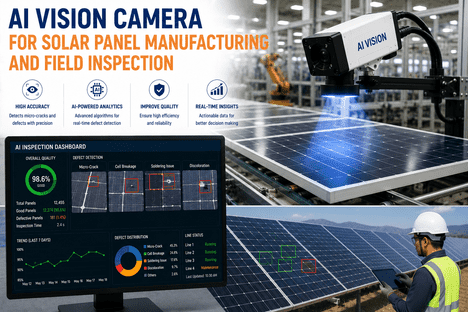
Solar farms lose a measurable share of their annual energy yield to defects that conventional O&M cycles catch too late — microcracks that spread silently inside laminated cells, hotspots that signal cell mismatch or bypass diode failure, soiling that dims output panel by panel, and Potential Induced Degradation that can erode 30% of a string's power before anyone notices a problem. A technician walking rows with a handheld thermal camera covers only one to two megawatts a day, so by the time a 100 MW farm finishes a manual sweep, conditions at the first panels have already changed. iFactory's AI Vision Camera replaces that calendar-based walk with continuous, drone-deployable computer vision trained on solar-specific defect signatures — turning panel inspection from a slow manual audit into a real-time yield-protection system. Book a Demo to see the platform classify cracks, hotspots, and soiling on real PV imagery.
Catch Cracks, Hotspots, and Soiling Before They Cost You Yield
iFactory's AI Vision Camera turns drone and fixed-camera imagery into panel-level defect detection — start a turnkey pilot on your own array.
Why Solar Farms Need Continuous AI Vision Inspection
Photovoltaic modules experience more than a dozen documented failure modes across their 25 to 30 year operating life, and each one has a distinct visual or thermal signature. Microcracks form during lamination and thermal cycling, are invisible in standard photos, and gradually widen into hotspots that accelerate cell degradation. Bypass diode failures show up as a heat pattern across roughly a third of a module. Soiling and bird droppings dim output gradually and unevenly across an array. Treating all of this as "needs cleaning" misses the structural diversity of the losses, and that is exactly why a single rule-based check cannot keep pace with a utility-scale fleet. AI Vision Camera applies defect-specific detection models trained on solar imagery to classify each anomaly correctly — separating a genuine cracked cell from a harmless shadow or a temporary reflection.
Microcrack & Cell Defect Detection
High-resolution optical and electroluminescence-style imaging surfaces cell cracks and cell mismatch that are invisible to the naked eye but expand over time into hotspots and accelerated panel degradation.
Thermal Hotspot & Diode Failure Detection
Radiometric thermal imaging flags localized overheating from cell mismatch, shading, or reverse-bias conditions, and identifies the characteristic sub-string heat pattern of a failed bypass diode.
Soiling & Surface Anomaly Detection
Vision models quantify dust, debris, bird droppings, and vegetation encroachment across every module, prioritizing cleaning crews by yield impact instead of a fixed maintenance calendar.
PID & String-Level Degradation Tracking
Combined imaging and string performance data flag Potential Induced Degradation patterns early, before voltage-driven cell darkening compounds into double-digit string power loss.
Drone & Fixed-Camera Deployment
The same detection pipeline runs on drone-captured imagery for full-farm sweeps or on fixed cameras at high-risk inverter zones, covering 100+ MW per day without sending crews into the field.
Severity-Ranked Work Orders
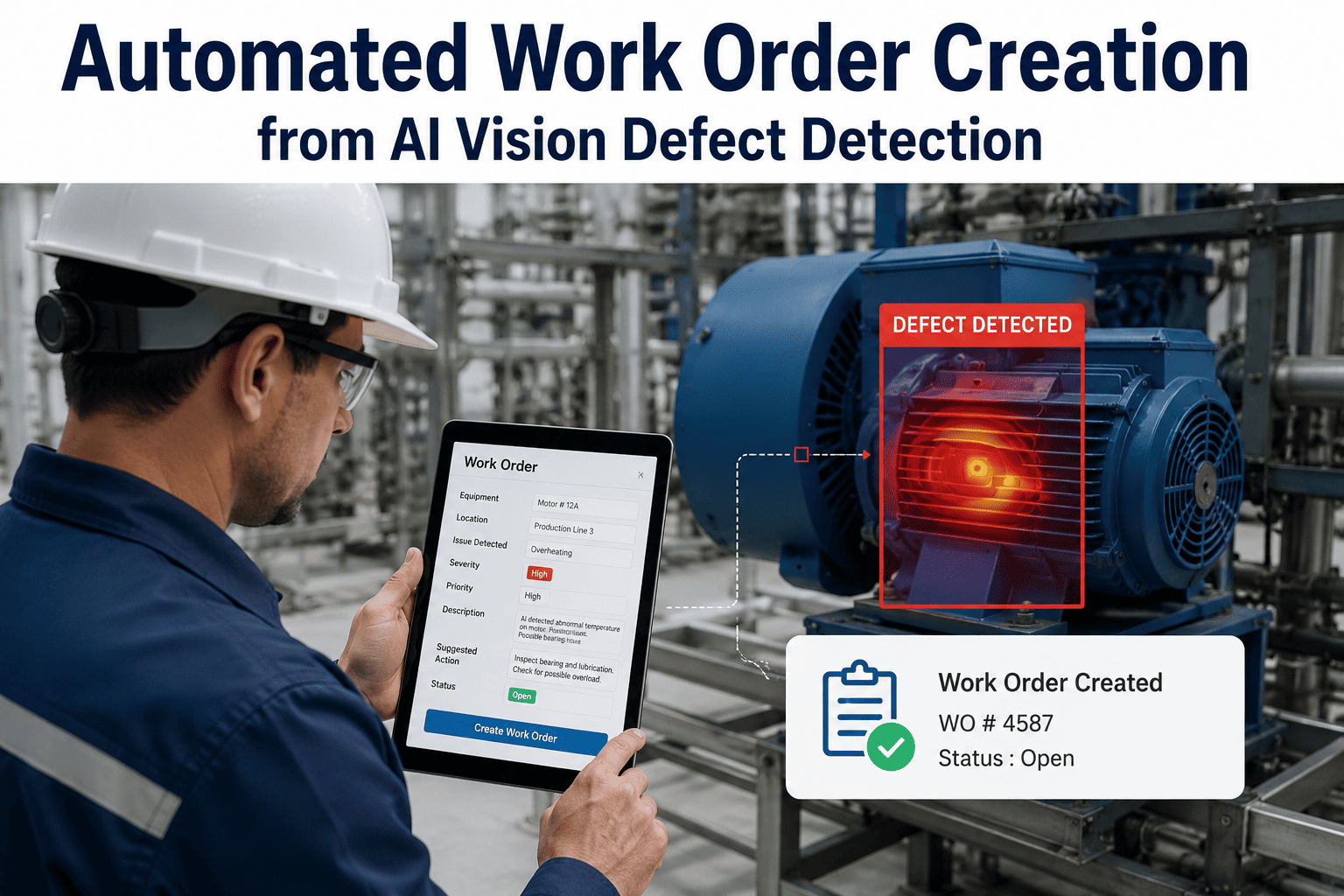
Every detection is geo-tagged, annotated, and ranked by urgency — safety-critical hotspots and diode failures route ahead of low-severity soiling — and synced directly into your CMMS or O&M ticketing system.
Common PV Defects and What AI Vision Catches
Not every solar anomaly carries the same financial weight, and the imaging method that reveals one defect type often misses another entirely. RGB cameras capture surface-level issues at low cost, while thermal imaging is the workhorse for the electrical faults that actually drive lost generation. The table below maps the most common PV defect categories to the signature AI Vision Camera looks for and the operational value of catching each one early.
| Defect Type |
Detection Signature |
Imaging Method |
Why It Matters |
| Microcracks |
Fine dark lines across cell boundaries, often invisible to RGB cameras |
Electroluminescence-style & high-res optical |
Untreated cracks expand and seed future hotspots |
| Hotspots |
Bright localized thermal anomaly against a uniform panel background |
Radiometric thermal IR |
Surface temperatures can exceed safe limits, creating fire risk |
| Bypass Diode Failure |
Heat pattern spanning roughly one-third of a module |
Thermal IR |
Disables an entire sub-string until repaired |
| Soiling & Debris |
Surface discoloration, dust layering, bird droppings |
Visible-spectrum optical |
Gradual, farm-wide yield loss that compounds without cleaning |
| Potential Induced Degradation (PID) |
Cells appear dark or dim relative to healthy neighbors |
Electroluminescence & string performance correlation |
Can cause up to 30% power loss across an entire string |
Start a Turnkey AI Vision Pilot on Your Solar Farm
iFactory connects drone imagery, fixed cameras, and your existing inverter and CMMS data into one defect detection pipeline — live in days, not months.
Frequently Asked Questions: AI Vision for Solar Panel Inspection
What solar defects can AI vision actually detect?
AI Vision Camera detects microcracks, thermal hotspots, bypass diode failures, soiling and debris accumulation, vegetation encroachment, delamination, and the early visual and thermal signatures of Potential Induced Degradation, classifying each by severity.
Book a Demo to see detection running on your panel imagery.
Does this require drones, or can it work with fixed cameras?
Both. Drone-mounted optical and thermal cameras are typically used for full-farm sweeps covering large arrays quickly, while fixed cameras can provide continuous coverage of high-risk inverter zones or sections with a history of underperformance.
How does AI vision tell a real defect from a harmless shadow?
Detection models are trained specifically on solar panel imagery and differentiate genuine thermal or visual anomalies from temporary shading, bird droppings, or sun glare — reducing false positives so maintenance teams act only on real issues.
How quickly can a solar farm inspection pilot go live?
A turnkey pilot typically launches within one to two weeks, starting with a defined inspection zone or feeder, and scales to full-farm coverage once detection accuracy is validated against your specific module type and site conditions.
What happens after a defect is detected?
Every detection is geo-tagged, annotated with the defect classification and confidence score, and ranked by urgency before syncing into your CMMS or O&M ticketing workflow — so safety-critical hotspots are routed ahead of low-severity soiling.
Protect Every Megawatt of Yield
iFactory's AI Vision Camera finds cracks, hotspots, soiling, and faulty cells before they become lost generation — start a turnkey pilot on your solar farm today.