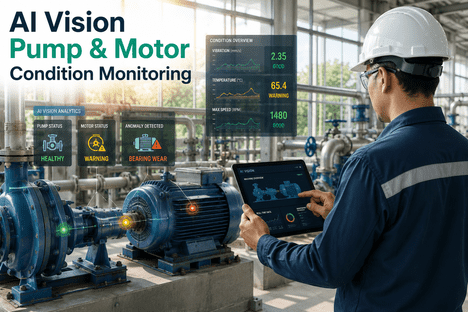
AI Vision Pump & Motor Condition Monitoring

By Austin on June 22, 2026

ai-vision-pump-motor-condition-monitoring

Pumps and motors rarely fail without warning — a bearing heats up for weeks before it seizes, a mechanical seal weeps fluid in small amounts long before it fails outright, and a shaft develops a wobble that is invisible to the naked eye but already measurable in how the machine moves. The problem is that conventional condition monitoring tools each see only part of this picture: vibration sensors need physical contact and per-asset wiring, while a quarterly thermal walkdown is already days or weeks behind the degradation it is meant to catch. iFactory's AI Vision Camera closes that gap by combining thermal imaging and motion-based vision analysis into one continuous, non-contact monitoring layer — watching every pump and motor for overheating, leaks, seal degradation, and abnormal vibration patterns around the clock, then converting what it sees directly into CMMS work orders. To see this running on equipment like yours, Book a Demo with our engineering team.

AI THERMAL & MOTION VISION PLATFORM
Still Waiting for the Next Manual Inspection Round?
iFactory's AI Vision Camera watches pumps and motors continuously for heat, leaks, and abnormal motion — converting what it sees into prioritized CMMS work orders before a breakdown occurs.

Why Pumps and Motors Need Both Thermal and Motion Vision

The Failure Modes That Sensors and Calendars Both Miss

Rotating equipment fails through a small set of well-understood mechanisms — bearing wear, shaft misalignment, rotor imbalance, mechanical looseness, seal degradation, and cavitation — and each one produces a visible or thermal signature long before it produces an audible noise or a tripped alarm. A bearing under lubrication stress generates a steady, measurable temperature rise weeks before traditional vibration symptoms become obvious. A failing mechanical seal weeps fluid gradually around the shaft long before a visible spray develops. A motor running with a developing imbalance moves in ways that are too subtle for the human eye to register directly but are entirely visible once that motion is captured on video and amplified. AI Vision Camera applies both thermal and motion-based imaging to the same asset simultaneously, so a single camera position can catch failure modes that would otherwise require separate sensor types wired into separate systems.

Capability 01
Thermal Overheating Detection
Continuous infrared imaging tracks motor housing, bearing, and seal temperatures against an asset-specific baseline. A bearing under developing lubrication stress or a motor winding under thermal stress is flagged as soon as its heat signature departs from normal, well before insulation damage or seizure occurs.
Non-Contact — Continuous
Capability 02
Visual Leak & Seal Detection
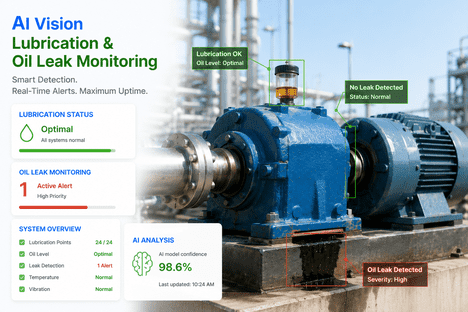
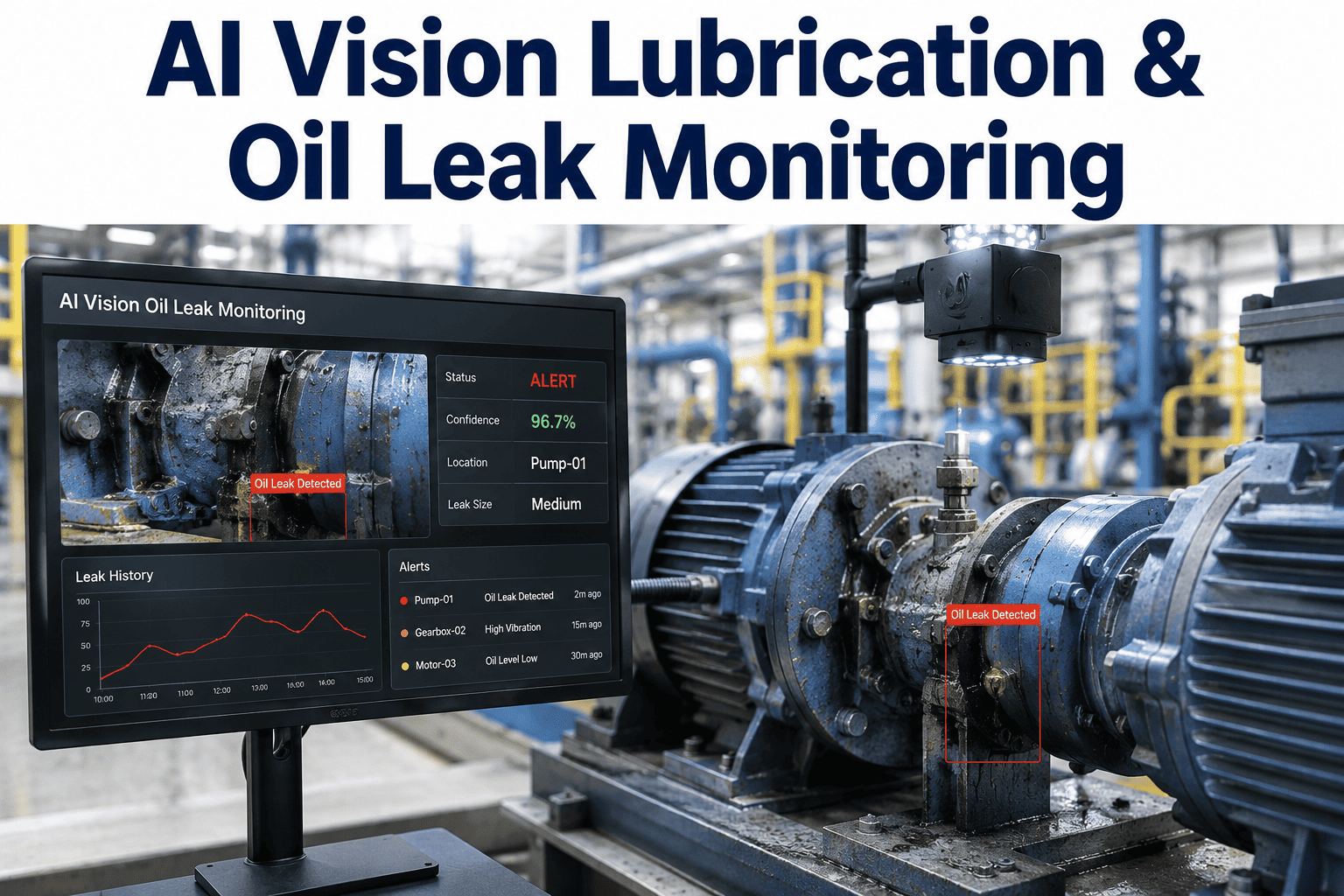
Optical models trained on pump and motor imagery identify fluid seepage at seal faces, gasket joints, and shaft penetrations — catching leaks at the stage where they are a stain on the housing, not yet a spray or a pooling hazard on the floor.
Visual — Early-Stage Detection
Capability 03
Motion-Based Vibration Analysis
Camera-based motion analysis turns every pixel in the frame into a measurement point, revealing shaft wobble, structural looseness, and resonance that are invisible to the naked eye — diagnosing misalignment and imbalance without contact sensors on every asset.
Visual — Sub-Millimeter Motion
Capability 04
Automated CMMS Work Order Generation
When a thermal or motion deviation crosses a defined severity threshold, the platform automatically opens a CMMS work order with asset ID, failure type, image or video evidence, and a recommended intervention — closing the gap between detection and dispatch.
Automated — Condition-Triggered

Pump & Motor Failure Modes: What AI Vision Actually Sees

Mapping Visual and Thermal Signatures to the Failures They Predict

Each rotating equipment failure mode carries a distinct visual or thermal fingerprint, and AI Vision Camera is trained to recognize the specific signature for each one rather than applying one generic anomaly threshold across every asset. Understanding which signal precedes which failure is what turns a camera feed into an actionable maintenance signal rather than just footage.

Failure Mode Visual / Thermal Signature Detection Method Typical Advance Warning
Bearing Wear Gradual, steady temperature rise at bearing housing Thermal imaging vs. asset baseline 30–60 days
Mechanical Seal Failure Fluid seepage or staining at shaft seal face Visual leak detection model Days to weeks
Shaft Misalignment Abnormal coupling motion, asymmetric vibration pattern Motion amplification & vibration mapping Weeks
Rotor Imbalance Visible shaft wobble once motion is amplified on video Motion-based vibration analysis Weeks
Motor Winding Stress Localized hotspot on motor housing or terminal box Infrared thermal imaging Weeks
Cavitation & Structural Looseness Irregular structural motion at pump base or piping Motion amplification visualization Days to weeks

Want to see which failure modes apply to your specific pump and motor fleet? Book a Demo with iFactory's platform team for a site-specific assessment.

From Camera Feed to Work Order: How the Platform Operates

Continuous Monitoring Without New Sensors on Every Asset

AI Vision Camera is deployed at fixed camera positions covering critical pumps and motors, requiring no contact sensors wired to each individual asset and no disruption to existing equipment. The platform establishes a thermal and visual baseline for every monitored asset during normal operation, then continuously compares live footage against that baseline to surface deviations the moment they begin.

01
Baseline Learning Per Asset
The system records each pump and motor under normal operating conditions, establishing its specific thermal and motion baseline — accounting for load, ambient temperature, and normal mechanical movement so that genuine deviations are not lost in normal operating variation.

02
Continuous Thermal & Motion Comparison
Every frame is compared against the established baseline in real time, watching for the specific signatures of bearing heat, seal leakage, and abnormal motion rather than waiting for a fixed alarm threshold to trip.

03
Severity Classification & Evidence Capture
When a deviation is detected, the model classifies the likely failure mode and severity, attaching the thermal image or motion-amplified video clip as supporting evidence rather than a generic text alert.

04
Automatic CMMS Work Order Dispatch
A structured work order is generated automatically — asset ID, failure type, severity, and visual evidence attached — so the maintenance team receives an actionable task rather than a vague alert requiring further investigation before dispatch.

Starting a Pilot: Where to Point the Cameras First

Proving Value on a Small Set of Critical Assets Before Scaling

The fastest path to measurable results is a focused pilot on the five to ten pumps and motors where the cost of an unplanned failure is highest — not a facility-wide rollout planned over many months. Starting with high-criticality rotating equipment, using existing camera infrastructure where it already exists, and defining the specific failure modes to watch for before deployment lets the ROI case build itself from real detection events rather than vendor projections.

Manual Walkdowns & Contact Sensors Only
Thermal checks limited to quarterly or monthly walkdown frequency
Small seal leaks go unnoticed between inspection rounds
Subtle shaft wobble and imbalance invisible to the naked eye
Vibration sensors require wiring and installation on every asset
Detection-to-work-order lag often spans days
VS
AI Thermal & Motion Vision Approach
Continuous thermal monitoring, 24 hours a day
Early-stage leaks flagged as soon as staining appears
Motion amplification reveals imbalance and misalignment on video
One camera position covers multiple assets, non-contact
Detection-to-work-order time reduced to minutes

Ready to Prevent the Next Pump or Motor Breakdown?

iFactory's AI Vision Camera combines thermal imaging and motion-based vibration analysis into a single non-contact monitoring layer — turning what the camera sees into automated CMMS work orders before a failure occurs.

Conclusion

Pump and motor failures are rarely sudden — they are the end point of a slow accumulation of heat, leakage, or abnormal motion that was visible long before the equipment actually stopped working. The challenge has never been a lack of warning signs; it has been the gap between when those signs appear and when someone notices them. iFactory's AI Vision Camera closes that gap by watching continuously, combining thermal imaging and motion-based vision analysis on the same camera feed, and converting every meaningful deviation into a structured CMMS work order before it becomes an unplanned breakdown.

AI THERMAL & MOTION VISION PLATFORM
Start a Pilot on Your Most Critical Pumps and Motors
Our platform team will map your highest-criticality rotating equipment, identify the right camera placement for thermal and motion coverage, and deliver a deployment roadmap showing exactly how AI Vision Camera prevents the breakdowns that matter most.

Frequently Asked Questions

AI Vision Camera detects bearing overheating, motor winding hotspots, mechanical seal leakage, shaft misalignment, rotor imbalance, and structural looseness — using thermal imaging for heat-driven failures and motion-based video analysis for the vibration and movement signatures that the human eye cannot register directly.
No — motion-based vision analysis turns the camera frame itself into a measurement instrument, capturing abnormal shaft motion, imbalance, and structural looseness without wiring a contact sensor to each individual asset. This makes it practical to cover assets where sensor installation would otherwise be costly or impractical.
Bearing degradation typically shows a steady thermal rise weeks before failure, while seal leaks are often visible as staining or seepage days to weeks before a visible spray develops. The exact advance warning window depends on the specific failure mode and asset, which is why a site-specific pilot assessment is the most reliable way to set expectations.
Yes — detected anomalies generate structured work orders automatically with asset ID, failure type, severity, and visual evidence attached, syncing directly into your existing CMMS or maintenance workflow through standard integration methods rather than requiring a separate monitoring dashboard.
A focused pilot covering a handful of high-criticality pumps and motors can typically begin within a few weeks, starting with baseline learning on each asset before moving into active anomaly detection and automated work order generation. Book a Demo to scope a pilot for your specific equipment.

Share This Story, Choose Your Platform!