Chemical plants operate under a continuous leak and spill risk profile that conventional monitoring methods address incompletely at best. Flanged connections, pump seals, valve packings, heat exchanger headers, and tank nozzles are each potential failure points where process fluid release — whether gradual seepage or sudden rupture — can progress from an incipient leak to a personnel safety incident, an environmental release reportable to regulators, or a fire and explosion event in less time than a patrol inspection round takes to complete. The EPA estimates that fugitive emissions and process leaks from chemical manufacturing facilities account for billions of dollars in product loss, regulatory penalty, and remediation cost annually — the majority of which occur at equipment that was inspected recently but had not yet reached the threshold where the defect was detectable by the inspection method in use. Manual visual patrol, fixed point gas detectors, and periodic LDAR surveys each address specific release scenarios with specific detection limitations: visual patrol misses colourless fluid seepage, low-flow leaks, and releases that begin between inspection rounds; point gas detectors trigger only when vapour concentration at the detector location reaches a threshold, not at the release source; and LDAR surveys detect fugitive emissions at the frequency of the survey cycle, not continuously. iFactory's AI vision camera platform with thermal imaging and motion-pattern analysis addresses the detection gaps that these methods leave open — providing continuous, automated monitoring of process equipment for liquid leak formation, pool accumulation, vapour release signatures, and thermal anomalies that precede and accompany process fluid releases. Chemical plant safety, process, and maintenance engineers evaluating their current leak detection architecture regularly choose to Book a Demo with iFactory's engineering team to map the platform's detection capabilities against their specific process hazard profile and facility layout.
Detect Chemical Leaks and Spills the Moment They Begin — Not After the Next Patrol Round.
iFactory's AI vision anomaly detection platform with thermal imaging provides continuous, automated monitoring of process equipment for liquid leaks, pool formation, vapour releases, and thermal precursors — triggering instant alerts and CMMS work orders before a process release becomes a safety or environmental incident.
AI Vision Leak and Spill Detection: Closing the Detection Gap in Chemical Process Safety
A technical overview of how AI vision, thermal imaging, and motion-pattern analysis provide the continuous process monitoring coverage that manual patrol, point detectors, and LDAR surveys cannot — and how iFactory's platform connects every detection event to instant safety alerts and automated maintenance response. Book a Demo to see iFactory's detection capabilities demonstrated on a chemical process equipment configuration matching your facility.
Why Conventional Leak Detection Leaves Critical Windows Unmonitored
The fundamental limitation of conventional chemical plant leak and spill monitoring is that all three primary methods — manual patrol, fixed point gas detection, and scheduled LDAR surveys — are either periodic, location-specific, or concentration-threshold dependent in ways that allow significant detection delays. iFactory's AI vision camera platform provides the continuous, area-based monitoring layer that closes the gaps between these methods. Facilities ready to evaluate how this coverage maps to their specific process areas can Book a Demo with iFactory's chemical industry engineering specialists.
Manual Patrol Inspection Gap
Visual patrol detects surface-visible liquid releases and obvious spills — but misses colourless process fluids, slow seepage at flange faces, releases that begin and grow between patrol rounds, and leaks in inaccessible or unmanned areas of the plant. Patrol frequency creates inspection intervals during which an unreported release can grow from incipient seepage to a reportable quantity release without detection.
Point Gas Detector Limitation
Fixed gas detectors trigger when vapour concentration at the sensor location reaches the alarm threshold — not when a release begins at the source. Wind direction, vapour density, and detector placement geometry mean that a release can persist for minutes or hours before the vapour plume reaches a detector in sufficient concentration to trigger an alarm. Small liquid leaks may never generate a vapour plume detectable at fixed detector positions.
LDAR Survey Interval Gap
EPA Method 21 and optical gas imaging LDAR surveys are conducted at frequencies of monthly to annually depending on component type and regulatory program — leaving long intervals during which fugitive emissions and developing leaks are undetected and unreported. Leaks that begin after one survey and grow to reportable levels before the next are a primary driver of compliance exceedances in LDAR-regulated facilities.
Thermal Survey Periodicity
Handheld thermal imaging surveys conducted by maintenance or inspection teams provide excellent detection capability for thermal anomalies and high-temperature process fluid releases — but only for the duration and coverage of the survey. Equipment that develops a thermal leak signature between survey dates generates no alert until the next qualified thermal survey is conducted, potentially weeks or months later.
Inaccessible Zone Coverage
Chemical plants contain process areas where regular human access is restricted by operational conditions, radiation, oxygen deficiency, toxic atmosphere risk, or physical access constraints. These zones — reactor feed areas, cryogenic sections, high-pressure vessel clusters — are precisely the areas where continuous leak monitoring is most critical and where manual patrol provides the least reliable coverage.
Night and Low-Visibility Detection
Visual patrol detection capability drops significantly in low-light conditions, steam environments, and heavy process vapour areas where distinguishing a genuine leak from background vapour is difficult even for experienced inspectors. AI vision with thermal imaging maintains detection performance independently of visible lighting conditions, providing consistent detection capability across all operating hours and weather conditions.
Detection Method Comparison: Coverage vs. Latency vs. Specificity
Understanding the detection profile of each monitoring method — and the gaps each leaves open — is the starting point for building a chemical plant leak detection architecture that provides defensible continuous coverage.
| Detection Method | Coverage Type | Detection Latency | Colourless Fluids | iFactory Advantage |
|---|---|---|---|---|
| Manual Visual Patrol | Periodic, route-dependent | Minutes to hours (patrol interval) | Not detected | AI vision continuous; detects thermal signature of colourless releases |
| Fixed Point Gas Detectors | Point-specific, concentration-threshold | Minutes to hours (plume travel) | Vapour-producing only | AI detects liquid pool formation before vapour threshold reached |
| LDAR Method 21 Survey | Periodic, component-level | Days to months (survey cycle) | Vapour-producing only | Continuous thermal monitoring between survey dates |
| Handheld Thermal Survey | Periodic, survey-dependent | Days to weeks (survey interval) | Thermal signature detectable | Fixed thermal cameras provide 24/7 thermal monitoring of all critical zones |
| iFactory AI Vision + Thermal | Continuous, area-based | Seconds from release onset | Thermal signature detected | Full coverage, all hours, instant alert, automated work order generation |
How iFactory's AI Vision and Thermal Monitoring Detects Chemical Leaks
iFactory's chemical leak and spill detection platform integrates three detection mechanisms — visual anomaly detection, calibrated thermal imaging, and motion-pattern analysis — into a single continuous monitoring system that identifies process releases at the earliest detectable stage. Each mechanism addresses different physical manifestations of the leak event, ensuring that the combined system detects releases that any single method would miss.
Visual Anomaly Detection — Pool Formation and Surface Liquid Accumulation
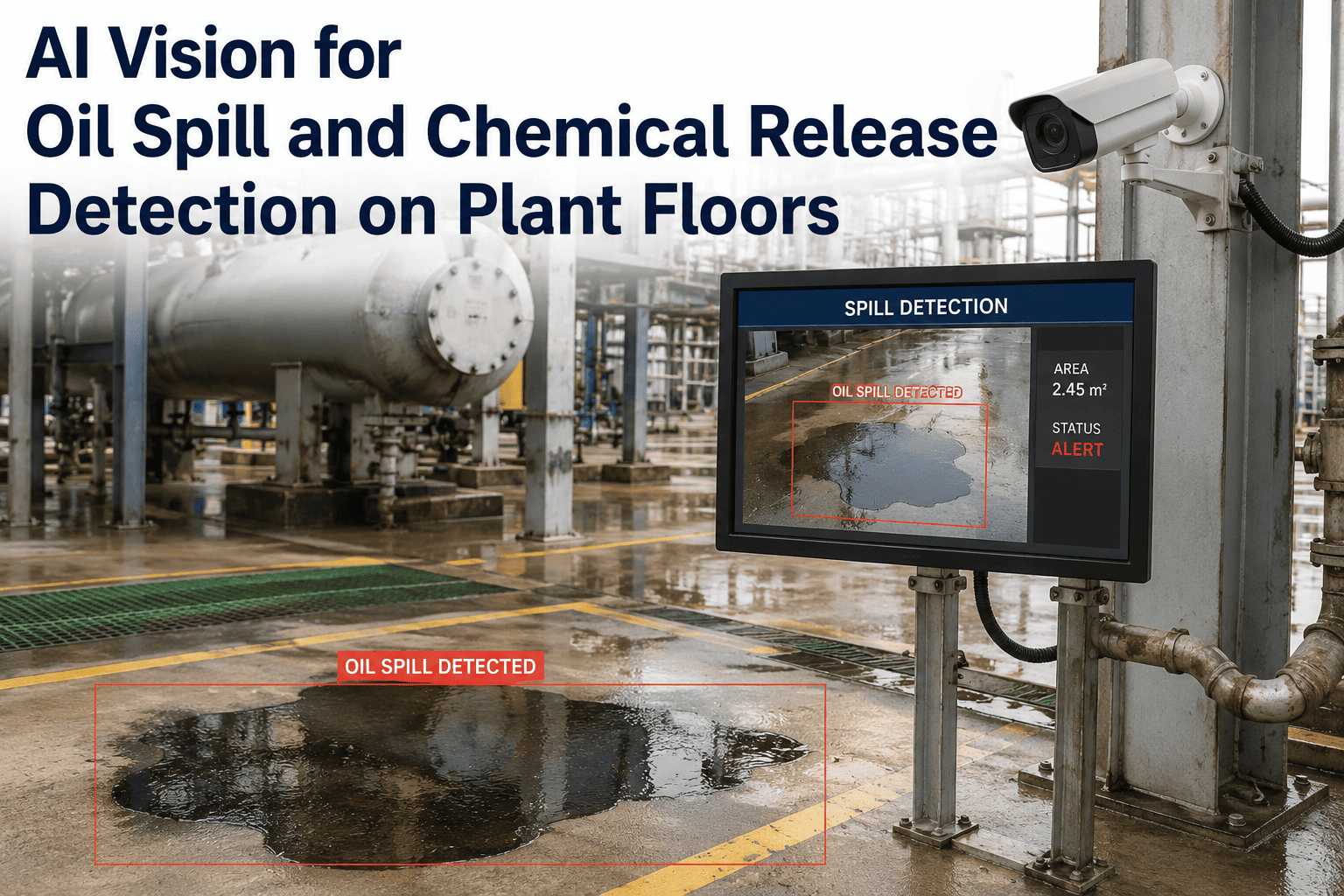
High-resolution cameras monitor process equipment surfaces, bunded areas, drain points, and ground surfaces continuously. AI models trained on chemical plant imagery detect liquid pool formation, surface wetness accumulation, and process fluid visible-spectrum signatures — identifying leak-sourced liquid accumulations that differ from the normal dry-surface baseline of the monitored area. Detection is effective for coloured process fluids, oil-based products, and any fluid that creates a surface appearance change detectable in the visible spectrum. Pool growth rate analysis enables the system to distinguish a genuine process leak from a non-hazardous water accumulation by tracking whether the detected liquid area is expanding, stable, or contracting over successive image frames.
Thermal Imaging — Temperature Differential Leak Detection
Calibrated thermal imaging cameras provide continuous temperature maps of all monitored process zones. Process fluid releases generate thermal signatures based on the temperature differential between the released fluid and the ambient environment — a high-temperature steam or process water leak appears as a hot anomaly on a cooler surface; a cryogenic fluid release or an evaporating volatile process chemical appears as a cold anomaly. Thermal imaging detects colourless process fluid releases that are invisible to visible-spectrum cameras — including water, many solvents, and clear process chemicals — by their temperature signature rather than their visual appearance. Zone-specific alert thresholds are configured for each monitored area based on the expected normal temperature range and the temperature differential that indicates a process release event.
Motion-Pattern Analysis — Vapour and Aerosol Plume Detection
Motion-pattern analysis models process consecutive image frames to detect movement patterns characteristic of gas or vapour release — the characteristic flow pattern of a pressurised vapour plume, the aerosol dispersion signature of a spray release from a pressurised leak, and the dense vapour cloud formation of a high-flow release event. This detection mechanism extends the system's capability to gaseous and volatile process chemical releases that create no immediate liquid pool but generate visible or thermally detectable vapour movement. Motion-pattern detection operates in conjunction with visual and thermal anomaly detection, providing a third independent signal that corroborates or independently identifies release events that might be ambiguous in either the visual or thermal channel alone.
Automated Alert and Work Order Generation
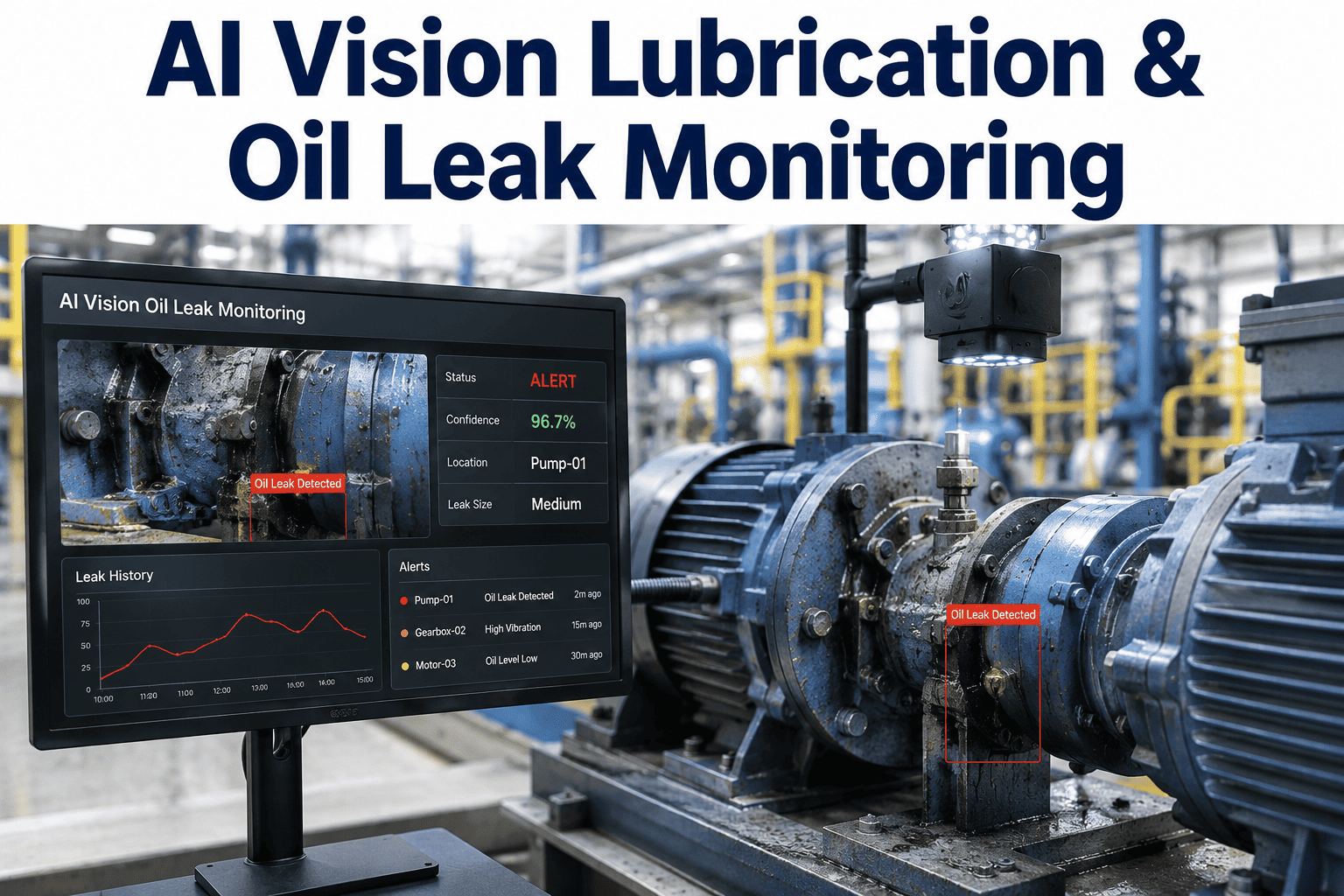
When any detection channel identifies an anomaly above the configured confidence and severity threshold, the platform generates a multi-channel response within seconds: a real-time alert to the control room DCS/SCADA display with the detection type, location, severity, and annotated image evidence; a safety alert notification to the designated plant safety team via the configured notification channel; and a structured CMMS work order pre-populated with the equipment ID, leak classification, detection evidence images, and recommended maintenance response action. This simultaneous multi-channel response eliminates the sequential communication delay between detection, notification, and maintenance dispatch that characterises manual reporting workflows in most facilities.
Performance Benchmarks: AI Vision vs. Conventional Leak Monitoring
The operational improvement from deploying continuous AI vision leak monitoring is measurable across the safety, compliance, and maintenance metrics that define chemical plant process integrity performance. Book a Demo to benchmark these improvements against your current facility incident and compliance data.
| Performance Metric | Conventional Monitoring | iFactory AI Vision + Thermal | Operational Improvement |
|---|---|---|---|
| Detection Latency from Release Onset | 15 min – several hours | Under 30 seconds | 97%+ reduction in detection delay |
| Colourless Fluid Detection | Not detected visually; vapour only | Thermal signature detected continuously | New detection capability added |
| Night / Low-Visibility Coverage | Degraded or absent | Full performance; thermal independent of lighting | 24/7 consistent detection |
| Reportable Release Events | Industry baseline | 40–65% reduction with continuous monitoring | Significant EPA/regulatory exposure reduction |
| CMMS Work Order Generation | Manual — post-patrol report | Automated — seconds from detection | Elimination of manual dispatch delay |
EPA LDAR, PSM, and Process Safety Documentation Compliance
The regulatory compliance implications of AI vision continuous leak monitoring extend beyond operational safety improvement to the documented detection and response evidence that EPA, OSHA, and process safety management frameworks require. Under EPA's NSPS and LDAR regulations, facilities operating Method 21 or OGI-based LDAR programs are required to demonstrate that leaking components are detected and repaired within defined timeframes. Continuous AI vision monitoring provides an independent, timestamped detection record that demonstrates the facility's monitoring program extends beyond the periodic survey interval — evidence that is increasingly valued by EPA inspectors and OSHA Process Safety Management auditors evaluating the adequacy of a facility's leak detection and prevention program. Under OSHA PSM 29 CFR 1910.119, the Process Hazard Analysis and Mechanical Integrity requirements both benefit from continuous leak monitoring data: PHA teams gain access to historical release event data with spatial and temporal resolution that periodic inspection records cannot provide, and Mechanical Integrity programs gain a continuous performance monitoring layer that identifies equipment degradation before PSM-reportable incidents occur. iFactory's platform generates a structured, immutable detection event log for every monitored zone — including inspection coverage records showing that all monitored areas were covered during every operating shift — providing the documentation evidence that PSM auditors and regulatory inspectors require as proof of continuous process monitoring compliance. For chemical plants preparing for PSM compliance audits or EPA LDAR program reviews, iFactory's platform documentation output maps directly to the evidence requirements of both frameworks without additional record-keeping effort from the plant compliance team.
Frequently Asked Questions: AI Vision for Chemical Leak and Spill Detection
How does thermal imaging detect leaks of colourless process fluids that are invisible to standard cameras?
Process fluid releases generate thermal signatures based on the temperature differential between the released fluid and the ambient environment. A process water or solvent leak at 60°C releases into a 25°C ambient environment — the released fluid creates a thermal anomaly on the receiving surface that is clearly visible to a calibrated thermal camera even though the fluid itself is colourless to visible-spectrum imaging. Similarly, cryogenic fluid releases and highly volatile solvents that cool rapidly through evaporation create cold anomalies on surfaces below the monitoring cameras. iFactory's thermal imaging calibration is configured for the specific process fluid temperature ranges and ambient conditions at each monitored zone — enabling detection of temperature differentials as small as 2–3°C, which corresponds to early-stage seepage events long before the release volume reaches a level visible to the naked eye.
What is the false positive rate, and how does the system avoid nuisance alerts from steam, water splashes, and normal process operations?
False positive management is the core calibration challenge in chemical plant leak detection, and it is addressed through the combination of multi-channel detection corroboration and site-specific model training. Nuisance sources — steam vents, water wash-down operations, normal warm equipment surfaces, cooling tower vapour drift — each have characteristic signatures in the visual, thermal, and motion-pattern channels that differ from genuine leak events in ways the AI models learn during calibration. A genuine process fluid leak typically generates both a thermal anomaly and a pool growth pattern simultaneously; a steam vent generates thermal and motion signatures without pool accumulation. iFactory's calibration phase — running over 2–4 weeks on the live process — trains the models on the specific nuisance signatures present at each monitored zone, reducing false positive rates to below 2% while maintaining high sensitivity to genuine release events.
Can the system detect underground or below-grade process fluid releases that do not reach the surface quickly?
AI vision monitoring detects surface-visible and thermally-detectable release manifestations — it cannot detect releases entirely contained below grade with no surface expression. For below-grade release risk, the platform's most effective contribution is early detection of above-grade releases at connection points, pump seals, and valve packings before process fluid reaches below-grade drainage systems — preventing the subsurface contamination event rather than detecting it after the fact. For facilities with specific below-grade release monitoring requirements, iFactory's engineering team can assess whether surface thermal anomaly signatures from soil heating or tracer-assisted detection methods extend the platform's coverage to the subsurface release scenario.
How does the platform handle electrically classified (hazardous area) zones in chemical plant process areas?
Camera hardware for Zone 1, Zone 2, and NEC Division 1 and Division 2 classified area installations is specified with IECEx and ATEX certification as required by the area classification at each installation point. Intrinsically safe and explosion-proof certified camera housings are available for installation within the classified area boundary, with the edge compute processing hardware located outside the classified zone in a safe area control room or enclosure. Fibre optic cabling between the classified area cameras and the edge compute node eliminates any electrical connection that could introduce an ignition risk. The certification documentation for each camera model used in classified area applications is provided as part of the installation documentation package to satisfy the facility's hazardous area equipment register requirements.
What CMMS platforms does iFactory integrate with for automatic work order generation from leak detection events?
iFactory's leak detection platform generates structured work orders via REST API to all major CMMS platforms — including SAP Plant Maintenance, IBM Maximo, Infor EAM, Fiix, and Maintenance Connection — with the detected anomaly type, equipment location, severity classification, and annotated detection images pre-populated in the work order record. Integration with plant DCS and SCADA systems for real-time alert display uses OPC-UA and Modbus TCP protocols compatible with all major distributed control system platforms. For facilities using safety management systems for incident logging, detection events can be simultaneously routed to the safety management platform via API as pre-filled incident precursor records. Custom integration to facility-specific systems is supported through iFactory's API documentation and can be reviewed in detail during a Book a Demo session with iFactory's chemical industry integration specialists.
Deploy Continuous AI Vision Leak and Spill Detection Across Your Chemical Plant.
iFactory's AI vision anomaly detection platform with thermal imaging and motion-pattern analysis provides 24/7 process monitoring coverage that manual patrol, point detectors, and periodic LDAR surveys cannot — connecting every detection event to instant safety alerts and automated CMMS work orders.