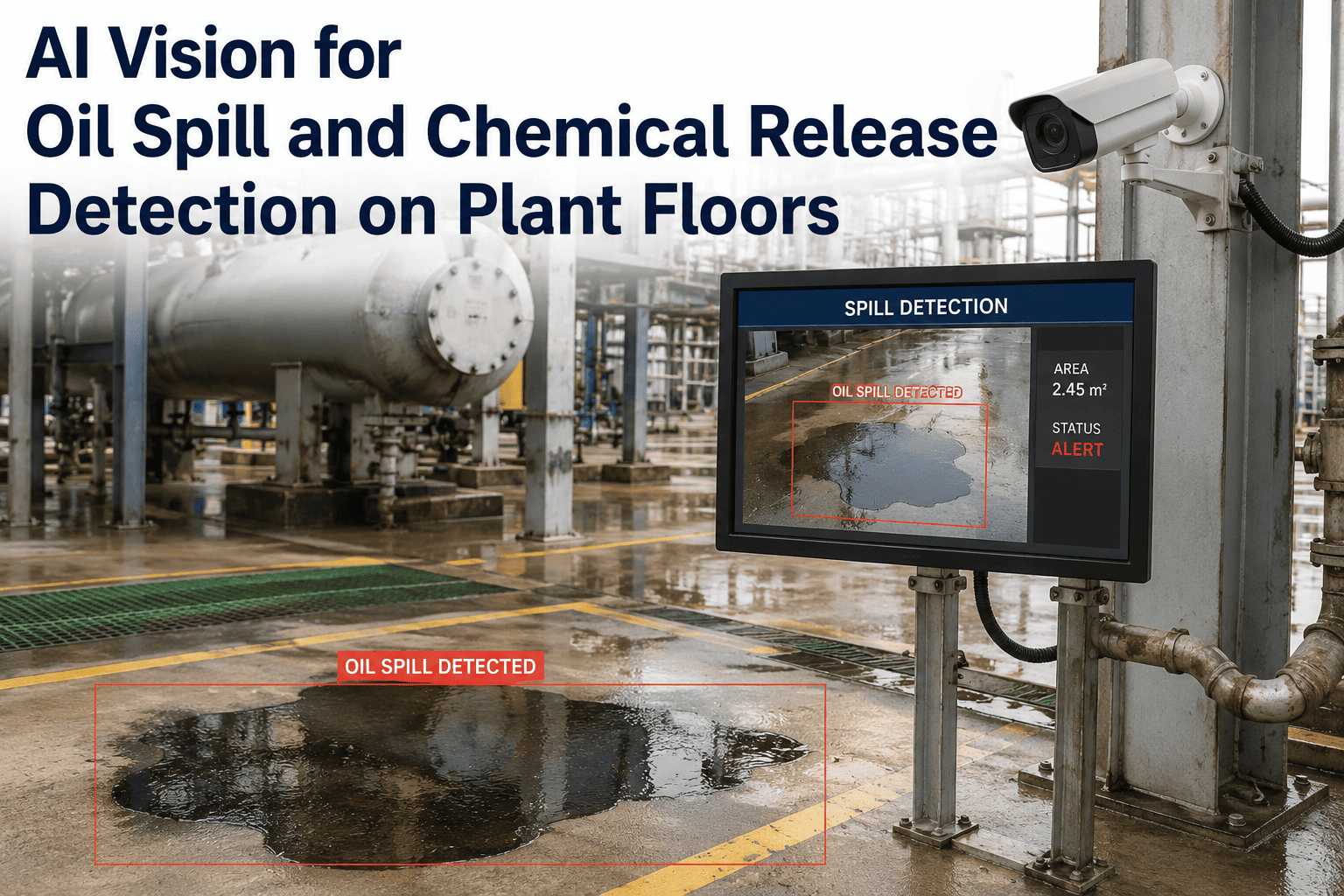
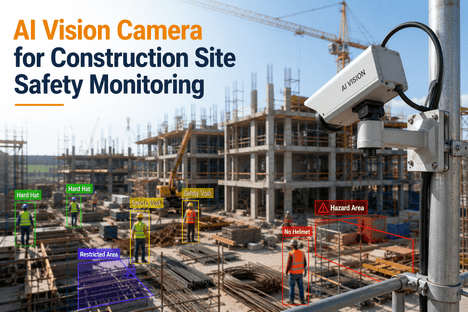
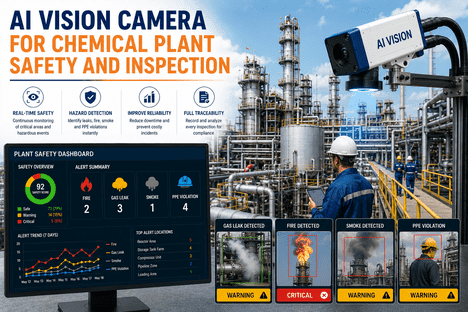
A pallet jack clips a drum fitting at 6:40am. By the time the day shift notices the sheen spreading across the aisle, it's already reached the drain grate, and what should have been a five-minute mop-up is now an environmental incident with a reporting clock attached. Liquid spills on plant floors are strange this way: the damage has almost nothing to do with the volume spilled and everything to do with how long it sits there unnoticed. A pint of hydraulic oil ignored for two hours creates more risk and cleanup cost than five gallons caught in the first sixty seconds, which is why continuous visual monitoring beats another walkthroughs and signage. See how AI vision spill detection works on a live plant floor.
ENVIRONMENTAL SAFETY · PLANT FLOOR MONITORING
Every Minute a Spill Goes Unseen, the Risk Compounds
0–2 MIN
AI camera detects liquid on floor, alert sent instantly
15–30 MIN
Typical time before a walkthrough inspector reaches the same aisle
HOURS
How long an unmonitored spill can spread before shift change catches it
WHY THIS RISK IS BIGGER THAN IT LOOKS
Slip Hazards and Environmental Releases Are the Same Problem, Twice
Slips, trips, and falls account for more than a fifth of all workplace injuries, and wet or contaminated floor surfaces are consistently the single most common cause of same-level falls across every industry. A spill that isn't cleaned immediately doesn't just sit there quietly, it becomes the root cause behind an incident report weeks later, and the workers compensation claim, lost workdays, and OSHA recordable that come with it. Injuries tied to slips and falls also tend to keep people out of work longer than most other injury categories, which compounds the cost well beyond the initial incident.
On top of the injury exposure, oil and chemical releases carry their own separate compliance clock. Discharges that create a sheen on water, or exceed reportable quantity thresholds, trigger notification requirements to federal and state agencies within hours, not days, and those obligations exist independently of whether anyone was actually hurt. A facility can have zero injuries from a spill and still face regulatory exposure purely from the environmental release itself. Catching the spill at the moment it happens, before a sheen forms or a puddle spreads to a walkway, is the only point in the timeline where both risks are still fully preventable rather than merely manageable.
27%+
of nonfatal workplace injuries are attributed to slips, trips, and falls
13 days
average time away from work for a slip or fall injury, nearly triple other injury types
1,000 gal
discharge threshold triggering written EPA notification within 60 days under SPCC rules
WHAT THE CAMERA IS TRAINED TO SEE
Not Every Liquid on a Floor Looks the Same, and That's the Point
A generic motion sensor can't tell the difference between a shadow, a wet floor sign, and an actual hazard. AI vision inspection is trained specifically on the visual signatures liquids and chemical residues actually produce, so it can classify what it's looking at instead of just flagging movement. That distinction matters because a system that can't tell a hazard from a false alarm either gets ignored after enough false triggers, or misses the real event entirely while chasing shadows.
Oil and Hydraulic Fluid Pools
Identified by surface reflectivity and pooling pattern, distinct from a plain water spill through gloss and edge-spreading behavior on concrete or epoxy floors.
Rainbow Sheens
The thin-film interference pattern that forms when even a small amount of oil spreads across a wet surface, the same visual signature regulators use to define a reportable water discharge.
Chemical Discoloration
Color shifts on flooring or drainage channels that indicate a corrosive or reactive chemical release, flagged even when no visible pool has formed yet.
Vapor and Fume Haze
Visible haze or shimmer near a leak source, useful for catching volatile releases before the liquid itself has spread far enough to be obvious from a distance.
Tracked Contamination
Footprint or wheel-track trails leading away from a spill source, which helps responders find the origin point even if the original pool has already been partially tracked through the facility.
DETECTION TO CLEANUP, START TO FINISH
From First Drop to Closed Alert in Under a Minute
An AI vision spill detection deployment doesn't just watch for movement, it distinguishes a genuine liquid hazard from the routine visual noise of a working plant floor, then moves the response along automatically instead of waiting on a person to notice.
01
Continuous Floor Monitoring
Cameras positioned across aisles, loading docks, and drum storage areas scan continuously, not on a walkthrough schedule.
02
Liquid Signature Detection
The model identifies a liquid or discoloration pattern the moment it appears, distinguishing a real hazard from shadows, wet-cleaning residue, or reflections.
03
Instant Alert Routing
The nearest available team member is notified with the exact location and a snapshot, cutting out the delay of someone stumbling onto it by chance.
04
Escalation for Reportable Volumes
If the spill footprint or location suggests a potential reportable release, the alert escalates automatically to EHS staff instead of waiting for a routine shift log.
05
Incident Record for Compliance
Every detection is timestamped and logged with location and image, building the documentation trail regulators and insurers ask for after any incident.
WHERE SPILLS ACTUALLY HAPPEN
Zone-by-Zone Risk Looks Different Across a Plant Floor
Not every part of a facility carries the same spill risk, and monitoring coverage should reflect that rather than treating the whole floor the same way. High-traffic zones near drum storage, loading docks, and machining stations see the most frequent incidents and also the highest injury exposure since foot and vehicle traffic passes through them constantly. Mapping risk by zone rather than blanketing the entire facility equally also makes the initial deployment more affordable, since the highest-value coverage areas can go live first while lower-risk zones are added as the program expands.
| Zone |
Primary Risk |
Why It Matters Most Here |
| Drum and Tote Storage |
Fitting leaks, transfer spills |
Concentrated chemical volumes, close to drainage pathways |
| Loading Docks |
Hose disconnects, forklift punctures |
High vehicle traffic combines with liquid hazard for compound risk |
| Machining and Hydraulic Lines |
Slow leaks, coolant pooling |
Small volumes go unnoticed until they've spread across a wide area |
| Aisles and Walkways |
Tracked contamination, standing puddles |
Highest foot traffic means highest slip and fall exposure |
| Drainage and Sump Areas |
Sheen formation, secondary containment failure |
Direct pathway to reportable environmental release if missed |
Find Out What's Slipping Past Your Current Walkthroughs
Book a demo and see how AI vision monitoring maps to your plant floor layout, drainage points, and highest-risk zones.
THE REAL COST OF A LATE CATCH
What Changes Between a Spill Caught in Seconds and One Caught by Chance
The financial gap between an early catch and a late one is rarely proportional to spill size. A small hydraulic leak found within seconds needs a rag, a few minutes, and a note in a maintenance log. The same leak left unnoticed for a shift can spread across an entire aisle, require a hazmat-trained cleanup crew, take a section of the floor out of service, and generate a slip-and-fall claim from someone who walked through it before anyone knew it was there. None of those downstream costs scale with the actual volume of liquid involved, they scale with how long the spill went undetected.
CAUGHT IN SECONDS
Minor cleanup, no production disruption, no injury exposure, routine log entry closes the incident.
CAUGHT BY CHANCE, HOURS LATER
Wider contamination footprint, possible line stoppage, injury and liability exposure from anyone who crossed the area, and a compliance clock that may already be running against you.
Insurance carriers and regulators both tend to view a documented, fast-responding safety program more favorably than a facility that discovers incidents after the fact, which means the value of continuous detection compounds well beyond the immediate cleanup savings on any single event.
THE COMPLIANCE CLOCK YOU DON'T WANT TO START LATE
Reporting Deadlines Begin the Moment a Release Happens, Not When You Find It
Environmental release reporting doesn't wait for someone to notice. Under federal rules, an oil discharge that creates a sheen on water, or exceeds set volume thresholds, and certain chemical releases above reportable quantities, trigger notification obligations that start counting from the moment of the release itself. A facility that discovers a spill hours late doesn't get extra time to report it, it just has less time left to do everything correctly, from containment through the written notifications some rules require within 60 days of a qualifying discharge. Early detection doesn't just reduce cleanup cost, it protects the window a facility has to respond, contain, and document the incident properly before the reporting clock runs out, and it gives EHS teams accurate timestamps instead of an estimated start time reconstructed after the fact.
Sheen-Based Reporting
An oil release that causes a visible sheen or discoloration on water is reportable regardless of the exact volume spilled.
Volume Thresholds
Discharges above set gallon thresholds to navigable waters require written notification to the EPA Regional office within 60 days.
Reportable Quantities
Hazardous substance releases at or above listed reportable quantities require immediate notification under federal release-reporting rules.
Documentation Trail
Root cause analysis, cleanup records, and disposal manifests are expected to be retained for years after any reportable incident.
TURNKEY DEPLOYMENT, READY TO INSTALL
Hardware and Software Ship Together, Pre-Configured
iFactory ships a pre-configured NVIDIA AI server, racked and ready, with spill detection software pre-loaded. Rack it, plug power and Ethernet, and monitoring is live across your covered zones. Camera placement is planned around your actual floor layout, drainage points, and highest-traffic areas before installation day, so the system is watching the locations that actually matter to your facility from the first day it's turned on rather than a generic grid pattern applied without context.
Pre-configured NVIDIA edge AI hardware, racked and shipped ready to install
Camera placement mapped to drum storage, loading docks, and high-traffic aisles
Model training on liquid, sheen, and discoloration detection included, not billed separately
Instant alert routing to EHS staff or floor supervisors by zone
Incident logging built for compliance documentation and audit trails
Twenty-four seven remote monitoring from day one of production
FROM CONTRACT TO PRODUCTION
Live in 6 to 12 Weeks
Weeks 1–4
Site Mapping and Installation
Cameras installed across identified risk zones, network integration completed, and baseline floor imagery collected across normal operating conditions.
Weeks 5–8
Model Training and Pilot Run
The model is trained on your specific fluids, floor materials, and lighting conditions, then validated in a live pilot before alert authority is granted.
Weeks 9–12
Go-Live and Full Coverage
System takes live alert authority across all covered zones with staff training complete and remote monitoring active around the clock.
FREQUENTLY ASKED QUESTIONS
What Safety and EHS Teams Ask Before Adopting Spill Detection
Can this actually tell the difference between a real spill and a wet floor from routine cleaning?
Yes, this is one of the first things the model is trained to distinguish because a system that constantly flags routine mopping would quickly get ignored by the team responsible for responding to it. The model learns the visual pattern of a scheduled cleaning pass, including which zones and times it typically occurs, versus an unplanned liquid appearing outside that pattern or in a location cleaning doesn't normally cover. Over time the system also learns your facility's specific fluids and floor materials, which sharpens the distinction between a light water residue and an oil or chemical pool that actually needs a response. You can see this filtering in action by requesting a
demo scoped to your specific floor plan.
Does this replace our existing spill response plan or SPCC documentation requirements?
No, it doesn't replace your SPCC plan, spill response procedures, or any regulatory documentation you're already required to maintain, it strengthens the detection and timestamp side of that plan so the response and reporting steps you've already built can actually start on time. A written response plan is only as effective as how quickly someone learns a spill occurred, and that's the specific gap continuous monitoring closes. The incident logs the system generates, including timestamp, location, and image, also support the root cause analysis and documentation retention most spill response plans already require.
Contact support to see how detection alerts integrate with your existing EHS workflow.
How many cameras does a typical facility need, and where do they go?
Camera count depends heavily on facility size, ceiling height, and how many distinct risk zones you're covering, but most deployments start by prioritizing drum storage, loading docks, machining areas with hydraulic lines, and drainage or sump points rather than attempting full blanket coverage on day one. This zone-based approach concentrates monitoring where spill frequency and consequence are both highest, which typically covers the majority of real incident risk without requiring coverage of every square foot of floor space. A site assessment is the only reliable way to scope exact camera count and placement for your specific layout.
What happens after the system detects a spill, does it stop the line automatically?
Detection and response are configured separately, and most facilities start with alert-only mode where the system notifies the nearest available team member or EHS staff rather than triggering an automatic line stop. This keeps a human in the decision loop for judgment calls about production impact while still eliminating the detection delay that used to be the biggest bottleneck. Facilities with especially high-consequence zones, such as areas near ignition sources, sometimes configure automated alerts to safety systems in addition to personnel notification, but that's a deliberate configuration choice scoped to the specific hazard rather than a default behavior.
Is this worth it for a facility that hasn't had a major spill incident yet?
A clean incident history often reflects good fortune and diligent staff as much as it reflects the absence of risk, since the same conditions that create slip hazards and environmental release exposure exist at any facility handling oils, coolants, or chemicals regardless of how many incidents have actually occurred so far. Continuous monitoring is generally more valuable as a proactive investment before a serious incident forces a reactive one, since retroactive fixes tend to arrive alongside regulatory scrutiny, insurance premium increases, or an injury claim that could have been avoided with earlier visibility. Starting with a pilot on your highest-volume storage or transfer area is a reasonable way to validate the value on your own floor before expanding coverage further across the rest of the facility.
Stop Finding Spills After They've Already Spread
iFactory ships turnkey AI vision hardware and software to detect liquid spills, sheens, and chemical discoloration the moment they appear, on every shift, across every zone.