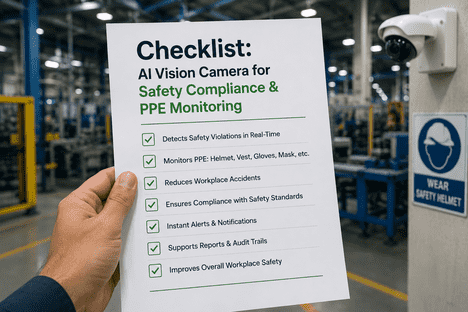
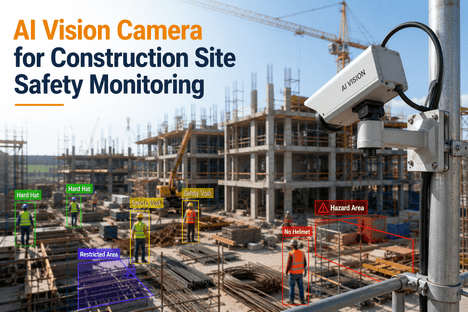
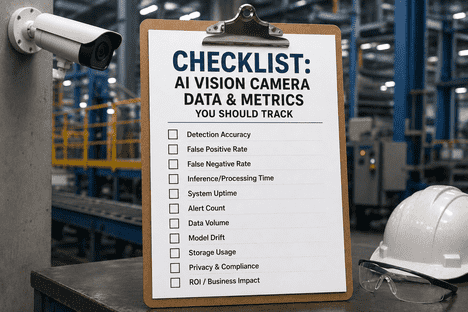
Workplace safety compliance in industrial environments has historically depended on periodic manual audits, supervisor walk-throughs, and self-reported near-miss data — methods that leave significant detection gaps between inspection rounds. AI vision cameras fundamentally change this model by providing continuous, automated monitoring of PPE compliance, restricted zone access, hazardous condition detection, and worker safety behaviour across every shift, every hour, without inspector fatigue or coverage gaps. This checklist is designed for EHS managers, plant safety officers, and operations leaders evaluating or deploying AI vision camera systems for safety compliance and PPE monitoring. It covers the complete scope of requirements — from hardware configuration and detection capability through integration with safety management systems and regulatory documentation — that a production-grade AI vision safety platform must satisfy to deliver measurable compliance improvements. iFactory's AI vision camera platform delivers every capability on this checklist as a unified, production-ready deployment across manufacturing, logistics, and industrial facilities. Book a Demo to see how iFactory's safety compliance vision system deploys across your specific facility layout and hazard zones.
Deploy AI Vision Safety Monitoring Across Your Entire Facility — Live in 4 Weeks
iFactory AI vision cameras monitor PPE compliance, restricted zone access, and hazardous conditions 24/7 across every shift — with automatic alerts, compliance reporting, and full integration with your safety management system.
Book a Demo and see live detection accuracy on your specific PPE and safety requirements.
Why AI Vision Cameras Are Now the Standard for Industrial Safety Compliance
Manual safety audits catch what is happening when an auditor is present. AI vision cameras capture what is happening at 2:00 AM on a Tuesday when no supervisor is on the floor. This distinction is not academic — OSHA data consistently shows that workplace incidents peak during low-supervision periods, shift transitions, and high-production-pressure windows. Continuous AI vision monitoring eliminates the supervision gap that periodic audits cannot close, detecting PPE non-compliance, unsafe behaviours, and hazardous conditions the moment they occur and alerting responsible personnel before an incident develops.
The compliance documentation benefit is equally significant. AI vision systems generate timestamped, audit-ready records of every compliance monitoring event — PPE checks passed, violations detected, zone access incidents, and corrective actions triggered — creating the continuous evidence trail that OSHA inspections, ISO 45001 audits, and insurance assessments increasingly expect. iFactory's safety compliance platform generates this documentation automatically as a standard output of monitoring operations, eliminating the manual recordkeeping burden that consumes EHS team time without improving actual safety outcomes.
95%+
PPE detection accuracy across hard hats, vests, gloves, and safety footwear
24/7
Continuous monitoring — no coverage gaps between safety audits or supervisor shifts
<3 sec
Alert generation time from PPE violation or zone breach detection
60–70%
Reduction in recordable safety incidents documented at AI vision-monitored facilities
Section 1: PPE Detection and Compliance Monitoring Checklist
PPE compliance monitoring is the most widely deployed AI vision safety application — and the one with the clearest, most immediate ROI. The following checklist items define what a production-grade AI vision PPE monitoring system must detect, how it must respond to violations, and what documentation it must generate to satisfy safety management requirements.
Hard hat presence detection at all designated mandatory zones
AI vision system detects hard hat presence or absence for every worker entering or present in designated mandatory head protection zones — loading docks, heavy machinery areas, overhead work zones, and construction areas.
Hard hat colour classification for zone-specific role identification
System distinguishes hard hat colours mapped to worker roles — contractor (white), supervisor (yellow), visitor (orange), electrical (blue) — enabling zone-level access compliance beyond basic presence detection.
Improper wear detection — tilted, backwards, or removed hard hats
Detection extends beyond presence to wearing compliance — hard hats worn backwards, tilted above head, or carried rather than worn are flagged as non-compliant, not as present.
Real-time alert generation for non-compliance events
Compliance violation triggers immediate alert — visual alarm at entry point, supervisor mobile notification, control room alert — within 3 seconds of detection event, before the non-compliant worker advances into the hazard zone.
High-visibility vest presence detection in vehicle and forklift operation zones
AI vision identifies workers in pedestrian-vehicle interface zones without high-visibility vest compliance — a leading indicator of struck-by incidents in warehouse, logistics, and heavy manufacturing environments.
Reflective stripe visibility in low-light and night-shift conditions
Detection operates effectively under the variable lighting conditions of active production floors — including low-light zones, high-contrast industrial lighting, and night shift operation — without degradation in accuracy.
Class-level vest compliance detection for site-specific requirements
For facilities requiring ANSI Class 2 or Class 3 visibility standards in specific zones, the system classifies vest type and flags downgrades — a worker wearing a Class 1 vest in a Class 2 mandatory zone is detected as non-compliant.
Safety glasses and face shield compliance detection in chemical and machining zones
AI vision detects safety glasses, face shields, and welding visors in designated eye protection mandatory zones — grinding, chemical handling, laser operation, and high-pressure wash areas.
Respirator and dust mask compliance in controlled atmosphere zones
Respiratory protection presence detection for dust, fume, and chemical vapour exposure zones — painting, welding, grinding, and hazardous material handling areas requiring specific respirator types.
Proper respirator fit and seal positioning detection
Beyond presence detection, system identifies respirators worn improperly — below the nose, chin-strapped only, or visibly unseated — conditions that satisfy presence checks but provide no actual respiratory protection.
Safety glove detection in machinery and chemical handling zones
Glove presence detection for hand protection mandatory zones — machine operation, chemical transfer, sharp material handling, and welding areas — with classification capability for glove type where zone-specific glove standards apply.
Safety footwear detection at facility entry and hazardous area access points
Steel-toe and safety boot compliance detection at facility entry points and area-specific access zones — identifying workers in non-compliant footwear before they enter areas with crush, puncture, or chemical spill exposure risk.
Section 2: Restricted Zone and Access Control Monitoring Checklist
Restricted zone violations — workers entering machine guarded areas, confined spaces, or exclusion zones without authorisation — are among the highest-severity safety incidents in industrial environments. AI vision zone monitoring provides the continuous, boundary-level detection that physical barriers alone cannot deliver, and does so without the false alarm rates that undermine operator confidence in legacy detection systems.
Real-time person detection inside machine exclusion zones during operation
AI vision detects worker presence inside defined machine exclusion zones while equipment is in operation — triggering immediate machine stop signal, supervisor alert, and incident record within 2–3 seconds of zone breach.
Guard bypass and safety barrier removal detection
Detection of physical safety guard removal, safety gate bypass, and light curtain defeat attempts — monitoring the integrity of physical safety systems in addition to worker behaviour within them.
Approach zone warning before exclusion zone breach
Configurable pre-breach warning zone triggers audio and visual alert when a worker approaches an exclusion boundary — providing a correction opportunity before the actual zone violation occurs.
Lockout/Tagout compliance monitoring during maintenance windows
During LOTO procedures, AI vision monitors that only authorised maintenance personnel enter affected zones and that established LOTO visual indicators are in place — providing continuous surveillance during the highest-risk maintenance period.
Pedestrian detection in active forklift and vehicle travel lanes
AI vision monitors pedestrian-vehicle interface zones — warehouse aisles, loading docks, outdoor yards — detecting worker presence in active vehicle lanes and triggering forklift operator alerts and supervisor notifications.
Crossing zone compliance at designated pedestrian crossings
Detection of workers crossing vehicle travel lanes at non-designated points — a leading indicator of struck-by risk in facilities with active material handling equipment operating on shared floor space.
Proximity alert when pedestrian and vehicle approach shared blind spots
Camera placement at aisle intersections and blind corners triggers proximity alerts to forklift operators and pedestrians when both are simultaneously approaching the same intersection point — preventing intersection collisions before they occur.
Unauthorised confined space entry detection
AI vision monitors confined space entry points and detects worker entry without visible permit documentation or attendant presence — alerting safety personnel immediately to unauthorised entry events.
Fall arrest equipment compliance detection at elevated work areas
Detection of workers at elevated platforms, roof access points, and ladder entry zones without visible harness or fall arrest equipment — mandatory PPE detection at the point of elevation access before the fall hazard is reached.
Section 3: Hazardous Condition and Behavioural Safety Monitoring Checklist
Beyond PPE and zone compliance, AI vision cameras monitor for the environmental conditions and worker behaviours that precede incidents — spills, blocked emergency exits, unsafe manual handling postures, and fatigue indicators that aggregate into elevated incident risk. The following checklist covers the behavioural and environmental detection capabilities that a complete AI vision safety system must provide.
Spill and Floor Hazard Detection
AI vision identifies liquid spills, debris accumulation, and slip hazard conditions on walkways and work surfaces — alerting facilities teams before a worker encounters the hazard rather than after a slip event triggers a report.
Proactive hazard elimination
Emergency Exit and Egress Route Blockage Detection
Continuous monitoring of emergency exit doors, fire door clearance zones, and evacuation route aisles for obstruction by materials, equipment, or stored inventory — a persistent compliance failure in active production environments.
Fire code compliance monitoring
Ergonomic Risk and Manual Handling Posture Detection
AI vision identifies unsafe lifting postures, repetitive strain risk positions, and excessive load handling that precede musculoskeletal injuries — the most common recordable incident category across manufacturing and logistics operations.
Leading MSD indicator detection
Worker Down and Incapacitation Detection
AI vision detects workers in fallen, collapsed, or stationary positions inconsistent with normal work activity — triggering immediate emergency alert when a worker requires assistance in areas without bystander visibility.
Emergency response enablement
Mobile Phone Use Detection in No-Phone Zones
Detection of mobile phone use in designated no-phone safety zones — around heavy machinery, in chemical handling areas, and in vehicle operation zones where distraction creates incident risk beyond normal production contexts.
Distraction risk reduction
Smoking Detection in Restricted and Hazardous Areas
AI vision detects smoking behaviour in fire-restricted, flammable material, and oxygen-enriched zones — a high-consequence violation that manual patrols cannot reliably intercept in large or complex facility layouts.
Fire and explosion risk control
Section 4: System Integration and Alert Management Checklist
A safety compliance AI vision system that generates accurate detections but cannot connect those detections to the safety management systems, alert workflows, and compliance documentation platforms that EHS teams actually use delivers incomplete value. The following checklist defines the integration and alert management requirements that a production-grade AI vision safety platform must satisfy.
| Integration Requirement |
Manual Safety Audit Approach |
iFactory AI Vision Safety Platform |
| Real-Time Alert Delivery |
Violation discovered during audit — may be hours or days after occurrence |
Alert delivered to supervisor mobile device, control room display, and site PA system within 3 seconds of detection event |
| Safety Management System Integration |
Manual incident entry into SMS after audit finding — incomplete and delayed |
Automatic violation record created in safety management system with timestamped image evidence and location data |
| Compliance Reporting |
Manual report compilation — weekly or monthly summary with incomplete event capture |
Automated daily, weekly, and monthly compliance reports by zone, shift, department, and violation type — generated without manual data assembly |
| OSHA Recordkeeping Support |
Manual OSHA 300 log maintenance — dependent on accurate near-miss reporting |
AI vision monitoring data supports OSHA 300 documentation and provides objective evidence for incident investigations |
| Access Control System Integration |
Not connected — physical access control and safety compliance monitored separately |
AI vision integrates with access control systems to enforce PPE compliance at zone entry points — non-compliant workers denied access until PPE corrected |
| Audit Trail and Evidence Retention |
Paper audit records — limited image evidence, manual storage and retrieval |
Timestamped image and video evidence retained for all compliance events — searchable by date, zone, violation type, and shift for audit and investigation use |
iFactory's AI vision safety platform integrates with leading safety management systems including Intelex, Cority, Enablon, and SAP EHS — as well as custom safety platforms through REST API connectors. Book a Demo to review the specific integration path for your safety management and access control systems.
Section 5: Regulatory Compliance and Documentation Checklist
AI vision safety monitoring delivers its highest compliance value when the system generates the documentation that regulatory inspections, ISO 45001 audits, and insurance assessments require — automatically, as a byproduct of normal monitoring operations. The following checklist defines the regulatory documentation capabilities that an AI vision safety platform must provide to satisfy the compliance frameworks most commonly applicable to manufacturing and industrial facilities.
Continuous PPE compliance monitoring records aligned with OSHA 29 CFR 1910 and 1926 standards
AI vision monitoring generates timestamped compliance records that demonstrate proactive PPE enforcement aligned with OSHA General Industry and Construction standards — evidence that an OSHA inspection's spot audit cannot produce from manual methods alone.
Machine guarding and lockout/tagout monitoring documentation for OSHA 1910.147 compliance
Continuous monitoring records for exclusion zone access, guard integrity, and LOTO compliance events provide the objective documentation that OSHA inspections of LOTO programs increasingly request alongside written procedures.
Incident investigation evidence — timestamped image and video retention
All detection events retain timestamped image and video evidence searchable by date, zone, and event type — enabling rapid incident investigation reconstruction that reduces the time and cost of OSHA recordable incident documentation.
Objective evidence of operational safety control effectiveness for ISO 45001 Clause 8 requirements
ISO 45001 auditors require objective evidence that operational controls are functioning effectively — not just documented procedures. AI vision compliance monitoring data provides sensor-verified evidence of control operation that manual audit records cannot match.
Safety performance metric trending for ISO 45001 Clause 9 performance evaluation
AI vision monitoring generates the leading indicator data — PPE compliance rates, near-miss zone breach frequency, violation trend by department and shift — that ISO 45001 Clause 9 performance evaluation requires but manual auditing produces too infrequently to be actionable.
Corrective action linkage — violation detection to corrective action record in safety management system
Each AI vision violation detection automatically generates a corrective action record in the connected safety management system — creating the closed-loop corrective action documentation that ISO 45001 Clause 10 improvement requirements demand.
Section 6: Deployment and Configuration Checklist
A complete AI vision safety compliance deployment requires careful attention to camera placement, coverage zone definition, lighting adequacy, and system configuration before monitoring begins. The following checklist guides the pre-deployment assessment and configuration steps that determine system accuracy and coverage completeness.
Step 1
Hazard Zone Mapping and Camera Coverage Assessment
Map all mandatory PPE zones, machine exclusion zones, pedestrian-vehicle interface areas, and restricted access points. Assess camera placement positions for each zone to ensure complete coverage without blind spots. Identify lighting conditions at each location — supplemental lighting requirements confirmed before camera installation. iFactory's deployment engineers complete this assessment as part of the Phase 1 site survey.
Step 2
PPE Detection Model Configuration and Training
Configure detection models for the specific PPE types, colours, and compliance standards applicable to each zone. Train models on representative images from the specific facility environment — lighting conditions, worker demographics, and PPE specifications vary sufficiently between facilities that site-specific training improves accuracy above generic pre-trained model performance. Initial accuracy validation completed in week 2 of deployment.
Step 3
Alert Workflow and Escalation Path Configuration
Define alert recipients, escalation paths, and response requirements for each violation type. Configure response time thresholds — a machine exclusion zone breach requires faster escalation than a vest non-compliance at an entry point. Integrate with safety management system for automatic violation record creation. Test all alert workflows before go-live.
Step 4
Privacy Compliance Configuration and Worker Communication
Configure the system to operate within applicable workplace privacy requirements — defining monitoring zones, data retention periods, and access controls aligned with GDPR, CCPA, and facility-specific privacy policies. Communicate monitoring scope, purpose, and data handling to workers and union representatives before system activation. Document privacy impact assessment and worker notification records.
Step 5
Go-Live Validation and Baseline Compliance Measurement
Run parallel monitoring period — AI vision active alongside existing safety audit process — to validate detection accuracy and false positive rate before transitioning to AI-primary compliance monitoring. Establish baseline compliance metrics by zone, shift, and violation type during the parallel run period. First compliance trend reports available within week 3 of deployment.
Frequently Asked Questions About AI Vision Camera Safety Compliance
What PPE types can iFactory's AI vision cameras reliably detect?
iFactory's safety monitoring platform detects hard hats (including colour classification and wearing position), high-visibility vests (including ANSI class classification), safety glasses and face shields, respirators and dust masks, safety gloves, and safety footwear. Detection accuracy exceeds 95% for all primary PPE categories under properly configured lighting conditions. The system also detects improper wearing — respirators below the nose, hard hats tilted above the head — not just presence or absence.
How does AI vision PPE monitoring handle privacy requirements in unionised or regulated workplaces?
iFactory's platform is configured to monitor for PPE and safety behaviours without capturing biometric identification data. The system detects the presence or absence of safety equipment and compliance behaviours — it does not require facial recognition or worker identification to function. Monitoring zone definitions, data retention periods, and access controls are configured to align with GDPR, CCPA, and facility-specific collective bargaining requirements. iFactory's deployment engineers support the privacy impact assessment and worker communication process as part of the deployment program.
What is the false alarm rate for AI vision safety monitoring, and how is it managed?
False positive rates — alerts triggered by non-compliance that did not actually occur — are the primary operational challenge in AI vision safety deployments. iFactory's models are site-specifically trained to minimise false positives under the actual lighting and environmental conditions of each facility. During the parallel run period, false positive rates are measured and model tuning is applied until the rate reaches a level that sustains operator confidence. Typical production false positive rates for PPE detection at iFactory deployments are below 2% — low enough to sustain alert credibility without triggering alarm fatigue.
Can AI vision safety monitoring integrate with existing access control and turnstile systems?
Yes. iFactory's platform integrates with access control systems through standard interfaces — where a worker approaching a PPE-mandatory zone entry point is detected as non-compliant, the integration layer can trigger a barrier hold signal that prevents access until the PPE issue is corrected. This creates a hardware enforcement mechanism that converts AI detection from an alert-only system into an access control system. Integration is configured during the deployment phase and is compatible with most major access control platforms.
How quickly can iFactory's AI vision safety compliance system be deployed across a facility?
Most iFactory safety compliance deployments go live within 3–4 weeks. Site survey and camera placement planning complete in week 1. Camera installation, model configuration, and initial training complete by week 2. Alert workflow integration and parallel run validation complete by week 3. Full go-live with compliance reporting active by week 4. The deployment timeline scales with facility size — multi-site or large-campus deployments are phased by priority zone, with the highest-risk areas live first.
Book a Demo to receive a deployment timeline assessment for your specific facility.
DOCUMENTED SAFETY OUTCOMES FROM AI VISION COMPLIANCE MONITORING
Facilities deploying iFactory AI vision safety monitoring consistently report measurable incident reduction within the first 90 days — driven by the behavioural change that continuous, real-time compliance monitoring produces compared to periodic manual audits. Workers in AI-monitored facilities show significantly higher sustained PPE compliance rates than those in audit-only environments.
60–70%
Reduction in recordable safety incidents within 12 months of deployment
85%+
Sustained PPE compliance rate in AI-monitored zones vs 55–65% pre-deployment
50–70%
Reduction in audit preparation time with automated compliance documentation
Deploy AI Vision Safety Compliance Monitoring Across Your Facility — Live in 4 Weeks
iFactory AI vision cameras monitor PPE compliance, restricted zone access, hazardous conditions, and worker safety behaviour 24/7 — with automatic alerts, continuous compliance documentation, and full integration with your safety management system and access control infrastructure.
95%+ PPE detection accuracy across all primary equipment types
60–70% recordable incident reduction documented
Real-time alerts within 3 seconds of violation detection
Automated OSHA and ISO 45001 compliance documentation