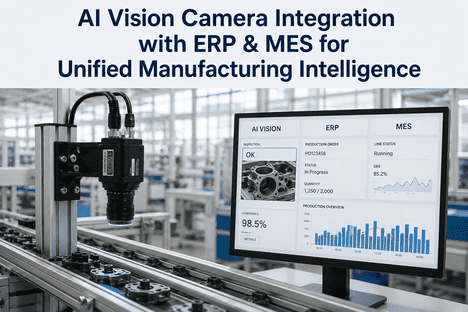
Manufacturing operations generate more data per shift than most organizations can meaningfully analyze — yet the majority of that data sits in disconnected systems that cannot communicate with each other in real time. AI vision cameras capture defect and process images at the line level. MES systems track production orders, work-in-process, and operator activity. ERP systems manage inventory, procurement, and financial performance. When these three systems operate independently, manufacturers forfeit the unified intelligence that only cross-system data correlation can produce. Integrating AI vision cameras with ERP and MES platforms closes this gap by creating a continuous, bidirectional data flow that converts line-level visual inspection data into operational decisions — in real time, at every level of the manufacturing organization. iFactory's AI vision camera platform is purpose-built for this integration architecture, delivering unified manufacturing intelligence across quality, production, and business systems from a single connected deployment. Book a Demo to see how iFactory's integration framework applies to your specific ERP, MES, and production environment.
AI VISION · ERP · MES · UNIFIED MANUFACTURING INTELLIGENCE
Connect AI Vision Intelligence to Every Layer of Your Manufacturing Operation
iFactory AI vision cameras integrate directly with your ERP and MES platforms — feeding real-time quality, production, and traceability data into the business systems your teams already use to make operational decisions.
Why AI Vision Cameras Without System Integration Deliver Incomplete Value
AI vision cameras deployed as standalone inspection systems solve one problem well — they detect defects faster and more consistently than manual inspection. But standalone deployment leaves the majority of the value embedded in vision data untapped. A vision system that cannot communicate defect data to the MES in real time cannot trigger automatic lot holds, update work order quality status, or adjust production scheduling based on emerging defect patterns. A system that cannot feed quality metrics to the ERP cannot update inventory valuations for nonconforming stock, drive automated procurement actions when incoming material rejection rates rise, or populate the cost-of-quality reports that executives use to allocate improvement resources.
The integration gap between AI vision systems and enterprise manufacturing software is the primary reason that vision AI deployments in industrial settings frequently underperform their stated ROI potential. The cameras perform as specified. The models detect accurately. But without bidirectional integration with MES and ERP systems, the manufacturing organization cannot act on vision data at the speed and scale that integrated systems make possible. iFactory's platform eliminates this gap by treating ERP and MES integration not as an optional add-on but as a foundational architectural requirement of every AI vision camera deployment.
73%
of manufacturers cite disconnected quality and production data as their top barrier to real-time operational decision-making
4–6x
greater ROI realized from AI vision deployments with full ERP and MES integration versus standalone inspection-only deployment
<90 sec
average latency from defect detection to MES work order update in iFactory integrated deployments
100%
per-part traceability across vision inspection, production, and distribution records in a unified data environment
Integration Architecture
How AI Vision Camera, MES, and ERP Integration Actually Works
Understanding the technical architecture of AI vision and enterprise system integration is essential for manufacturers evaluating whether a vision platform can genuinely connect with their existing software environment. iFactory's integration model operates across three distinct data exchange layers — each designed to deliver specific operational value while maintaining the security, reliability, and performance characteristics that production-grade manufacturing systems require.
01
Real-Time Event Layer: Vision to MES
The event layer handles time-critical data exchange between the AI vision camera system and the MES — the transactions where latency directly affects production outcomes. Defect detection events trigger immediate MES responses: automatic lot hold creation for nonconforming parts, work order quality status updates, reject station activation signals, and production count corrections that reflect actual pass/fail output rather than gross cycle counts. iFactory communicates via OPC-UA, MQTT, and direct database connectors to the MES platforms most commonly deployed in discrete and process manufacturing — including SAP ME, Siemens Opcenter, Rockwell Plex, and custom MES architectures. The event layer operates with sub-90-second latency from vision detection to MES record update across all supported integration targets.
02
Analytical Data Layer: Vision to ERP
The analytical layer manages the structured data exchange between aggregated vision quality data and ERP business processes — the integration that enables quality performance to drive financial and operational decisions. iFactory feeds inspection result summaries, nonconforming material quantities, and first-pass yield data to ERP systems including SAP S/4HANA, Oracle Cloud Manufacturing, Microsoft Dynamics 365, and Infor LN at configurable intervals — from near-real-time streaming to end-of-shift batch transfer depending on ERP system architecture and business process requirements. This layer enables ERP-driven workflows that depend on accurate quality data: automatic generation of quality notifications, nonconforming material stock segregation, cost-of-quality posting, and supplier scorecard updates based on incoming material inspection results.
03
Traceability Layer: Unified Cross-System Records
The traceability layer creates and maintains the bidirectional linkage between vision inspection records, MES production records, and ERP material documents — enabling complete forward and backward lot traceability that no single system can provide independently. When a quality escape is suspected, the traceability layer enables instant lot identification by querying the unified record that connects vision inspection results, work order data, material lot numbers, and shipping documents. iFactory's traceability architecture supports the FSMA 204, IATF 16949, and AS9100 traceability requirements that regulated manufacturers must satisfy, generating the audit-ready documentation that compliance programs demand without manual assembly from disconnected records.
04
Feedback Layer: ERP and MES to Vision
Integration is not unidirectional. iFactory's platform also receives context data from MES and ERP systems that improves AI vision model performance and inspection relevance. Product change notifications from the MES trigger automatic inspection parameter updates in the vision system — ensuring that when a new SKU or product variant enters production, the vision system applies the correct acceptance criteria without manual reconfiguration. Material lot data from the ERP enables the vision system to correlate inspection results with supplier lot information — identifying material quality patterns that only become visible when vision data and procurement records are analyzed together. This feedback layer is the architectural feature that transforms AI vision from a passive inspection tool into an active participant in the manufacturing intelligence network.
Operational Benefits
What Integrated AI Vision, ERP, and MES Intelligence Makes Possible
The operational benefits of AI vision and enterprise system integration extend across every function that depends on quality data to make production decisions. The following capabilities are enabled specifically by the integration architecture — they are not achievable with standalone AI vision deployment, however capable the camera hardware and detection model may be. Food safety managers, quality directors, production managers, and operations executives considering AI vision investment should evaluate each capability against their current operational gaps to determine where integrated intelligence delivers the highest priority value.
01
Automatic Nonconforming Material Management in ERP
When iFactory AI vision cameras detect a nonconforming part or lot, the integration layer automatically creates an ERP quality notification, moves the affected stock to a blocked quality inspection storage location, and generates the documentation required for disposition decisions — all without manual quality department intervention. This eliminates the window between defect detection and ERP action that allows nonconforming material to continue flowing through downstream production processes or into finished goods inventory. Manufacturers report a 65–80% reduction in the time between defect detection and ERP stock block activation following full integration deployment, directly reducing the volume of nonconforming material that reaches subsequent production stages.
02
Real-Time First-Pass Yield Reporting Across MES and ERP
First-pass yield is one of the most operationally important quality metrics in manufacturing — and one of the most frequently calculated incorrectly in environments where vision inspection data and MES production data are not connected. Standalone inspection systems report pass/fail counts that must be manually reconciled with MES work order data to produce accurate yield figures. iFactory's MES integration automatically updates work order yield status in real time as the vision system processes each part, producing accurate first-pass yield data at the work order, shift, line, and facility level without manual calculation. ERP cost accounting that depends on accurate yield data — standard cost variances, production efficiency reporting, quality cost allocation — improves correspondingly as inspection results flow directly into production records.
03
Supplier Quality Intelligence Through Incoming Inspection Integration
AI vision cameras deployed at incoming inspection stations generate objective, part-level quality data for every incoming material lot — data that is meaningless without integration to the ERP procurement and supplier management modules where supplier performance decisions are made. iFactory's ERP integration feeds incoming inspection results directly to supplier quality scorecards, triggers purchase order quality holds for lots that fail incoming inspection, and maintains a continuously updated rejection rate history by supplier, material, and lot that procurement teams can use to make sourcing decisions. Manufacturers using integrated incoming inspection consistently report improved supplier quality performance within 12 months of deployment — suppliers respond to objective, lot-level quality data shared systematically through the ERP with more urgency than periodic quality review meetings.
04
MES-Driven Dynamic Inspection Parameter Management
Production environments that run multiple product variants on the same line require AI vision systems that can switch inspection parameters — accepted tolerances, defect classification thresholds, and inspection region configurations — as production orders change. Without MES integration, these parameter changes require manual configuration updates by quality or engineering personnel at every product changeover. iFactory's MES integration receives production order change events and automatically applies the correct inspection configuration for the incoming product variant before production begins. This eliminates manual reconfiguration as a source of inspection error and ensures that every product variant is inspected against its own acceptance criteria from the first part of each production run.
05
Unified Quality Intelligence Dashboard Across All Systems
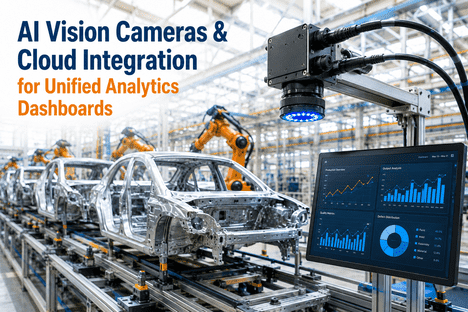
iFactory's integrated platform provides a unified quality intelligence dashboard that aggregates vision inspection data, MES production data, and ERP quality and cost data into a single operational view accessible to quality managers, production supervisors, and operations executives. This dashboard eliminates the daily reconciliation effort that organizations without integration invest in manually combining data from multiple systems to produce consolidated quality reports. Trend data — defect rate by product, line, shift, material lot, and supplier — is available in real time rather than in the next morning's report, enabling the responsive quality management decisions that only real-time cross-system visibility makes possible.
Book a Demo to see iFactory's unified intelligence dashboard configured against your specific quality metrics and reporting requirements.
Performance Benchmark
Standalone AI Vision vs. Integrated AI Vision, ERP, and MES: Performance Comparison
The performance difference between standalone AI vision deployment and fully integrated AI vision, MES, and ERP deployment is measurable across every operational dimension that matters to manufacturing management. The following comparison reflects outcomes from iFactory deployments across discrete manufacturing, process manufacturing, and food and beverage production environments, comparing the same underlying AI vision technology operating with and without full enterprise system integration.
AI Vision Integration Performance Comparison — 2026
Implementation Roadmap
Integration Deployment Roadmap: From Standalone Vision to Unified Manufacturing Intelligence
iFactory's integration deployment follows a structured sequence that delivers operational value at each phase rather than requiring full enterprise integration before any benefit is realized. The roadmap is designed to fit within the manufacturing organization's change management capacity — extending system connectivity progressively while allowing each integration layer to stabilize before the next is activated. Manufacturers who want to review the specific integration path for their ERP and MES environment can Book a Demo for a technical integration assessment tailored to their system architecture.
Phase 1
System Discovery and Integration Architecture Design (Weeks 1–2)
iFactory integration engineers conduct a structured discovery of the manufacturer's existing MES and ERP landscape — identifying system versions, API availability, data model structures, and network topology relevant to the integration design. Integration points are prioritized by operational impact: highest-value connections — defect event to MES lot hold, and inspection yield to ERP work order — are designed first. The output of Phase 1 is a documented integration architecture that maps every data exchange, defines the communication protocol for each integration point, and establishes the acceptance criteria for integration testing in subsequent phases.
Outcome: Integration architecture document, prioritized connection map, protocol specifications
Phase 2
AI Vision Camera Deployment and MES Event Integration (Weeks 3–6)
AI vision cameras are installed and calibrated at priority inspection stations. Initial AI model training is completed using production parts. MES event integration is activated for the highest-priority data exchanges: defect detection to MES lot hold, inspection result to work order quality status, and production order change to vision inspection parameter update. Each integration is tested against defined acceptance criteria — latency, accuracy, and failure behavior — before production go-live. The vision system operates in parallel monitoring mode during this phase, with MES integration active but auto-reject held until parallel run validation is complete.
Outcome: AI vision cameras live, MES event integration active, parallel run validation complete
Phase 3
ERP Quality and Inventory Integration Activation (Weeks 7–10)
ERP integration layer is activated for quality management and inventory workflows: automatic quality notification generation from defect events, nonconforming material stock block posting, and first-pass yield data transfer to production work orders. Incoming inspection integration is configured where applicable, connecting material lot receipt in the ERP to the AI vision inspection workflow. Cost-of-quality data flows are established, enabling ERP financial reporting on scrap, rework, and inspection costs sourced from vision and MES data. Full production go-live with auto-reject enabled follows ERP integration validation.
Outcome: ERP quality and inventory integration live, cost-of-quality reporting active, full auto-reject production go-live
Phase 4
Supplier Intelligence, Traceability, and Unified Dashboard (Week 11+)
Supplier quality scorecard integration is activated, connecting incoming inspection results to ERP supplier performance records. Enterprise lot traceability is validated through mock recall exercises — verifying that full forward and backward lot traces complete within the 8-minute target using the unified vision, MES, and ERP data environment. The unified quality intelligence dashboard is configured with the manufacturer's specific KPI hierarchy and distributed to quality, production, and operations leadership. Quarterly performance review cycles and model retraining processes are established to sustain and improve integration performance over time.
Outcome: Full enterprise integration live, supplier quality intelligence active, unified dashboard deployed, ongoing governance established
Regulatory and Compliance Value
Compliance Documentation Benefits of Integrated AI Vision, MES, and ERP
Regulatory compliance in quality-intensive manufacturing sectors demands complete, accurate, and audit-ready documentation that connects inspection results to production records, material traceability, and distribution history. Integrated AI vision, MES, and ERP systems generate this documentation automatically as a byproduct of normal production operations — eliminating the manual assembly burden that consumes quality department time before every customer audit or regulatory inspection.
IATF 16949 and Automotive Quality Requirements
Automotive quality standards require complete production part inspection records linked to control plans, work orders, and customer-specific requirements. iFactory's MES integration creates this linkage automatically — every vision inspection result is associated with the active work order, control plan revision, and production conditions at the time of inspection. PPAP documentation for new product launches benefits from integrated inspection data that demonstrates measurement system capability across production conditions, not just capability studies conducted under controlled laboratory conditions.
FDA 21 CFR Part 11 and Medical Device Requirements
Electronic quality records in FDA-regulated manufacturing must satisfy 21 CFR Part 11 requirements for audit trail completeness, record integrity, and access control. iFactory's integrated platform generates inspection records with time-stamped, user-authenticated audit trails that satisfy Part 11 requirements without additional documentation overhead. DHR and DHF documentation for medical device manufacturers benefits from vision inspection data linked to ERP production records — providing the complete device history record that FDA inspections require.
ISO 9001 and GFSI Scheme Documentation
ISO 9001 and GFSI scheme audits increasingly require objective evidence of quality control effectiveness — not just documented procedures. iFactory's integrated platform provides objective, sensor-verified inspection records linked to production data that demonstrably satisfies this evidence standard. Audit preparation time for manufacturers with integrated AI vision systems is consistently 50–70% lower than for manufacturers assembling the same documentation manually from disconnected quality and production records.
FSMA 204 Traceability Requirements
The FDA's FSMA 204 traceability rule requires electronic records for Critical Tracking Events linking production transformations to input materials and output lots. iFactory's integrated platform satisfies FSMA 204 as a standard output of the production traceability data it maintains across vision, MES, and ERP systems. Manufacturers subject to FSMA 204 avoid the need for separate traceability system investment when iFactory's integration architecture is deployed across their production and distribution operations.
Frequently Asked Questions
AI Vision Camera ERP and MES Integration — Frequently Asked Questions
Which ERP and MES systems does iFactory AI vision integrate with natively?
iFactory includes pre-built connectors for SAP S/4HANA, SAP ME, SAP EWM, Oracle Cloud Manufacturing, Microsoft Dynamics 365, Infor LN, Siemens Opcenter, Rockwell Plex, and major SCADA platforms. Custom integration is available for non-standard MES architectures using OPC-UA, MQTT, REST API, or direct database connectors. Integration scope and effort are assessed during the Phase 1 system discovery and documented before deployment commitment.
How long does it take to integrate iFactory AI vision cameras with an existing MES?
For supported MES platforms with standard API availability, MES event integration is typically activated within weeks 3–6 of the deployment timeline — running in parallel with camera installation and initial model training. Complex integrations involving custom MES architectures or restricted network policies may require additional scoping time, which is identified and planned during the Phase 1 discovery. Manufacturers consistently report that iFactory's integration approach requires significantly less IT resource than initially anticipated.
Does ERP integration require changes to the existing ERP configuration?
iFactory's ERP integration is designed to minimize changes to the existing ERP configuration. Standard ERP objects — quality notifications, inspection lots, stock blocks, work order confirmations — are used wherever the ERP standard supports the required data exchange. Custom ERP development is scoped and agreed upon before integration begins if standard objects are insufficient for a specific workflow requirement. The goal is an integration that fits into the manufacturer's existing ERP processes rather than requiring those processes to be redesigned around the vision system.
What happens to the vision system if the MES or ERP connection is temporarily unavailable?
iFactory's integration architecture includes local event buffering that stores inspection events and integration transactions during MES or ERP connectivity interruptions. When connectivity is restored, buffered transactions are replayed in sequence to maintain data integrity across all connected systems. The AI vision inspection system continues to operate and generate quality decisions during connectivity interruptions — no production stoppage occurs due to an integration outage.
Can iFactory AI vision integration support multi-site manufacturing networks with different ERP and MES configurations?
Yes. iFactory's platform supports multi-site deployments where individual sites operate different MES versions or ERP configurations. Site-level integration configurations are maintained independently while enterprise-level quality analytics aggregate data from all sites into a unified reporting environment. Manufacturers with mixed ERP landscapes — for example, SAP at one facility and Oracle at another — are supported through the same platform without requiring ERP standardization as a prerequisite for integration deployment.
How does integrated AI vision improve production scheduling through the MES?
When AI vision quality data flows into the MES in real time, production schedulers gain visibility into emerging quality trends — rising defect rates, increasing rework volumes — before they affect work order completion. iFactory's MES integration enables quality-aware scheduling adjustments: when vision data indicates a defect pattern associated with a specific material lot, the MES can sequence work orders to exhaust the suspect lot on less critical production runs while priority orders use verified conforming material. This closed-loop feedback between quality detection and production scheduling is only possible with integrated systems.
Integration architecture questions that go beyond the FAQ are best addressed in a live technical discussion with iFactory's integration engineering team. Book a Demo and request a systems integration focus — we will include integration engineers in the session to address your specific MES and ERP environment in detail.
AI VISION · ERP · MES · UNIFIED INTELLIGENCE · LIVE IN 10 WEEKS
Connect Your AI Vision Cameras to Every System That Drives Manufacturing Decisions
iFactory delivers unified manufacturing intelligence by integrating AI vision inspection with your MES and ERP — enabling real-time nonconforming material management, automatic yield reporting, supplier quality intelligence, and complete lot traceability without manual data reconciliation between systems.