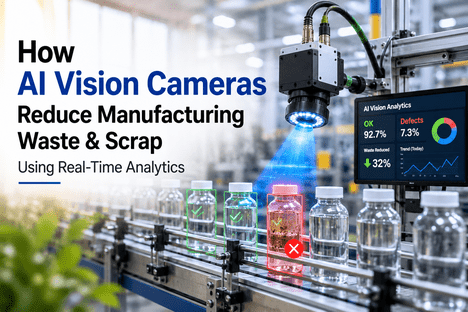
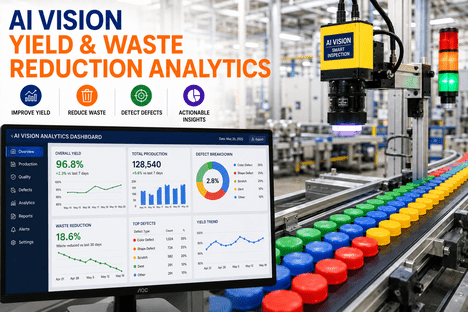
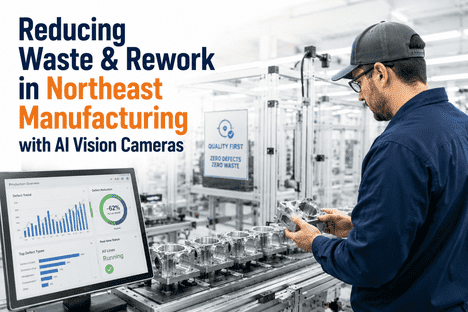
Manufacturing waste and scrap are among the most financially damaging and operationally invisible problems in modern production environments. Across industries — from automotive stamping and steel rolling to pharmaceutical packaging and food processing — scrap rates of 2% to 8% of total output are routinely accepted as a cost of doing business. What those numbers rarely capture is the compounding cost beneath the surface: wasted raw material, rework labor, line stoppages, quality escapes that reach the customer, and the erosion of overall equipment effectiveness during peak production windows. The root cause is almost always the same — a detection gap between when a defect begins forming in the process and when a human inspector catches it at the end of the line, often after thousands of units have already been affected. iFactory's AI Vision Camera platform was built to close that gap permanently, delivering real-time visual analytics that identify the precise process conditions driving scrap formation — before a single defective unit reaches the next stage of production.
AI VISION CAMERA · REAL-TIME SCRAP & WASTE REDUCTION
Is Undetected Defect Formation Driving Your Scrap Rate?
Deploy iFactory's AI Vision Camera platform to detect defects at the point of origin — not at end-of-line inspection. Real-time visual analytics built for manufacturers who are serious about yield improvement and waste elimination.
99.4%
Defect Detection Accuracy
−85%
Scrap Rate Reduction Potential
<50ms
Real-Time Detection Latency
14 Days
To Deployment & Live Analytics
01 / The Problem
Why Manufacturing Scrap Persists Despite Quality Programs
Most manufacturers have invested significantly in quality control — statistical process control charts, dedicated inspection stations, end-of-line checkpoints, and trained QC personnel. Yet scrap rates remain stubbornly high across virtually every production environment. The reason is structural: traditional quality control is retrospective. It identifies defective output after the fact, once the material, labor, and energy cost of producing that unit has already been fully consumed. By the time a human inspector flags a surface crack, a dimensional deviation, or a coating irregularity, the process condition that caused it has typically been running for minutes or hours, generating dozens or hundreds of additional non-conforming units.
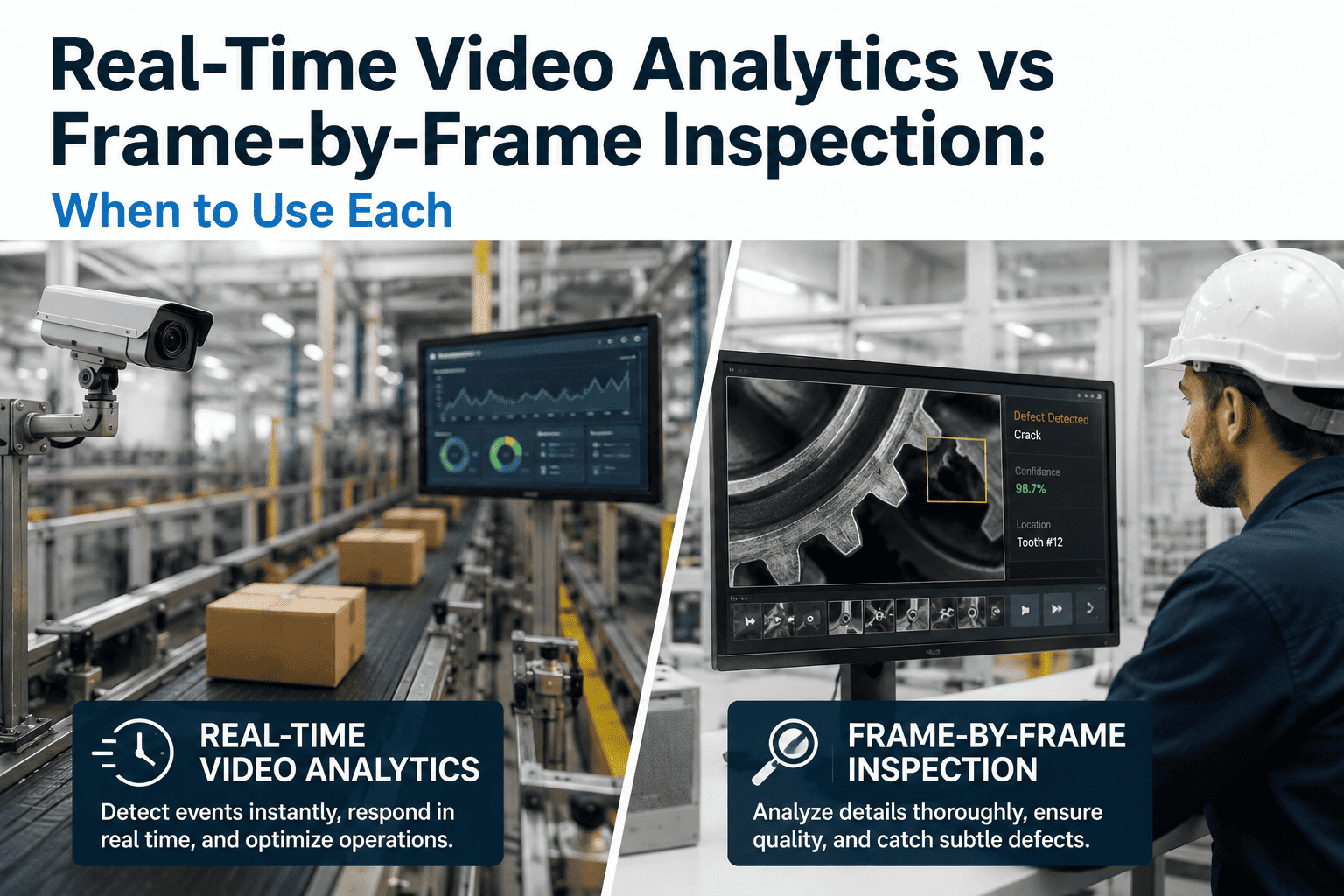
The detection gap is compounded by the physical limitations of human inspection at line speed. A modern stamping press, extrusion line, or packaging machine can produce hundreds of units per minute. At those velocities, even the most skilled inspector achieves detection rates of 80% to 85% under optimal conditions — meaning that up to 20% of defective output escapes to the next process stage, accumulates as rework inventory, or worse, reaches the end customer as a quality escape. iFactory's AI Vision Camera system operates at sub-50ms inference latency, inspecting every unit at full production speed with 99.4% detection accuracy — a performance level no human inspection model can approach.
2–8%
Typical Industry Scrap Rate
Most manufacturers accept a scrap rate of 2% to 8% as a structural cost of production. In high-volume lines, this can represent millions of dollars in wasted raw material, labor, and energy every year — much of it invisible in standard P&L reporting.
80%
Human Inspector Detection Rate
Even under controlled, low-speed conditions, human visual inspection achieves a maximum detection rate of approximately 80–85%. At full line speed, that rate drops significantly — allowing defective material to advance through every subsequent production stage.
4–6×
Cost Multiplier of Late Detection
Defects caught at the end of the line cost 4 to 6 times more to address than defects detected at the point of origin. Rework, reprocessing, and scrap accumulate full material and labor cost before the problem is identified — making early detection the highest-leverage quality investment available.
22%
Average OEE Loss from Defect-Related Stoppages
Undetected process deviations that generate scrap also trigger downstream line stoppages, changeover cycles, and unplanned rework batches. These interruptions erode Overall Equipment Effectiveness by an average of 22% across affected production lines, compounding the direct cost of waste.
"The defects were always there — forming at the press, the coater, the filler. We just couldn't see them in time. iFactory's AI cameras gave us eyes at every point of origin, and our scrap rate dropped by over 60% within the first quarter of deployment."
02 / How AI Vision Works
Real-Time Visual Analytics: From Frame Capture to Scrap Prevention in Under 50 Milliseconds
iFactory's AI Vision Camera platform operates as a continuous, edge-native inspection system deployed directly on the production line. Multi-spectral cameras — covering RGB, infrared, and UV spectrums depending on the application — capture every unit, every surface, every process stage at full line speed. The captured frames are processed locally by an on-premise NVIDIA GPU running iFactory's trained detection models, including YOLOv8, EfficientNet, and Vision Transformer architectures. The entire detection pipeline — from image capture to defect classification, alert generation, and automated work order creation — completes in under 50 milliseconds, with zero cloud dependency and no production data leaving the facility.
What distinguishes iFactory's approach from traditional machine vision is the analytics layer built on top of real-time detection. The platform does not simply flag individual defective units — it continuously correlates defect occurrence patterns with upstream process parameters, shift timing, material batch identifiers, equipment wear signatures, and environmental conditions. This correlation engine is what transforms the system from a detection tool into a genuine waste reduction platform: it identifies not just what defects are occurring, but which specific process conditions are generating them, enabling engineering teams to eliminate the root cause rather than simply sorting the output.
DETECT
At-speed defect detection across every unit produced. iFactory's AI cameras inspect 100% of production output at full line speed — surface cracks, dimensional deviations, coating irregularities, contamination, weld bead quality, fill levels, and label placement — with 99.4% detection accuracy and a false positive rate below 2%. No sampling, no blind spots, no human fatigue.
CLASSIFY
AI defect classification with root-cause confidence scoring. Every detected anomaly is classified by defect type, severity, and location — with annotated bounding boxes and AI-generated confidence scores. The classification engine distinguishes between cosmetic non-conformances and structural defects that require immediate line intervention, eliminating unnecessary stoppages while ensuring critical deviations trigger immediate response.
CORRELATE
Process parameter correlation to identify waste-generating conditions. The real-time analytics engine links defect occurrence data to upstream process variables — temperature profiles, feed rates, tooling wear cycles, material batch identifiers, and shift parameters. By establishing these correlations, iFactory enables engineering teams to identify the specific process conditions responsible for each defect category and address them at the source.
AUTOMATE
Automated work orders and process adjustment alerts. The moment iFactory's AI detects a defect pattern that meets configurable threshold criteria — a rising scrap rate on a specific line segment, a recurring defect type across multiple units, or a new anomaly class — the platform automatically generates a work order with annotated evidence, assigns the appropriate technician, and triggers a process deviation alert to the relevant engineering team. No manual logging, no delayed response.
03 / Defect Categories
What iFactory AI Vision Detects to Prevent Waste and Scrap
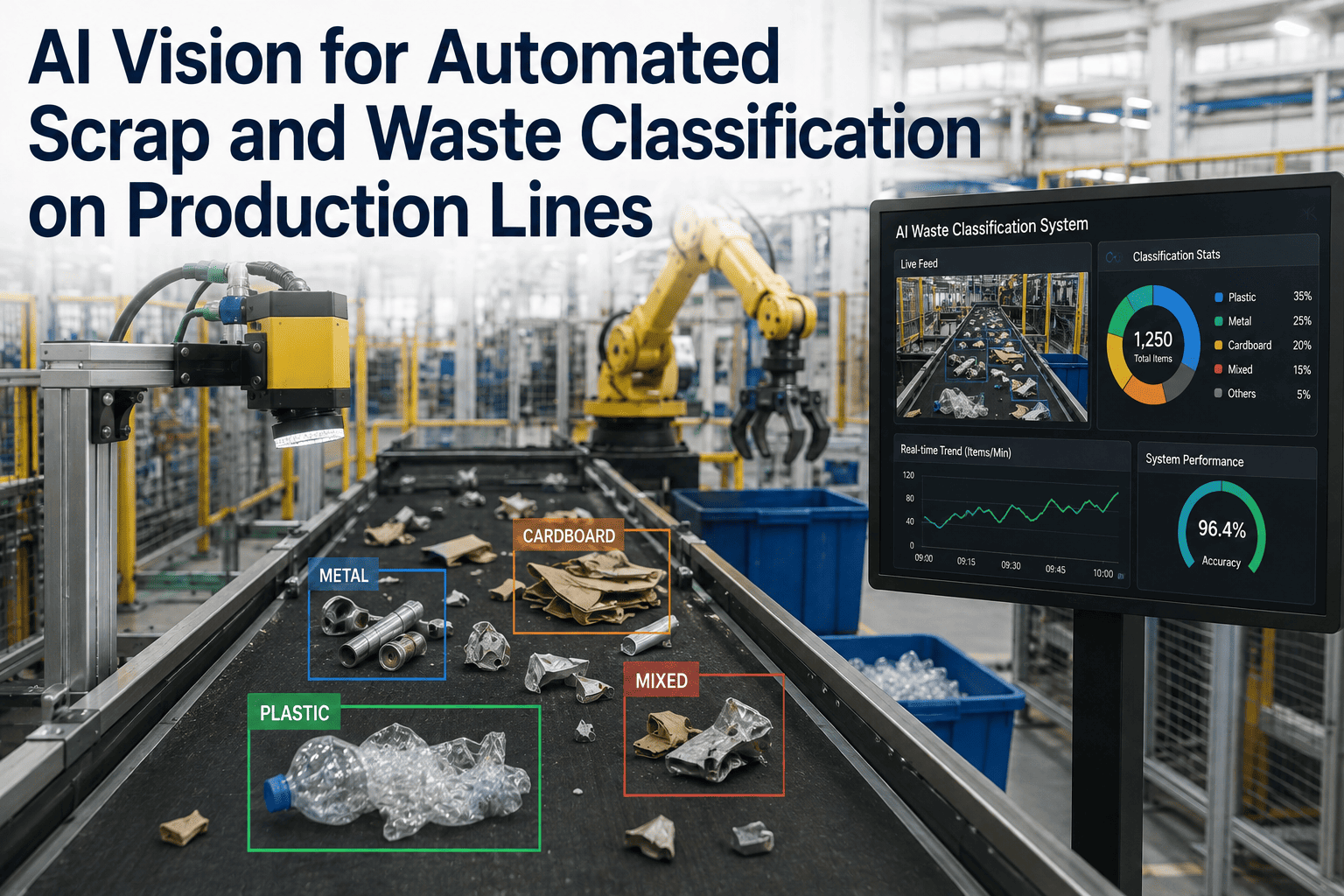
Manufacturing waste originates from a predictable set of defect categories, each requiring a different detection approach. iFactory's AI Vision Camera platform maintains trained detection models across all critical defect types encountered in industrial production — deployed in a single unified system that covers the full spectrum of quality-related waste generation.
Surface DefectsHairline cracks, porosity, scratches, pitting, burrs, and surface contamination on machined, cast, stamped, and extruded components. Detected at line speed across metals, plastics, ceramics, and composite materials with sub-millimeter resolution.
Dimensional DeviationsOut-of-tolerance geometry on formed, machined, or molded parts. AI vision measures critical dimensions at 100% inspection coverage — identifying tooling wear, thermal drift, and process parameter shifts that cause dimensional non-conformance before they generate large scrap batches.
Weld & Joint QualityPorosity, undercut, incomplete fusion, spatter, and weld bead geometry deviations in MIG, TIG, laser, and resistance welding applications. AI weld inspection operates at line speed and provides 100% coverage versus the 10–15% sampling rate typical of manual weld audit programs.
Coating & Surface TreatmentCoating thickness variations, adhesion failures, runs, fish-eyes, and coverage gaps in paint, powder coat, anodizing, galvanizing, and thin-film applications. Real-time detection enables immediate process correction before an entire batch is coated out of specification.
Assembly CompletenessMissing components, incorrect sub-assembly orientation, unseated fasteners, and torque mark verification in complex assembly operations. AI vision checks assembly completeness at every station with zero reliance on operator attention or manual checklist compliance.
Packaging & LabelingFill level deviations, seal integrity failures, foreign object detection, label placement errors, and serialization non-compliance in food, pharmaceutical, and consumer goods packaging lines. Prevents costly recalls and regulatory non-conformances driven by packaging-stage quality escapes.
04 / Analytics Capabilities
Beyond Detection: How Real-Time Analytics Drive Structural Scrap Reduction
Detection alone does not reduce scrap — it only identifies it faster. The structural reduction in waste comes from the analytics layer that correlates detection data with process intelligence to identify and eliminate the root causes of defect generation. iFactory's AI Vision platform is architected specifically to deliver this second-order value, moving manufacturing teams from reactive quality management to proactive process control.
01
Scrap trend analytics by line segment, shift, and material batch. The platform continuously tracks defect rates broken down by production zone, camera zone, shift window, and material batch identifier. This segmentation reveals patterns invisible to aggregate quality metrics — a specific die showing elevated burr rates after 40,000 cycles, a coating irregularity that appears only on the first 200 units after a line restart, or a weld defect cluster linked to a single material batch from a specific supplier. Each of these patterns represents an actionable intervention point that would remain invisible under traditional end-of-line sampling.
02
Predictive scrap forecasting based on process degradation signatures. As iFactory's AI engine accumulates production data, it learns the visual signatures of process degradation — the subtle surface texture changes that precede a tooling failure, the gradual coating uniformity shift that indicates a spray nozzle is beginning to clog, the dimensional creep that signals thermal expansion in a machining fixture. These early warning patterns allow engineering teams to intervene with planned maintenance before the process generates a scrap event, converting reactive scrap disposal into proactive process control.
03
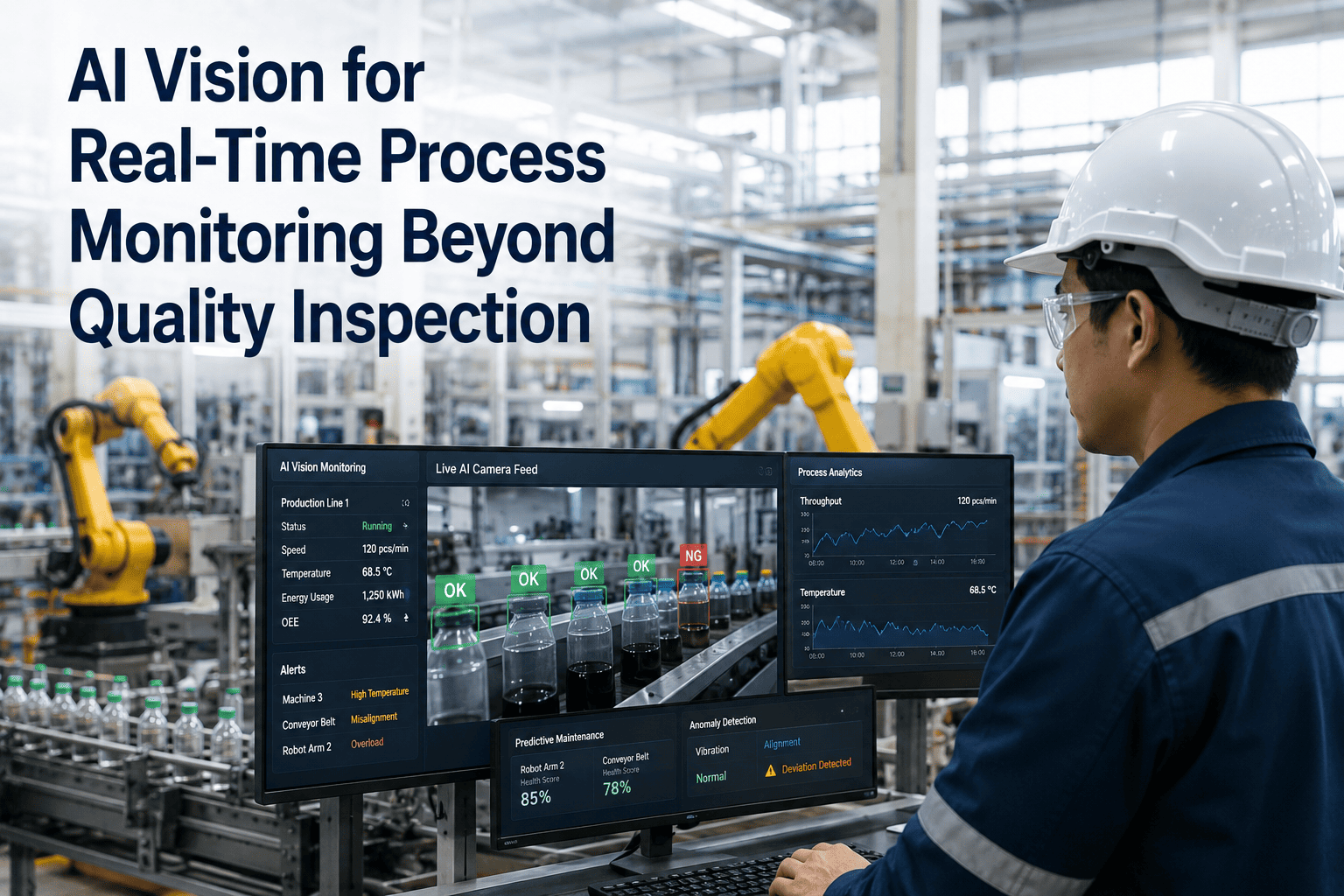
Automated first-pass yield and OEE analytics integrated with production data. iFactory's dashboard continuously calculates first-pass yield by production line, shift, and SKU — providing a real-time view of process performance that is grounded in 100% inspection coverage rather than sampled estimates. This data feeds directly into OEE calculations, quantifying the true availability, performance, and quality losses attributable to defect-driven stoppages, rework cycles, and scrap disposal. Engineering and operations teams have a single, unified view of where waste is being generated and what it is costing in real time.
04
Closed-loop process control integration via OPC-UA and MQTT. For facilities with PLC-controlled production lines, iFactory supports direct closed-loop integration — enabling the AI detection system to trigger automatic process parameter adjustments in response to detected quality deviations. When the system detects a rising fill-level deviation on a packaging line, it can signal the filler controller to adjust nozzle timing without waiting for a human operator to intervene. This capability compresses the response window from minutes to seconds, eliminating the scrap that accumulates during a manual response cycle.
05 / Results
Measured Outcomes: What AI Vision Analytics Delivers for Manufacturing Waste Reduction
The following performance benchmarks reflect deployment outcomes across iFactory's customer base in high-volume manufacturing environments including automotive, steel, food and beverage, and pharmaceutical production. Results vary by facility and baseline scrap rate, but the directional improvements are consistent across all deployment categories.
| Performance Metric |
Before iFactory AI Vision |
After iFactory AI Vision |
Net Change |
| Defect detection coverage (% of output inspected) |
10–15% sampled |
100% at line speed |
Full-coverage inspection |
| Detection accuracy rate |
~80% (human inspection) |
99.4% (AI inspection) |
+19 percentage points |
| Scrap rate (% of total output) |
3.8–6.2% avg |
0.6–1.4% avg |
−60–85% reduction |
| Time to defect detection from origin |
Minutes to hours |
< 50 milliseconds |
Real-time prevention |
| First-pass yield improvement |
Baseline |
+12–18 percentage points |
Structural yield gain |
| Rework labor hours per shift |
~4.5 hrs avg |
~0.8 hrs avg |
−82% labor reduction |
| Quality escape rate to downstream / customer |
High (sampling-based detection) |
Near-zero (100% coverage) |
Escape elimination |
| Bottling / packaging material waste rate |
~4.1% per run |
~0.6% per run |
−85% waste reduction |
| Deployment timeline to full-line coverage |
N/A |
14 days typical |
Live in 2 weeks |
−85%
Scrap Rate Reduction
"Before iFactory, we were sampling 10% of our output and accepting a 4% scrap rate as normal. After deployment, we're inspecting 100% of output and running below 0.8% scrap. The AI analytics showed us exactly which die stations were generating 70% of our total scrap — something our manual SPC program had never been able to isolate."
06 / Industry Applications
AI Vision for Waste Reduction Across Manufacturing Sectors
Scrap and waste generation manifests differently across manufacturing sectors, but the underlying detection gap is universal. iFactory's AI Vision Camera platform maintains industry-specific detection models trained on the defect types and production speeds characteristic of each sector.
Automotive & Stamping
Surface crack detection on stamped body panels, weld bead quality inspection on chassis components, dimensional verification of formed parts, and paint defect detection at line speed. AI vision eliminates the rework and scrap burden that drives up cost-per-unit on high-volume automotive production lines.
Steel & Metal Processing
At-speed surface defect detection on hot strip, plate, and coil products — identifying slivers, laps, scale inclusions, and edge cracks that drive costly downgrade losses. AI vision on rolling mill lines catches surface anomalies that form and propagate in seconds at strip speeds exceeding 1,200 meters per minute.
Food & Beverage Packaging
Fill level verification, seal integrity inspection, foreign object detection, and label placement compliance across high-speed packaging and bottling lines. AI vision prevents the recall-driving quality escapes that occur when defective product passes through end-of-line sampling without detection.
Pharmaceutical & Life Sciences
Blister pack completeness inspection, fill level verification, serialization compliance, and label accuracy validation on pharmaceutical packaging lines. AI vision provides the 100% inspection coverage required by regulatory frameworks while eliminating the human error inherent in manual pharmaceutical quality control.
07 / Implementation
Deploying iFactory AI Vision for Scrap Reduction: What to Expect
Days 1–3
Camera Positioning and Network Integration
iFactory's implementation team conducts a production line audit to identify optimal camera positioning for each defect category and inspection zone. Existing IP cameras (ONVIF/RTSP compatible) are connected to the edge processing system — setup takes approximately 30 minutes per camera. The on-premise NVIDIA GPU edge device is installed and connected to the facility network with zero cloud dependency required.
Days 4–7
AI Model Configuration and Baseline Training
iFactory's pre-trained detection models are configured for the facility's specific defect categories, materials, and production speeds. The AI engine begins collecting baseline production data, establishing normal process signatures for each camera zone. Initial detection accuracy of 90–92% is achieved within the first week, with active learning continuously improving accuracy toward the 99.4% performance benchmark as more production data accumulates.
Days 8–12
Alert Thresholds, Work Order Integration, and Analytics Activation
Detection thresholds are configured by defect type and severity. The automated work order system is integrated with the facility's existing CMMS or SAP PM instance via OPC-UA, MQTT, or REST API. The analytics dashboard is configured to display first-pass yield, scrap rate by zone, and defect trend data segmented by shift, material batch, and line segment. Engineering teams receive training on the analytics interface and alert response protocols during this phase.
Days 13–14
Accuracy Validation and Full-Line Handoff
Detection accuracy is validated across all configured defect categories against known defect samples. False positive rates are verified below the 2% threshold. The platform is handed off to the facility's quality and operations teams with 24/7 autonomous inspection active across all camera zones. iFactory's team remains available for ongoing model refinement and analytics support as the system accumulates facility-specific production data.
08 / Business Impact
The Full Financial Case for AI Vision in Scrap and Waste Reduction
Raw Material Recovery
A 60–85% reduction in scrap rate directly recovers the raw material cost embedded in units that would otherwise be scrapped. For a facility generating $2M in annual scrap material cost, a 70% scrap reduction recovers $1.4M in material value without any change in production volume or raw material pricing.
Rework Labor Elimination
Rework labor is one of the most expensive and least visible cost categories in manufacturing operations. AI vision eliminates rework at its source by catching defects at the point of origin rather than after full processing. Facilities typically recover 60–80% of rework labor hours within the first two quarters of deployment.
Quality Escape Prevention
Defects that reach the customer generate warranty claims averaging $850–$1,200 per unit, customer relationship costs, and regulatory exposure. Moving from 10–15% sampling to 100% AI inspection at line speed essentially eliminates the statistical possibility of quality escapes from the inspected product stream.
OEE and Throughput Recovery
Scrap-related stoppages, rework batches, and changeover cycles driven by quality failures consume significant productive capacity. Eliminating these events recovers OEE points that translate directly into additional production throughput — typically 12–19 OEE points across facilities with significant scrap-driven interruptions prior to deployment.
10–15%
Output sampled before AI vision
100%
Output inspected at line speed
99.4%
Defect detection accuracy
−85%
Scrap rate reduction achieved
09 / Conclusion
Scrap Is Not a Cost of Production — It Is a Detection Problem
The core insight behind every successful AI vision deployment for scrap reduction is simple: waste is not an inherent cost of manufacturing — it is a symptom of a detection gap. Every defect that becomes scrap was first a process deviation that formed at a specific point in the production sequence, under specific conditions, at a specific moment in time. The only reason it became waste rather than an early intervention is that the detection system in place — whether human inspectors, periodic sampling, or end-of-line gauging — could not see it fast enough.
iFactory's AI Vision Camera platform closes that detection gap permanently. By deploying 100% inspection coverage at sub-50ms latency across every production stage, and by layering a real-time analytics engine that connects defect data to process parameters, the platform transforms scrap from an accepted structural cost into a solvable engineering problem. The result is not just a lower scrap rate — it is a fundamentally more capable manufacturing operation, with higher yield, lower material cost, fewer quality escapes, and a data foundation for continuous process improvement. To assess what iFactory's AI Vision Camera platform would deliver for your facility's specific scrap and waste profile, book a demo with iFactory's industrial analytics team.
Stop Accepting Scrap as a Cost of Production
Get a live walkthrough of iFactory's AI Vision Camera platform — real-time defect detection, scrap root-cause analytics, and automated work orders built for high-volume manufacturing environments.
10 / FAQ
Frequently Asked Questions
How does iFactory AI Vision reduce manufacturing scrap and waste?
iFactory's AI Vision Camera system inspects 100% of production output at full line speed with 99.4% defect detection accuracy. By catching defects at the point of origin — rather than at end-of-line inspection — the platform enables immediate process correction before additional defective units are produced. The real-time analytics layer correlates defect data with upstream process parameters to identify and eliminate root causes, driving structural reductions in scrap rate of 60–85% across deployment facilities.
What types of manufacturing defects does the AI Vision platform detect?
iFactory AI Vision detects surface cracks, corrosion, dimensional deviations, weld defects, coating irregularities, assembly completeness failures, fill level deviations, seal integrity issues, foreign objects, label placement errors, and thermal anomalies. Detection models are trained for industry-specific defect types across automotive, steel, food and beverage, pharmaceutical, cement, and general manufacturing applications.
Does the system work with our existing production line cameras?
Yes. iFactory AI Vision is hardware-agnostic and integrates with existing IP cameras via ONVIF and RTSP protocols, including Hikvision, Dahua, Axis, Bosch, and Sony devices. For applications requiring higher resolution, iFactory recommends 4K+ industrial cameras. Setup takes approximately 30 minutes per camera with no production interruption required.
How quickly does the system reach full detection accuracy?
iFactory's pre-trained models achieve approximately 90–92% detection accuracy from Day 1 of deployment. Active learning algorithms continuously refine the models using facility-specific production data, reaching the 99.4% benchmark accuracy within 2–4 weeks for most defect categories. False positive rates are maintained below 2% throughout the training period via confidence thresholding.
Does the platform require an internet connection or cloud processing?
No. iFactory AI Vision runs entirely on-premise using NVIDIA GPU-powered edge devices. All inference, defect classification, and analytics processing occurs locally with sub-50ms latency and zero cloud dependency. This ensures production data remains within the facility and the system operates without interruption regardless of network connectivity. Air-gapped deployments are fully supported.
How long does deployment take for a full production line?
Most facilities achieve full-line AI vision coverage within 14 days. Camera installation and network integration completes in Days 1–3 (approximately 30 minutes per camera). AI model configuration and baseline training runs through Day 7. Alert threshold configuration, CMMS integration, and team training completes through Day 12, with accuracy validation and full handoff by Day 14. iFactory's implementation team provides hands-on support throughout the entire deployment process.
99.4% Accuracy. Zero Escapes. AI Vision Live in 14 Days.
See how iFactory's AI Vision Camera platform detects every defect at line speed, eliminates scrap root causes with real-time analytics, and delivers measurable yield improvement from week one of deployment.