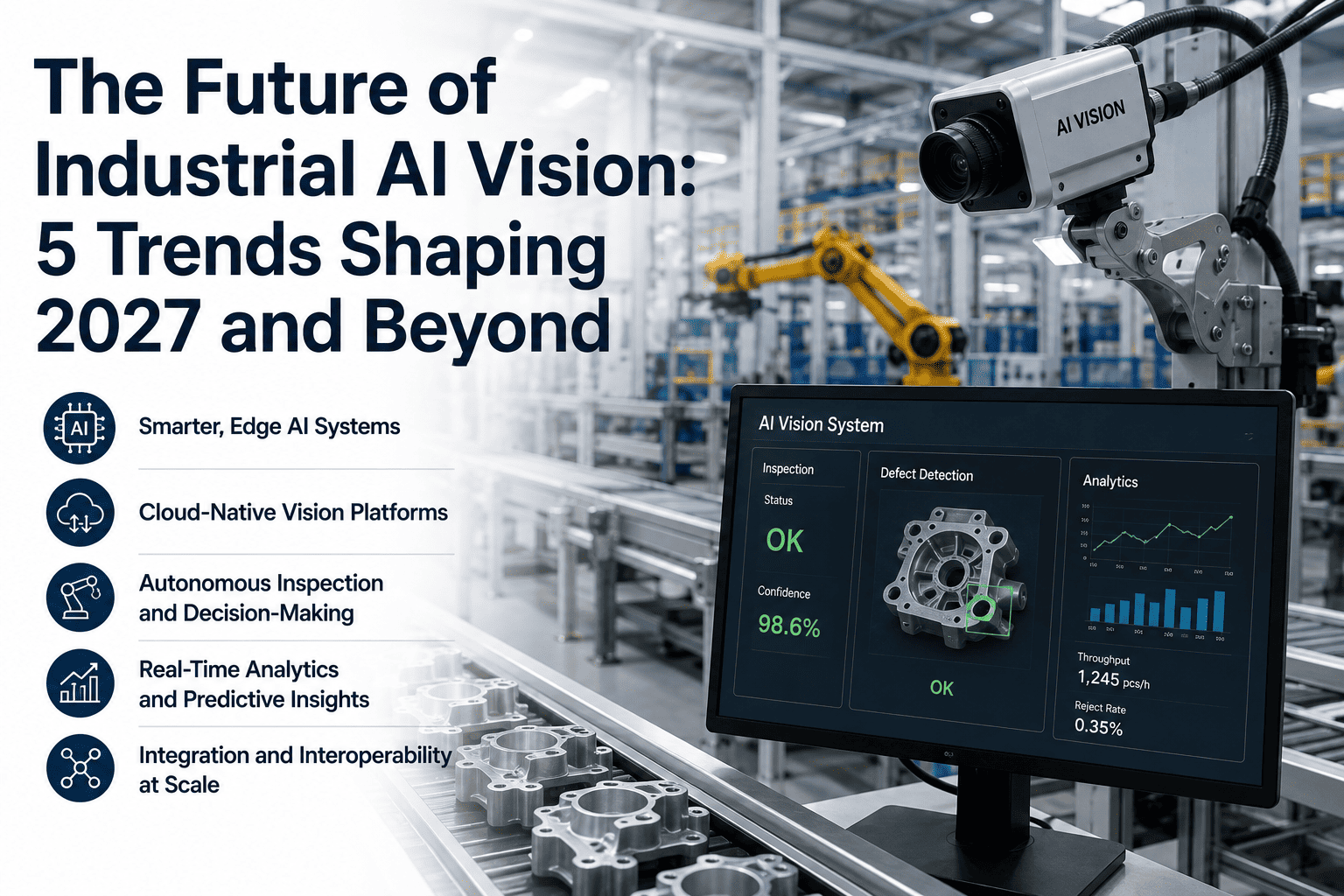
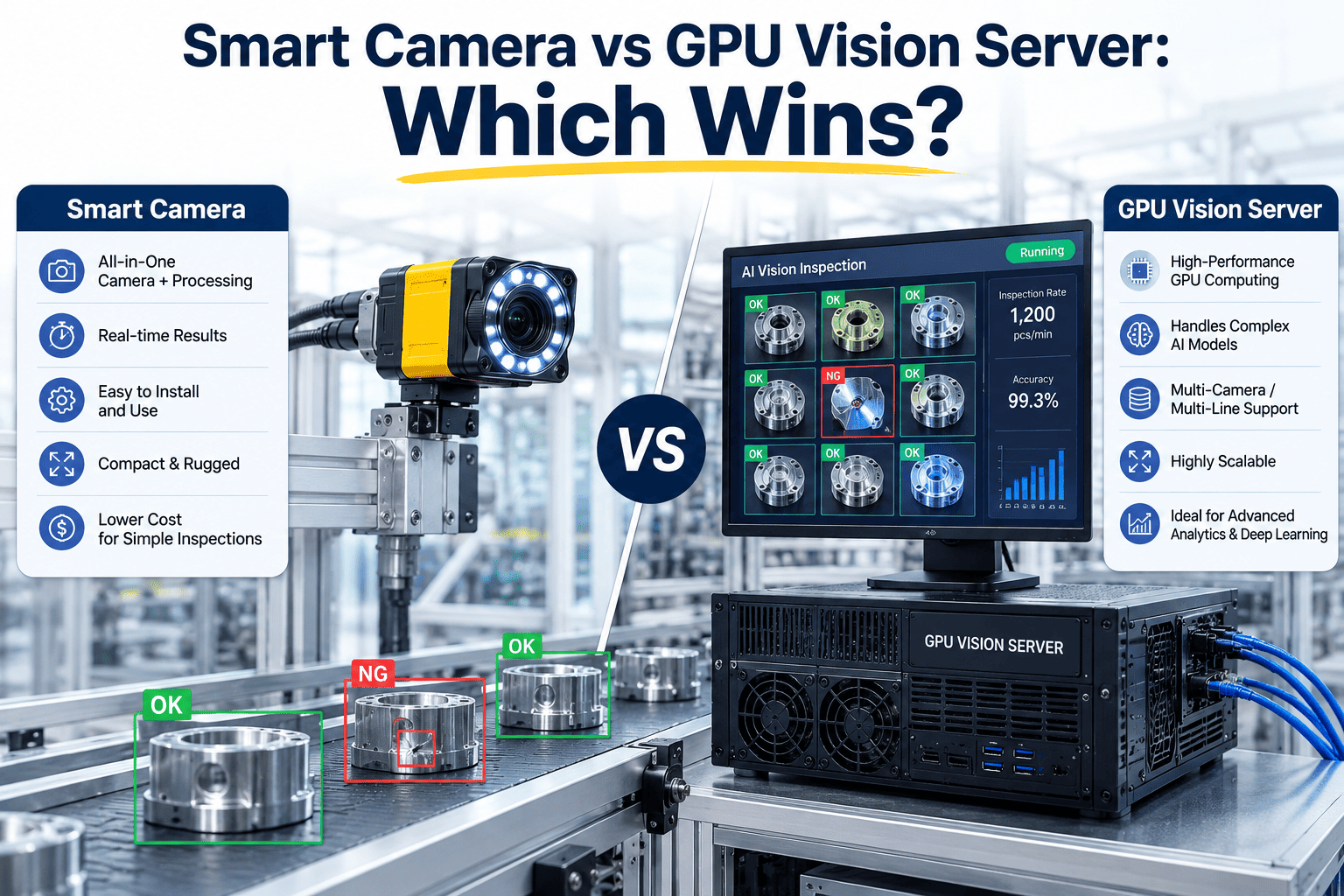
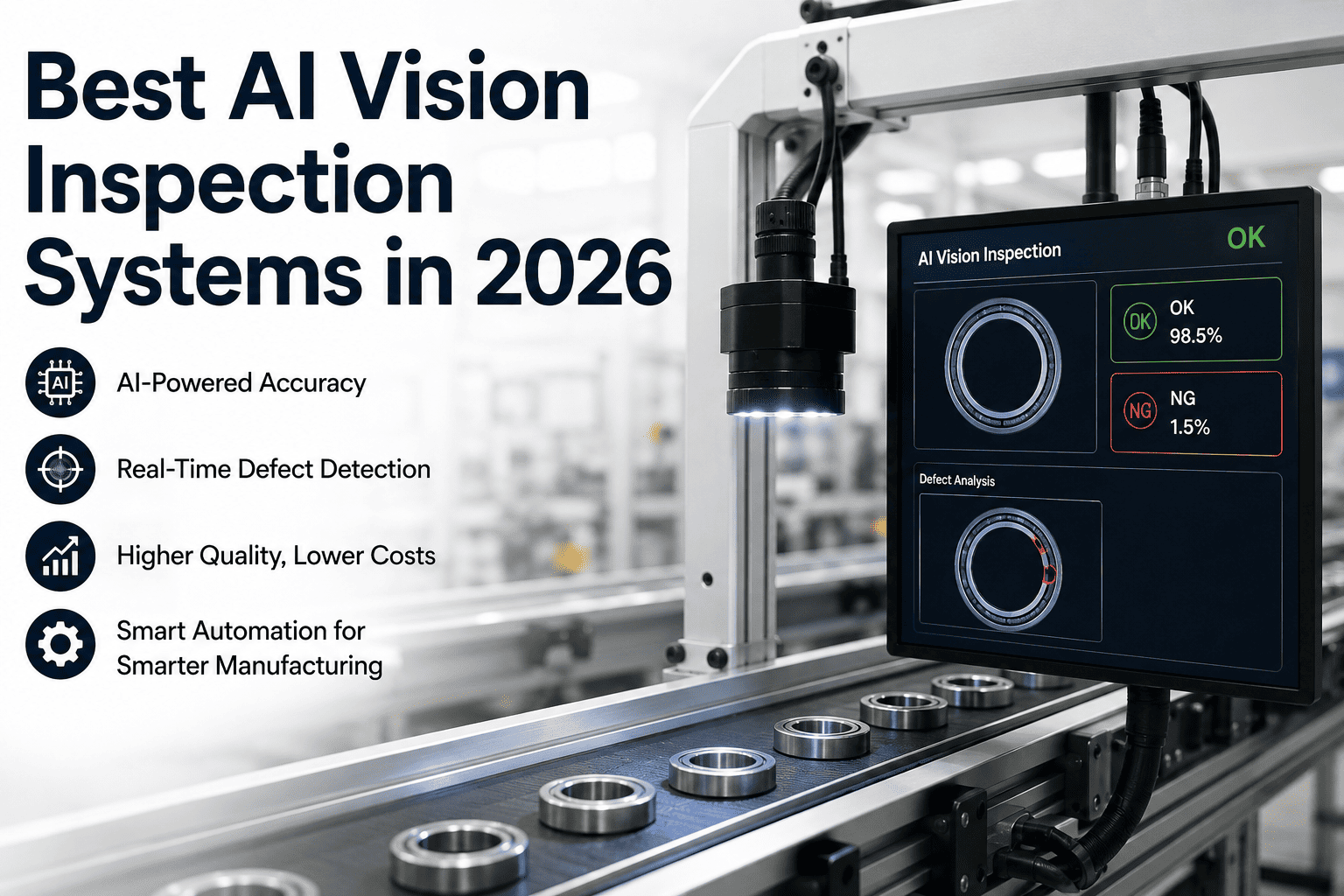
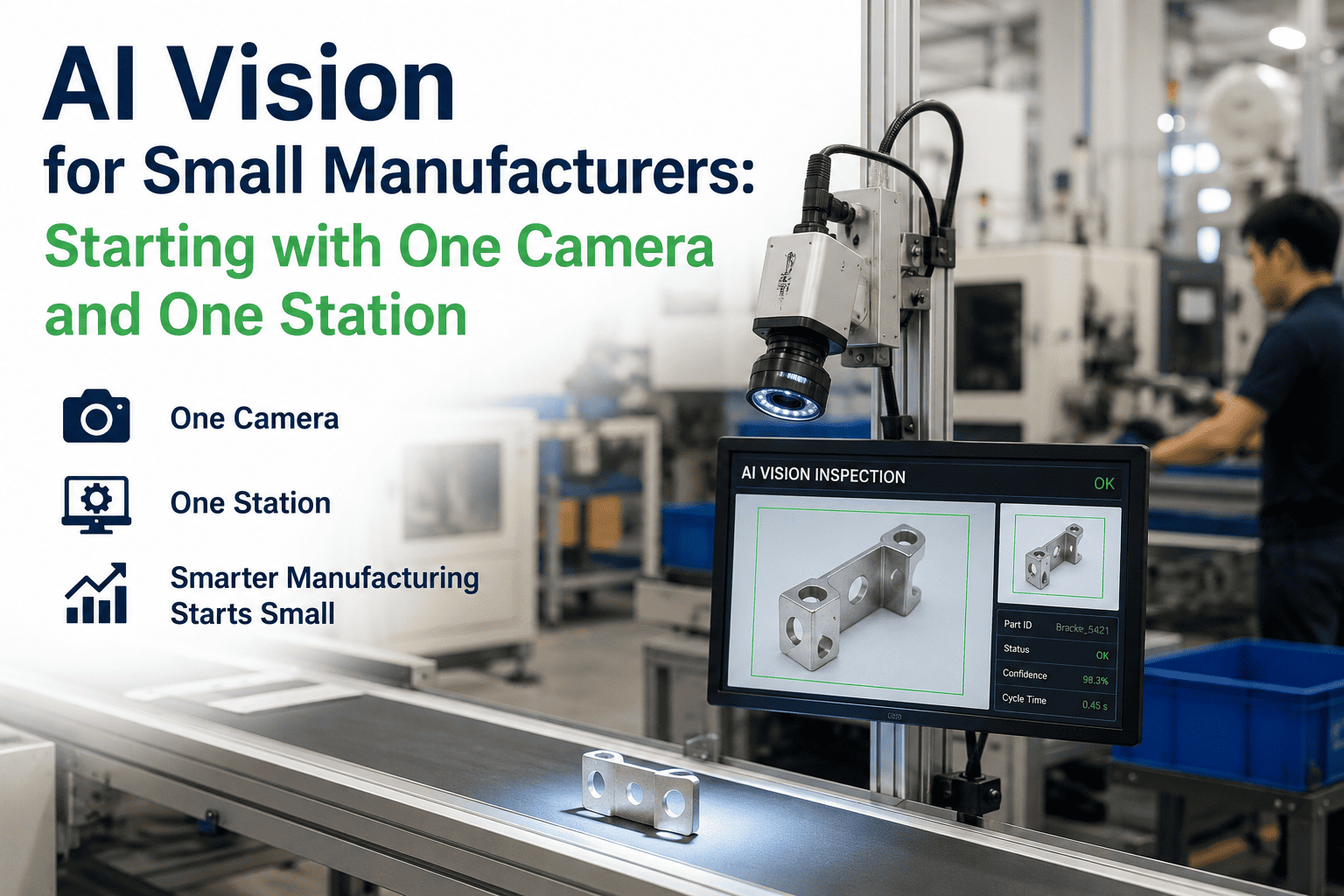
Manufacturing is entering a period of accelerated technological change, and AI vision cameras are at the centre of it. The systems being deployed in 2026 bear little resemblance to the rule-based machine vision tools of five years ago — they learn from production data, adapt to new product variants without manual reprogramming, operate entirely at the edge without cloud dependency, and integrate bidirectionally with MES and ERP systems to convert visual inspection events into real-time operational decisions. For manufacturers evaluating capital investment in quality and production technology this year, understanding which AI vision trends are delivering measurable results now — and which are approaching production readiness — is essential for making informed deployment decisions. iFactory's AI vision camera platform is built around the architectures and capabilities that define 2026's most impactful trends. Book a Demo to see how iFactory's 2026-generation AI vision platform applies to your specific production environment.
Trend 1: Edge AI Inference Replaces Cloud-Dependent Architectures
The shift from cloud-connected to fully edge-based AI inference is the most consequential architectural change in AI vision for 2026. Early industrial vision deployments routed image data to cloud infrastructure for model inference — acceptable for pilot programs, untenable for production environments where network latency, connectivity interruption, or data security requirements make cloud dependency a disqualifying constraint. In 2026, production-grade AI vision systems run the complete inference pipeline on-device: image capture, preprocessing, model inference, defect classification, and output signal generation all occur locally within the inspection cycle window, typically under 50 milliseconds per part.
Edge inference delivers three operational advantages that cloud architectures cannot match. First, latency: local inference produces classification results fast enough to trigger physical line responses — reject actuators, lot hold signals, operator alerts — within the same production cycle as the detected anomaly. Second, reliability: edge systems continue operating during network outages, with local event buffering that synchronises to connected systems when connectivity is restored. Third, data sovereignty: raw image data containing proprietary product appearance never leaves the facility boundary, satisfying the security and IP protection requirements that automotive, defence, and pharmaceutical manufacturers impose on their technology stack. iFactory's AI vision platform is fully edge-native — every inspection decision is made on-device, with system integration handled through buffered event streams rather than real-time cloud dependency.
Trend 2: 3D Vision and Structured Light Move Into Mainstream Production
Three-dimensional imaging has been technically available in industrial vision for over a decade, but the cost, complexity, and processing overhead of 3D systems kept them confined to high-value, low-volume inspection applications. In 2026, that calculus has changed. Advances in structured light projection, laser profilometry hardware, and edge processing power have brought 3D vision into cost and throughput ranges compatible with high-volume discrete and process manufacturing. For manufacturers whose defect types require depth information — weld bead geometry, formed surface deviation, gasket compression, solder joint height — 3D imaging delivers detection capability that no 2D system can replicate.
The practical deployment threshold for 3D vision in 2026 is defined by two factors: inspection cycle time and system cost relative to the value of the parts being inspected. 3D structured light systems now support inspection cycle times compatible with most automotive, electronics, and precision machining line speeds, and the cost per inspection station has dropped into ranges that produce acceptable payback periods at medium production volumes. iFactory's platform supports both 2D and 3D imaging modalities within the same deployment architecture — manufacturers can deploy 2D inspection at high-throughput stations and 3D imaging where geometry requires it, with unified data management and analytics across both modalities.
Trend 3: Deep Learning Models Trained on Small Datasets
One of the most significant practical barriers to AI vision adoption in manufacturing has been training data requirements. Early deep learning inspection systems required thousands of labelled defect images per defect class to reach production-ready accuracy — a threshold that was simply unattainable for manufacturers whose defect rates were low, whose production volumes were moderate, or whose defect types were genuinely rare. In 2026, transfer learning, synthetic data generation, and few-shot learning architectures have collapsed this requirement dramatically.
Production-ready defect detection models can now be trained with 50–200 labelled examples per defect class for the most common inspection applications. Synthetic data augmentation — generating realistic defect image variations from a small seed dataset — extends limited real defect examples to the training volumes that high-accuracy models require. This development fundamentally changes the economic viability of AI vision for manufacturers who previously could not accumulate sufficient training data. iFactory's model training methodology uses transfer learning from large industrial inspection datasets, requiring as few as 50–100 labelled images per defect class to reach the accuracy thresholds that production deployment demands, with continuous model improvement as production inspection data accumulates.
Trend 4: Full MES and ERP Integration as a Standard Deployment Requirement
In 2025, MES and ERP integration was a differentiating capability that advanced AI vision platforms offered as a premium feature. In 2026, it is becoming a baseline deployment requirement — manufacturers who have experienced integrated AI vision are unwilling to accept standalone inspection systems that generate quality data without connecting it to the production and business systems where operational decisions are made. The shift reflects a maturing understanding of where AI vision creates value: not in the detection event itself, but in the operational response that detection enables.
Full bidirectional integration means that defect detection events automatically trigger MES lot holds, ERP quality notifications, and nonconforming material stock blocks within seconds — without manual quality department intervention. It also means that MES production order changes automatically update vision inspection parameters at product changeover, and that ERP material lot data provides the supplier and procurement context that correlates vision inspection results with incoming material quality. iFactory's integration architecture supports SAP S/4HANA, SAP ME, Oracle Cloud Manufacturing, Microsoft Dynamics 365, Infor LN, Siemens Opcenter, and Rockwell Plex through pre-built connectors, with custom integration available for non-standard MES architectures.
| Integration Capability | Standalone AI Vision (Pre-2025) | iFactory Integrated AI Vision (2026) |
|---|---|---|
| Defect to MES Lot Hold | Manual quality action required — 30 min to 4 hours | Automatic lot hold in under 90 seconds from detection |
| ERP Quality Notification | Manual ERP entry — dependent on quality team availability | Automatic quality notification and stock block generated from detection event |
| Product Changeover Adaptation | Manual vision parameter reconfiguration at every changeover | MES production order change triggers automatic inspection parameter update |
| Lot Traceability | Vision records isolated — manual correlation with production data required | Full forward and backward lot trace across vision, MES, and ERP in under 8 minutes |
| Supplier Quality Feedback | Incoming inspection data disconnected from ERP procurement | Automatic ERP supplier scorecard updates from incoming inspection results |
| Cost-of-Quality Reporting | Manual compilation from disconnected quality and production records | Automated cost-of-quality posting in ERP from vision and MES data |
Trend 5: Predictive Quality — From Defect Detection to Process Control
The most advanced AI vision deployments in 2026 are moving beyond reactive defect detection — catching bad parts after they are made — into predictive quality control that detects process drift before defects form. This shift requires AI vision systems that do more than classify inspection images: they must correlate visual quality data with upstream process parameters, identify leading indicators of quality degradation, and feed actionable signals back to process control systems before the defect rate crosses the rejection threshold.
Predictive quality operation depends on continuous SPC applied to vision data streams — monitoring defect rate trends, defect type distribution shifts, and spatial defect patterns that indicate specific upstream process causes. When a vision system identifies a rising frequency of scratch defects correlated with increasing tool wear signatures in machine sensor data, it can trigger a preventive tool change before the defect rate escalates. iFactory's analytics layer provides real-time SPC on vision data streams, with pattern correlation to upstream process parameters where sensor data integration is configured, enabling the closed-loop quality management that defines advanced smart manufacturing operations.
Trend 6: Multi-Camera Unified Inspection Architectures
Single-station AI vision deployments are being superseded in 2026 by multi-camera unified inspection architectures that cover entire production cells, assembly lines, or manufacturing facilities under a single AI platform with centralised data management and analytics. Multi-camera architectures allow manufacturers to deploy inspection at every critical point — incoming material, in-process assembly stages, and final inspection — with all inspection data consolidated in a unified environment that enables cross-station quality correlation and enterprise-wide trend analysis.
The operational value of unified multi-camera deployment becomes most visible in root cause investigation. When a quality escape is detected at final inspection, a unified architecture enables immediate query across all upstream inspection stations to identify where the defect originated and which other parts or lots from the same production window may be affected. iFactory's platform is designed for multi-camera unified deployment — from a single inspection station to a network of cameras across a multi-facility manufacturing operation — with the same data model, analytics capability, and integration architecture at every scale. Book a Demo to see how iFactory's multi-camera architecture applies to your production layout.
Trend 7: Regulatory Compliance Built Into the Inspection Architecture
Regulatory requirements for electronic inspection records, audit trails, and lot traceability are tightening across food and beverage (FSMA 204), medical devices (FDA 21 CFR Part 11), automotive (IATF 16949), and aerospace (AS9100) manufacturing sectors. In 2026, manufacturers in regulated industries increasingly require that AI vision platforms generate compliance documentation as a standard output of the inspection process — not as a separate documentation exercise that must be performed after inspection events are recorded in disconnected systems.
iFactory's integrated platform generates FSMA 204-compliant Critical Tracking Event records, 21 CFR Part 11-compliant inspection audit trails, and IATF 16949-compliant production part inspection records as a byproduct of normal production operation. The traceability architecture links vision inspection results to MES production records and ERP material documents, enabling complete forward and backward lot traces that regulated manufacturers must produce in response to customer audits, regulatory inspections, and potential recall investigations. Manufacturers deploying iFactory consistently report 50–70% reductions in audit preparation time compared to assembling equivalent documentation manually from disconnected systems.
Trend 8: Faster Deployment — From Pilot to Production in Under Four Weeks
The deployment timeline for AI vision camera systems has compressed significantly in 2026. First-generation industrial AI vision deployments required months of engineering work — custom model development, bespoke hardware integration, and manual MES connectivity — before producing production-ready results. Current platforms compress this timeline to 2–4 weeks through pre-built industry model libraries, standardised hardware configurations, and out-of-the-box MES and ERP connectors that eliminate the bespoke integration work that previously dominated deployment schedules.
iFactory's structured deployment process delivers live defect detection within the first week and full production integration — including MES event integration and ERP quality workflows — by week four. Manufacturers receive measurable quality metrics from week one rather than waiting months for a system that is still in configuration. For manufacturers who have deferred AI vision investment based on concern about deployment complexity, the 2026 generation of platforms removes that barrier. Book a Demo to review the specific deployment timeline for your production environment and defect types.