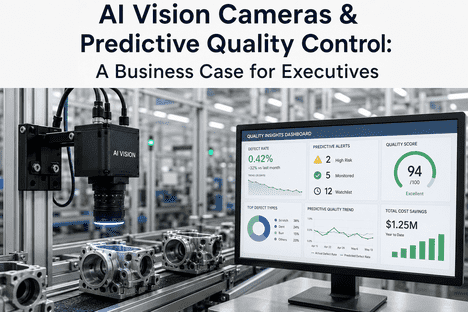
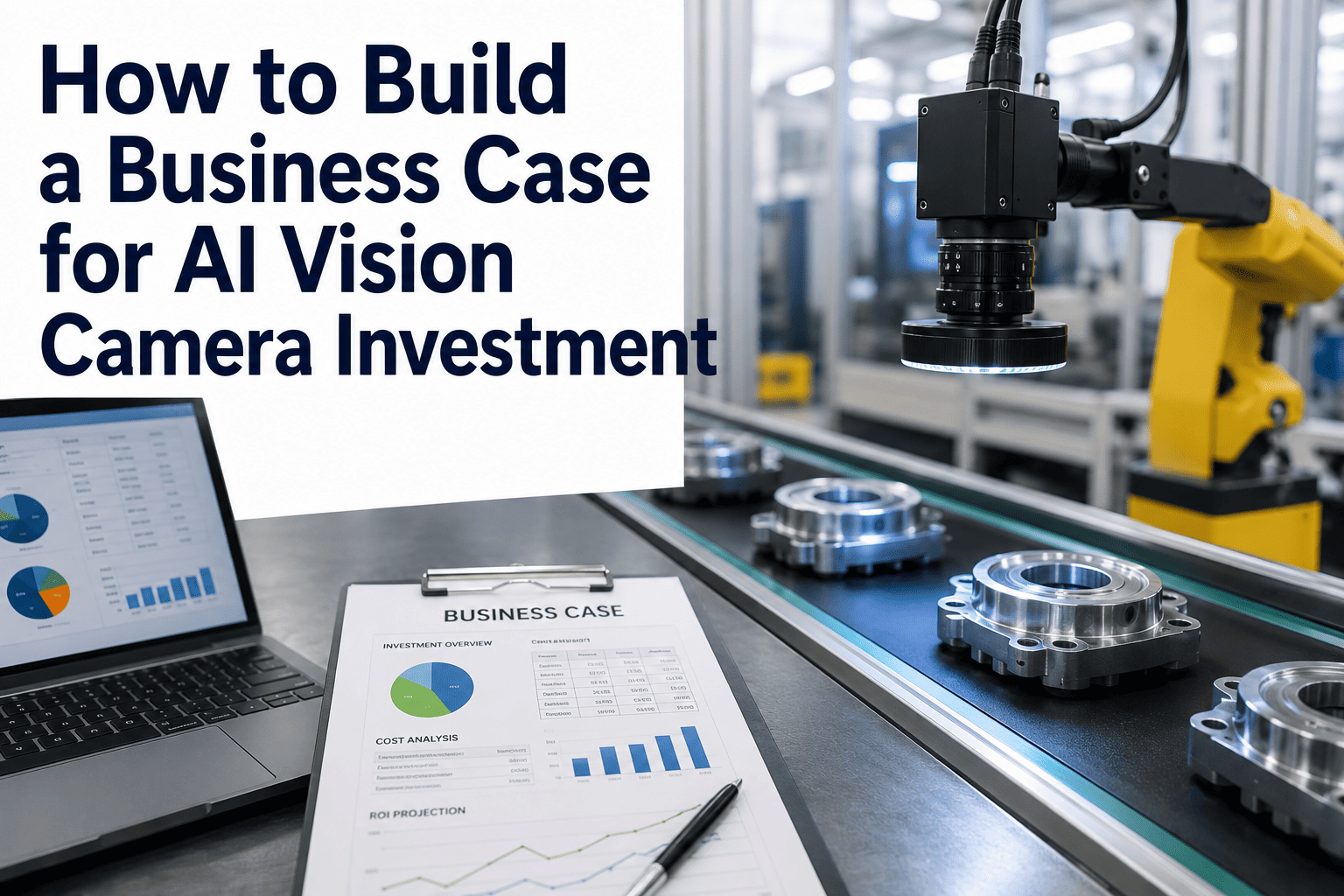
Manufacturing executives face a quality control paradox: defect detection systems that rely on human inspection and periodic sampling have remained largely unchanged for decades, while product complexity, regulatory scrutiny, and customer tolerance for defects have shifted dramatically. The result is a growing gap between what conventional quality programs promise and what they actually deliver at the production line level. AI vision cameras with predictive quality control capabilities close that gap by moving quality assurance from reactive detection to proactive prevention — identifying conditions that precede defects before a single nonconforming part is produced. For executives evaluating where artificial intelligence delivers genuine, measurable manufacturing ROI, predictive quality control built on AI vision cameras represents one of the highest-conviction investments available in 2025. Book a Demo to see how iFactory AI vision cameras apply to your specific manufacturing environment and quality objectives.
See the Business Case in Action — Live on Your Production Line
iFactory AI vision cameras deliver predictive quality control, real-time defect detection, and automated compliance documentation across manufacturing environments. Our deployment team builds the ROI case specific to your line, your defect profile, and your current quality cost structure.
$2.9T
Annual global cost of poor quality in manufacturing, including scrap, rework, and warranty claims
97%
Defect detection accuracy achieved by AI vision camera systems in documented industrial deployments
60%
Average reduction in quality escapes reaching customers after AI vision camera deployment
6–10 wks
Deployment timeline from site assessment to live predictive quality monitoring on the production line
The Real Cost of Conventional Quality Control: What Executives Are Not Seeing
Most manufacturing quality cost analyses capture scrap rates, rework labor, and warranty claims — the visible costs that appear in financial reporting. They systematically miss the larger category of hidden quality costs that do not appear on any single line of the P&L: the production throughput lost to inspection bottlenecks, the engineering time consumed by defect root cause investigations, the customer relationship damage from quality escapes, and the regulatory exposure created by gaps in quality documentation. Research consistently places total cost of poor quality between 5% and 30% of annual revenue for manufacturers without continuous automated inspection — a range that places the true quality cost burden far above what most executive teams are tracking.
Conventional quality control programs built on periodic sampling, manual visual inspection, and end-of-line gauging share three structural limitations that no amount of staffing or process improvement can resolve. First, they are inherently retrospective — they detect defects that have already been produced, not conditions that are about to produce them. Second, sampling-based approaches create statistical certainty gaps: a 10% sample inspection program, however rigorously executed, provides zero information about 90% of production output. Third, human visual inspection performance degrades predictably with fatigue, lighting variation, and production speed increases — introducing systematic accuracy variance that quality systems cannot measure or compensate for. AI vision cameras with predictive capabilities eliminate all three limitations simultaneously.
100% Inspection at Full Line Speed
AI vision cameras inspect every part on every cycle without the throughput penalty of manual inspection. No sampling gaps, no fatigue-related accuracy variance, and no trade-off between production speed and inspection coverage.
Predictive Defect Prevention
By correlating process parameters — tool wear, temperature drift, material lot variation — with early-stage surface and dimensional anomalies, AI vision identifies conditions that predict defect formation before nonconforming parts are produced at scale.
Objective, Repeatable Standards
Every inspection decision is made by the same calibrated model using the same acceptance criteria across all shifts, all operators, and all production conditions. Shift-to-shift and inspector-to-inspector variation is eliminated at the source.
Real-Time Quality Intelligence
Quality metrics — defect rate by type, location, shift, material lot, and machine — are available in real time rather than in the next day's production report. Trends become visible hours before they escalate into line stoppages or customer escapes.
Automated Compliance Documentation
Every inspection result is logged with part traceability data, creating the complete production quality record required for ISO 9001, IATF 16949, FDA 21 CFR Part 11, and customer-specific quality audit documentation — without manual data entry.
MES and ERP Integration
iFactory AI vision cameras connect directly to existing manufacturing execution systems, enterprise resource planning platforms, and SCADA infrastructure — feeding quality data into production planning, inventory management, and supplier quality systems without manual intervention.
Predictive Quality Control: The Shift From Detection to Prevention
The distinction between defect detection and predictive quality control is not semantic — it represents a fundamentally different economic model for managing manufacturing quality. Detection-based systems, including conventional AI vision deployments configured only for pass/fail inspection, reduce the cost of defects by catching them earlier in the production process. Predictive quality control systems reduce the cost of defects by preventing their formation. The financial gap between these two approaches compounds with production volume: a system that prevents 1,000 defects per shift from being produced eliminates 100% of the rework, scrap, inspection, and potential escape cost associated with those parts — a system that detects them after production eliminates only a fraction of that cost.
iFactory's AI vision platform achieves predictive quality control by operating across two simultaneous analytical layers. The first layer performs real-time defect detection on every part, classifying surface defects, dimensional deviations, assembly errors, and contamination with the consistency and speed that human inspection cannot match at production line throughput. The second layer analyzes the pattern of early-stage anomalies — subtle surface texture changes, minor dimensional drift, color or reflectivity shifts — that precede high-severity defects by minutes or hours of production time. When the second layer detects a predictive signature, it generates a process alert before the defect fully manifests, enabling line operators or automated systems to intervene while the upstream cause is still correctable. This architecture converts AI vision from a quality filter into a quality control system.
| Quality Control Dimension |
Conventional Inspection Programs |
iFactory AI Vision — Predictive Quality |
| Inspection Coverage |
Sample-based: 5–15% of production volume inspected. Statistical certainty inversely proportional to production speed increases. |
100% of production volume inspected at full line speed. No sampling gaps regardless of throughput level or shift conditions. |
| Detection Timing |
Defects identified after production. Root cause investigation begins only after nonconforming parts have accumulated. Rework or scrap already incurred. |
Early-stage anomaly signatures detected during production. Process alerts generated before high-severity defects form at scale. |
| Consistency Across Shifts |
Inspector performance varies with fatigue, experience level, lighting, and time of day. Shift-to-shift quality rate variation of 15–25% common in manual inspection operations. |
Identical acceptance criteria applied by the same model across all shifts, all operators, and all production conditions. Shift variation eliminated at the measurement level. |
| Defect Root Cause Visibility |
Defect location and type logged manually. Pattern analysis requires engineering time and retrospective data review. Root cause identified days to weeks after onset. |
Defect type, location, frequency, and correlation with process parameters logged automatically per part. Emerging patterns visible in real-time dashboard within hours of onset. |
| Customer Escape Rate |
Inspection gaps in sampling-based programs create systematic customer escape risk proportional to defect rate and sample interval. Escape events trigger full lot containment and customer notification. |
100% inspection coverage with AI model accuracy above 97% reduces customer escape rate to near-zero for inspected defect classes. Traceability data provides instant lot disposition capability. |
| Compliance Documentation |
Manual inspection records require data entry, are subject to human error, and create audit preparation burden. Gaps in traceability records are common in high-volume operations. |
Complete per-part inspection record created automatically with timestamp, result, and part traceability data. Audit-ready documentation generated without manual input across all relevant quality standards. |
Building the Executive Business Case: Financial Quantification Framework
Justifying AI vision camera investment to a board or executive committee requires translating quality improvement into financial terms that connect directly to the metrics that governance and financial leadership track: gross margin improvement, warranty cost reduction, revenue at risk from customer escapes, and regulatory compliance cost avoidance. The following framework structures the business case across the four financial categories that consistently produce the most compelling ROI calculations in iFactory deployments, drawing on outcomes from live manufacturing engagements across automotive, electronics, food and beverage, and precision component manufacturing sectors.
Scrap and rework are the most directly quantifiable quality costs because they appear in production cost accounting. For manufacturers running sampling-based inspection, the defect population that reaches rework or scrap includes not only true defects but also a significant volume of false rejects from inconsistent manual inspection — parts classified as defective that were actually conforming. AI vision camera deployment consistently reduces total scrap and rework cost through two simultaneous mechanisms: higher true defect capture rate (reducing escapes and late-stage rework) and lower false reject rate (reducing unnecessary scrap of conforming parts). Across documented iFactory deployments, manufacturers report scrap and rework cost reductions of 35–55% within the first six months of live operation. For a production operation generating $2M annually in scrap and rework cost, this range represents $700K–$1.1M in direct annual cost avoidance — typically sufficient to fully recover hardware and deployment investment within the first year.
35–55%
Scrap and rework cost reduction in first 6 months of AI vision deployment
<12 mo
Typical payback period from scrap and rework savings alone in mid-volume manufacturing
97%+
True defect capture rate from iFactory AI vision models in production environments
Warranty claims represent one of the highest-leverage financial targets in the AI vision business case because each field failure generates costs that far exceed the original part value: warranty labor, parts, freight, administration, and the customer relationship cost that does not appear in warranty accounting at all. For manufacturers in automotive, aerospace, and medical device sectors, a single customer escape event can trigger full lot containment, customer notification, field investigation, and regulatory reporting costs that total $500K–$5M per incident — orders of magnitude above the value of the defective parts involved. iFactory AI vision camera deployment reduces customer escape rate by achieving 100% inspection coverage with model accuracy above 97%, eliminating the statistical sampling gap that makes customer escapes an unavoidable probability in conventional programs. Executives in sectors with significant warranty exposure typically find that preventing two to three customer escape events per year produces financial benefit that exceeds the entire AI vision system cost.
60%
Average reduction in customer escapes following AI vision 100% inspection deployment
$500K–5M
Typical total cost per customer escape incident in regulated manufacturing sectors
100%
Production inspection coverage — eliminating the sampling gap that creates escape probability
Manual visual inspection is labor-intensive, high-turnover, and increasingly difficult to staff at the headcount levels required to maintain meaningful sampling rates in high-volume production environments. The true labor cost of conventional inspection programs includes not only the direct wages of inspection personnel but also the cost of training, the productivity losses from inspection bottlenecks at line transitions, and the supervisory overhead required to manage inspection accuracy and consistency. iFactory AI vision camera deployment does not eliminate quality roles — it reallocates quality labor from repetitive visual inspection to higher-value activities: defect pattern analysis, supplier quality management, process improvement initiatives, and customer quality engagement. Manufacturers consistently report a 40–70% reduction in manual inspection labor hours following full AI vision deployment, with quality staffing redirected to roles that generate quality improvement rather than quality measurement.
40–70%
Reduction in manual inspection labor hours following full AI vision deployment
Zero
Inspector fatigue, shift variation, or training lag affecting AI model performance
24/7
Consistent inspection accuracy across all shifts without overtime or staffing constraints
Regulatory compliance in quality management carries two distinct financial exposures: the ongoing cost of maintaining compliance documentation and audit readiness, and the episodic cost of compliance failures — FDA warning letters, automotive customer quality holds, aerospace AS9100 audit findings, and the associated corrective action programs that consume engineering and management resources for months following a significant finding. iFactory's AI vision platform addresses both exposures. Ongoing compliance documentation is generated automatically from inspection records, eliminating the manual data entry burden and the human error risk that creates documentation gaps in high-volume operations. Compliance audit performance improves because AI vision provides complete, timestamp-verified inspection records for every part — the traceability standard that manual systems struggle to achieve consistently. Manufacturers in FDA-regulated sectors report audit preparation time reductions of 50–70% and a demonstrable improvement in audit finding severity when automated inspection records replace manual quality documentation.
50–70%
Reduction in audit preparation time with automated AI vision inspection records
Per-Part
Traceability records with timestamp and result — generated automatically for every unit produced
Multi-Standard
Documentation aligned with ISO 9001, IATF 16949, FDA 21 CFR Part 11, and AS9100 requirements
Strategic Risk Reduction: What AI Vision Cameras Protect Beyond the P&L
The financial case for AI vision cameras in predictive quality control is compelling on direct cost avoidance alone. But the strategic risk reduction case — the value of outcomes that do not appear in financial statements until they go wrong — is equally important to executive decision-making. Manufacturing organizations that experience significant quality failures do not just absorb the direct cost of the failure event. They absorb reputational damage with customers that influences purchasing decisions for years, regulatory scrutiny that adds compliance overhead across all product lines, and organizational distraction that consumes leadership bandwidth at the expense of growth initiatives. The strategic value of AI vision camera deployment is best understood as the present value of these adverse outcomes multiplied by their probability — a calculation that consistently supports investment even for operations where the direct financial ROI alone is borderline.
iFactory AI vision cameras provide three categories of strategic risk protection that executives should incorporate into the business case alongside direct financial metrics. Supply chain quality risk is reduced because AI vision data provides objective, part-level evidence of supplier material lot performance — enabling faster, more defensible supplier quality decisions without dependence on manual incoming inspection sampling. Product liability risk is reduced because complete inspection traceability eliminates the documentation gaps that create uncertainty in litigation about whether a specific part was inspected and what the inspection result was. Customer concentration risk is reduced because manufacturers with documented AI vision quality programs consistently qualify for preferred supplier status with major customers who require continuous monitoring evidence — reducing the revenue vulnerability that comes from qualification uncertainty in competitive resourcing reviews. Book a Demo to discuss how iFactory quantifies strategic risk reduction for your specific customer base and regulatory environment.
Implementation Roadmap: What Executives Should Expect
Executive sponsorship of AI vision camera deployment is most effective when it is grounded in realistic expectations about the implementation sequence, the organizational changes required, and the timeline from investment commitment to measurable financial return. iFactory's deployment program follows a structured six-to-ten-week sequence that delivers live inspection results within the first two weeks and full predictive quality capability by week eight — a timeline that compresses the gap between capital commitment and financial benefit that has historically made manufacturing AI investments difficult to justify in annual planning cycles.
Weeks 1–2
Quality Baseline Assessment and Business Case Validation
iFactory engineers conduct a site assessment quantifying current defect rates, scrap and rework costs, inspection labor, and escape history. This data forms the baseline against which ROI is measured and provides the financial model for executive investment justification. Camera placement, lighting specification, and system architecture are finalized. SCADA, MES, and ERP integration points are mapped.
Weeks 3–4
Hardware Installation and Initial Model Training
AI vision cameras installed, calibrated, and integrated with existing production control infrastructure. Training data collection begins with production parts across all defect classes. Initial AI model training completed and validated against the quality baseline established in phase one. Live defect detection begins in monitoring mode — results logged without triggering automatic reject actions.
Weeks 5–6
Parallel Run and Model Validation
AI inspection decisions run in parallel with existing quality process. Discrepancies between AI and manual inspection results are reviewed with quality engineering to validate model performance and refine acceptance criteria. Operator training for all production shifts completed. Escalation procedures and dashboard access established for quality and production leadership.
Weeks 7–10
Full Production Go-Live and Predictive Analytics Activation
Auto-reject enabled for validated defect classes. Predictive quality analytics layer activated — process parameter correlation and early-anomaly pattern detection begin generating process alerts. MES and ERP quality data feeds live. Executive-level quality KPI dashboard delivering daily defect rate, first-pass yield, and escape risk metrics. ROI tracking against baseline begins from go-live date.
MEASURABLE FINANCIAL RETURNS BEGIN WITHIN 30 DAYS OF LIVE INSPECTION
Manufacturers deploying iFactory AI vision cameras report measurable scrap and rework cost reductions within the first month of live operation — with full ROI realized within 8–14 months across mid-volume production environments. The predictive quality layer delivers additional compounding value as the model accumulates production history and process correlation data over the first 90 days of operation.
8–14 mo
Typical full investment payback period from combined quality cost reductions
35–55%
Scrap and rework cost reduction achievable within first 6 months of deployment
3–5x
Five-year ROI multiple reported by manufacturers with significant warranty exposure
Addressing Executive Objections: The Questions Boards Ask About AI Vision Investment
Executives evaluating AI vision camera investment encounter a consistent set of objections from finance, operations, and IT leadership that must be addressed before capital allocation decisions move forward. The following section responds to the questions most frequently raised during iFactory's executive engagement process — providing the data and framing needed to advance the investment case through internal approval processes.
How do we justify AI vision camera capital expenditure when our current quality program is already certified and passing audits?
Audit certification and financial performance are not the same metric. A quality program can pass ISO 9001 or IATF 16949 audits while still carrying significant scrap, rework, and customer escape costs that AI vision would reduce. The relevant comparison is not "certified vs. uncertified" but "current quality cost burden vs. quality cost burden with AI vision in place." iFactory's baseline assessment quantifies this gap before any investment commitment is made — allowing executives to evaluate the financial return on a specific cost reduction number, not a general AI capability claim.
What happens to the AI model when we introduce new product variants or change materials?
New product variants and material changes are managed through iFactory's structured model update protocol, which treats each significant product or process change as a retraining trigger. New variant images are collected during product development and qualification — before production launch — so the model is validated for the new variant before it enters production. iFactory's quarterly model review cycle and automated drift detection monitor ongoing model performance and alert the quality team when production data indicates conditions outside the model's training distribution.
How does AI vision camera ROI compare to other quality improvement investments — Six Sigma programs, CMM upgrades, or additional inspection headcount?
AI vision cameras provide continuous, scalable inspection coverage that quality improvement programs and periodic measurement equipment cannot replicate. Six Sigma programs generate process improvements but do not provide 100% inspection coverage or real-time defect detection. CMM upgrades improve measurement accuracy for sampled parts but do not change the fundamental sampling gap. Additional inspection headcount scales linearly with cost and does not resolve shift-to-shift consistency issues. AI vision delivers 100% coverage, consistent accuracy, and a declining cost-per-inspection as production volume increases — the only quality investment model that improves in unit economics as output scales.
What is the integration complexity with our existing MES and ERP systems?
iFactory's platform includes pre-built connectors for major MES and ERP systems and communicates via standard industrial protocols including OPC-UA, MQTT, and REST API. Integration scope and complexity are assessed during the week one baseline audit, and custom integration work for non-standard systems is scoped and priced before deployment commitment. Manufacturers consistently report that iFactory's integration approach requires significantly less IT resource than anticipated — most integrations are completed within the first two weeks of deployment without requiring production system modifications.
How do we measure ROI after deployment to confirm the investment thesis delivered?
iFactory establishes a pre-deployment financial baseline covering scrap rate, rework cost, inspection labor hours, warranty claims, and customer escape frequency using the manufacturer's own production and quality data. Post-deployment performance on each metric is tracked through the iFactory quality dashboard and reported in monthly executive summaries. The ROI tracking framework is agreed upon before deployment begins, ensuring that financial performance measurement uses the same definitions and data sources as the original investment case — not retrospective adjustments that make results look better than they were.
What is the realistic risk if the AI vision system underperforms after deployment?
iFactory's deployment protocol mitigates underperformance risk through a mandatory parallel run period — a minimum of five production days where AI decisions are logged and validated against existing inspection outcomes before auto-reject is activated. If model performance does not meet acceptance criteria established during baseline assessment, the system remains in monitoring mode while the model is refined. Manufacturers do not transition to automated rejection until the iFactory model has demonstrated validated performance on their specific parts and defect profile — eliminating the scenario where a poorly performing model disrupts production before its accuracy is confirmed.
Conclusion: Predictive Quality Control Is a Strategic Advantage, Not a Technology Upgrade
The executive business case for AI vision cameras in predictive quality control rests on a straightforward strategic logic: manufacturers who move from reactive defect detection to predictive defect prevention achieve a compounding quality cost advantage over competitors who do not. The direct financial returns — scrap reduction, warranty cost avoidance, inspection labor reallocation — are measurable and significant. The strategic returns — customer escape risk elimination, regulatory compliance strength, and preferred supplier qualification — are less easily quantified but equally important to manufacturing organizations operating in competitive, compliance-intensive markets.
iFactory's AI vision camera platform delivers both categories of return through a structured deployment program that produces measurable financial results within the first 30 days of live operation and full predictive quality capability within eight to ten weeks of installation. The investment timeline is short enough to produce within-year financial impact for capital commitments made in the current planning cycle. The ROI model is conservative enough to withstand board-level financial scrutiny. And the strategic risk reduction value is demonstrable through customer qualification data, regulatory audit performance, and warranty cost trends that executives can track directly against pre-deployment baselines. Book a Demo to receive a financial model built on your production volume, current quality cost data, and defect profile — giving your investment committee the specific numbers required to make a confident capital allocation decision.
Get a Financial Model Built on Your Quality Cost Data
iFactory's deployment team builds a manufacturer-specific ROI model using your production volume, current scrap and rework rates, inspection labor costs, and warranty exposure — giving your executive team the precise financial justification needed for capital allocation approval. No generic industry benchmarks. Numbers from your operation.
Stop Accepting Quality Costs That AI Vision Cameras Eliminate. Build the Business Case Today.
iFactory gives manufacturers 100% production inspection coverage, predictive defect prevention, real-time quality intelligence, and automated compliance documentation — integrated with your existing MES, ERP, and SCADA systems within 8 weeks. Measurable ROI begins within 30 days of live operation.
97%+ defect detection accuracy from AI vision models
35–55% scrap and rework cost reduction in first 6 months
60% reduction in customer escape rate with 100% inspection coverage
8–10 week deployment to full predictive quality operation