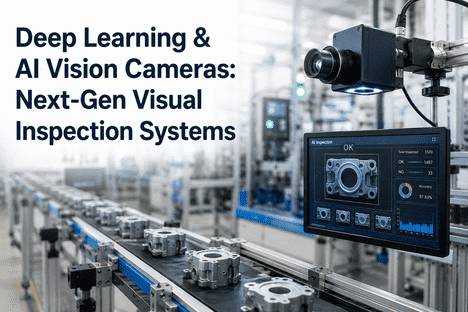
Deep learning and AI vision cameras are redefining industrial quality control. Traditional machine vision systems — rule-based, threshold-driven, and dependent on handcrafted feature engineering — fail to generalize across product variations, lighting shifts, and subtle surface defects that only a trained neural network can reliably distinguish. AI vision cameras powered by convolutional neural networks (CNNs) and transformer-based architectures now deliver inspection accuracy above 99.5% across automotive, electronics, pharmaceutical, and food manufacturing lines, while reducing false rejection rates by 40–70% compared to conventional imaging systems. Book a Demo to see how iFactory AI vision cameras deploy across your production environment.
See AI Vision Inspection in Action on Your Production Line.
iFactory AI Vision Cameras deploy with pre-trained deep learning models and adapt to your specific defect classes within days — no custom programming required. Inspection accuracy above 99.5% from week one.
What Deep Learning Changes About Visual Inspection
Classical machine vision relies on engineers defining explicit rules: pixel intensity thresholds, edge gradient tolerances, blob geometry filters. This approach breaks down the moment product appearance deviates from the training baseline — a new material batch, a seasonal lighting change, a tooling wear shift. Deep learning eliminates this brittleness by learning feature representations directly from labeled image data rather than from manually specified logic. A CNN trained on thousands of pass and fail images automatically extracts the spatial patterns, texture gradients, and anomaly signatures that matter — patterns that no human engineer could efficiently encode as rules.
Modern AI vision inspection architectures go beyond simple defect classification. Object detection networks localize defects to sub-millimeter regions on the part surface. Semantic segmentation models classify every pixel in the field of view, distinguishing cosmetic variation from structural failure. Anomaly detection models trained exclusively on conforming product identify any deviation from learned normality without requiring labeled defect examples — critical for low-volume production where defect images are scarce. iFactory's AI vision platform combines all three approaches into a unified inspection pipeline, selecting the optimal architecture per inspection task and product line automatically.
Core Deep Learning Architectures Powering AI Vision Cameras
Not all deep learning inspection systems are architecturally equivalent. The defect detection performance operators see in production depends on which neural network design the platform uses, how inference is optimized for real-time throughput, and whether the model generalizes or merely memorizes the training distribution. iFactory AI vision cameras are built on four proven architectures, each matched to a specific inspection challenge.
99.5%+
Defect detection accuracy on production lines with deep learning models
40–70%
Reduction in false rejection rates vs. traditional rule-based vision systems
<5 ms
Inference latency per image with edge-optimized deep learning deployment
Days
Time to deploy a trained AI vision model on a new production line
Convolutional neural networks remain the backbone of high-speed surface inspection, excelling at detecting scratches, pitting, discoloration, and micro-crack patterns on flat or curved surfaces at line speeds exceeding 2,000 parts per minute. Transformer-based vision models — specifically Vision Transformers (ViTs) — capture long-range spatial dependencies across the full inspection image, making them superior for assembly verification tasks where the spatial relationship between components matters as much as individual component quality. Feature Pyramid Networks (FPNs) deliver multi-scale defect detection in a single inference pass, enabling simultaneous detection of both macro-level structural defects and sub-pixel surface anomalies. Unsupervised anomaly detection frameworks such as PatchCore and PaDiM provide inspection coverage for new product introductions where labeled defect data does not yet exist — the model learns the distribution of conforming product and flags any deviation as a candidate defect for human review.
Why Traditional Vision Systems Cannot Be Upgraded to Match AI Performance
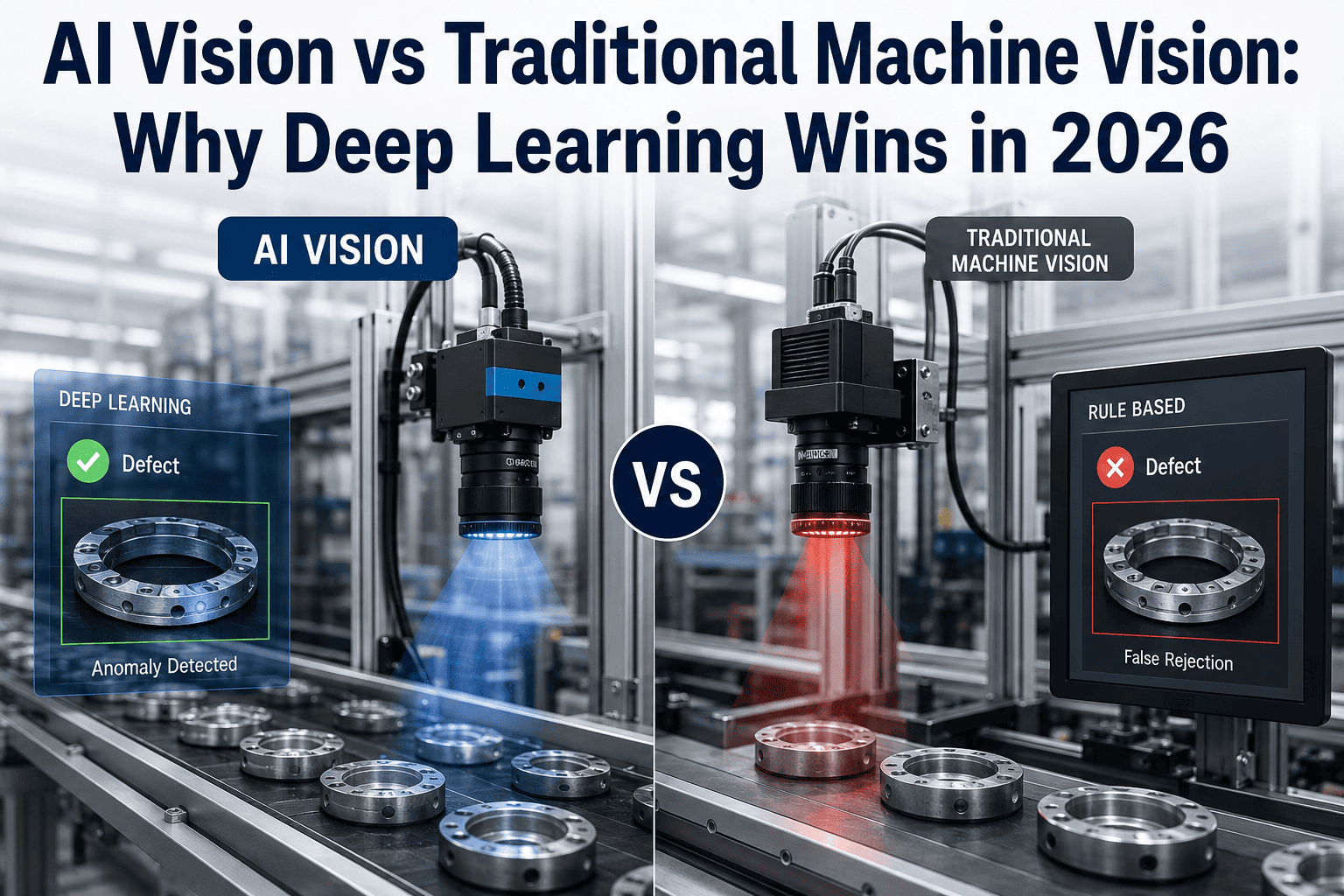
The performance gap between deep learning AI vision cameras and traditional machine vision is not a matter of hardware resolution or lighting quality — it is architectural. Traditional systems separate feature extraction (which a human engineer defines) from classification (which a simple threshold performs). This pipeline has a hard ceiling: the system can only detect defects whose features the engineer anticipated when building the inspection logic. In practice, this means defect escapes whenever a new failure mode appears that the original ruleset does not cover, and over-rejection whenever normal product variation falls outside the fixed tolerance bands.
| Inspection Capability |
Traditional Rule-Based Vision |
iFactory Deep Learning AI Vision |
| Defect Detection Method |
Engineer-defined pixel thresholds and geometric filters. Fails on defect types outside the original ruleset. |
CNN/ViT models learn defect signatures from labeled data. Generalizes to unseen defect variants within trained defect classes. |
| Handling Product Variation |
Tight tolerance bands reject normal variation as defects, driving false positive rates above 5–15% in high-variation environments. |
AI models trained on full product variation distribution. False positive rate maintained below 0.5% across normal appearance variation. |
| New Defect Class Onboarding |
Requires engineer re-programming, re-validation, and production stoppage for logic update. Weeks per new defect class. |
New defect class added by labeling images and retraining. Model updated and deployed within 1–3 days without production interruption. |
| Inspection Speed |
Rule processing scales with image resolution. High-resolution inspection creates throughput bottlenecks at speeds above 500 ppm. |
GPU-accelerated inference delivers sub-5ms latency per frame at full resolution. Scales to 2,000+ ppm without accuracy degradation. |
| Multi-Defect Simultaneous Detection |
Each defect class requires a separate inspection stage. Multi-defect lines require multiple cameras and processing units. |
Single AI model detects and classifies 20+ defect classes per image in a single inference pass. Reduces hardware footprint 30–50%. |
| Continuous Improvement |
No learning mechanism. Performance fixed at deployment unless engineer manually updates rules. |
Active learning pipeline flags low-confidence detections for review and incorporates confirmed labels into ongoing model retraining. |
How iFactory AI Vision Cameras Deploy Across Visual Inspection Programs
iFactory follows a deployment process that delivers a calibrated, production-ready AI inspection model within the first two weeks and full multi-line integration by week six. Every stage produces measurable output — not consulting deliverables, but working inspection models running against live production data.
Weeks 1–2
Inspection Baseline and Data Audit
iFactory engineers review existing inspection specifications, defect libraries, and historical escape and rejection data. Camera positioning, lighting configuration, and image acquisition parameters are optimized for the product geometry. Initial training dataset assembled from production images, with active labeling support provided for rare defect classes.
Weeks 3–4
Model Training and Validation Against Production Standards
Deep learning models trained on the customer-specific defect library. Validation performed against holdout test sets matched to customer accept/reject criteria. Detection accuracy, false positive rate, and inference speed benchmarked against current inspection system performance. Architecture selection (CNN, ViT, anomaly detection, or hybrid) finalized based on defect type profile and line speed.
Weeks 5–6
Production Deployment and MES/SCADA Integration
AI vision cameras deployed at inspection stations with edge inference hardware. Integration with MES, ERP, and SCADA systems established for real-time defect data push and production quality dashboards. Operator interface configured with defect visualization, confidence scoring, and escalation workflows. Parallel run against existing inspection system to validate false positive and escape rates in live production conditions.
Ongoing
Active Learning and Continuous Model Improvement
iFactory's active learning pipeline continuously monitors model confidence distributions and surfaces low-confidence detections for quality engineer review. Confirmed labels are automatically incorporated into scheduled retraining cycles, improving detection accuracy over time without production interruption. Defect trend analytics identify upstream process deviations before they affect yield.
MEASURABLE QUALITY OUTCOMES FROM WEEK 2: AI INSPECTION RUNNING AGAINST LIVE PRODUCTION
Manufacturers completing iFactory's 6-week AI vision deployment report immediate reduction in defect escape rates and false rejection losses — recovering $800K–2.1M in annual scrap and rework cost within the first quarter, with full multi-line integration delivering $3.5–6.8M annual quality cost reduction by week six.
$800K–2.1M
Annual scrap and rework cost recovered in first 90 days
40–70%
Reduction in false rejection rate from deep learning vs. rule-based systems
99.5%+
Defect detection accuracy in production deployment across trained defect classes
Deep Learning AI Vision: Use Cases From Live Manufacturing Deployments
The following outcomes reflect iFactory AI vision deployments across automotive component, electronics assembly, and pharmaceutical packaging production environments. Performance data represents 9–14 month post-deployment production records.
A Tier 1 automotive supplier producing transmission housings at 1,200 parts per hour was managing surface inspection with a legacy rule-based vision system achieving 94.2% detection accuracy and a 7.8% false rejection rate. Rework and scrap from false rejects cost $2.3M annually; three field warranty claims in 12 months traced to escaped surface cracks not detected at inspection. iFactory deployed a CNN-based AI vision system with multi-spectral lighting optimized for the aluminum alloy surface. After training on 14,000 labeled production images covering 11 defect classes, the deployed model achieved 99.6% detection accuracy with a 1.1% false rejection rate. Warranty escapes dropped to zero in the 11 months following deployment. Annual rework and scrap savings of $1.9M delivered, plus two false rejection-driven line stoppages per week eliminated.
Book a Demo to see how this applies to your component inspection line.
99.6%
Defect detection accuracy vs. 94.2% with prior rule-based system
$1.9M
Annual scrap and rework savings from AI inspection deployment
Zero
Warranty escapes in 11 months post AI vision deployment
A contract electronics manufacturer producing 400+ SKU variants on shared assembly lines faced an inspection programming bottleneck: each new product introduction required 3–5 days of engineer time to configure the AOI system's rule libraries, with new defect escapes routinely discovered in the first production runs of each new variant. iFactory deployed a Vision Transformer-based AI inspection system trained on a cross-SKU defect library covering solder defects, component misplacement, polarity errors, and missing components. The architecture's attention mechanism generalized component presence and placement verification across new PCB variants with minimal retraining — new SKU onboarding reduced from 3–5 days to 6 hours. First-pass yield improved from 97.1% to 99.2% across the high-mix line within 60 days of deployment.
6 hrs
New SKU inspection onboarding time vs. 3–5 days with rule-based AOI
99.2%
First-pass yield post AI vision deployment vs. 97.1% prior
400+
SKU variants covered by single AI vision model with cross-SKU generalization
A pharmaceutical manufacturer running blister pack fill-finish at 800 cycles per minute required 100% inspection coverage for seal integrity defects, tablet presence, and label placement — a combined inspection task that legacy vision systems handled with three separate camera stations and required complete reprogramming for each new SKU. iFactory deployed a multi-task deep learning model handling all three inspection tasks from a single camera array in a single inference pass, with sub-4ms latency per cycle at full line speed. The anomaly detection module — trained only on conforming packs — identified two previously undetected seal defect modes during the first week of production deployment, before either defect type had been added to the labeled training set. Regulatory inspection documentation automated through direct integration with the site's batch record system.
<4 ms
Inference latency per pack at 800 cycles/min — 3 inspection tasks, 1 model
2
Previously unknown defect modes detected by anomaly AI in first week
50%
Reduction in inspection hardware footprint — three camera stations replaced by one
Expert Perspective: Why Deep Learning Is the Only Scalable Path for Modern Visual Inspection
Industry Review — Manufacturing Quality Engineering Perspective
"The failure mode of rule-based vision is silent. The system passes every part it cannot confidently reject, and the escape rate climbs every time the process drifts outside the original specification envelope. Deep learning changes the dynamic entirely — the model has learned what conforming product looks like across thousands of real production examples, so anything that deviates from that learned distribution is surfaced for review, regardless of whether an engineer anticipated that specific failure mode. That generalization capability is what makes AI vision the only viable inspection architecture for high-mix, high-speed, and continuously evolving production environments."
Quality Systems Engineering Lead — Global Tier 1 Automotive Manufacturer (provided via iFactory deployment reference)
This perspective reflects what iFactory's inspection engineering team consistently finds across deployments: the highest-value improvement from deep learning AI vision is not the raw accuracy number — it is the elimination of the unknown escape category. Traditional inspection has a documented false negative rate for anticipated defects and an entirely unmeasured escape rate for unanticipated ones. AI anomaly detection closes the second gap by making conformance the detection criterion, not defect recognition. Book a Demo to discuss how iFactory AI vision applies to your specific inspection environment.
Deep Learning Visual Inspection. Production-Ready in 6 Weeks.
iFactory AI Vision Cameras combine CNN, Vision Transformer, and anomaly detection architectures into a unified inspection platform — integrated with your MES, SCADA, and batch record systems. Measurable defect detection improvement from week two of deployment.
Conclusion: Deep Learning AI Vision Is Production-Ready, Not a Future Investment
The evidence from documented manufacturing deployments is unambiguous: deep learning AI vision cameras outperform rule-based inspection systems on every measurable quality metric — detection accuracy, false positive rate, new defect class adaptability, and total inspection system TCO. The architectural advantages are permanent, not incremental. A CNN or Vision Transformer trained on production data will always generalize better than a rule library authored by engineers because learned representations capture the full statistical distribution of production reality, not an engineer's approximation of it.
iFactory's AI vision platform brings together the architectures, deployment infrastructure, and active learning pipeline that production-grade deep learning inspection requires. The 6-week deployment program means measurable quality improvement begins within days of camera installation — not after a year-long integration project. Operators managing high-mix lines, tight defect escape tolerances, or escalating manual inspection labor costs have a documented path to better quality outcomes at lower operating cost. Book a Demo to receive a visual inspection assessment specific to your production lines and defect profile.
Frequently Asked Questions About Deep Learning AI Vision Cameras
How much labeled training data is needed to deploy a deep learning inspection model?
iFactory's models leverage transfer learning from large pre-trained vision networks, significantly reducing labeled data requirements. Most production deployments achieve target accuracy with 500–2,000 labeled images per defect class. For new product introductions with limited defect examples, iFactory's anomaly detection architecture trains on conforming product only — requiring no labeled defect images at all.
Can deep learning AI vision cameras operate at high line speeds without accuracy loss?
Yes. iFactory AI vision cameras use edge-deployed inference hardware with GPU acceleration, delivering sub-5ms latency per frame. This supports inspection at line speeds exceeding 2,000 parts per minute at full image resolution without batching or accuracy compromise.
How does iFactory's AI vision system handle new product introductions after initial deployment?
New SKU onboarding uses iFactory's active learning pipeline: operators label a representative image set for the new product, and the model is fine-tuned and validated within 1–3 days. For products sharing defect classes with existing trained variants, cross-SKU generalization often reduces onboarding to hours rather than days.
What systems does iFactory AI vision integrate with?
iFactory connects directly to MES platforms (SAP, Oracle, Siemens Opcenter), SCADA and DCS systems (Honeywell, Emerson, ABB), ERP quality modules, and batch record systems for pharmaceutical applications. Defect data, inspection results, and quality trend analytics are pushed in real time to operator dashboards and existing quality management infrastructure.
Does iFactory's deep learning vision platform support 3D inspection as well as 2D imaging?
Yes. iFactory supports structured light 3D scanning and laser profilometry inputs in addition to standard 2D camera feeds. 3D point cloud data is processed through dedicated depth-aware neural network architectures, enabling volumetric defect detection for applications including weld bead inspection, surface waviness measurement, and dimensional conformance verification.
Stop Relying on Rules That Cannot Learn. Deploy Deep Learning AI Vision in 6 Weeks.
iFactory gives manufacturers production-grade deep learning inspection with CNN, Vision Transformer, and anomaly detection architectures — integrated with MES, SCADA, and batch record systems. Defect detection above 99.5% from week two.
99.5%+ defect detection accuracy across trained defect classes
40–70% false rejection rate reduction vs. rule-based vision
New defect class onboarding in 1–3 days with active learning
6-week deployment with live AI inspection from week 2