Top 10 Advanced Use Cases of AI Vision Cameras for Quality Control in 2026
By Austin on May 22, 2026
AI vision cameras have moved well beyond simple pass/fail inspection in 2026. Across automotive assembly lines, semiconductor fabs, food processing plants, and pharmaceutical packaging facilities, AI-powered machine vision is now the primary quality control layer — replacing manual inspection, rule-based camera systems, and periodic sampling with continuous, high-accuracy automated detection. The capabilities available today — real-time defect classification, dimensional metrology, surface analysis, and predictive quality scoring — represent a fundamental shift in what quality assurance teams can achieve without adding headcount. Book a Demo to see how iFactory's AI Vision platform deploys across your production line within weeks.
99.4%
Defect detection accuracy in production-deployed AI vision systems
85%
Reduction in false reject rates vs. legacy rule-based vision systems
60%
Lower quality inspection labor cost with full AI vision automation
6 wks
Typical deployment timeline from camera install to live production QC
Why AI Vision Cameras Are Redefining Quality Control in 2026
Traditional machine vision systems operate on fixed, hand-coded rules: inspect for a specific defect shape, at a specific threshold, under controlled lighting. They work well for highly constrained inspection tasks — but fail the moment product variation, lighting shift, or a new defect type falls outside the rule set. The result is a constant cycle of engineer intervention, threshold adjustments, and false rejects that erode line efficiency without improving true defect escape rates.
AI vision cameras solve this by learning from annotated production images rather than following programmed rules. Once trained, models generalize across product variation, lighting conditions, and defect morphology in ways that no rule-based system can replicate. iFactory's AI Vision platform combines deep learning-based defect detection with real-time analytics, digital twin integration, and closed-loop process feedback — delivering quality intelligence that goes beyond flagging defects to understanding why they occur and preventing recurrence. Book a Demo to see detection accuracy benchmarked against your current inspection system.
Deep Learning Defect Classification
Convolutional neural networks trained on production image libraries classify defect types, severity, and location with accuracy exceeding human inspectors at 100% throughput coverage.
Multi-Camera Inspection Architecture
Synchronized AI camera arrays inspect all surfaces, angles, and dimensions of complex assemblies simultaneously — eliminating the coverage gaps of single-station inspection setups.
Real-Time Process Feedback Loop
Defect detection outputs connect directly to process control systems — triggering upstream parameter adjustments before defect rates escalate, not after the shift report reveals a quality event.
Digital Twin Quality Correlation
AI vision data feeds directly into iFactory's digital twin layer, mapping defect patterns to process variables, machine states, and material batch records for root cause analysis.
Automated Compliance Documentation
Every inspection result is timestamped, image-archived, and exportable as audit-ready quality records — satisfying ISO 9001, IATF 16949, FDA 21 CFR Part 11, and customer PPAP requirements automatically.
Continuous Model Retraining
iFactory's AI models update automatically as new defect types emerge on the line — eliminating the re-programming cycles that make legacy vision systems expensive to maintain as products evolve.
Top 10 Advanced AI Vision Camera Use Cases for Quality Control
The following use cases represent the highest-impact applications of AI vision in active production environments across U.S. manufacturing sectors. Each reflects deployment patterns from iFactory's AI Vision installations and published industry performance data through early 2026.
Use Case 01
Surface Defect Detection on Metal and Composite Parts
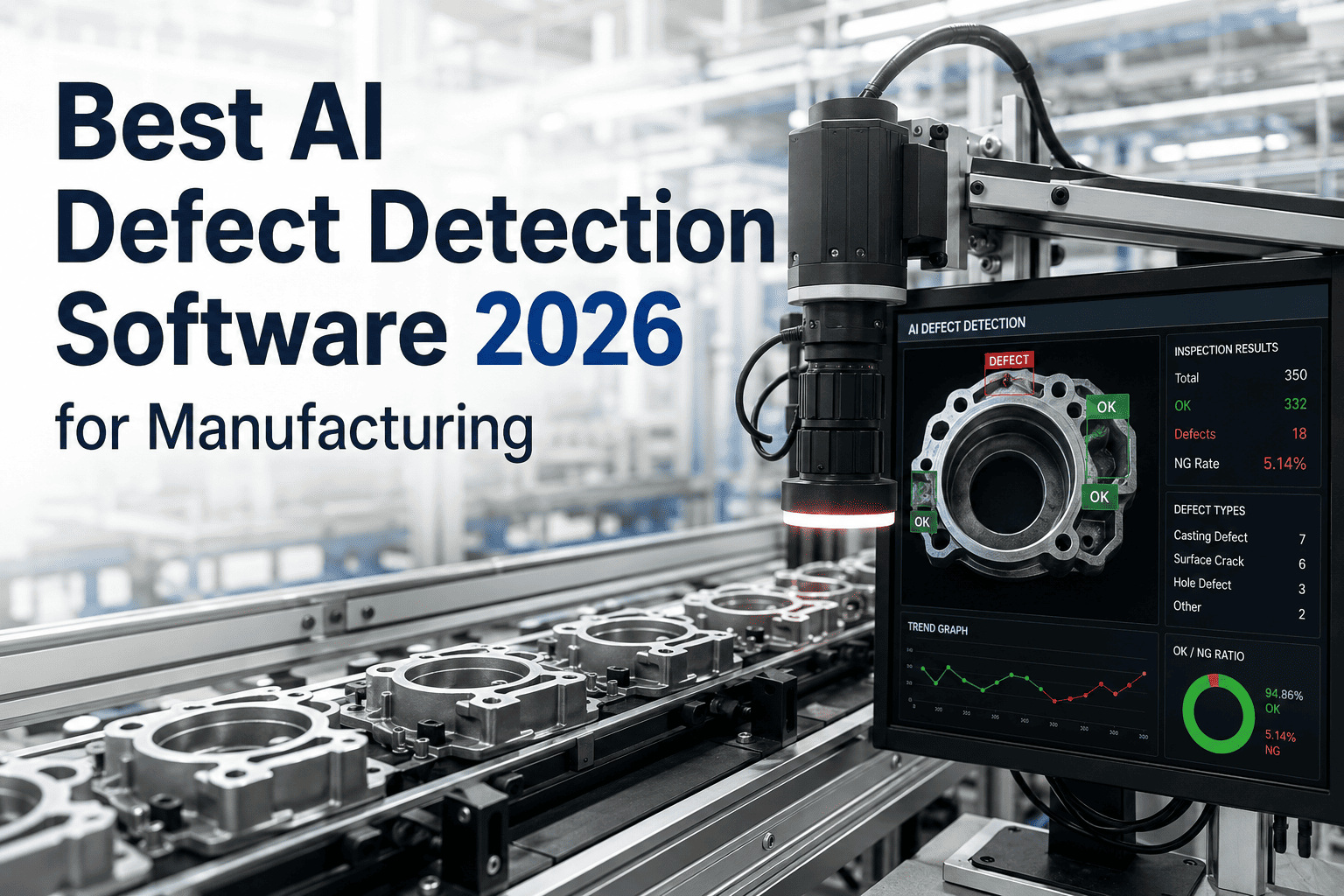
AI vision cameras trained on labeled defect image datasets detect scratches, dents, porosity, cracks, and surface contamination on machined and stamped metal components with sub-millimeter resolution at full line speed. Unlike rule-based systems that require separate configurations for each defect type, deep learning models classify multiple defect morphologies simultaneously — including novel defect variants not present in training data. Automotive Tier 1 suppliers using iFactory's AI Vision platform report false reject rate reductions of 70–85% compared to legacy vision systems, with defect escape rates near zero across 100% production coverage. Book a Demo to benchmark AI vision against your current surface inspection process.
99.4%
Surface defect detection accuracy at full line speed
85%
False reject rate reduction vs. rule-based vision
100%
Production coverage replacing sampling-based inspection
Use Case 02
Dimensional Measurement and Geometric Tolerance Verification
AI vision systems combining structured light, stereo imaging, and deep learning replace contact CMM measurement for high-volume dimensional verification — measuring critical dimensions, hole patterns, and geometric tolerances at inline speeds impossible for physical gauging. iFactory's vision platform performs GD&T-compliant measurement at cycle times under 500ms per part, integrating measurement data directly with SPC dashboards and ERP systems for real-time process capability tracking. Manufacturers eliminate manual gauge R&R uncertainty and reduce CMM lab backlog by shifting 80–90% of dimensional checks to inline AI vision.
<500ms
Full dimensional inspection cycle time per part
±5µm
Achievable measurement repeatability with AI vision metrology
90%
CMM lab backlog reduction by shifting to inline AI measurement
Use Case 03
Weld Quality and Solder Joint Inspection
AI vision cameras using 2D and 3D imaging detect weld porosity, undercut, spatter, incomplete fusion, and solder bridging or insufficient fill on PCB assemblies — quality characteristics that are costly to detect at final test and nearly impossible to rework economically after downstream assembly. iFactory's AI Vision models trained on production weld images achieve inspection coverage across 100% of weld beads at line speed, identifying defects with 97%+ accuracy and feeding defect location data directly to robotic repair stations. Electronics manufacturers report 55–65% reduction in field warranty returns attributable to solder defects within 12 months of AI vision deployment.
97%+
Weld and solder defect detection accuracy at line speed
65%
Reduction in field warranty returns from solder defect escapes
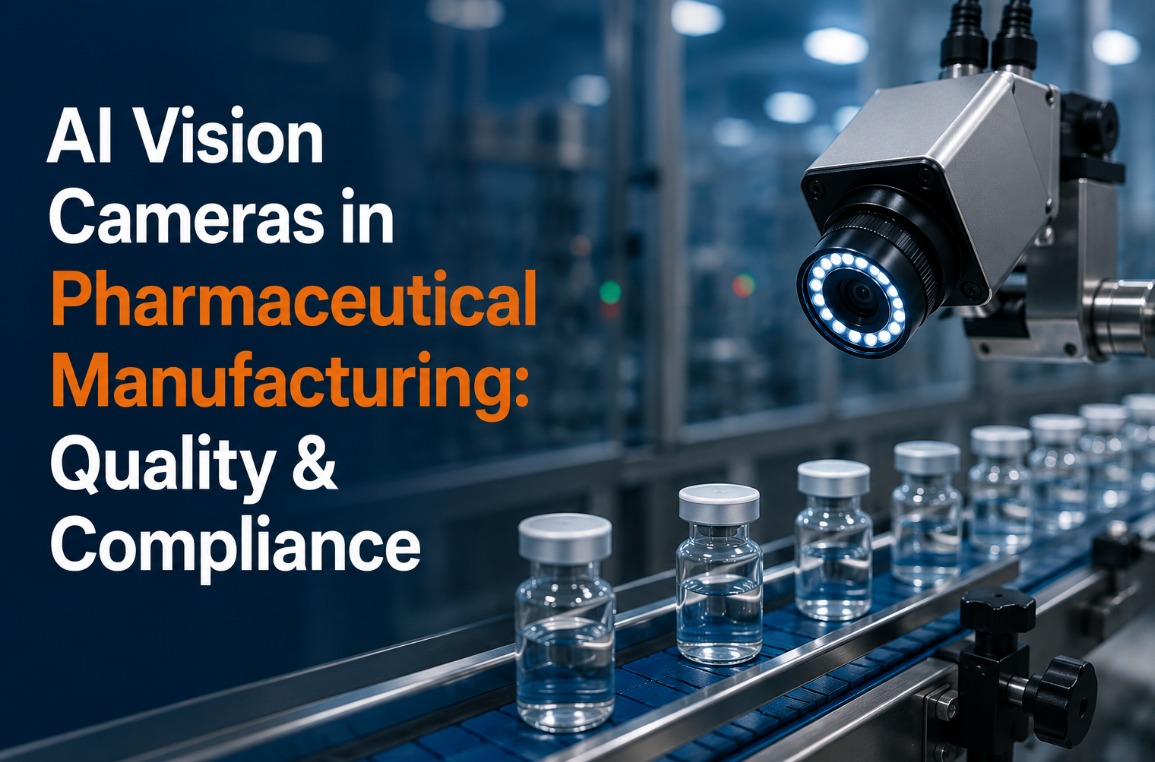
AI vision systems verify label placement accuracy, barcode readability, expiration date printing, lot number legibility, and tamper-evident seal integrity on pharmaceutical, food, and consumer goods packaging at conveyor speeds exceeding 1,000 units per minute. iFactory's platform rejects non-conforming units in real time and generates FDA 21 CFR Part 11-compliant inspection records for every unit — eliminating the manual sampling audits that miss low-frequency errors and expose manufacturers to recall liability. Pharmaceutical customers report elimination of labeling-related recalls within 18 months of AI vision deployment on primary packaging lines.
Use Case 05
Assembly Completeness and Component Presence Verification
AI vision cameras confirm correct component presence, orientation, connector seating, fastener installation, and sub-assembly completeness at every assembly station — preventing missing-component escapes that are the leading cause of field service calls and warranty claims across automotive, appliance, and industrial equipment manufacturing. iFactory's multi-camera assembly verification systems check 40–120 assembly attributes per station at cycle times compatible with production pace, with natural language alert descriptions that direct assemblers to the exact missing or incorrectly installed component rather than a generic fault code.
Use Case 06
Color and Appearance Consistency Verification
AI vision systems using hyperspectral and calibrated color imaging detect color variation, gloss inconsistency, texture mismatch, and appearance anomalies on painted, coated, and molded plastic surfaces that human inspectors miss under variable lighting conditions. iFactory's color verification models are trained to ISO 105 and SAE J1545 color measurement standards, providing objective Delta-E measurements that replace subjective human color judgment — critical for automotive interior panels, consumer electronics enclosures, and branded packaging where appearance consistency is a direct customer satisfaction driver.
Use Case 07
Semiconductor and PCB Micro-Defect Inspection
AI vision systems deployed in semiconductor packaging and PCB fabrication detect micro-cracks, die attach voids, wire bond defects, trace delamination, and BGA solder ball anomalies at resolutions below 10 microns — defect scales invisible to standard machine vision and impractical for manual inspection at production volumes. iFactory's AI vision models trained on wafer and PCB image libraries achieve yield-limiting defect detection that reduces scrap rates 30–45% and improves electrical test first-pass yield on high-density assemblies. Book a Demo to review inspection accuracy on your PCB or semiconductor product profile.
<10µm
Detection resolution for semiconductor micro-defect inspection
45%
Scrap rate reduction in PCB and semiconductor assembly
30%+
First-pass electrical test yield improvement post-AI vision deployment
Use Case 08
Food and Beverage Foreign Object and Contamination Detection
AI vision systems combining X-ray, near-infrared, and visible-spectrum imaging detect foreign object contamination — bone fragments, metal particles, plastic inclusions, and discolored product — in food and beverage processing at line speeds requiring sub-10ms detection decisions. iFactory's food safety inspection models are trained on FDA FSMA-compliant defect libraries and generate HACCP-aligned inspection records for every production lot. Processors report contamination detection sensitivity improvements of 3–5x versus legacy X-ray systems operating on fixed threshold rules, with a corresponding reduction in product recall exposure.
Use Case 09
Predictive Quality Scoring and Scrap Forecasting
Advanced AI vision deployments go beyond binary pass/fail inspection to generate continuous quality scores for every part — scoring dimensional trends, surface quality trajectories, and assembly accuracy patterns that predict downstream failures before they manifest as defects at final inspection. iFactory's predictive quality layer correlates AI vision scores with upstream process variables (temperature, pressure, tool wear, material batch) to forecast scrap accumulation windows and trigger process adjustments before yield loss begins. Manufacturers using predictive quality scoring report 40–55% reductions in end-of-line scrap versus AI vision systems operating only as pass/fail gates.
Use Case 10
Robotic Guidance and Adaptive Assembly Using AI Vision
AI vision cameras integrated with collaborative and industrial robots provide real-time part localization, pose estimation, and assembly guidance that enables adaptive robotic handling of variable-position, variable-orientation parts — eliminating the precision fixturing that makes traditional robotic assembly expensive to deploy and inflexible to product changeovers. iFactory's vision-guided robotics platform enables bin-picking, deformable part handling, and multi-variant assembly operations that previously required human dexterity — with the AI vision layer continuously updating robot path planning based on actual part position rather than assumed nominal position. Book a Demo to see vision-guided robotics deployed on your assembly operation.
AI Vision vs. Traditional Quality Inspection: Production Floor Comparison
The performance gap between AI-powered machine vision and legacy inspection methods has widened significantly in 2026. The following comparison reflects documented deployment outcomes across manufacturing sectors, not theoretical benchmarks.
Inspection Capability
Traditional / Manual Inspection
iFactory AI Vision Platform
Defect Detection Accuracy
75–85% human inspector accuracy; degrades with fatigue and shift change. Rule-based vision limited to pre-programmed defect types only.
97–99.4% AI defect classification accuracy across all trained defect types, including novel variants not in training set, at 100% throughput coverage.
Inspection Coverage
Sampling-based (1–10% of production volume). 100% coverage requires prohibitive labor cost or line speed reduction.
100% part coverage at full line speed with multi-camera arrays. No sampling gaps that allow low-frequency defect types to escape to the field.
False Reject Rate
Rule-based systems: 5–15% false reject rate requiring secondary manual review. Human inspection: subjective and inconsistent across inspectors.
AI reduces false reject rates 70–85% vs. rule-based systems. Confidence-scored borderline decisions route to human review only when justified.
New Product Introduction
Rule-based vision: 4–12 weeks of engineering time to reprogram thresholds per product variant. Manual inspection: training time per product.
AI model retraining from new labeled images in 2–5 days. Transfer learning from existing models accelerates NPI inspection deployment 60–80%.
Process Feedback Integration
Quality data available after shift end or at daily review meetings. Defect trends identified hours to days after process drift begins.
Real-time defect rate dashboards trigger automated process alerts within minutes of quality trend change. Closed-loop feedback to PLC and SCADA without human intervention.
Compliance Documentation
Manual inspection records, spreadsheet-based SPC, periodic sampling data. Audit preparation requires days of data assembly.
Automated timestamped image archives and inspection records per unit. ISO 9001, IATF 16949, FDA 21 CFR Part 11-aligned reports generated on demand.
Every Uninspected Part on Your Line Is a Quality Risk Accumulating Undetected.
iFactory AI Vision delivers 100% production coverage, real-time defect classification, predictive quality scoring, and automated compliance documentation — fully integrated with your existing production systems in 6 weeks. Book a Demo to see detection accuracy benchmarked against your current quality system.
Expert Perspective: What Quality Engineers Get Wrong About AI Vision Deployment
Industry Review — Manufacturing Quality Engineering Perspective
"The most common mistake quality teams make when evaluating AI vision is treating it as a faster version of their existing rule-based system — configuring it to catch the same defects they already inspect for, at the same stations. The transformative value is in what AI vision catches that you never had visibility into: sub-threshold surface variation trends that predict future defects, novel defect types that emerge with new material batches, and assembly drift patterns that are invisible to sampling-based inspection. Operators who deploy AI vision as a direct swap for legacy systems capture maybe 30% of the available value. The ones who integrate it with process data and use it as a quality intelligence layer capture the other 70%."
Quality Systems Director — Major U.S. Automotive Tier 1 Supplier (provided via iFactory deployment reference)
This perspective is consistent across iFactory deployments: manufacturers who integrate AI vision outputs with upstream process variables — tool wear, material batch data, machine thermal state — achieve defect reduction results 2–3x greater than those using AI vision as a standalone inspection gate. The intelligence layer is what differentiates AI vision from advanced photography. Book a Demo to discuss how AI vision integrates with your existing quality and process control infrastructure.
MEASURABLE QUALITY OUTCOMES FROM WEEK 6: AI VISION ACTIVE ACROSS ALL PRIORITY INSPECTION STATIONS
Manufacturers completing iFactory's 6-week AI vision deployment report defect escape rates approaching zero on covered inspection stations within the first production month — with initial scrap cost reductions of $800K–2.1M annually and warranty claim reductions compounding over the first 12-month operating period.
$800K–2.1M
Annual scrap and rework cost reduction in first deployment year
55–65%
Reduction in field warranty returns tied to inspection escapes
12–18mo
Typical full ROI timeline including labor cost reallocation
Conclusion: AI Vision Is the Quality Control Standard for 2026 and Beyond
The ten use cases above represent a cross-section of what AI vision cameras are delivering in active production environments today — not roadmap capabilities, but documented outcomes from deployed systems. The common thread across surface inspection, dimensional metrology, weld quality, packaging verification, semiconductor inspection, and robotic guidance is the same: AI vision provides accuracy, coverage, and intelligence that no sampling-based or rule-based system can match at the scale and speed modern manufacturing demands.
iFactory's AI Vision platform is built for industrial deployment — not a research prototype or a single-purpose inspection tool, but an integrated quality intelligence system that connects inspection data to process control, digital twins, compliance documentation, and production analytics in a unified architecture. The 6-week deployment program means measurable quality improvement begins within the first production month, with the predictive quality layer compounding returns over the following 12–18 months. Whether you are replacing a failing legacy vision system, closing coverage gaps on a high-defect product line, or building a factory-wide quality intelligence platform, iFactory provides the AI vision capability, domain expertise, and deployment support to deliver results from day one.
Frequently Asked Questions About AI Vision Cameras for Quality Control
How does AI vision differ from traditional rule-based machine vision for quality inspection?
Traditional vision follows fixed, hand-coded rules that break when lighting, product variation, or defect types change; AI vision learns from labeled production images and generalizes across variation without reprogramming, delivering significantly higher accuracy and lower false reject rates.
What image data volume is needed to train an AI vision quality inspection model?
iFactory typically trains initial deployment models on 500–2,000 labeled production images per defect class; transfer learning from pre-trained industrial models reduces this requirement significantly for common defect types.
Can iFactory's AI vision system integrate with existing production line PLCs and SCADA?
Yes — iFactory connects to all major PLC platforms (Siemens, Allen-Bradley, Mitsubishi) and SCADA systems via OPC-UA and standard industrial protocols, enabling real-time defect alert delivery and closed-loop process feedback without replacing existing control infrastructure.
What industries benefit most from AI vision camera quality control deployments?
Automotive, electronics/PCB, semiconductor, pharmaceutical packaging, food processing, and aerospace manufacturing see the highest ROI — any industry with 100% inspection requirements, tight dimensional tolerances, or high warranty cost from field escapes.
How long does it take to deploy AI vision quality inspection on a production line?
iFactory's standard deployment is 6 weeks from camera installation to live production inspection, with initial model training completed in weeks 3–4 and full closed-loop process integration active by week 6.
Deploy AI Vision Quality Control Across Your Production Line. Live in 6 Weeks.
iFactory gives manufacturers 100% production coverage, 99.4% defect detection accuracy, predictive quality scoring, and automated compliance documentation — integrated with your existing PLCs, SCADA, and ERP systems from day one.
99.4% defect detection accuracy at full line speed
85% reduction in false reject rates vs. legacy vision
100% production coverage replacing sampling inspection
6-week deployment with live inspection from week 4