Unplanned downtime costs manufacturers between $125,000 and $260,000 per hour on average — and in automotive assembly, that figure exceeds $2 million per hour. The average facility experiences over 800 hours of unplanned downtime every year, with equipment failure accounting for 42% of all incidents. Traditional maintenance models — run-to-failure or fixed-calendar schedules — guarantee either reactive breakdowns or wasted resources servicing equipment that does not need it. AI vision cameras change this entirely. By continuously monitoring machinery for the earliest visual signals of mechanical wear, thermal drift, and structural degradation, iFactory's AI vision platform predicts failures before they occur — converting unplanned emergencies into scheduled, cost-controlled maintenance events.
Predictive Maintenance
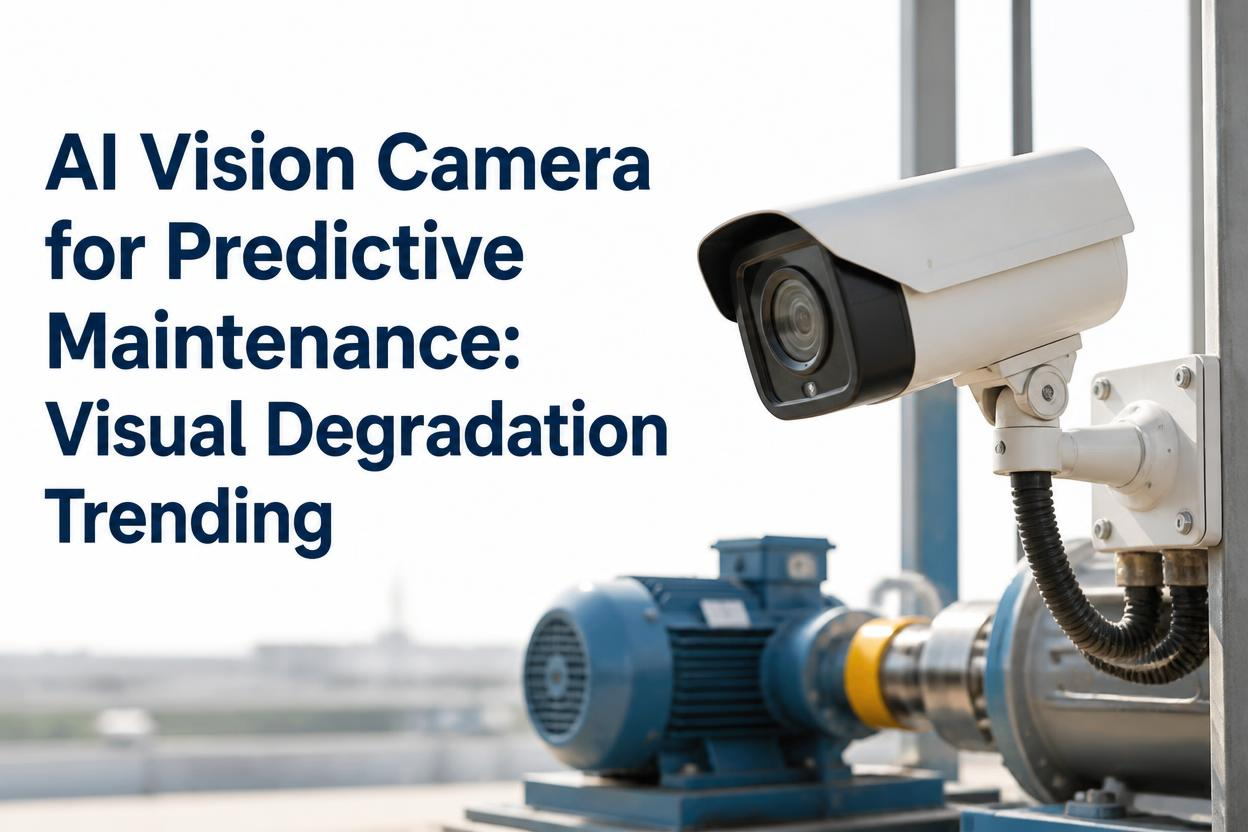
AI Vision Cameras for Predictive Maintenance in Manufacturing
How machine learning vision systems detect the earliest signs of equipment failure — weeks before breakdown — at full production speed, 24/7, without manual inspection shutdowns
50%
Reduction in unplanned downtime with AI predictive maintenance
McKinsey Benchmark
25–40%
Decrease in total maintenance costs after AI vision deployment
Industry Verified
800 hrs
Average annual unplanned downtime per manufacturing facility
Industry Average
Why Conventional Maintenance Models Are Failing Modern Factories
Most manufacturing plants still operate on one of two maintenance strategies — both of which are fundamentally reactive. Run-to-failure keeps equipment running until something breaks, guaranteeing expensive emergency shutdowns at the worst possible moment. Time-based schedules service equipment on a calendar regardless of actual condition — wasting maintenance budget on machinery that does not need attention while missing the machines quietly deteriorating between service windows. Neither approach uses the information the factory already has: continuous visual data from every piece of production equipment, every shift, every hour. AI vision cameras capture that data and transform it into failure predictions weeks in advance.
How Maintenance Gaps Become Million-Dollar Breakdowns
1
The Invisible Degradation Window
Equipment failure rarely happens without warning — but the early warning signs are visual and subtle. Surface wear, micro-cracks, bearing discolouration, belt fraying, seal seepage, and alignment drift are all detectable weeks before functional failure. Without continuous vision monitoring, these signals go unseen until the machine stops producing.
2
The Manual Inspection Gap
Manual inspections happen periodically and cover accessible surfaces only. Two-thirds of manufacturers experience unplanned downtime at least once per month — because the failure event occurs between inspection rounds, in locations technicians cannot safely access during live production, or at a scale of degradation too subtle for human visual assessment.
3
The Cascade Effect
A single machine failure does not stop at the machine. Downstream lines halt, buffers drain, shift targets collapse, and secondary equipment undergoes stress from abnormal operating conditions. What begins as a single bearing failure cascades into a multi-hour production event affecting output, quality, and delivery commitments simultaneously.
4
The True Cost Multiplier
Emergency maintenance triggered by breakdown costs 3–5x more than the same repair scheduled in advance — premium parts sourcing, overtime labour, expedited logistics, and lost production hours that cannot be recovered. AI vision converts that emergency spend into planned maintenance cost at a fraction of the price.
How many failure signals is your factory missing right now? Book a Demo to see what iFactory's AI vision cameras reveal on your production equipment.
What AI Vision Cameras Actually Detect for Predictive Maintenance
iFactory's AI vision cameras are trained on millions of labelled images of industrial equipment in various stages of wear, degradation, and pre-failure condition. The models classify visual anomalies by type, severity, and progression rate — enabling maintenance teams to prioritize interventions by remaining useful life rather than calendar schedule. Here are the critical failure categories that AI vision detects consistently, at timescales that allow intervention before production is affected.
Bearing surface wear
Gear tooth erosion
Belt fraying
Chain elongation
Shaft scoring
Equipment Monitored
CNC machines, conveyors, robotic arms, presses, packaging lines, drive systems
AI Advantage
Detects wear progression 2–4 weeks before functional failure — enabling scheduled replacement during planned downtime
Motor overheating
Bearing hot spots
Electrical hotpoints
Friction zones
Insulation breakdown
Equipment Monitored
Drive motors, electrical panels, welding robots, heat exchangers, compressors
AI Advantage
Thermal imaging combined with AI classification identifies fault locations and severity before temperature reaches critical thresholds
Micro-cracks
Corrosion progression
Weld fatigue
Frame deformation
Fastener loosening
Equipment Monitored
Press frames, robot structures, conveyor supports, stamping dies, turbine blades
AI Advantage
98%+ crack detection accuracy with progression tracking — distinguishing surface marks from structurally critical fractures
Oil seepage
Seal degradation
Coolant leaks
Hydraulic weeping
Contamination staining
Equipment Monitored
Hydraulic systems, gearboxes, CNC coolant circuits, pneumatic actuators, lubrication systems
AI Advantage
Visual seepage detection weeks before volume loss affects performance or triggers equipment damage
Shaft misalignment
Conveyor tracking drift
Spindle runout
Tool offset creep
Fixture wear
Equipment Monitored
CNC spindles, conveyor systems, robotic end-effectors, stamping fixtures, assembly jigs
AI Advantage
Real-time geometric measurement triggers process correction before alignment drift produces defective output or bearing overload
Cutting edge wear
Insert chipping
Die surface erosion
Coating breakdown
Build-up accumulation
Equipment Monitored
CNC tooling, stamping dies, injection mould tools, extrusion heads, forming rolls
AI Advantage
Predicts remaining tool life from visual wear patterns — eliminating both premature replacement and overrun-to-failure
From Visual Signal to Maintenance Action: The AI Prediction Pipeline
Predictive maintenance with AI vision is not a single alert — it is a closed-loop pipeline that connects visual data capture to maintenance execution. iFactory's platform runs this pipeline continuously across every monitored asset, turning raw camera feeds into prioritized maintenance work orders without manual interpretation in the middle.
iFactory AI Vision Predictive Maintenance Pipeline
Monitor
Continuous Visual Capture
Industrial AI cameras monitor equipment surfaces, joints, seals, and moving components at high frame rates. Thermal, visible-spectrum, and 3D imaging options adapt to each asset type and environment — from cleanrooms to foundries to high-heat process areas.
Analyse
Real-Time Anomaly Classification
Deep learning models classify visual anomalies by type, location, and severity in under 50 milliseconds. The AI compares each frame against baseline appearance and historical degradation patterns to assess current condition and estimate progression rate.
Predict
Failure Probability Forecasting
Machine learning models correlate visual condition data with historical failure records to generate remaining useful life estimates and failure probability scores for each asset — giving maintenance planners a precise intervention window rather than a guess.
Act
Automated Maintenance Execution
When risk thresholds are crossed, iFactory automatically generates a CMMS work order pre-populated with asset ID, fault type, severity, and recommended action — routed to the right maintenance team for scheduling during the next planned downtime window.
Stop Reacting to Breakdowns. Start Predicting Them.
iFactory's AI vision cameras monitor your production equipment 24/7, detect the earliest signs of wear and failure, and generate maintenance work orders automatically — before a single production hour is lost.
The True Cost of Running Without Predictive Maintenance
The financial impact of reactive maintenance is rarely captured in a single budget line. It is distributed across emergency repair invoices, overtime records, scrap logs, production shortfall reports, and customer penalty notices that no one consolidates into a total number. When manufacturers do the calculation, the result consistently exceeds what any predictive maintenance system costs to deploy and operate.
Emergency Repair Costs
Breakdown maintenance costs 3–5x more than the equivalent planned repair — premium parts sourcing, overtime call-outs, specialist contractor rates, and expedited logistics all compound the base repair cost.
3–5x Planned Cost
Lost Production Revenue
At $125,000–$260,000 per hour of unplanned downtime, a single 4-hour breakdown event costs between $500,000 and $1 million in lost production — before accounting for customer penalties and expedite freight to recover late orders.
$500K–$1M per event
Unnecessary Preventive Maintenance
Time-based maintenance schedules service equipment that does not need it — consuming labour, parts, and planned downtime on assets with significant remaining useful life. AI vision replaces calendar schedules with condition-based interventions.
20–30% Wasted Spend
Total Maintenance Cost Without AI
Combined reactive repair, lost production, and inefficient preventive maintenance costs — before accounting for quality escapes caused by degraded equipment producing out-of-specification output in the hours before failure.
15–20% of Revenue
How iFactory AI Vision Technology Works for Predictive Maintenance
iFactory's predictive maintenance platform combines industrial-hardened camera hardware with deep learning models trained specifically on manufacturing equipment degradation data. The system runs entirely on edge hardware — no cloud dependency, no latency, no data sovereignty concerns — and integrates directly with your existing CMMS, MES, and SCADA systems through standard industrial protocols.
Layer 1
Industrial AI Camera Hardware
High-resolution industrial cameras in ruggedized IP67 housings withstand the heat, vibration, dust, and coolant exposure of live production environments. Visible-spectrum, thermal, and 3D sensing options mount at equipment locations determined by failure mode analysis — capturing the visual data most predictive of each asset's failure history.
Layer 2
Precision Illumination
Custom lighting arrays maximize the visibility of wear signatures, surface anomalies, and fluid traces under production conditions. Different failure types require different lighting geometries — surface wear needs directional illumination, cracks need dark-field contrast, and alignment checks need structured light projection — all configured at deployment.
Layer 3
Edge Computing — Zero Cloud Dependency
GPU-accelerated edge servers process visual data in real time with inference latency under 50 milliseconds. All computation runs on-premises — eliminating cloud latency, protecting proprietary manufacturing data, and maintaining full system function independent of internet connectivity. Redundant architecture ensures continuous monitoring with no data loss during network events.
Layer 4
Deep Learning Condition Models
Convolutional neural networks trained on millions of labelled industrial equipment images classify anomaly type, severity, and progression stage. LSTM-based sequence models — achieving up to 94.3% accuracy in equipment failure prediction — analyze condition trends over time to generate remaining useful life estimates rather than simple threshold alerts. Models improve continuously with every production shift.
Layer 5
CMMS, MES, and SCADA Integration
iFactory connects directly to your maintenance management, production execution, and control systems through standard APIs and industrial protocols. Predictive alerts generate CMMS work orders automatically. Asset condition data feeds SCADA operator dashboards. Maintenance history enriches model training — creating a self-improving loop where every repair record makes the next prediction more accurate.
See iFactory's predictive maintenance pipeline running on live equipment data from a facility similar to yours. Book a Demo to schedule a personalized walkthrough.
Proven Results from AI Vision Predictive Maintenance Deployments
Where AI Vision Delivers the Highest Predictive Maintenance Impact
AI vision cameras for predictive maintenance are not limited to a single industry or equipment type. Any manufacturing facility where unplanned downtime is costly, manual inspection is insufficient, or equipment degradation produces quality escapes before mechanical failure benefits from continuous visual condition monitoring.
Automotive and Stamping
Monitor stamping presses, welding robots, paint booth equipment, and precision machining centres where downtime costs exceed $2 million per hour in assembly operations. AI vision detects die wear, robot joint degradation, and alignment drift before they produce defective stampings or welding failures that escape to final assembly.
Downtime costs exceeding $2M/hr make AI predictive maintenance an immediate-ROI investment in automotive
Electronics and Semiconductor
Inspect reflow ovens, wafer handling robots, PCB assembly equipment, and cleanroom conveyors for thermal drift, mechanical wear, and contamination accumulation. In semiconductor fabrication, a 72% decrease in unscheduled downtime was documented after AI vision monitoring was deployed across equipment with yield-critical tolerances.
72% unscheduled downtime reduction documented at semiconductor facilities with AI vision monitoring
Food, Beverage and Packaging
Monitor conveyor systems, filling machinery, sealing equipment, and labelling lines for belt wear, seal degradation, and mechanical drift. Nestlé's deployment of AI vision on conveyor belt monitoring in chocolate manufacturing reduced unplanned stoppages while maintaining the hygiene standards required for food-contact equipment environments.
Continuous conveyor and sealing equipment monitoring prevents the line stoppages that compound across high-speed packaging operations
Energy and Heavy Industry
Inspect turbines, compressors, heat exchangers, and pipeline infrastructure for thermal faults, insulation degradation, and corrosion progression without manual inspection shutdowns in high-consequence operating environments. Visual surface degradation signals typically emerge weeks earlier than functional anomalies detectable by vibration or pressure sensors alone.
Visual degradation detected 2–4 weeks earlier than sensor-only systems — the intervention window that prevents catastrophic failure
Frequently Asked Questions
How do AI vision cameras detect mechanical failure before it happens?
AI vision cameras detect the visual precursors of mechanical failure that precede functional degradation by days or weeks. Bearing surfaces show wear patterns and surface changes before vibration signatures become detectable. Seals show early seepage before fluid loss affects system pressure. Cutting tools show edge erosion before dimensional accuracy degrades. iFactory's deep learning models are trained to recognize these early-stage visual signatures, classify their severity, and track their progression — generating intervention recommendations while there is still time to act without disrupting production.
How does iFactory integrate with our existing CMMS and maintenance workflows?
iFactory integrates with all major CMMS platforms through standard APIs and industrial protocols. When the AI detects a condition crossing a configured risk threshold, it automatically generates a maintenance work order in your existing system — pre-populated with asset identification, fault type, severity classification, and recommended action priority. Your maintenance team works from their familiar interface. No new software or workflow changes are required. The first work orders from AI-generated predictions are typically visible within the first week of deployment.
How much historical data is needed before predictions become accurate?
iFactory's models begin generating condition assessments from the first day of operation using pre-trained transfer learning models built on millions of industrial equipment images. These baseline models identify anomalies immediately without facility-specific training data. Prediction accuracy for remaining useful life estimates improves continuously as the system accumulates equipment-specific condition history — typically reaching high-confidence failure predictions within 8–12 weeks of live operation for well-defined failure modes.
Can AI vision cameras work alongside existing vibration or temperature sensors?
Yes. iFactory's platform is designed to complement existing condition monitoring infrastructure, not replace it. Visual data from AI cameras provides earlier failure detection than vibration or temperature sensors for many failure modes — particularly surface degradation, seal failures, and structural cracking — while sensor data provides quantitative confirmation and trend data for mechanical wear. The combination of visual and sensor data in a single monitoring platform increases prediction accuracy and reduces both false positives and missed failures compared to either source alone.
What ROI can we realistically expect from AI predictive maintenance?
Manufacturers deploying AI vision predictive maintenance consistently document full ROI within 6–12 months. The financial return compounds from multiple sources: 30–50% reduction in unplanned downtime events, 25–40% decrease in total maintenance costs through condition-based scheduling, extended asset life through earlier intervention, and reduced quality escapes from degraded equipment. High-downtime-cost facilities — particularly automotive and semiconductor — typically achieve payback in under 6 months. The broader AI manufacturing maintenance market is growing at 35% CAGR, reflecting the scale of documented returns across early adopters.
Your Equipment Is Showing You the Warning Signs. iFactory Reads Them.
Every machine on your floor is generating visual data about its condition right now. iFactory's AI vision cameras capture it, classify it, and turn it into maintenance work orders — before the next breakdown costs you another hour of production.