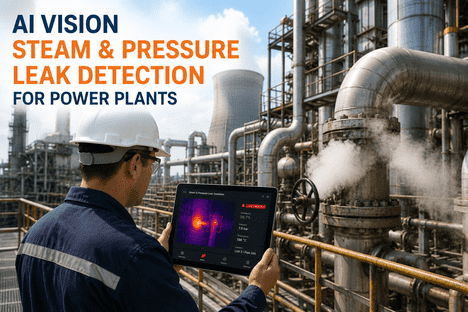
Steam loss in a power plant is invisible until it is expensive. A turbine casing micro-fissure releasing heat shimmer at 0.3 bar differential, gland packing seepage on a high-pressure isolation valve, a weld seam on a main steam header developing a hairline crack at 540°C — these are not the dramatic steam plumes that trigger a control room alarm. They are the slow, continuous energy losses that accumulate across a plant's steam system for weeks or months before any pressure trend deviation registers on the SCADA historian. A 550 MW combined cycle plant that went through iFactory's AI vision deployment discovered 19 early-stage turbine casing leaks in the first three weeks of operation — all at the precursor phase, before any measurable efficiency deviation had occurred. The cumulative heat rate impact of those 19 leaks, had they continued undetected, was projected at 1.4% station heat rate degradation and $2.1M in additional annual fuel cost. One coal-fired station operating 127 high-pressure valves found that undetected gland packing seepage and gradual seal degradation were responsible for 14 to 22 percent excess steam consumption across the valve field — a loss that conventional monthly thermal imaging surveys had not quantified. iFactory's AI vision camera platform replaces periodic thermal survey programmes and acoustic leak detection walkdowns with continuous, 24-hour automated monitoring — using multi-spectral imaging, heat shimmer detection, plume trajectory analysis, and condensation pattern recognition trained specifically on power plant steam system behavior to detect leaks at the precursor stage, classify severity in real time, and generate CMMS maintenance work orders before steam losses reach the threshold where they register as efficiency or safety events. Book a Demo to see iFactory's steam leak detection platform applied to your specific turbine, valve, and header configuration.
Detect Steam Leaks at the Precursor Stage — Before Efficiency Losses Appear in Your Heat Rate
iFactory's multi-spectral AI vision platform continuously monitors turbine casings, steam valves, header welds, and gland packings for steam and pressure leaks — classifying severity in real time and generating CMMS work orders before losses reach the threshold where they impact plant output or safety.
Why Periodic Thermal Surveys Miss the Leaks That Cost Power Plants the Most
The standard steam leak survey methodology — a quarterly or monthly thermographic walkdown conducted by an external contractor with a handheld thermal camera — is structurally incapable of detecting the category of steam loss that generates the highest long-term energy cost in a power plant. Turbine casing micro-fissures, gland packing seepage, and valve seat leakage all develop gradually over weeks, presenting as subtle heat shimmer distortions, condensation trail anomalies, or minor surface temperature differentials that are detectable only when the imaging system is looking at the right asset at the right moment with the right thermal sensitivity and viewing angle. A quarterly walkdown provides approximately 0.3% temporal coverage of a steam system that is degrading continuously. The 99.7% of operating time between surveys is a detection blind window during which small, correctable leaks become large, expensive ones. iFactory's AI vision camera platform closes this blind window with 24-hour continuous monitoring that updates its leak probability assessment for every monitored asset every 12 seconds — detecting the precursor thermal signatures of developing leaks before they cross the threshold where they generate measurable efficiency or pressure losses.
Turbine Casing Micro-Leaks
Heat shimmer and radiant temperature anomalies from hairline casing fissures are detectable at temperature differentials as low as 0.8°C using iFactory's high-sensitivity thermal fusion models — far below the threshold that registers on conventional thermal camera surveys performed by handheld instruments at variable standoff distances.
Gland Packing Seepage
Valve gland packing degradation produces condensation trail signatures and localized surface thermal differentials that develop over days before progressing to visible steam release. AI pattern recognition identifies the condensation geometry and thermal gradient characteristics of early gland seepage — enabling packing replacement during planned maintenance rather than emergency intervention.
Header Weld and Flange Leaks
Main steam header welds and flanged connections subject to high-cycle thermal fatigue develop micro-leaks that manifest as localised condensation patterns and sub-visible steam misting at ambient conditions. Continuous monitoring with AI-classified condensation pattern analysis detects weld seam leakage at the stage where it can be addressed with seal repair rather than header section replacement.
Steam Trap Failures
A single failed-open steam trap wastes $5,000 to $15,000 per year in live steam discharged to condensate return. AI vision detects the characteristic upstream-downstream temperature differential pattern of failed trap operation — distinguishing failed-open, failed-closed, and normal cycling conditions across the entire trap population continuously, replacing manual trap survey programmes that may cover a large trap population on a 6 to 12 month rotation.
Four Ways iFactory AI Vision Changes Steam Leak Detection in Power Plants
The shift from periodic survey-based steam leak management to continuous AI vision monitoring is not an incremental improvement — it is a fundamental change in what detection capability a power plant steam system actually has. These four transformations define the operational difference between a plant running iFactory's AI platform and one relying on conventional walkdown inspection programmes.
From Periodic Surveys to 24-Hour Continuous Detection
A quarterly thermal survey provides a snapshot of leak status at one point in time, on a three-month interval. iFactory's AI vision platform updates its leak probability assessment for every monitored steam asset every 12 seconds — providing 7.2 million monitoring intervals per year where a quarterly survey provides 4. This temporal resolution transforms leak management from a retrospective snapshot programme into a continuous early warning system that catches developing leaks at the stage where intervention cost is lowest and energy recovery is highest.
From Single-Modality to Multi-Spectral Fusion Detection
Individual detection technologies each have blind spots: thermal cameras miss low-emissivity leaks on polished metal surfaces; visible-spectrum cameras cannot detect leaks on insulated pipework; acoustic detectors require proximity to the source. iFactory fuses data from RGB, thermal, and spectral camera channels simultaneously — combining visual plume tracking, heat shimmer analysis, condensation pattern recognition, and surface temperature differential mapping into a single leak probability score per asset. This multi-spectral fusion approach detects leak categories that any single-modality technology misses consistently.
From Qualitative Observations to Quantified Severity Classification
A thermal survey report characterises leaks as low, medium, or high severity based on thermographer judgement. iFactory's AI platform quantifies leak severity as a mass flow rate estimate in kg/hr, a heat rate impact estimate in kJ/kWh degradation, and a time-to-critical-threshold projection in operating hours — giving maintenance planners the prioritisation data they need to schedule interventions by financial impact rather than by location proximity or survey date. This shift from qualitative to quantified severity is what enables the correct maintenance decision: repair now, monitor, or schedule for next planned outage. Book a Demo to see iFactory's severity classification model applied to your valve and turbine casing leak portfolio.
From Disconnected Reports to Automated CMMS Work Order Generation
Thermal survey reports generate a PDF document that gets emailed to a maintenance planner who manually creates CMMS work orders — a process with a typical delay of two to five days between survey completion and work order creation. iFactory generates structured CMMS work orders automatically when a leak detection event crosses its configured severity threshold — with asset ID, location, leak classification, severity score, supporting thermal and visual image evidence, and recommended action pre-populated. The delay from detection to dispatched work order is measured in minutes, not days.
The AI Vision Architecture That Detects Steam Leaks Before They Become Losses
iFactory's power plant steam leak detection platform combines purpose-built multi-spectral camera hardware with deep learning models trained specifically on steam system thermal behavior — accounting for the high-emissivity variation of insulated versus bare pipe surfaces, the ambient temperature and humidity conditions that affect steam plume visibility, and the characteristic thermal signatures of each leak source type in a power plant steam circuit.
iFactory Steam Leak Detection — Four-Layer Detection Architecture
High-sensitivity thermal cameras (NETD <30mK) combined with high-resolution RGB cameras are positioned at fixed monitoring points covering turbine sections, valve fields, header runs, and steam trap manifolds. Camera housings incorporate thermal management and purge air systems for sustained operation in high-ambient-temperature plant environments. Multi-angle coverage eliminates the viewing-angle blind spots that restrict handheld thermal survey detection accuracy.
All image processing and leak detection inference executes on NVIDIA GPU edge hardware installed inside the plant network — with sub-50ms frame processing latency and zero cloud dependency for real-time detection decisions. The edge architecture ensures continuous operation during network outages and keeps all steam system thermal imagery within the plant's security boundary without cloud transmission.
iFactory's detection models are trained on steam plant-specific image datasets covering turbine casing heat shimmer, valve gland condensation patterns, weld seam moisture traces, steam trap differential signatures, and insulation failure thermal profiles — not general-purpose anomaly detection models. Plant-specific fine-tuning during commissioning calibrates detection thresholds to the ambient thermal background and steam pressure conditions of each facility.
Detected leak events above configured severity thresholds generate structured CMMS work orders automatically via REST API — with asset ID, zone, leak classification, severity score, mass flow estimate, heat rate impact projection, and annotated thermal and visual images attached. Alert escalation workflows notify operations, maintenance, and engineering teams by severity tier, with full digital audit trail of every detection event and maintenance response.
What Continuous AI Steam Leak Detection Delivers for Power Plant Operations
The operational and financial impact of replacing periodic survey programmes with continuous AI vision steam leak detection is measurable within the first quarter of deployment — through direct steam loss reduction, heat rate improvement, and avoided emergency repair costs from leaks that would have progressed to failure under a survey-interval-limited detection programme. The following performance outcomes reflect iFactory deployment results in power plant steam system monitoring applications.
One plant achieved a 19.8% reduction in steam system energy losses within six months of iFactory AI vision deployment — through early detection and repair of gland packing seepage, valve seat leakage, and header condensation events that quarterly surveys had not identified or had classified as below-threshold.
A 550 MW combined cycle plant detected 19 turbine casing micro-fissures at the precursor stage within three weeks of deployment — all before any measurable efficiency deviation had appeared in the plant historian. The projected heat rate impact of those leaks continuing undetected was 1.4% station heat rate degradation.
A coal-fired station replaced its quarterly valve field thermal survey with iFactory continuous monitoring across 127 high-pressure steam valves — identifying systematic gland packing seepage responsible for 14 to 22% excess steam consumption that the survey programme had not quantified during the previous three inspection cycles.
AI vision detects failed-open steam trap signatures within hours of failure onset — versus the weeks or months between manual trap survey intervals. A single failed-open trap wastes $5,000 to $15,000 per year in live steam. Continuous detection prevents the energy waste accumulation that survey-interval gaps allow.
iFactory maintains a continuous digital audit trail of every steam leak detection event, severity classification, maintenance response, and resolution record — providing the documented evidence of steam system monitoring activity that OSHA, HSE, and plant insurance underwriters require for high-pressure steam zones operating above 40 bar.
Six weeks of continuous AI vision leak data accumulated before a planned outage gives maintenance planners the complete steam system leak inventory they need to pre-stage parts, assign labor, and scope gland packing, valve seat, and casing work — converting reactive outage discoveries into pre-planned scope that executes in the scheduled window without extension.
Deploy Continuous AI Steam Leak Detection Across Your Turbine, Valve, and Header Infrastructure
iFactory's multi-spectral AI vision platform monitors every steam asset continuously — detecting gland seepage, casing micro-fissures, header weld leaks, and failed steam traps at the precursor stage, with automated CMMS work order generation and full severity classification before losses register in your heat rate.
Every Hour Between Surveys Is an Hour a Developing Leak Goes Undetected
The economics of steam leak management in power plants are asymmetric in a specific and expensive way: the leaks that generate the highest long-term energy cost are the slow, sub-visible ones that develop gradually between survey intervals — not the dramatic, immediately visible plumes that trigger control room alarms. A turbine casing micro-fissure that develops over six weeks before a quarterly survey discovers it has already added weeks of unnecessary heat rate degradation. A gland packing seepage event that begins after the last valve field walkdown and continues for three months before the next one has consumed steam equivalent to thousands of dollars in fuel cost that can never be recovered. The 19.8% steam loss reduction achieved by one iFactory deployment represents the financial scale of what continuous detection recovers compared to survey-interval-limited programmes. The turbine casing micro-fissures detected in the precursor stage before efficiency impact at the 550 MW plant represent the safety and availability risk that survey gaps leave unaddressed. Continuous AI vision monitoring is not a more expensive version of a thermal survey programme — it is a structurally different quality of protection that eliminates the detection blind window entirely. Power plants ready to replace their periodic survey programme with 24-hour continuous steam leak detection should Book a Demo to see how iFactory's platform covers their specific turbine, valve, and header steam system configuration.
AI Vision Steam Leak Detection for Power Plants — Common Questions Answered
What types of steam and pressure leaks can iFactory's AI vision system detect in a power plant?
iFactory's power plant steam detection platform covers turbine casing micro-fissures producing heat shimmer anomalies, valve gland packing seepage generating condensation trail signatures, main steam header weld and flange leaks presenting as localised moisture patterns, failed-open and failed-closed steam trap anomalies detectable from upstream-downstream temperature differentials, and insulation failure events presenting as surface thermal elevation above bare pipe temperature profiles. All detection categories operate simultaneously on the same camera infrastructure — no separate system or dedicated sensor type is required for each leak source.
How does AI vision detect steam leaks that are invisible to the human eye at normal operating conditions?
iFactory's high-sensitivity thermal cameras with NETD below 30mK detect surface temperature differentials as small as 0.8°C — resolving the thermal signatures of developing leaks that are below human perception and below the detection threshold of standard industrial thermal cameras used in periodic survey programmes. Deep learning models trained on steam plant-specific thermal image datasets recognise the characteristic heat shimmer distortion patterns of casing micro-leaks, the condensation geometry of gland seepage, and the surface temperature gradient profiles of weld seam leakage at detection sensitivities that handheld survey instruments at variable standoff distances cannot approach consistently. Book a Demo to see sensitivity demonstration data for your specific steam system pressure and temperature operating range.
How does iFactory's steam detection platform operate in the high-temperature, high-humidity environments typical of turbine halls and boiler houses?
iFactory's camera housings for power plant steam system deployment incorporate active thermal management, positive-pressure purge air systems, and vibration-dampened mounting brackets designed for sustained operation in the 40°C to 65°C ambient temperatures and high relative humidity conditions typical of turbine halls, boiler fronts, and valve manifold areas. The AI detection models are trained on image data collected at varying ambient temperature and humidity conditions — so detection accuracy is validated for the background thermal noise levels present in actual power plant operating environments, not controlled laboratory conditions where competitor sensitivity claims are often established.
How does iFactory's CMMS integration work for steam leak detection events?
When a steam leak detection event crosses a configured severity threshold, iFactory automatically generates a structured CMMS work order via REST API with the asset ID, plant zone, leak classification, severity tier, estimated mass flow rate, heat rate impact projection, and annotated thermal and visual evidence images attached. The work order is created and queued for maintenance planner review within minutes of detection — compared to the two to five day delay typical between survey report delivery and manual CMMS work order creation in conventional steam leak management programmes. iFactory integrates with all major CMMS platforms including SAP PM, IBM Maximo, Infor EAM, and custom systems via standard REST API.
What ROI timeline should power plants expect from deploying iFactory's AI vision steam leak detection?
Power plants with active steam loss programmes typically achieve measurable fuel cost reduction within the first quarter of iFactory deployment — through detection and repair of the sub-threshold leaks that periodic survey intervals had left undetected. The 19.8% steam system loss reduction achieved in one plant deployment, applied to typical high-pressure steam generation costs, represents $400,000 to $900,000 in annual fuel cost recovery depending on plant capacity and steam pressure. At those recovery rates, full platform deployment cost payback within six to twelve months is achievable at plants with significant valve field or turbine casing leak populations. Pre-deployment steam system loss quantification surveys are available as part of iFactory's deployment assessment to establish the baseline against which ROI is measured.