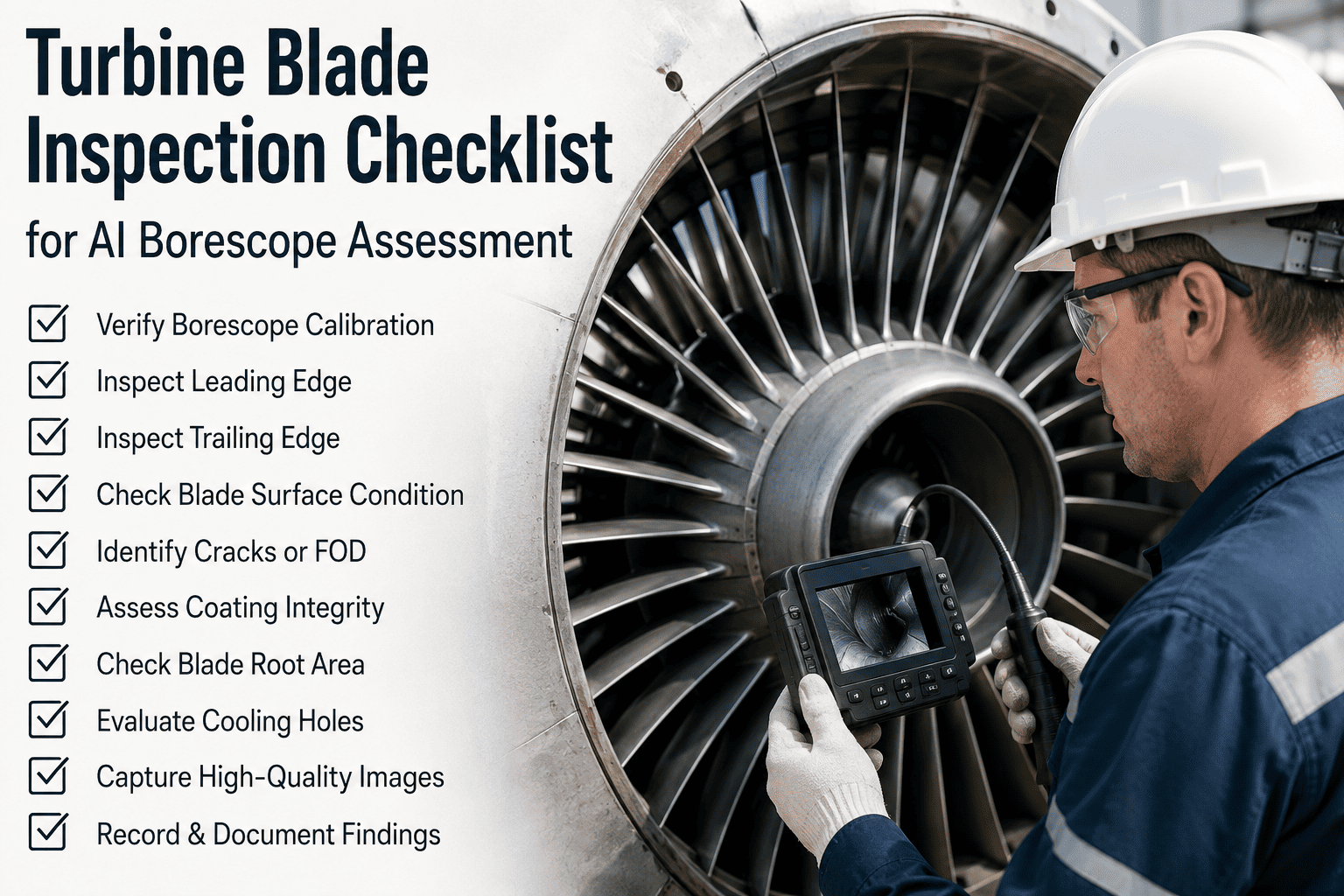
A steam turbine major inspection historically consumes 5 to 7 days on the critical path of a 3 to 5 week outage. Half of that time is not turning wrenches — it is inspectors physically walking the steam path with a flashlight, filling out paper checklists, then spending the next 10 days back at the office turning those notes into a report that determines whether Stage 3 gets a replacement rotor or one more run. Meanwhile the plant burns roughly $250,000 to $500,000 per day in lost generation waiting for that report to land. AI-assisted robotic inspection collapses the same scope into a single 8-hour sprint: a crawler-mounted camera captures every accessible surface, an on-premise vision engine flags and measures every defect, and the disposition report is on the plant engineer's screen before the next shift hands over. You can book a demo to see how iFactory runs an outage inspection sprint end to end.
AI VISION · PLANNED OUTAGE · ROBOTIC INSPECTION · STEAM TURBINE
Compress Steam Turbine Inspection From 7 Days to 8 Hours Without Cutting Corners
iFactory deploys AI-assisted robotic cameras into HP, IP, and LP sections during planned outages, capturing every accessible surface at inspection-grade resolution and returning a fully classified defect map before the outage crew comes off shift.
The Outage Inspection Compression
Traditional Inspection
168 hours
AI-Assisted Sprint
8 hours
21x compression on the critical-path inspection window with zero reduction in coverage scope
THE OUTAGE COST CLOCK
Every Hour Your Turbine Sits Open Costs Real Money
Outage inspection is not just an engineering activity — it is a burn rate. Lost generation revenue accumulates every hour the machine is down, and the inspection window is squarely on the critical path of most major overhauls. Compressing the inspection sprint releases the rest of the outage from waiting on that report.
Per Hour
$10K to $20K
Lost generation revenue for a typical mid-size steam turbine unit during a scheduled outage window.
Per Day
$250K to $500K
Cumulative revenue impact across a full day of the inspection sitting on the critical path.
Per Week
$1.75M to $3.5M
Traditional major inspection consumes roughly a full week of the outage doing what AI-assisted sprints do in a shift.
Per Outage Cycle
$1M plus
Typical net value unlocked per major outage by returning the unit to service 5 to 6 days earlier than the manual inspection schedule.
TIME COMPRESSION MATRIX
Where the Hours Actually Come From — Task by Task
The compression is not a single trick. Every step of the traditional inspection has an equivalent AI-assisted step that runs faster because the machine is doing the tedious work. The matrix below shows where each block of time on the critical path goes.
| Inspection Task |
Manual Time |
AI-Assisted Time |
Compression |
| HP Section Steam Path Scan |
18 to 24 hours |
90 minutes |
12x to 16x |
| IP Section Diaphragm Check |
10 to 14 hours |
60 minutes |
10x to 14x |
| LP Long-Blade Erosion Assessment |
16 to 20 hours |
75 minutes |
13x to 16x |
| Valve Internal Inspection |
8 to 12 hours |
45 minutes |
10x to 16x |
| Casing and Shell Visual |
12 to 16 hours |
60 minutes |
12x to 16x |
| Defect Measurement and Sizing |
20 to 30 hours |
Automatic during capture |
Real-time |
| Report Compilation and Sign-Off |
40 to 80 hours |
Under 2 hours |
20x to 40x |
STEAM TURBINE COMPONENT TREE
Every Internal Component the AI Vision Sprint Covers
Steam turbine inspection is not a monolithic task — it is a set of parallel scans across three pressure sections plus valves and auxiliaries, each with its own defect physics. iFactory ships dedicated model weights per section so the classifier is calibrated to the geometry and failure signatures of what it is actually looking at.
HP Section
Control-stage nozzle block
First-stage buckets and diaphragms
HP rotor journal and shaft seals
Steam admission valves and stems
Inner casing horizontal joint
IP Section
Reheat inlet nozzles
Intermediate diaphragms and buckets
IP rotor thermal bore and body
Cross-under piping interface
Intercept valve internals
LP Section
Long last-stage buckets and tie wires
Moisture removal features
LP rotor and blade attachment
Exhaust hood and diffuser
Journal bearings and seals
Casing and Auxiliaries
Outer casing shell and studs
Bolted horizontal joint faces
Steam chest and stop valves
Turning gear and coupling
Instrumentation penetrations
DEFECT DISPOSITION QUAD
Every Finding Sorted Into a Disposition Bucket, Automatically
Inspectors do not just find defects — they decide what to do about them. iFactory grades each detected defect against the accepted disposition standard for that component and stage, so the report handed to the outage manager is a ready-to-action plan rather than a list of concerns.
ACCEPT
Return to Service As-Is
Cosmetic wear inside acceptable limits — light surface wear on casing joints, sub-millimeter nicks on trailing edges outside high-stress zones, minor discoloration without base metal exposure. Logged for trend but no action needed.
MONITOR
Track Between Outages
Findings that do not require action this cycle but must be re-imaged next outage — early erosion patterns on LP long blades, coating scuff outside critical zones, minor seal wear. Baseline recorded for next-cycle comparison.
REPAIR
Blend or Repair In Situ
Damage that can be corrected during the current outage without component replacement — deep FOD nicks with sharp corners, moderate erosion at defined blade zones, localized coating patches. Work orders generated with location and access route.
REPLACE
Component Replacement Required
Findings that exceed refurbishment thresholds — through-thickness cracks, base metal exposure over large areas, tip curl, journal bearing scoring. Parts department alerted immediately with severity grade and photographic evidence attached.
See the Full Sprint Run End-to-End on a Sample Deployment
Book a walk-through and iFactory will show the entire compressed inspection — camera insertion, capture, classification, disposition, and CMMS handoff — on a real steam turbine dataset from a comparable unit.
THE 8-HOUR SPRINT
Hour by Hour, What Actually Happens Inside the AI-Assisted Inspection
The 8-hour sprint is not one long imaging run. It is a choreographed sequence of parallel captures, model inference, and human review, executed against a pre-planned inspection playbook loaded before the machine is opened.
Hour 0
Access Preparation
Outage crew removes upper casing per standard sequence. iFactory field team stages robotic cameras, edge compute cabinet, and inspection playbook adjacent to the deck plate. Confined space permits reviewed and signed.
Hour 1
Robotic Camera Insertion
Crawler and boom-mounted cameras deployed into HP section. Position marking and reference targets set for downstream defect coordinate mapping. Live view confirms illumination and focus before the sprint clock starts.
Hours 1 to 3
HP and IP Steam Path Scan
Full 4K imagery capture across HP and IP stages. Vision model runs live segmentation on every frame, isolating individual airfoils and diaphragms. Defect classification runs in parallel with capture so the report is being built as the scan progresses.
Hours 3 to 5
LP Section and Long-Blade Sweep
Cameras repositioned to LP end. Long-blade capture uses wide-angle plus telephoto passes to resolve trailing edges and moisture erosion zones. Exhaust hood and diffuser imaged during the same pass to eliminate a separate access cycle.
Hours 5 to 6
Valve and Casing Scan
Steam admission valves, intercept valves, and casing horizontal joint faces imaged. Rotor journal and coupling zones captured under structured illumination to detect fine surface features not visible under ambient light.
Hours 6 to 7
AI Analysis and Disposition
Defect map assembled per component and stage. Each finding graded against disposition criteria — accept, monitor, repair, or replace. Severity flags applied and location coordinates confirmed against reference marks set at insertion.
Hours 7 to 8
Engineering Review and Handoff
Plant engineering team reviews the graded findings on the AI dashboard, approves dispositions, and hands off to CMMS as prioritized work orders. Parts department triggered for any replace-level findings. Outage plan updated with real inspection data.
REPORT AUTOMATION
Reports That Used to Take Weeks Are Ready Before the Next Shift
The biggest hidden cost of traditional inspection is not the walkthrough — it is the two weeks of post-outage report writing that determines whether spare parts get ordered in time for the next cycle. iFactory eliminates that lag by generating the report as the capture happens.
01 CAPTURE
Every frame timestamped, geo-tagged to component and stage, and stored with the illumination and camera-angle metadata needed to reproduce the view.
02 CLASSIFY
Vision model outputs defect class, severity grade, spatial mask, and measured dimensions for every detected finding, with confidence scores logged for audit.
03 DISPOSE
Findings sorted into accept, monitor, repair, or replace buckets against the plant's disposition standard for the specific component and stage.
04 DELIVER
Structured report handed to plant engineering with prioritized work orders, parts requirements, and photographic evidence embedded per finding.
DEPLOYMENT OUTCOMES
What Utilities Get in the First Outage Cycle
The results below reflect aggregated outcomes from AI-assisted outage inspections at fossil and combined-cycle facilities during the first year of deployment. Individual site results depend on turbine platform, outage scope, and existing inspection maturity.
5 to 6
days back
Outage Duration Recovered
Critical path shortened by returning the unit to service earlier than the manual inspection schedule would have allowed.
100 percent
of steam path
Coverage Per Sprint
Every accessible airfoil, diaphragm, and valve internal imaged and graded rather than the subset a fatigued crew had time for.
Under 60
minutes
Report Latency
Time from final scan complete to full graded disposition report available on the plant engineering dashboard for review.
$1M plus
per outage
Net Value Unlocked
Combined value of recovered generation days, avoided emergency parts orders, and reduced inspection labor across a typical major outage.
FREQUENTLY ASKED QUESTIONS
Questions Outage Managers and Reliability Teams Ask
Does the AI sprint replace our existing NDT contractors, or does it run in parallel with them?
The AI sprint runs in parallel with existing NDT programs and, in most deployments, actually makes those programs more effective. Ultrasonic thickness measurement, magnetic particle inspection on the rotor, and eddy current on critical welds continue as scheduled by the plant's inspection procedures. The AI vision sprint delivers the visual assessment layer — every airfoil, diaphragm, and casing surface graded — which then guides where the NDT contractors focus their more expensive point-inspection techniques. Plants typically reduce their NDT scope by 30 to 40 percent because the AI layer eliminates the exploratory inspections that used to be done just to find something worth measuring.
Book a demo to walk through how the workflows combine on a real outage.
What is the actual field team size required to run an AI-assisted outage inspection sprint?
A typical sprint runs with two iFactory field engineers on-site plus the plant's existing inspection engineer as reviewer. The field engineers handle camera deployment, capture supervision, and edge compute operation. The plant engineer reviews the graded output in the final hour of the sprint and confirms dispositions before handoff to CMMS. This is significantly smaller than the traditional inspection crew of 4 to 8 inspectors plus supervisors and clerical support for report compilation, and it eliminates the need to have specialists standing by during long inspection days.
Contact support to discuss the resource plan for your specific outage.
How does the system handle the fact that every steam turbine platform has different blade geometries and disposition standards?
iFactory ships pre-trained model weights covering the dominant steam turbine platforms in service across the US utility fleet, including the major OEM designs and the common industrial machines. Plant-specific disposition standards — the accept, monitor, repair, and replace thresholds your engineering team applies — are loaded into the system during the calibration phase before the first outage. When a new platform or upgraded component is introduced, a short calibration run using a small volume of historical inspection footage brings the model up to accuracy, typically within one outage cycle. Cross-fleet learning is opt-in so no plant's data ever benefits from another operator's imagery.
Book a demo to discuss calibration for your specific fleet.
Is the inspection data stored anywhere that could raise cybersecurity concerns for a NERC-registered facility?
iFactory runs entirely on-premise for outage inspections at NERC-registered facilities. Cameras, edge compute, and the inspection dashboard operate inside the plant network on ruggedized hardware that stays at site. No footage or defect metadata leaves the plant network at any point during the sprint, and all data storage stays on plant-owned hardware. This satisfies the strict data residency, network isolation, and change-management requirements typical for bulk electric system generators. If the plant prefers a hosted option for non-critical inspection contexts, that is also available.
Contact support to review the cybersecurity architecture in detail.
What happens if the AI misclassifies a defect or misses one during the sprint?
Every AI classification carries a confidence score, and low-confidence findings are automatically routed to the plant engineering reviewer during the final hour of the sprint. The reviewer can accept the AI disposition, upgrade or downgrade the severity, or flag a finding for follow-up ultrasonic or dye penetrant inspection before the machine is closed. During the first two outage cycles at any site, the sprint also captures video that would traditionally be reviewed manually, so if any doubt exists the plant team can pull the raw footage for their own review. False positive rates typically settle under 3 percent after the first cycle and true detection recall runs above 95 percent for the primary defect categories.
Book a demo to see how confidence scoring and human review work together.
Stop Letting Inspection Time Dominate the Critical Path of Your Next Major Outage
iFactory turns a week of steam turbine inspection into an 8-hour sprint with a fully graded disposition report at the end. Book a demo to see the sprint running on a real dataset from a comparable unit.