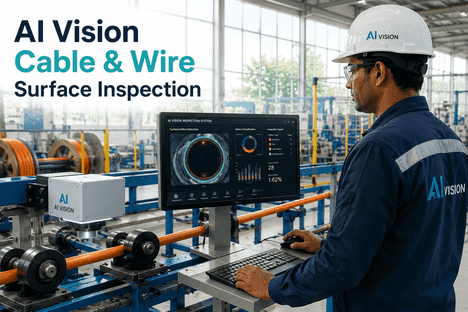
Wire and cable extrusion lines run continuously at speeds where manual checks every thirty minutes leave long windows for defects to run unnoticed across hundreds of meters of product. A die that drifts out of tolerance, an inconsistent melt temperature, or contaminated insulation material can introduce necking, bulging, ovalization, or surface cracks that a periodic visual spot-check simply cannot catch in time — by the time an operator notices, an entire reel may already be out of specification. iFactory's AI Vision Camera replaces that sampling-based approach with continuous, high-speed visual inspection that measures diameter, surface condition, and insulation integrity on every meter of wire or cable as it leaves the line — catching deviations the moment they begin rather than after a reel has already shipped. Book a Demo to see real-time defect detection running on your own extrusion line.
Catch Wire and Cable Defects Before a Reel Leaves the Line
iFactory's AI Vision Camera continuously inspects insulation, diameter, and surface quality at full line speed — turning sampling-based QC into 100% inline coverage.
Why Wire and Cable Lines Need Continuous AI Vision, Not Periodic Sampling
Cable and wire manufacturing operates under tight dimensional tolerances and zero room for hidden insulation flaws, yet most lines still rely on manual checks performed every twenty to thirty minutes, supplemented by offline sampling that only catches a problem after material has already been produced. At extrusion speeds, that detection lag translates directly into scrap, rework, and customer returns. AI vision changes the economics of quality control by inspecting every meter of product as it moves, comparing it against tight reference tolerances in real time, and flagging deviations the instant they appear rather than after a full reel has been wound and shipped.
Diameter & Dimensional Variation
Necking, bulging, and ovalization caused by tension swings, overheating, or die misalignment are measured continuously against target outer diameter, catching dimensional drift within fractions of a millimeter.
Insulation & Surface Defects
Cracks, fissures, wrinkles, bubbles, and burns from poor extrusion or contaminated material are detected across the full surface of the cable, not just at the sampling points a manual check can reach.
Lumps & Foreign Material
Raised lumps, contamination inclusions, and unfused pellets from extruder temperature or pressure inconsistencies are flagged as soon as they appear on the line, before they accumulate across a reel.
Conductor-Insulation Misalignment
A metal core that is not centered within its insulation jacket compromises electrical and mechanical performance. Vision-based profiling reconstructs the cable cross-section to confirm concentricity continuously.
Stray Strands & Stacker Defects
Loose filaments extending beyond the insulation layer are identified at line speed, preventing defective wire from reaching downstream processing or final assembly.
Color, Print & Discoloration Checks
Burn marks, discoloration from excess extrusion temperature, and print or jacket color consistency are verified continuously, distinguishing genuine defects from printed text or harmless surface variation.
Manual Sampling vs. AI Vision Inline Inspection
Moving from periodic manual checks to continuous AI vision changes the speed, coverage, and reliability of defect detection across a wire or cable production run. Book a Demo to see how this compares on your line speeds.
| Inspection Factor | Manual / Periodic Sampling | AI Vision Inline Inspection | Improvement |
|---|---|---|---|
| Inspection Coverage | Spot checks every 20–30 minutes | Every meter, continuously, at full line speed | 100% inline coverage |
| Dimensional Accuracy | Caliper spot checks, operator dependent | Continuous diameter measurement to ±0.05 mm | Sub-millimeter precision |
| Defect Detection Consistency | Subjective, fatigue-dependent | Consistent classification across every shift | Removes inspector variability |
| Time to Detect Drift | Up to 30 minutes between checks | Immediate, within seconds of onset | Faster correction, less scrap |
| Traceability | Manual logs, inconsistent records | Timestamped image and measurement record per reel | Full production traceability |
From Extrusion Die to Reel: How AI Vision Camera Inspects Wire and Cable
iFactory's AI Vision Camera mounts directly on the line, just downstream of the extrusion die or cooling trough, and builds a continuous picture of every meter of product without slowing production. Manufacturers adopting this workflow typically see defect alerts and reel-level quality reports generated automatically from the first day of deployment.
Multi-Angle Surface & Profile Capture
High-resolution cameras positioned around the cable capture surface images and reconstruct a 3D cross-sectional profile in real time, covering outer diameter, ovality, and surface condition simultaneously.
Deep Learning Defect Classification
Trained models classify each anomaly — necking, bulging, cracks, bubbles, lumps, burns, or stray strands — distinguishing genuine defects from printed markings, lighting artifacts, or harmless surface texture variation.
Real-Time PLC & SCADA Feedback
When a measurement drifts toward tolerance limits, the system feeds correction signals directly to line PLCs and SCADA — adjusting extruder parameters before a deviation becomes scrap.
Reel-Level Traceability & Reporting
Every reel is paired with a complete, timestamped quality record — defect locations, dimensional trends, and pass/fail disposition — ready for customer quality documentation without manual report assembly.
"Before deploying iFactory's AI Vision Camera, we were catching insulation defects on the next shift, sometimes the next day. Now the line stops correcting itself within seconds of a die drift, and our scrap on the jacketing line has dropped by more than a third. The reel-level traceability reports also satisfy our customer audits without anyone pulling logs together manually."
AI Vision for Cable and Wire Inspection: Common Questions
Q: What defects can AI vision actually detect on a wire or cable line?
AI Vision Camera detects necking and bulging, ovalization, conductor-insulation misalignment, stray strands, cracks and fissures, wrinkles, bubbles or cavities, lumps, and burns or discoloration — classifying each by type and severity rather than flagging a single generic "defect" alarm.
Q: Can this run at full extrusion line speed without slowing production?
Yes — the system is built for continuous inline inspection and inspects every meter of product as it moves, without requiring the line to slow down or stop for sampling checks.
Q: How accurate is the dimensional measurement compared to manual calipers?
Vision-based diameter and profile measurement can resolve dimensional variation to a fraction of a millimeter, continuously, which is both finer and far more consistent than periodic manual caliper spot checks performed by rotating shift operators.
Q: Does the system integrate with our existing PLC or SCADA setup?
Yes — iFactory's AI Vision Camera connects to standard PLC, SCADA, and MES environments, allowing measurement deviations to feed back into line control for automatic correction rather than requiring an operator to intervene manually.
Q: How quickly can we get a turnkey quote for our production line?
Most wire and cable manufacturers receive a scoped quote within days of an initial line assessment, based on cable diameter range, line speed, and the specific defect categories most relevant to your product mix.
Stop Finding Out About Defects After the Reel Is Wound
Wire and cable quality problems rarely announce themselves with a dramatic failure on the line — they show up gradually, as a die that has drifted, a melt temperature that has crept upward, or insulation material with a contamination issue that periodic sampling was never going to catch in time. iFactory's AI Vision Camera replaces that sampling gap with continuous, full-coverage inspection of diameter, surface condition, and insulation integrity, feeding corrections back into the line before a deviation becomes scrap and generating the reel-level traceability records your customers expect. Book a Demo and get a turnkey quote scoped to your specific wire or cable production line.
Get a Turnkey AI Vision Quote for Your Wire or Cable Line
Connect with an iFactory specialist today. Get a line-specific defect coverage assessment and a clear deployment roadmap — no obligation, no pressure.