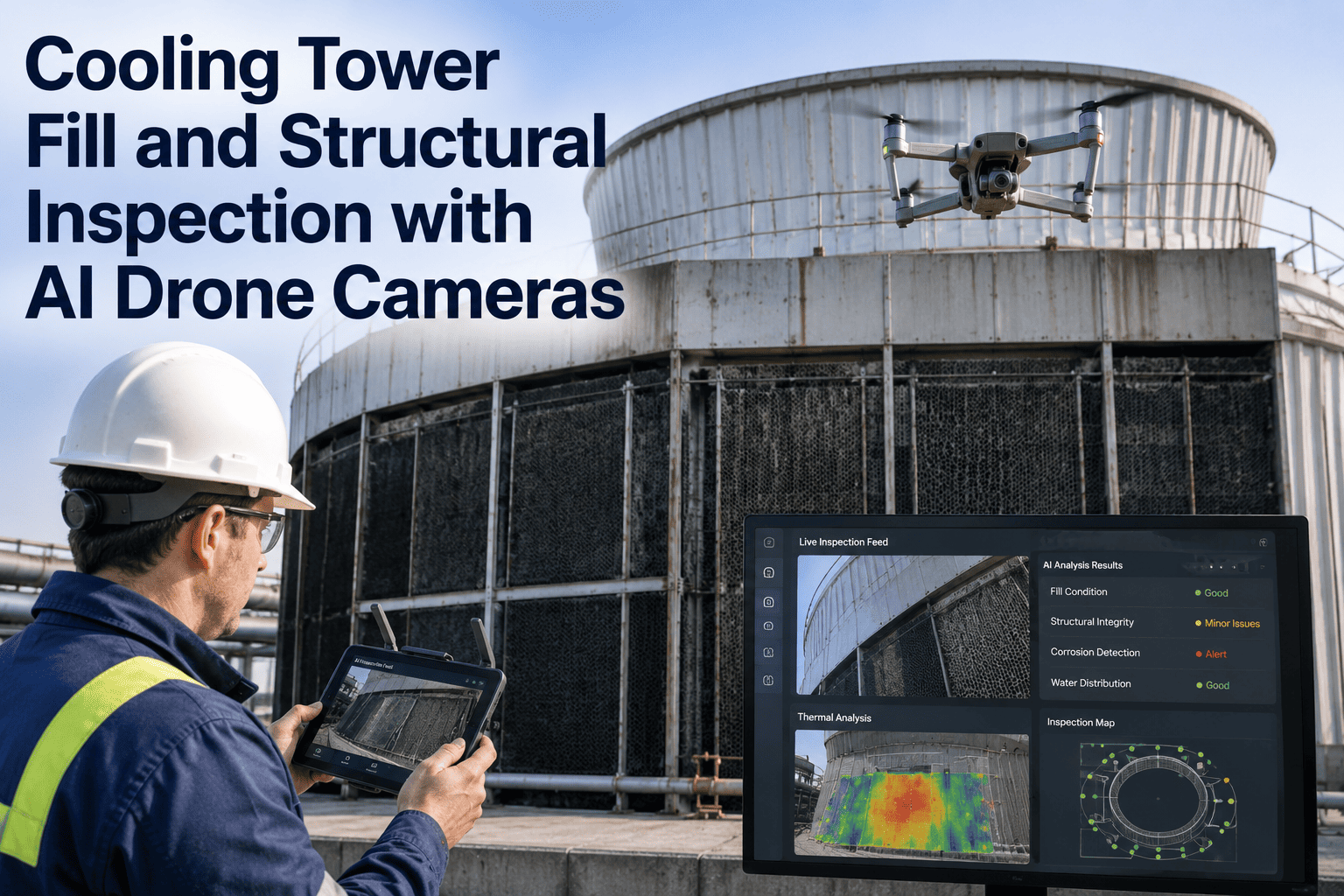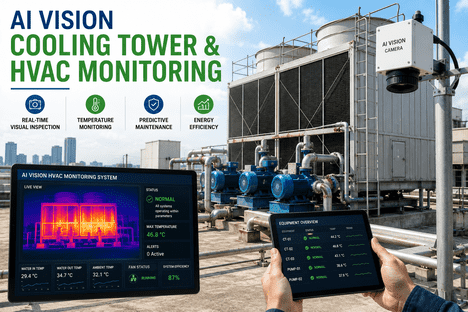
Cooling towers, fans, and HVAC systems quietly carry the entire thermal rejection load of a power plant, yet they remain among the least continuously monitored assets in the facility. Fill media fouling, drift eliminator damage, fan blockage, and thermal anomalies develop gradually over weeks — invisible to periodic walkdowns and undetected until approach temperature climbs, makeup water consumption spikes, or a fan gearbox fails outright. iFactory's AI Vision Camera closes this gap with continuous computer vision and thermal monitoring across every cooling cell, fan deck, and HVAC zone — detecting fill damage, drift, blockage, and thermal deviations before they erode plant efficiency. Reliability teams evaluating predictive maintenance vision programs for cooling and HVAC assets can Book a Demo to see the platform monitoring a live cooling tower deployment.
See Fill Damage, Drift and Fan Blockage Before They Cost You Efficiency
iFactory's AI Vision Camera continuously watches cooling towers, fan decks, and HVAC equipment — flagging thermal anomalies and mechanical degradation while there is still time to plan the fix.
Why Cooling Towers and HVAC Systems Need Continuous AI Vision
Cooling towers dissipate the waste heat from condensers, chillers, and process coolers across a power plant, but they degrade silently. Fill media fouls with biological growth, scale, and particulate over weeks before approach temperature measurably rises. Drift eliminators clog or crack, releasing treated water as vapor carryover long before makeup water bills reveal the loss. Fan blades imbalance, gearboxes overheat, and motor bearings wear — all while remaining below the threshold of routine inspection. A typical multi-cell tower may receive a full visual inspection once a year, leaving most of this degradation to progress unseen between checks. AI Vision Camera replaces the periodic walkdown with continuous optical and thermal coverage of every cell, fan, and fill section, surfacing the early visual signatures of damage and blockage while plant teams still have time to schedule a planned repair instead of absorbing an unplanned derate.
Fill Damage & Fouling Detection
Optical and thermal cameras identify fill collapse, sagging sheets, biological fouling, and scale buildup across each fill section before heat transfer capacity drops measurably.
Drift Eliminator & Plume Monitoring
Vision models detect cracked, displaced, or clogged drift eliminators and abnormal plume patterns that signal excess water carryover and chemical loss.
Fan, Blade & Airflow Blockage
Continuous monitoring flags debris blockage at air inlets, fan blade imbalance, belt wear, and louver obstruction that restrict airflow and reduce cooling capacity.
Thermal Anomaly Detection
Infrared overlays pinpoint hot gearboxes, overheating fan motors, uneven water distribution across fill, and HVAC coil fouling invisible to the naked eye.
What AI Vision Camera Watches Across Your Cooling Tower and HVAC Assets
Every cooling tower cell and HVAC zone has its own degradation profile, so detection models are trained per asset type rather than applied as a single generic rule set. The table below outlines the primary visual and thermal signatures the platform tracks, what triggers a flag, and the maintenance value of catching each one early. Facilities ready to map their own cooling and HVAC footprint against this coverage can Book a Demo for a site-specific deployment plan.
| Asset / Subsystem | Visual or Thermal Signature | What Triggers a Flag | Maintenance Value |
|---|---|---|---|
| Fill Media | Sagging, collapsed, or discolored fill sheets; uneven water distribution across sections | Visual deformation or thermal differential across fill depth beyond baseline | Avoids approach temperature degradation and turbine backpressure penalties |
| Drift Eliminators | Cracked, displaced, or debris-clogged eliminator panels; abnormal plume density | Panel geometry deviation or vapor carryover pattern change | Reduces treated water loss and chemical waste from excess drift |
| Fan & Gearbox | Blade imbalance, belt fraying, gearbox hotspot, motor housing temperature rise | Vibration-correlated visual wobble or thermal signature above baseline | Prevents catastrophic gearbox failure and forced fan outage |
| Air Inlet & Louvers | Debris accumulation, biological growth, or physical obstruction at intake | Reduced open inlet area detected against reference frame | Maintains design airflow and avoids load-independent capacity loss |
| HVAC Coils & AHUs | Coil fouling, fin damage, condensate pooling, refrigerant frosting patterns | Thermal gradient or visual buildup exceeding normal operating range | Protects chiller and AHU efficiency, lowers energy consumption |
How Detections Become Prioritized, Actionable Work Orders
A flagged thermal anomaly or drift defect only creates value if it reaches the maintenance queue with enough context to act on. iFactory's AI Vision Camera attaches the annotated image or thermal frame, the specific cell and subsystem identified, a fault classification, and a confidence score to every detection, then generates a work order automatically in your existing CMMS or EAM platform. Low-confidence findings route to an engineer for review before a work order is raised, and every validation feeds back into the model to reduce false positives specific to your towers and HVAC layout over time. Reliability and predictive maintenance teams can Book a Demo to see this detect-to-work-order pipeline running on live cooling tower footage.
AI Vision Cooling Tower & HVAC Monitoring — Frequently Asked Questions
What does AI vision actually detect on a cooling tower?
AI Vision Camera detects fill media collapse and fouling, drift eliminator damage and clogging, fan blade imbalance, gearbox and motor thermal hotspots, air inlet blockage, and abnormal plume or vapor patterns — across every cell of a multi-cell tower.
Can the platform monitor HVAC equipment alongside cooling towers?
Yes — the same vision layer extends to chillers, air handling units, and rooftop HVAC equipment, monitoring coil fouling, fin damage, condensate issues, and thermal anomalies using the same camera infrastructure and detection pipeline.
Does this require new cameras and hardware on every tower?
In most deployments, iFactory connects to existing plant cameras and adds targeted thermal or optical units only where coverage gaps are identified during the initial site audit, rather than requiring a full instrumentation overhaul.
How does AI vision improve efficiency, not just catch failures?
By catching fill fouling, drift loss, and blockage while they are still minor, the platform helps maintain design approach temperature and airflow — avoiding the gradual efficiency penalty that silently raises energy and water costs over a cooling season.
How quickly can a cooling tower and HVAC monitoring program go live?
Standard deployments complete within one to two weeks, starting with cameras on the highest-risk cells and HVAC zones, with detection models reaching production accuracy within the first weeks of active monitoring.
Turn Cooling Tower and HVAC Inspection Into Continuous Visual Intelligence
iFactory's AI Vision Camera watches fill, drift eliminators, fans, and HVAC coils around the clock — flagging fill damage, drift, blockage, and thermal anomalies before they cost you efficiency.