A cooling tower is one of the largest and hardest-to-inspect pieces of equipment on a thermal power or process plant site, and traditional inspection means either shutting the tower down and erecting scaffolding to reach the fill and drift eliminators, or accepting that meaningful sections will only get a superficial visual check between overhauls. Fouled fill, damaged drift eliminators, and sagging structural members quietly reduce heat rejection efficiency, drive up water consumption, and — in the case of drift eliminator damage — carry real Legionella exposure risk into surrounding buildings. iFactory deploys AI-guided drone inspection across cooling tower fill packs, drift eliminators, structural members, distribution basins, and collection basins, delivering full-coverage imagery and automated defect grading without shutdown or scaffolding — walkthrough available at iFactory support.
Drone-Enabled AI Inspection · Cooling Towers
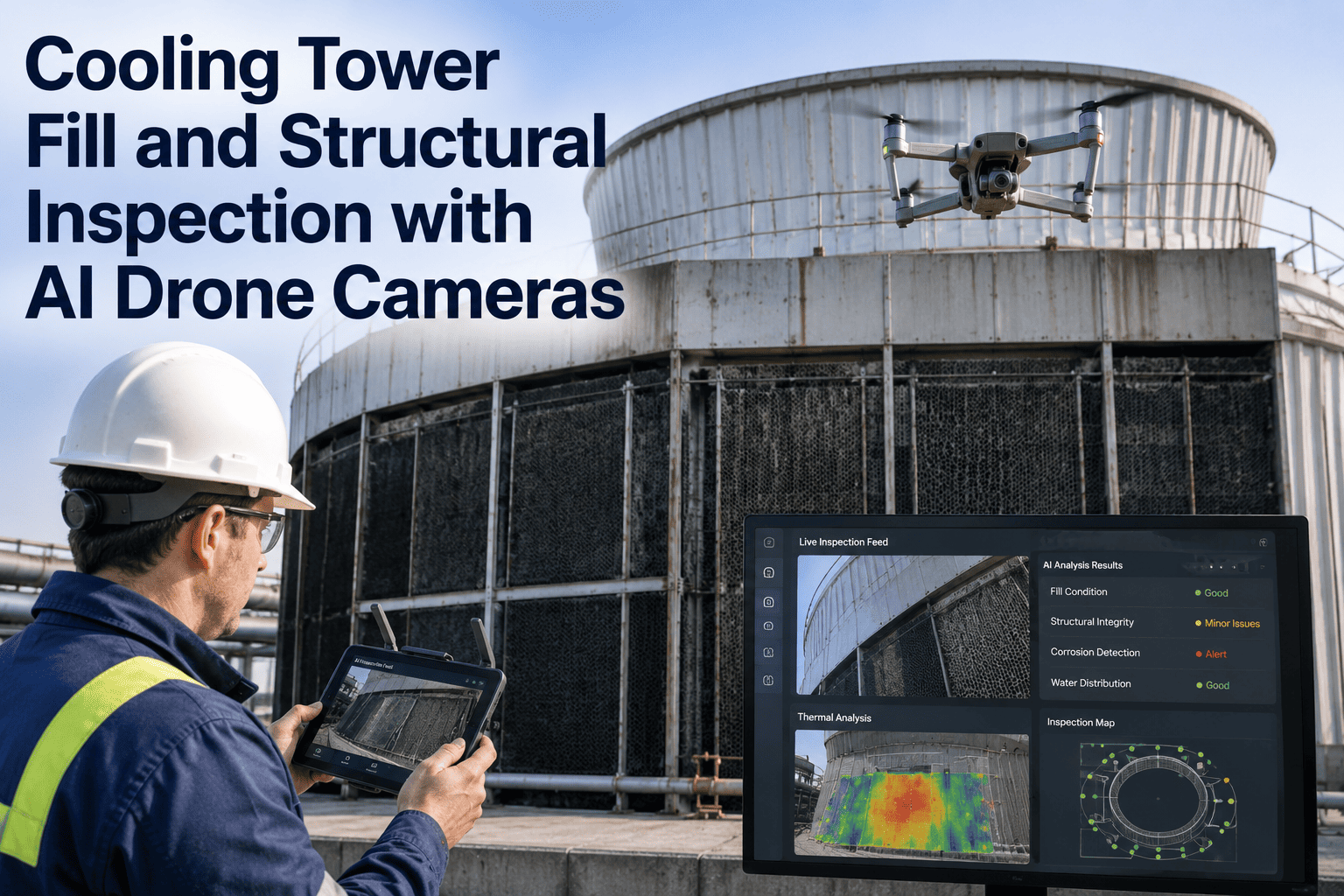
Cooling Tower Fill and Structural Inspection with AI Drone Cameras
Drones equipped with high-resolution cameras cover cooling tower fill condition, drift eliminator integrity, structural members, and basin sediment — with AI analysis grading each finding, without confined-space entry, scaffolding, or full tower shutdown.
1
Fan Deck & Drift Eliminators
Why Cooling Tower Inspection Is Underdone in Practice
Scaffolding, Shutdowns, and Confined Access Are Why Most Fill Never Gets Properly Inspected
Cooling tower inspection is one of those maintenance tasks that everyone agrees should happen more often than it actually does. The reason is entirely practical — the parts that most need to be inspected are also the hardest and most expensive to reach.
A
Shutdown Cost
Full internal inspection typically requires taking the tower offline. For a plant relying on that tower for condenser cooling, downtime translates directly into lost generation or process throughput, so inspections get postponed until they can be piggybacked onto planned outages.
B
Scaffolding & Access
Reaching the fill packs, upper structural members, and drift eliminators means erecting internal scaffolding inside the tower plenum — days of preparation labor before any actual inspection can begin, then more days to dismantle.
C
Confined Space Hazards
The interior of a cooling tower is dark, wet, structurally uneven, and often falls under confined space entry rules. That means permits, atmospheric testing, standby personnel, and rescue equipment — every entry incurs compliance overhead.
D
Coverage Gaps
Even during proper inspections, coverage is limited to what an inspector can physically reach and see clearly under portable lighting. Interior fill zones, mid-height structural connections, and hard-to-reach corners rarely get the same attention as accessible areas.
The Cooling Tower Inspection Map
Seven Zones a Drone Can Cover That Ground Inspection Struggles With
01
Fan Cylinder & Blades
Blade damage · Balance indicators · Erosion
Drone hovers alongside the fan cylinder to inspect blade condition, tip clearance, and cylinder integrity — a viewing angle that ground-based inspection cannot achieve without ladders or catwalks.
02
Drift Eliminators
Displacement · Cracks · Biofouling · Scale
Full-coverage imagery of drift eliminator panels identifies missing sections, biofouling, scale, and displacement — all of which directly affect drift rate and Legionella exposure risk.
03
Distribution System
Nozzle clogs · Uneven wetting · Piping
Nozzle condition and water distribution pattern captured from above, identifying clogged or broken nozzles that leave dry zones in the fill where biofilm develops.
04
Fill Media Packs
Collapse · Fouling · Scale · UV degradation
Fill condition — the single largest driver of heat rejection efficiency — imaged pack-by-pack, with AI grading for collapse, scale, biological fouling, and UV degradation.
05
Structural Members
Rot · Corrosion · Connection failures
Timber rot, FRP degradation, and steel corrosion on structural members and connections, captured at heights and angles where ground inspection has poor visibility.
06
Casing & Louvers
Panel damage · Air bypass · Louver condition
External casing panels and air inlet louvers inspected for damage, warping, and gaps that cause air bypass and reduce tower efficiency.
07
Distribution & Collection Basins
Sediment depth · Biofilm · Corrosion · Debris
Both distribution and collection basins imaged for sediment accumulation, biofilm growth, debris, and basin surface condition — sediment depth in particular is a leading indicator of under-deposit corrosion and bacterial growth risk.
Defect Detection Focus
What the AI Vision Layer Actually Grades
Fill & Flow Path
Efficiency Critical
Fill Collapse & SaggingStructural failure of fill packs that channels water around rather than through the media
Biological FoulingSlime and biofilm accumulation restricting airflow and providing bacterial harborage
Scale & Mineral DepositsCalcium carbonate and mineral scale reducing heat transfer surface area
Uneven Water DistributionDry zones from clogged nozzles that promote biofilm without chemical contact
Drift Eliminator Integrity
Compliance Critical
Displaced or Missing PanelsGaps that allow water droplets to escape carrying Legionella and treatment chemicals
Cracked or Warped BladesPanel damage that compromises droplet capture and drift rate compliance
Blockage & ScalePassage obstruction that raises pressure drop and can dislodge panels over time
Structural Health
Safety Critical
Timber Rot & DelaminationProgressive rot on wooden structural members from prolonged wetting cycles
Steel CorrosionRust and section loss on structural steel and hardware at exposed connections
Connection FailuresLoose, missing, or damaged fasteners and joints that compromise structural integrity
Basin Condition
Water Quality
Sediment AccumulationSludge and debris depth that drives under-deposit corrosion and bacterial growth
Biofilm & AlgaeVisible biological growth on basin surfaces indicating chemical treatment gaps
Debris & Foreign ObjectsLeaves, plastic, and other debris that can clog strainers and pump suction
The Drone Inspection Workflow
From Preflight Planning to Prioritized Repair Scope
Phase 01
Flight Planning
Tower drawings and prior inspection history are used to build a coverage flight path — every fill pack, structural connection, and drift eliminator zone gets defined imaging positions before the drone lifts off.
Phase 02
Drone Deployment
The drone operates from the fan deck and interior plenum, flying pre-planned paths through each zone. For counterflow towers, additional access from below the fan cylinder covers the eliminator underside.
Phase 03
Image Capture
High-resolution stills and video are captured across every zone, geotagged to the tower coordinate system so any finding maps directly back to a physical inspection location for follow-up work.
Phase 04
AI Analysis
Vision models flag candidate findings across fill, eliminator, structural, and basin defect classes, with each detection bounded and graded against the reference standard for that zone.
Phase 05
Inspector Review
Cooling tower specialist reviews every flagged finding on-screen, accepts or overrides grades, and identifies items requiring follow-up NDE or hands-on physical inspection.
Phase 06
Prioritized Scope
A prioritized repair and maintenance scope is generated with location-tagged imagery, severity grades, and recommended actions — feeding directly into the plant's maintenance planning system.
Every Fouled Fill Pack You Miss Costs You Heat Rejection. Every Damaged Drift Eliminator You Miss Costs You Compliance Exposure.
Drone inspection covers what ground walkdowns cannot reach — without scaffolding, without shutdown, without a person going into a confined space.
Ground Inspection vs. AI Drone Inspection
Where the Two Approaches Diverge in Practice
Aspect
Ground & Scaffolding Inspection
iFactory AI Drone Inspection
Shutdown Requirement
Typically requires tower shutdown for meaningful interior access
Most zones can be flown during reduced-load or brief offline windows
Preparation Time
Days of scaffolding erection, permit preparation, and standby coordination
Hours of flight planning against tower drawings before the drone launches
Coverage Depth
Limited to areas physically reachable by inspector on scaffolding
Full-coverage imagery of fill, eliminators, structure, basins, and casing
Structural Height Access
Upper members and connections often visually checked from a distance only
Close-range imagery of every structural connection regardless of height
Grading Consistency
Varies with inspector fatigue, lighting, and viewing angle inside the tower
Every image graded against the identical reference standard by the vision model
Historical Record
Written notes and selected photographs stored per inspection cycle
Complete image set retained and comparable frame-to-frame across inspections
Personnel Risk
Confined space entry, work at height, wet-slippery surfaces
Drone operator works from the fan deck or ground level throughout
Outcomes Reported by Cooling System Reliability Teams
What Changes in the First Two Inspection Cycles
01
Reduced
Scaffolding & Shutdown Duration
Most routine inspections are completed without erecting internal scaffolding, meaningfully cutting the shutdown window required for a full condition assessment.
100%
02
Coverage of Fill & Eliminator Surfaces
Every fill pack surface and drift eliminator panel accessible from the flight path gets imaged, replacing the sampled inspection approach that characterizes most ground programs.
Earlier
03
Detection of Structural Issues
Timber rot, corrosion at connections, and fastener degradation are typically caught one inspection cycle earlier than they would be under ground walkdown coverage.
Targeted
04
Repair Scoping
Repair crews arrive with a location-tagged, image-attached prioritized scope rather than a general work order — reducing on-site diagnosis time and material rework.
Full History
05
Searchable Defect Record
Every finding, image, and grade is retained as a queryable record tied to zone and inspection date, surviving inspector turnover and shift changes over years.
Zero
06
Confined Space Entries Per Routine Inspection
Routine condition assessment is completed by drone without any confined space entry, retaining manual entry only for repair work rather than diagnostic inspection.
Field Example
Catching Fill Collapse and Drift Eliminator Displacement That Ground Walkdown Had Missed for Two Cycles
A power generation site running a large induced-draft cooling tower had been performing annual ground-level walkdown inspections between planned outages, with a full internal inspection scheduled every four years during major overhauls. Approach temperature had drifted upward by roughly two degrees over the prior eighteen months, but the informal walkdowns had not identified a specific cause.
A drone inspection was performed during a brief unit derate, covering every fill pack, both drift eliminator layers, structural members, and the collection basin. AI analysis flagged a section of fill collapse in one bay covering several packs, along with three displaced drift eliminator panels near the fan cylinder that were not visible from any ground walkdown angle. Basin imagery also showed sediment depth in one corner exceeding the target maintenance threshold.
The cooling tower specialist reviewed the findings, agreed with the AI grades, and generated a prioritized repair scope covering the collapsed fill bay replacement, drift eliminator panel reseating, and basin sediment removal — all scheduled into the next planned outage window rather than triggering an emergency intervention. Approach temperature recovered by roughly a degree and a half after the repairs, and the drone inspection is now planned twice per year on this tower to catch similar issues earlier in their progression.
1 bay
Fill collapse identified and localized
3 panels
Displaced drift eliminators flagged
~1.5°F
Approach temperature recovery after repairs
Frequently Asked Questions
What Cooling Tower Reliability Engineers Ask First
Can drone inspection be done while the tower is running, or does it always require shutdown?
Many external inspection tasks — fan cylinder condition, casing panels, air inlet louvers, external structural members — can be flown while the tower is running normally. Internal coverage of fill, eliminators, and interior structure typically requires the tower to be offline or on a significant derate so that airflow through the plenum does not compromise drone stability and image quality. In practice, most inspection programs combine an external flight during operation with a brief offline window for internal coverage, which is still substantially shorter than the full shutdown required for scaffolding-based inspection. To scope a specific workflow for your tower geometry,
book a demo.
What about visibility inside the tower — is there enough light for good imagery?
Drones deployed for cooling tower inspection carry integrated LED lighting sized for the tower interior, giving the cameras and the vision model consistent illumination on every frame regardless of the ambient light inside the plenum. Modern inspection drones also use cameras with wide dynamic range that handle the mix of shadow and lit surfaces typical of tower interiors, and image capture parameters are tuned during the flight planning phase to match the specific tower geometry being inspected. For challenging environments such as counterflow towers with limited access, additional lighting is deployed on the tower structure itself before the flight.
How does drone inspection handle the wet, humid environment inside a cooling tower?
Inspection-rated drones deployed for cooling tower work are specified for humid environments and use protective enclosures rated for the moisture and mist typical of a recently-drained tower interior. Standard operating practice is to flush the tower and allow key surfaces to drain briefly before internal inspection, minimizing active water and mist during the flight. Between-flight maintenance also matters — inspection service teams follow specific drying and cleaning protocols after each cooling tower flight to protect drone electronics and cameras for the next inspection cycle. The
support team can share the operational protocols in detail during scoping.
Does drone inspection replace hands-on physical checks like drift eliminator flex testing?
No, and it is not designed to. Certain condition assessments — including drift eliminator flex testing to check for embrittlement, fastener torque checks on structural connections, and confirmation of biofilm composition by sampling — still require a hands-on inspector inside the tower. What drone inspection does is identify which specific locations need hands-on follow-up, so when a physical inspector does enter the tower, their time is focused on flagged locations rather than a blanket sweep. This targeted approach also reduces the total hours of confined space exposure per inspection cycle.
How long does deployment take, and what about pilots and regulatory approvals?
For a plant that wants to add drone inspection to its existing cooling tower program, initial deployment typically takes four to six weeks including flight path configuration for the specific tower geometry, integration with the plant's maintenance records system, and workflow training for the reliability team who will review AI-flagged findings. Certified drone pilots are provided as part of the inspection service, and all flights are conducted under the applicable local regulatory requirements for industrial site drone operation. To scope a first inspection against your next planned window,
book a demo.
Complete Cooling Tower Condition Coverage. Without Scaffolding. Without a Full Shutdown. Without a Person Inside the Plenum.
AI drone inspection across fill, drift eliminators, structural members, and basins — delivering the condition record your reliability program needs, in a fraction of the outage time.