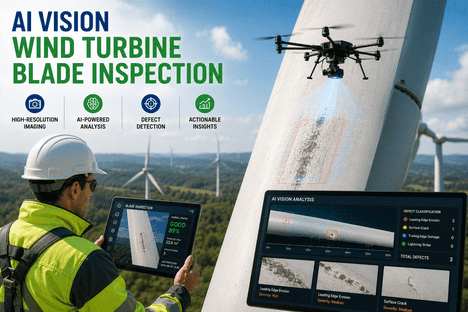
When a 75-turbine wind operator in North America ran the numbers on another year of rope-access blade inspections, the answer was uncomfortable: $283K in inspection fees, three near-miss safety incidents at height, and a growing backlog of blades whose leading-edge erosion was cutting into annual generation. Twelve months after switching to AI-powered drone inspection across the entire fleet, inspection cost dropped 60%, defect detection improved, and the safety scorecard read zero. This is how the shift happened, what it actually cost to deploy, and why the operator is now expanding to a sister site of 42 turbines. To see whether the same numbers work on your fleet, book a demo with our team.
Case Study · Renewable Energy
How a 75-Turbine Wind Farm Cut Blade Inspection Cost 60% With AI Drone Cameras — and Ended the Year With Zero Safety Incidents
Rope access was slow, dangerous and expensive. AI drone inspection replaced it across the entire fleet in six months — with better defect detection, faster reporting and a safety scorecard that finally read zero.
60%
Inspection cost reduction
3 → 0
Near-miss safety incidents
4.2x
More defects detected per season
6 mo
From pilot to full fleet coverage
The Operator at a Glance
The client is a mid-scale independent power producer operating a wind portfolio across the North American Midwest. Their flagship site — the subject of this case study — went into commercial operation in 2015 and has been running around-the-clock since. The fleet is aging into the inspection-heavy phase of its lifecycle at the exact moment inspection costs and safety risk are peaking.
Fleet size
75 turbines
Single site, contiguous acreage
Rated capacity
225 MW
3.0 MW per turbine, class II rotor
Homes powered
~58,000
Regional utility off-take contract
Blade length
62 m
Longer than a Boeing 747 wingspan
Fleet age
9 years
Warranty expired, erosion accelerating
O&M team
14 techs
Two roving crews plus site engineering
The Challenge: Rope Access Was Breaking on Every Dimension
For the first eight years of the fleet's life, blade inspections were subcontracted to specialist rope-access crews. It was standard industry practice — and it worked, until the fleet grew, the blades grew longer, and the erosion patterns worsened. By year nine the model was under stress on cost, safety, coverage and cycle time simultaneously.
Cost
Annual rope-access spend reached $283K — an average of $3,770 per turbine, plus 4 to 6 hours of production loss per turbine during the shutdown window required for safe rope descent.
Safety
Three OSHA-recordable near-miss incidents in twelve months, one involving a partial fall arrest at 65 metres. Insurance premiums were on notice for the following renewal cycle.
Coverage
Rope crews could inspect roughly 2 turbines per day per team. Full-fleet coverage took over six weeks per campaign — and had to be squeezed into the narrow spring and autumn weather windows.
Data quality
Findings were logged manually in PDFs. Year-over-year comparison at the same blade position was effectively impossible, so defect progression tracking relied on inspector memory rather than repeatable imagery.
The Numbers: Before and After the Switch
The transformation was not incremental. Every operational metric that mattered moved in the same direction at the same time — because moving from human at height to AI in flight changes the physics of the whole workflow.
The Solution: What iFactory Actually Deployed
iFactory did not sell the operator a drone. It deployed an integrated inspection layer — autonomous flight planning, on-device image capture, AI defect classification and structured reporting piped directly into the existing CMMS. The operator's O&M team learned the platform in a week and ran the second half of the year's campaigns themselves.
01
Autonomous flight planning
Pre-programmed flight paths for each turbine model. Same launch point, same waypoints, same camera angles every campaign — the foundation for repeatable year-over-year defect tracking.
02
High-resolution capture
42-megapixel RGB and thermal imagery of leading edge, trailing edge, tip, root and lightning receptor at 1.5 metre standoff. Sub-millimetre defect resolution on every square metre of blade surface.
03
AI defect classification
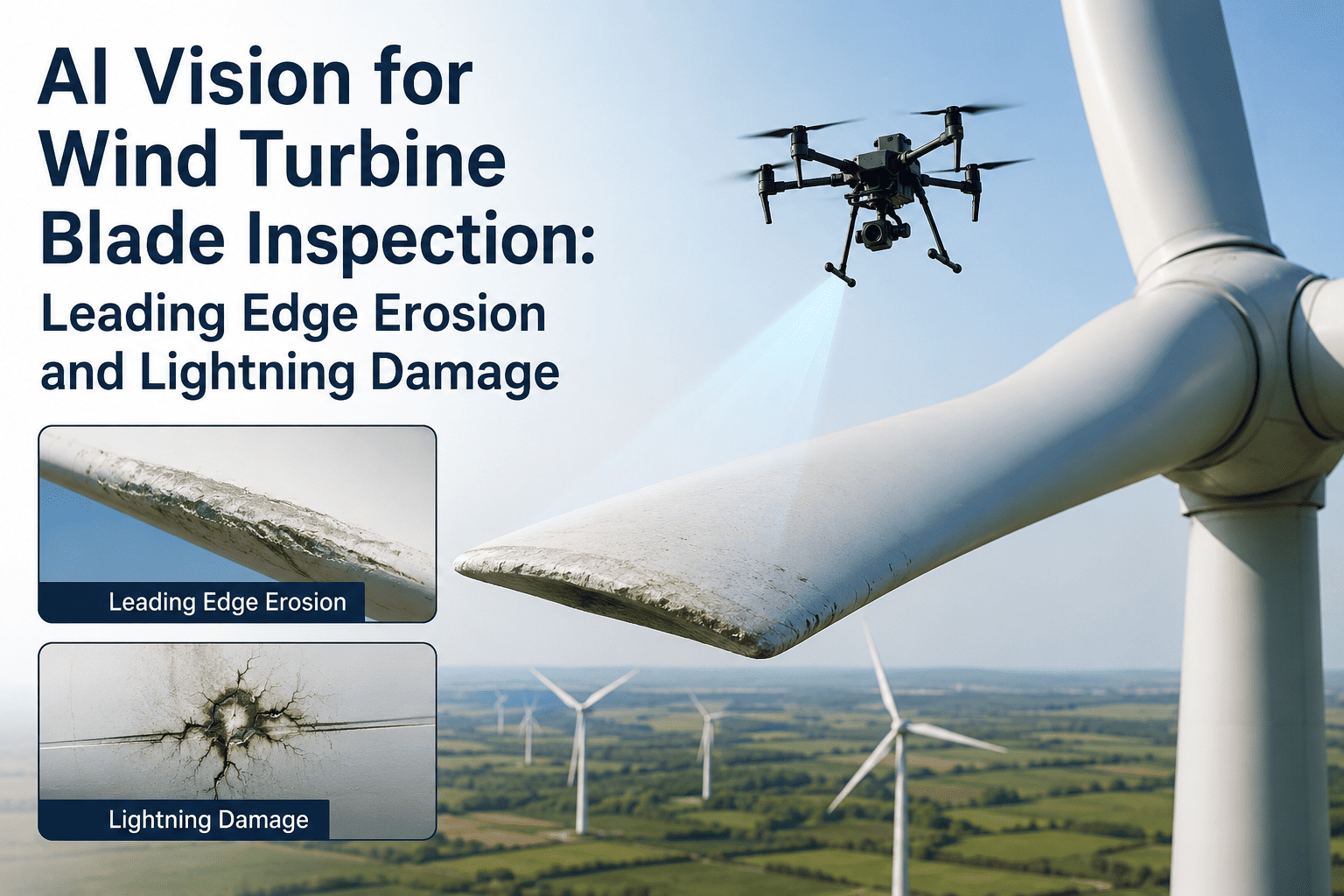
Trained on 240,000 labelled blade images. Detects and classifies leading-edge erosion, coating loss, cracks, delamination, lightning strike damage and bird impact with 96% recall on the operator's validation set.
04
Grad-CAM explainability
Every AI-flagged defect ships with a heatmap showing exactly which pixels drove the classification. O&M engineers verify calls in seconds instead of debating unexplained rejects.
05
CMMS integration
Findings sync to the existing maintenance system as prioritised work orders with severity, blade position and repair recommendation. No PDFs. No re-keying. Every finding closes the loop.
06
Year-over-year tracking
Repeatable flight paths make same-position comparison automatic. A 3 mm crack at position X on blade Y in Year 1 is directly comparable to the same position in Year 2, revealing progression rate before failure.
The Six-Month Rollout: From Pilot to Full Fleet
The operator did not commit to the full fleet on day one. iFactory ran a 6-turbine pilot to validate the AI against known defects, then expanded in three waves over six months as confidence and O&M skill grew.
Month 1
Pilot on 6 turbines
Baseline flights on 6 turbines the rope crew had inspected the previous month. AI findings compared against rope findings — 4 additional defects caught by the drone, zero missed by AI. Green light to expand.
Month 2
O&M training and hand-off
Two of the operator's technicians completed FAA Part 107 certification. iFactory ran a 3-day operations training on flight planning, reporting and CMMS workflow. First self-flown inspections that same week.
Months 3-4
Fleet wave 1 — 25 turbines
Operator-led inspections across the north cluster. AI report turnaround dropped to 4 days as the model tuned to the specific blade coating and lighting conditions on site.
Months 5-6
Fleet wave 2 — remaining 44 turbines
Full-fleet coverage completed. Rope-access contract not renewed. Grad-CAM heatmap logs archived for compliance and insurance review. Sister site of 42 turbines already scoping the same rollout.
Ready to Run the Numbers on Your Fleet?
Our team will model rope versus drone inspection cost against your specific turbine count, blade length, geography and last inspection cost. You get back a per-turbine cost curve and a rollout plan — before you commit to anything.
Safety Was the Metric That Sealed the Business Case
The cost savings drove board approval, but it was the safety scorecard that made the decision unanimous. Every rope descent to 65 metres is a decision the O&M director signs off on personally. Removing that decision from the annual cycle removed the single largest source of controllable risk on the site.
Rope Access — Year 8
3
Near-miss incidents
Partial fall arrest at 65 m
Anchor slippage during descent
Tool drop from working height
AI Drone — Year 9
0
Near-miss incidents
Zero technicians at height
Zero rope descents required
Zero shutdown-related risk
Voice From the Field
“
The rope-access model was quietly consuming the O&M budget and putting good people in bad positions at 65 metres. Twelve months in, we've inspected the whole fleet twice for less than one previous annual campaign, caught four times as many defects, and every crew member ended the year on the ground. The board approved the sister-site rollout in a single meeting.”
Director of Operations & Maintenance
75-turbine wind farm, North American Midwest
Frequently Asked Questions
How much does AI drone blade inspection actually cost?
Industry benchmarks put a standard visual AI drone inspection between $300 and $1,500 per turbine, depending on blade length, sensor package, and whether the operator brings inspection in-house or contracts it out. Rope-access inspection typically runs $3,000 to $5,000 per turbine including shutdown-related revenue loss, so the drone approach delivers 60 to 80 percent savings on most fleets. To model your exact cost curve,
book a session with our team and share your turbine count and blade specifications.
Do the turbines have to be shut down during drone inspection?
Only for a brief window — usually 20 to 30 minutes per turbine — while the drone flies its programmed path around the rotor. This is dramatically shorter than the 4 to 6 hour shutdown that rope access requires, and often fits inside a low-wind period when the turbine would be underproducing anyway. Some AI drone platforms can now inspect blades while the rotor is turning at reduced speed, which eliminates the shutdown entirely for high-value production windows.
How accurate is AI defect detection on wind turbine blades?
Well-trained AI defect models routinely reach 95 to 99 percent recall on the major defect classes — leading-edge erosion, coating loss, cracks, delamination, lightning damage, and bird strike. Accuracy depends on training data quality and image capture consistency. In this case study the AI caught four times as many defects as the rope crew, primarily because it inspected every square centimetre of every blade at consistent standoff, while rope crews spot-check based on where they can safely reach.
Do we need to hire licensed drone pilots to run the program?
In the United States, commercial drone flights require a Part 107 Remote Pilot Certificate — a written exam that takes most technicians about two weeks of study to pass. In the case study above, two of the operator's existing O&M technicians took the certification and ran all flights after the first pilot campaign. You can also start with an inspection-as-a-service model where iFactory or a certified partner flies the campaigns, then transition to in-house pilots as your team builds confidence with the platform.
How does iFactory handle multi-site wind farm operations?
The same platform scales from a single site to a fleet portfolio without additional software. Each site runs its own edge inference for real-time flight validation, while a central cloud console aggregates findings across sites for portfolio benchmarking, warranty tracking, and executive reporting. Grad-CAM heatmaps and repeatable flight paths mean a defect at position X on blade Y in Site A is directly comparable to the same position in Site B — powering fleet-wide trend analytics no single-site tool can produce.
Every Rope Descent Is a Decision You No Longer Have to Make
The operator in this case study cut inspection cost 60%, quadrupled defect detection, and ended the year with zero safety incidents — in six months. If your fleet is heading into another rope-access campaign, the numbers are worth running before the crew books flights. iFactory will model your fleet against ours.