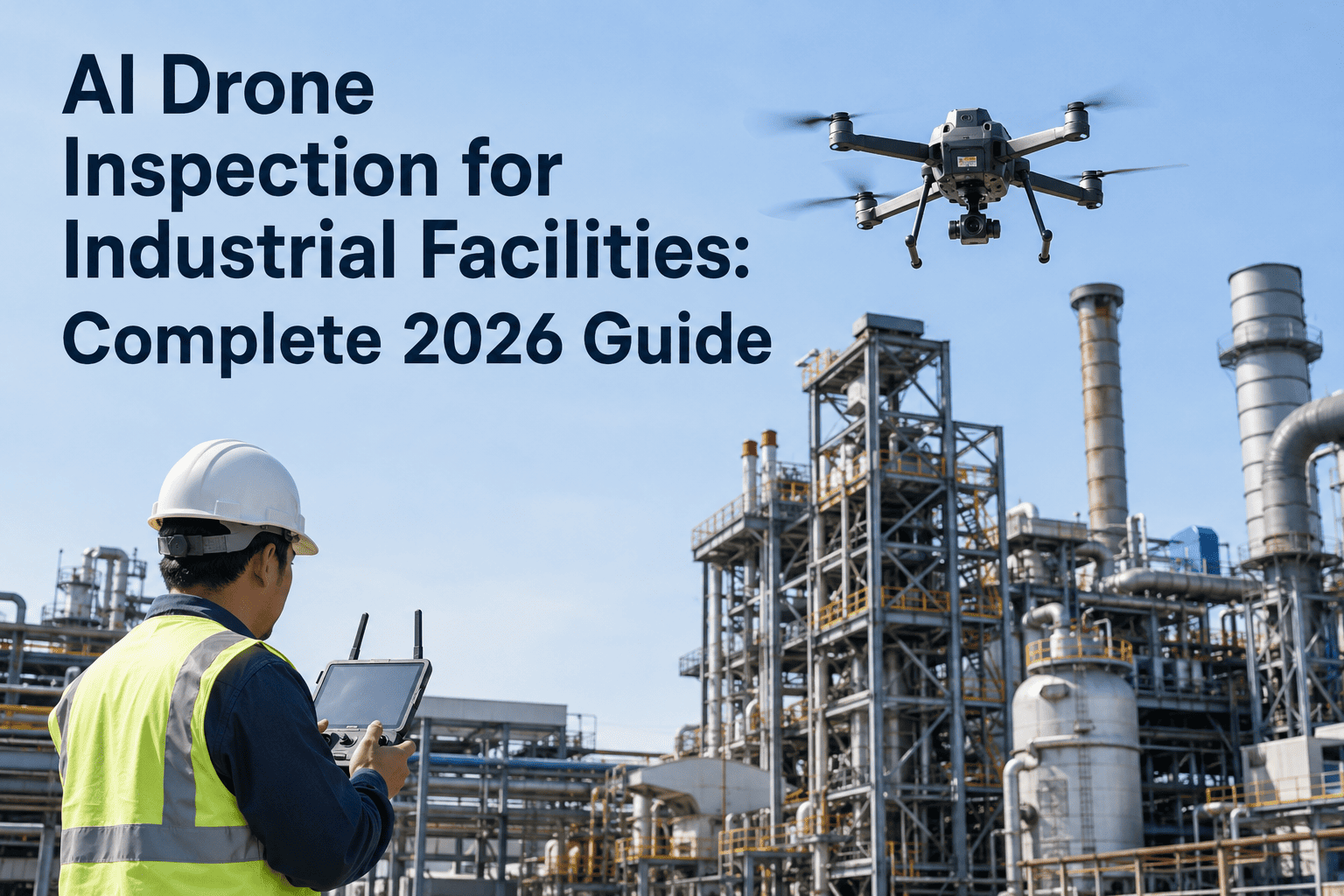
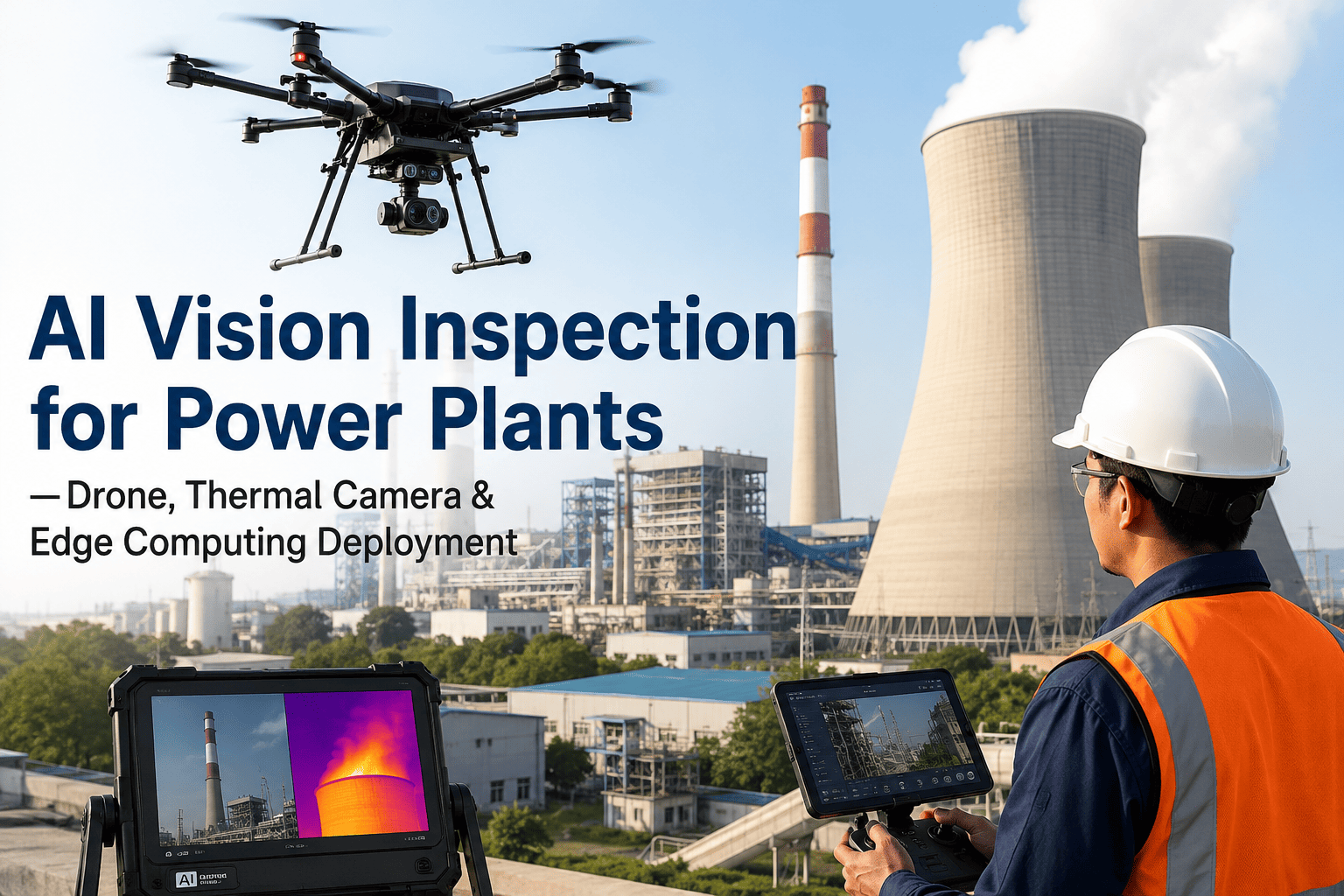
A refinery flare stack inspection used to look like this: shut the stack down, wait for it to cool, erect scaffolding for three to five days, send rope-access technicians up, take thickness measurements manually, come back down, dismantle. Three to five weeks of work. Total cost frequently past $200,000. In 2024 a drone with an ultrasonic thickness payload did the same inspection on a 200-foot in-service flare stack in California — no shutdown, no scaffolding, no rope access — in two hours, saving roughly $150,000 on a single mission. That is not an incremental improvement. That is a category shift in how industrial facilities get inspected, and by 2026 it is table stakes for any operator running elevated assets at scale. If you want a facility-specific cost projection before you decide, the iFactory support team can build one from your current inspection spend.
Drone Inspection · Complete 2026 Guide
Flare Stacks in 2 Hours. Tank Roofs in a Morning. Zero People at Height.
AI-powered drones inspect flare stacks, cooling towers, storage tanks, and rooftops in hours instead of days. Scaffolding costs vanish. Fall-from-height risk goes to zero. Every square meter is documented with imagery your team can audit for years.
$150K
Saved per flare stack inspection
75%
Faster than rope access
3-5x
More defects captured
300%+
Year-one ROI typical
The Cost Reality
What a Traditional Inspection Actually Costs — and What Drone Replaces It With
The pitch is not marketing math. It comes straight from operator invoices. Below is what one petrochemical facility spent on elevated inspections the old way, and what the same coverage cost after a five-drone autonomous fleet took over. The numbers are why plant managers are moving fast in 2026. The single largest cost line in traditional elevated inspection is not the technicians themselves — it is the scaffolding erection and dismantling time before a single measurement is ever recorded, plus the equipment offline hours accumulated while that scaffolding sits in place. Drones collapse both categories to near zero because inspection happens while the asset stays in service and no temporary structure is erected at all. What used to be a multi-week project sequence becomes a single-day mission.
Before Drones
$1.1Mper year
34 flare stacks and columns, 12 tank roofs, 2 pipeline corridor surveys
- Scaffolding erection3 to 8 days per structure
- Equipment offline timeFull inspection window
- Rope access crew$50K to $250K per stack
- Fall exposureEvery inspection, every day
- Missed defects7 the following year
Replaced by
After Drones
$127Kper year
Same 34 stacks, 12 tank roofs, 2 pipeline surveys — plus continuous coverage
- Scaffolding erectionZero
- Equipment offline timeZero for most inspections
- Total flight days22 days for full site
- Fall exposureZero
- Defects captured89 including 7 previously missed
Documented savings: $973,000 per year — before counting insurance premium reductions and avoided downtime.
Asset Playbook
Which Facility Assets Get Inspected, and What the Drone Actually Does
Every industrial facility has the same short list of structures that used to require scaffolding, rope access, or a helicopter charter. Here is the drone playbook for each one, with what the AI is looking for and how long the mission actually takes now. The pattern across all five asset classes is the same: the drone flies a repeatable mission with consistent standoff distance and lighting, the AI compares this cycle's imagery to the last one, and the output is a ranked defect list your maintenance team can act on the same day. What changes between assets is the sensor payload and the flight profile — everything else is the same platform running the same workflow.
01
Flare Stacks
2 hours in-service
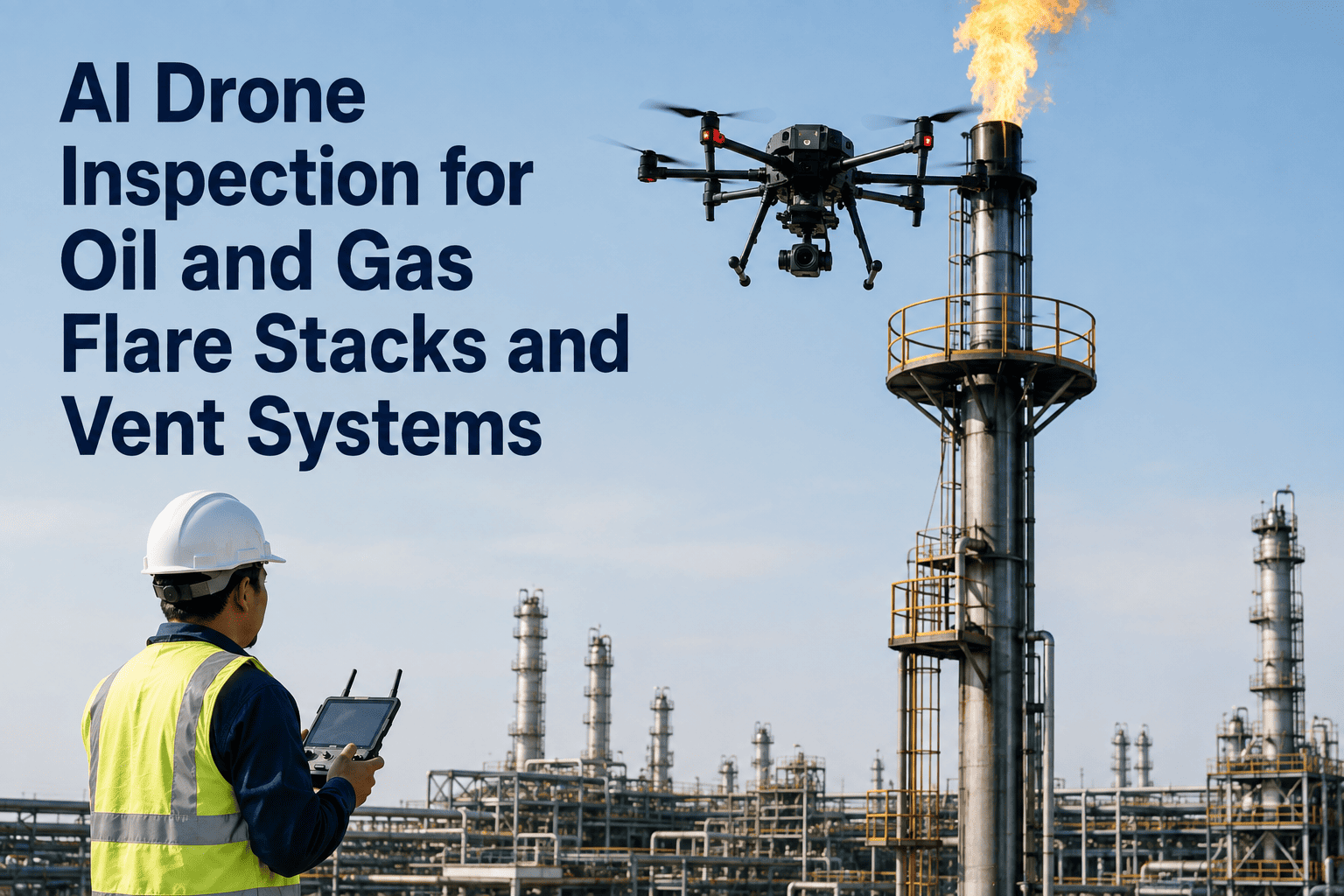
Thermal-payload drones inspect live flare stacks operating at temperatures approaching 1,500°F without shutting them down. The AI classifies cracks, refractory damage, tip erosion, and ignition-system anomalies from RGB and thermal frames captured in a single 55-minute flight. What used to take three to five weeks — including cooldown and scaffolding — closes in a single morning.
Cracks and erosion
Refractory damage
Tip corrosion
Ignition anomalies
02
Cooling Towers
Half a day per tower
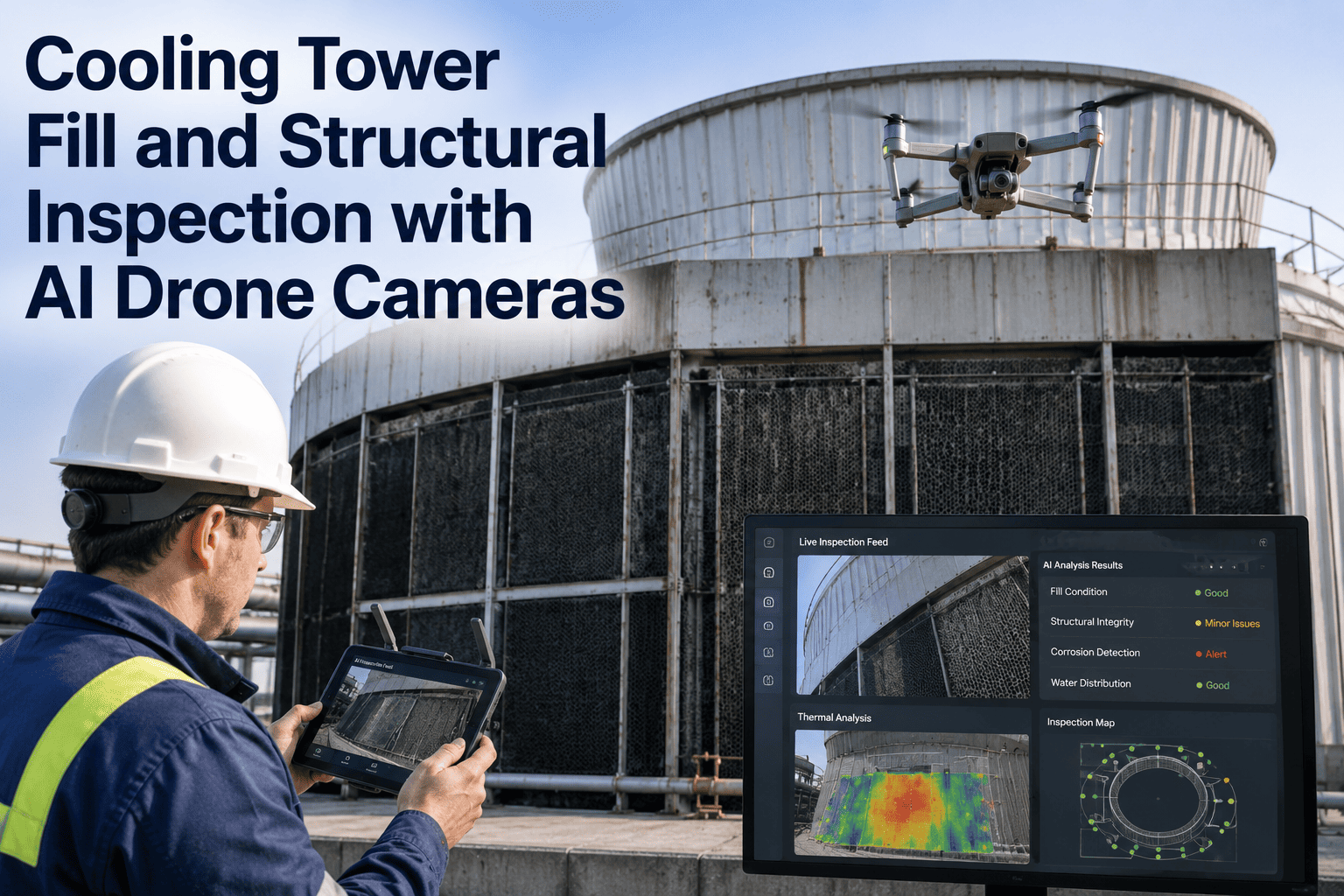
Drones map fill condition, nozzle wear, distribution-system integrity, and structural fatigue on the tower shell. Confined-space entry for internal fill inspection is largely eliminated with aerial imaging from above and camera-on-a-stick payloads reaching interior sections. AI compares condition to prior inspection cycles automatically, so degradation trends are quantified rather than guessed at.
Fill degradation
Nozzle wear
Structural fatigue
Distribution integrity
03
Storage Tank Roofs
45 minutes per tank
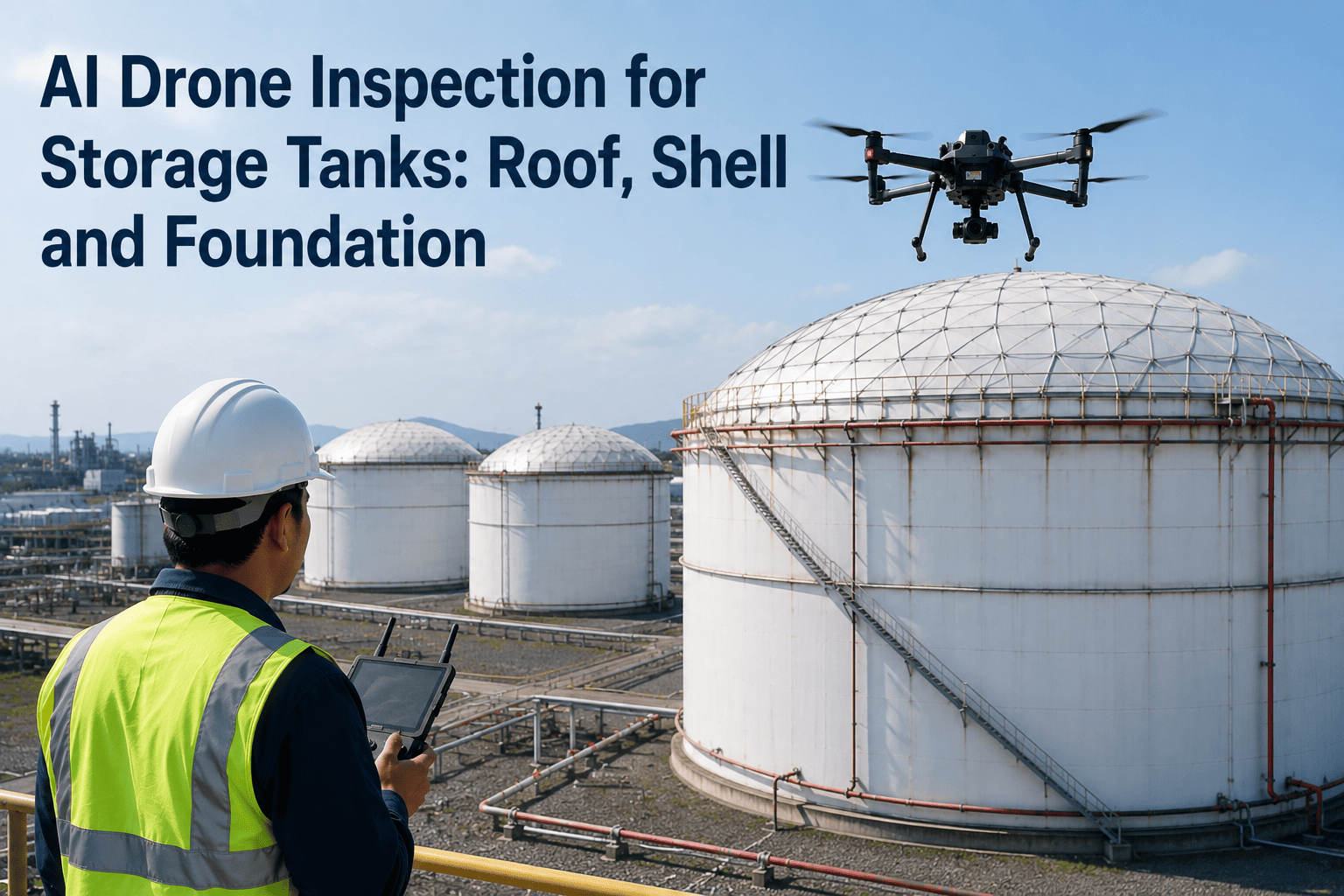
External tank roof inspection is the most common early win for drone programs because the risk-reward is so lopsided. Roof plate corrosion, seal integrity, and floating roof leg alignment are all captured at high resolution from above. AI flags corrosion patches by severity and tracks them against the previous inspection cycle, so wall thickness reductions are trended rather than surprises during turnaround.
Roof plate corrosion
Seal integrity
Floating roof legs
Coating breakdown
04
Rooftops and Building Envelopes
1 to 3 hours per building
Facility rooftops, HVAC units, parapets, and façade sections replace ladder trucks and manual walkovers with a single mission. Thermal imaging identifies moisture intrusion and insulation gaps invisible to a visual inspection. AI generates a rooftop condition map with defect locations, severity, and change-since-last-inspection — feeding straight into your CMMS work order queue.
Moisture intrusion
Membrane damage
HVAC condition
Insulation gaps
05
Pipeline Corridors and Pipe Racks
Miles per shift
Linear infrastructure was previously the domain of helicopter surveys at thousands of dollars per hour, or dangerous walk-downs of elevated pipe racks. Fixed-wing and multirotor drones now cover pipeline corridors, elevated pipe trays, and rack junctions at a fraction of the cost. AI flags corrosion, coating breakdown, insulation damage, and vegetation encroachment across long distances without human line-of-sight limitations.
Line corrosion
Coating damage
Insulation loss
Encroachment
See What Your Facility Would Save in Year One
iFactory will build a facility-specific ROI model from your current inspection spend, elevated asset count, and turnaround schedule. Most operators recover their investment inside a single inspection season.
The Safety Math
Why Insurance Carriers Are Rewarding Drone Programs
Fall-from-height accounts for more than 40 percent of refinery inspection injuries in the industry safety data. When rope access and scaffolding disappear from routine inspection workflows, the exposure profile of the entire program changes — and insurance carriers have started pricing that change into premiums. The numbers below are what actually moves on the workers' comp and liability side, and increasingly they are the numbers that show up in board-level safety reviews as the operator's justification for the drone program in the first place.
40%+
Refinery inspection injuries from falls
Every rope access mission is a fall exposure event. Removing rope access from routine inspection cycles is the single largest lever an operator has on fall-related incident rates. Insurance carriers see this on loss run reports and adjust accordingly.
0
People at height during a drone mission
Pilots operate from ground level, often from an air-conditioned command post. No harness, no exposure to toxic gases near flare stacks, no confined-space entry for tank interior imaging. The whole worker-at-height risk category is engineered out of the process.
1,500°F
Flare stack temperature during live inspection
Thermal drones inspect flares in active operation. Previously, a live-flare inspection was not attempted at all — the stack was shut down, cooled, then climbed. Drones make live inspection routine, catching defects while the asset is still generating value.
100%
Reduction in confined-space entry for imaging
Camera-equipped drones and tethered platforms handle interior imaging of tanks, vessels, and cooling tower fill sections. Confined-space entry permits, atmospheric testing, and rescue standby crews are simply not required for imaging missions the drone can complete from the manway.
How a Mission Runs
From Mission Plan to Work Order in One Day
A drone inspection is not just a flight. It is a five-stage workflow that produces auditable, defect-ranked output ready for your CMMS. This is what happens between the moment a mission is scheduled and the moment a maintenance work order appears in your team's queue, end to end, with humans in the loop only where judgment is actually required.
Stage 1
Mission Planning
Flight paths, altitude, sensor loadout, and safe corridors auto-generated from a 3D model of the facility. Weather API integration confirms flight window. Regulatory clearances checked against airspace database.
Stage 2
Autonomous Capture
Drone flies the planned mission, capturing RGB, thermal, and where applicable ultrasonic thickness data. High-resolution 4K to 8K imagery collected at consistent standoff distance for repeatability across inspection cycles.
Stage 3
AI Defect Analysis
Overnight processing runs computer vision models across every frame. Defects classified by type, severity, and location. Confidence scores flag ambiguous findings for human review. Change detection compares against prior cycles.
Stage 4
Report and Triage
Ranked defect list surfaced with imagery, location on 3D model, severity, and recommended action. Maintenance lead reviews and approves in the morning. Approvals push directly to CMMS as work orders.
Stage 5
Registry and Trending
Every defect logged to a persistent registry. Next inspection cycle automatically compares against prior state. Trend lines feed predictive maintenance dashboards for turnaround planning and CapEx forecasting.
Buyer Checklist
What to Ask Before You Sign With a Drone Inspection Vendor
Not every drone program is created equal. The difference between a service that saves you six figures and one that becomes a line item you regret comes down to a short list of questions. Bring these to your next vendor call.
Does the AI compare inspections cycle-over-cycle, or just flag defects in isolation?
Single-cycle detection is table stakes. Change detection across inspection cycles is what turns drone data into predictive maintenance intelligence. Without it, you are paying for a photo library.
Are results delivered as raw imagery or as work-order-ready records?
Raw imagery is what a generalist drone service provides. Ranked, prioritized, CMMS-integrated defect records are what an industrial inspection platform provides. The gap is the difference between a document and an action.
Can the platform inspect live assets, or does it require shutdowns?
Thermal payload capability separates live-asset inspection from shutdown-dependent services. If your flare stacks need to keep running during inspection, this is a non-negotiable line item.
Does the vendor own the aircraft and pilots, or subcontract?
Owned fleets deliver consistency across inspection cycles. Subcontracted flights introduce variability in imagery quality, pilot judgment, and scheduling reliability that shows up in your defect data as noise.
What integrations exist with our CMMS and SCADA?
A drone platform that lives outside your maintenance stack is another silo. Look for out-of-the-box integrations with the systems your planners already use, so defect data lands where work gets scheduled.
How is data ownership and retention handled after the contract?
Every inspection cycle creates data that has long-term regulatory and engineering value. Confirm you retain full ownership of imagery, defect records, and 3D models regardless of contract status.
Turnkey AI Deployment
How iFactory Ships an Industrial Drone Inspection Program
Standing up a drone inspection program from scratch is not a software installation. It is aircraft, sensors, pilots, AI models, integrations, and regulatory workflow all coming online at once. iFactory delivers this as a turnkey system so your team is running inspections in weeks, not quarters.
Hardware and Software Bundled
Pre-configured NVIDIA AI server for defect processing ships racked and ready. Drone fleet configured for your asset mix. AI vision models pre-trained on industrial defects and refined to your facility's imagery in the pilot phase. Rack it, plug power and Ethernet, and the AI is live.
Full Integration Scope
Network cabling, PLC and SCADA integration, CMMS connector setup, operator training, and 24 by 7 remote monitoring. The scope covers everything between the drone landing pad and the maintenance planner's screen — no separate integrator project required.
Live in 6 to 12 Weeks
Three-phase rollout: pilot on one asset group in six weeks, expand to full site by week ten, autonomous inspection loop live by week twelve. Trusted by more than 1,000 clients with 99.9 percent uptime across the platform stack.
Operator-Friendly AI
Your maintenance lead types: "Show me new defects on flare stack three since last quarter." The system responds with a ranked list, imagery, and recommended actions. No computer vision expertise needed to run the program day to day.
Regulatory and Audit Readiness
Why Auditors Prefer Drone Inspection Records to Rope-Access Reports
A rope-access inspection produces a report — a handful of photos, a written narrative, and a signed sign-off sheet. A drone inspection produces a data record: every square meter of the asset captured at consistent resolution, timestamped, geotagged, and preserved in a defect registry that regulators and internal auditors can query years later. The compliance value of that shift is understated in most vendor pitches, but it is one of the reasons operators who move to drone programs rarely go back. Regulators reviewing an inspection record no longer have to trust a technician's narrative description of a defect they cannot see themselves; they get the imagery directly. Internal engineering teams no longer have to argue about whether a corrosion patch is worsening; the AI has already measured the change from cycle to cycle. And insurers, who used to price uncertainty into every policy premium, get to price actual documented condition instead.
Full-Coverage Documentation
Every drone mission captures the entire asset, not just the areas an inspector could reach. Auditors get a complete visual record of the inspection surface rather than a sampled subset. Coverage gaps that used to be silently accepted — the top three meters of a tank shell, the far side of a flare tip — no longer exist in the record.
Change Detection Across Cycles
Because each inspection produces standardized imagery at consistent standoff distance, the AI compares current condition to prior state automatically. Corrosion propagation, crack growth, and coating breakdown are quantified rather than described. This is the data auditors ask for and the data traditional inspection cannot produce.
Immutable Defect Registry
Every defect logged carries a unique ID, location on the 3D asset model, timestamp, severity score, and repair history. The registry is queryable, exportable, and preserved beyond the life of any individual inspection contract. Insurance underwriters and regulators can trace the full history of any structural finding.
OSHA and Insurance Alignment
Elimination of fall-from-height exposure and confined-space entry from routine inspection maps directly to reduced OSHA recordable rates and lower workers' compensation loss runs. Insurance carriers increasingly price drone programs into premium calculations, which turns a maintenance investment into a measurable underwriting outcome.
Common Questions
Industrial Drone Inspection — Buyer Questions
How much does an industrial drone inspection actually cost compared to traditional methods?
A single autonomous drone inspection of a flare stack typically runs between three thousand and eight thousand dollars, replacing scaffolded or rope access inspections that fall in the fifty thousand to two hundred fifty thousand dollar range. That is a six-to-thirty-times return on a single mission. Facility-wide programs commonly document savings between forty and sixty percent versus rope access, with petrochemical complexes documenting nearly a million dollars in annual savings once elevated inspections shift to drones.
Book a demo and we will build a facility-specific model from your current spend.
Can drones really inspect flare stacks while they are still burning?
Yes — this is one of the highest-value drone use cases in oil and gas. Thermal-payload drones capture RGB and thermal imagery of flare stacks operating at temperatures near fifteen hundred degrees Fahrenheit without any human exposure to heat or toxic emissions. A recent California refinery case study documented a two-hour in-service flare inspection that replaced a three-day traditional cooldown-and-climb process, saving approximately one hundred fifty thousand dollars on a single mission and eliminating the associated production downtime entirely.
What happens if weather or wind grounds the drone during a scheduled inspection?
Industrial drones typically operate reliably in winds up to twenty to twenty-five knots and light drizzle, though heavy rain or fog will pause flights. The iFactory platform integrates live weather APIs and historical climate data to identify optimal inspection windows before a mission is scheduled, so weather-driven cancellations are rare. If conditions change mid-flight, the drone automatically returns to launch using pre-programmed safe routes. Missions get rescheduled inside the next viable window, which for most facilities is a matter of hours rather than the days a rope access rescheduling would require.
Contact support to see the weather integration dashboard.
How does the AI actually find defects that human inspectors miss?
Human inspectors on scaffolding or rope have physical constraints — they inspect what they can reach, in the light conditions they have, for as long as attention holds. AI processes every pixel of every frame with consistent accuracy, cross-references against defect libraries trained on hundreds of thousands of examples, and never gets tired. In the petrochemical case study, drone plus AI captured eighty-nine defects on a site where the prior year's manual inspection had captured eighty-two — including seven the manual crew could not reach because scaffolding did not extend to those locations. Coverage completeness is a fundamental advantage, not just accuracy.
What is the honest deployment timeline, and does our team need drone expertise?
A pilot inspection on a single asset group runs live in about six weeks from kickoff. Full site coverage typically lands between weeks ten and twelve. On your side, we need a technical lead to coordinate site access, someone from IT for the network and CMMS integration piece, and one or two maintenance operators who will become day-to-day users of the platform. No drone piloting expertise required — iFactory provides certified pilots and the AI defect analysis stack, so your team focuses on reviewing findings and dispatching work rather than learning to fly aircraft.
Stop Erecting Scaffolding for Inspections Drones Can Finish Before Lunch
AI drone inspection for flare stacks, cooling towers, tank roofs, rooftops, and pipeline corridors — with cycle-over-cycle change detection, CMMS integration, and zero people at height. Book a demo to see it running on your asset data.