AI Vision for Pallet Handling and Damage Detection in Logistics
By Johnson on July 29, 2026
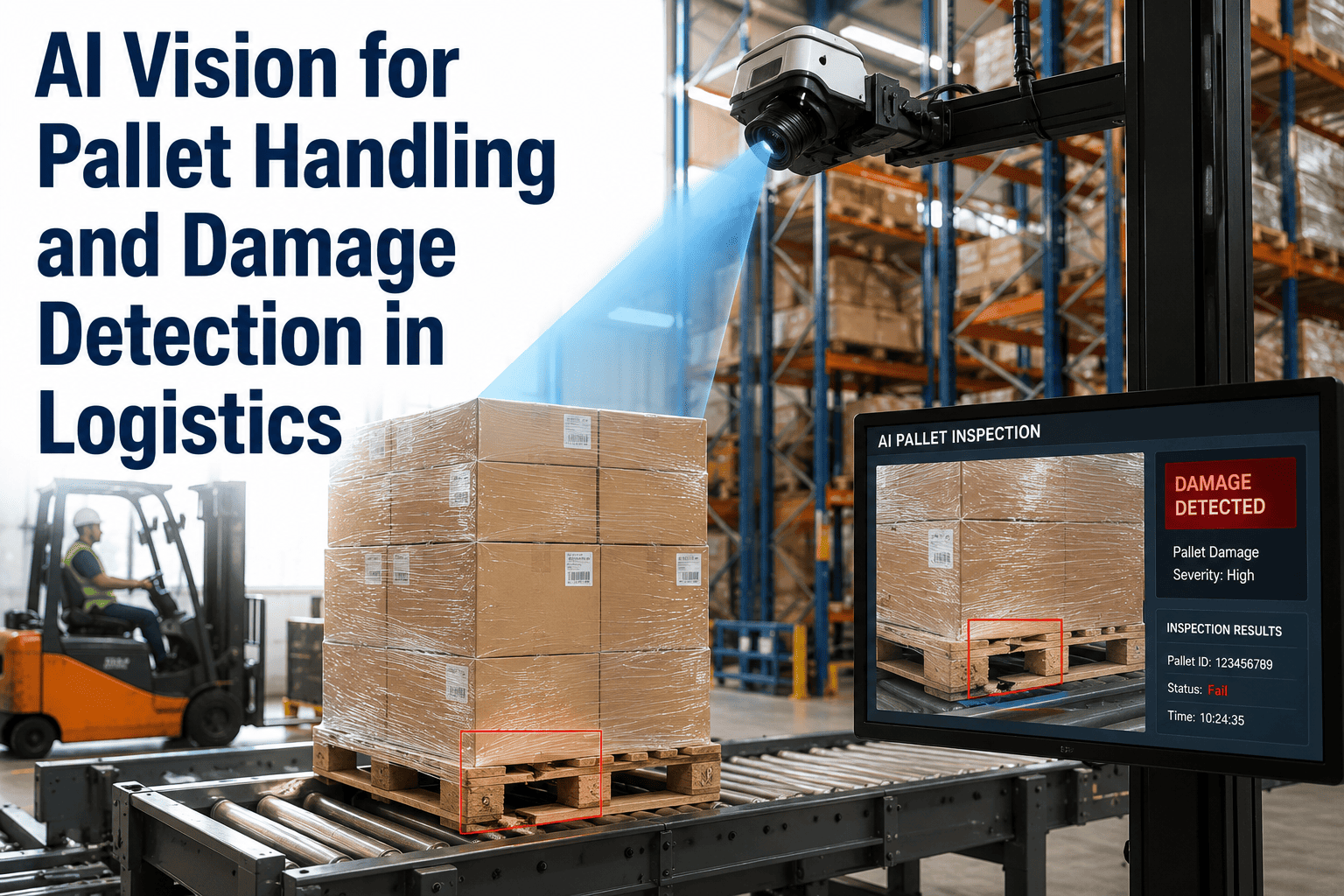
A cracked stringer, a torn shrink wrap, a top pallet leaning three degrees more than it should — these are the small warning signs that a shipment will become a claim, and by the time a receiving dock spots them the damage is already inside your walls. In a busy distribution center, pallets move faster than any single crew can inspect end to end, and the mistakes that generate returns, chargebacks, and workers' comp claims rarely announce themselves clearly enough to catch by eye. Damaged pallets do not just cost the pallet — they cost the product on top of it, the reshipment, the sorting labor, and sometimes the customer account itself. AI vision cameras positioned at receiving lanes, storage aisles, and outbound doors watch every pallet that moves through and flag the ones that should not proceed. See how iFactory's pallet vision platform works on a real DC floor.
iFactory Logistics Vision AI
See Every Pallet, Catch Every Damaged Load Before It Costs You
AI cameras at receiving, storage, and shipping identify broken stringers, torn wrap, unstable stacks, and handling violations in real time — protecting your product, your workers, and your customer relationships across the entire DC.
Pallets arrive at DCs with damage that costs money downstream
Real-Time
Damage detection at dock doors
Zero-Touch
Automated flagging and routing
Every Pallet
Traceability from receiving to ship
The Real Cost of a Damaged Pallet Nobody Sees
The number that reaches the P&L for pallet damage almost always understates the true cost, because most operations report only the direct claim value and never total up the operational drag around it. A single damaged pallet that reaches the customer generates a chargeback for the product, a reshipment cost, labor hours to investigate, and — for repeat incidents — a slowdown of scheduled loads while the account manager and quality team work out what happened. Multiply that by a few hundred incidents a year and the direct claim dollars are usually less than a third of the real number that hits the operating budget.
Damage that stays inside your four walls costs less per incident but happens far more often, and it shows up as rack shutdowns, restacking labor, product write-offs, and workers' compensation exposure when an unstable stack lets go in an aisle. The numbers below reflect the categories a pallet vision monitoring layer is designed to reduce — not eliminate — because no system fully removes damage from a real high-throughput operation. Bringing these numbers down is what pays back the deployment within the first year, and each of the four figures below tracks a distinct piece of the total cost picture that is usually managed in isolation.
$150+
Average claim per damaged pallet load
product value, freight, and labor to reprocess a single downstream incident
5-10%
Typical pallet damage rate at receiving
for high-throughput DCs with mixed carrier networks and pooled pallets
20-30%
Product damage traced to handling
rather than manufacturing defects or transit damage inside the trailer
1 in 3
Claims involve preventable causes
improper stacking, wrapping, or forklift contact a camera can see
Where Damage Actually Enters Your Facility
Pallet damage does not enter the operation at a single point. It enters at the receiving door on inbound loads that were mishandled at the origin or in transit, it accumulates during storage moves when forklift traffic contacts uprights and pallet corners, and it walks back out through the shipping door on outbound loads that were built or wrapped incorrectly under peak-hour pressure. Each zone has a different failure profile and a different set of upstream causes, so the vision coverage in each zone is tuned to what is most likely to go wrong there rather than applied as one uniform filter across the whole facility.
The three-zone breakdown below reflects the sequence a pallet actually moves through and the severity of consequences if damage is missed at that stage. Missed damage at receiving becomes internal loss inside the four walls; missed damage during storage becomes rack incidents and product write-offs; missed damage at shipping becomes a customer claim that is orders of magnitude more expensive to resolve. The detection priority indicator on each zone reflects where the most consequential misses tend to happen and where the vision layer earns back its cost fastest during the first six months of operation.
Zone 1
Receiving Dock
Where incoming pallets first meet your floor and inbound damage enters the four walls
Damaged pallets accepted without proper documentation under peak receiving pressure
Torn shrink wrap or loose banding missed on shrink-wrapped mixed loads at speed
Overhang and lean not caught before putaway sends the pallet directly into a rack
Wrong pallet type accepted against pooled carrier exchange agreements
Detection priority
Zone 2
Rack Storage & Staging
Where handling stress and rack contact accumulate over many touches per pallet
Forklift contact with rack uprights and pallet corners during slotting moves
Restacking errors during putaway that create leaning or off-center loads
Deck-board fatigue on repeat handling of the same pallet across multiple moves
Aisle incidents where product falls and is silently restacked without an incident report
Detection priority
Zone 3
Outbound Loading
The last chance to catch a damaged load before it becomes your customer's problem
Damaged pallets shipped and flagged by the receiving customer as a claim
Improperly wrapped loads that shift or collapse during transit handling
Missing or incorrect pallet exchange handling on CHEP or PECO customer accounts
Overheight or overhang loads that will not clear the customer dock envelope
Detection priority
Where Cameras Actually Go on a Distribution Center Floor
Camera vantages are placed where damage is most likely to be created or first visible, not distributed evenly across the ceiling grid. The layout below shows a typical three-zone deployment on a mid-size DC with dock doors on both ends and rack storage running through the middle, with vantage points marked at receiving doors, key aisle intersections, and outbound staging lanes. Receiving cameras face incoming pallets as they move through the dock door, so the very first frame captured is what the pallet looked like when it entered the building. Aisle cameras capture handling events during putaway and slotting moves, and shipping cameras look at every load twice — once during staging and once as it moves onto the trailer.
Typical Vantage Deployment Across a Mid-Size DC
Curious what a camera at your receiving door would flag on a typical shift? Book a 30-minute walkthrough with our logistics vision team.
Six Categories of Damage AI Vision Actually Catches
Not every kind of damage looks the same to a camera, and a vision model trained on generic warehouse imagery will miss most of the specific failure modes that generate real claims. The six categories below are what pallet-focused vision models are specifically trained on, tuned to the pallet types and packaging patterns most common across grocery, retail, industrial, and cold-chain distribution networks. Each category maps to a distinct set of visual signals — a broken stringer looks different from a wrap tear, which looks different from a leaning stack — and the platform handles them as separate detection classes with their own severity thresholds rather than dumping everything into one generic "damaged pallet" bucket that loses actionable detail.
Physical breakage of the pallet frame itself, including cracked stringers, split deck-boards, damaged corner blocks, and lift-slot deformation. These are the highest-severity structural issues because they compromise the load-bearing capacity for the entire pallet and often cause secondary product damage.
Wrap & Banding Failures
Torn shrink wrap, incomplete coverage, loose banding
Failed load containment including torn stretch or shrink wrap, incomplete wrap coverage on the top or bottom courses, loose steel or plastic banding, and missing corner boards on high-stack loads that will shift in transit.
Stack Instability
Leaning stacks, tilted top pallets, unstable rows
Geometric instability where the load is not sitting square on the pallet, including lean beyond acceptable degrees, tilted top courses, and product rows that are not aligned front-to-back or side-to-side per your load standard.
Overhang & Fit Issues
Product beyond pallet edge, footprint violations
Loads where product extends beyond the pallet footprint on one or more sides, including corner overhang, side overhang, and loads that exceed customer height restrictions or lane clearance envelopes on outbound routes.
Handling Violations
Forklift contact, drop events, double-fork attempts
Behavioral events captured during the pallet's journey including forklift contact with the load face, drop events during putaway, double-fork attempts on single-entry pallets, and rack contact incidents that create hidden damage.
Labeling and paperwork exceptions that stop the pallet at the next handoff, including missing SSCC labels, unreadable barcodes, incorrect label placement, mismatched pallet identification, and wrong-side placarding.
From Camera Snapshot to Corrective Action
Detection alone does not prevent damage — routing does. A pallet flagged with a torn wrap is only useful if that pallet is diverted before it reaches the shipping lane, and the supervisor gets photo evidence attached to the pallet ID before the load is closed out. The five-step flow below is what happens between the camera catching an event and the operation taking action, all within a few seconds of the pallet passing through the vantage zone.
The Five-Step Capture-to-Correction Loop
01
Capture
Multi-angle images and short video segments are recorded as the pallet moves through each vantage zone, with camera views tuned to the specific damage categories that stage is monitoring for.
02
Detect
The vision model classifies pallet type first, then evaluates against the damage class list appropriate for that pallet, returning damage category, location on the pallet, and severity score.
03
Route
Non-conforming pallets are automatically diverted to an inspection lane through a WMS hold record, so no additional dispatcher decision is needed to keep the pallet from reaching the shipping door.
04
Notify
Supervisors receive an alert with the pallet ID, damage category, and images attached, so their response starts with evidence in hand rather than a radio call to figure out what happened.
05
Log
The full event record is retained per pallet and searchable by pallet ID, SKU, date, damage type, and zone — building a searchable evidence trail for claim disputes and root-cause analysis.
Metrics DCs Actually Track After Deploying Pallet Vision
The value of a monitoring layer shows up in the operational metrics that were already being tracked before the deployment, not in a new dashboard invented for it. The four numbers below are the ones distribution operations typically report on when justifying continued investment in the platform to leadership, and they are the same numbers that were being missed or under-measured before automated detection came online. The ranges reflect what mid-size to large distribution centers have measured across the first twelve months of steady-state operation, with the actual result depending on baseline damage rates and how aggressively the operation acts on what the vision layer flags during the first quarter.
60-75%
Reduction in outbound damage claims
Damage caught inside the four walls before it becomes a customer chargeback, freight claim, or reshipment cost that hits the operating budget.
40-55%
Faster receiving inspection cycle
Vision handles first-pass on every pallet; human inspectors focus on the exceptions and edge cases that the model escalates for judgment.
3-5x
Faster claim resolution with vendors
Photo and short-video evidence per pallet cuts back-and-forth with carriers and suppliers when disputes come up months after the fact.
Zero
Lost or ambiguous inspection records
Every pallet imaged, tagged with pallet ID, and searchable — no more relying on memory or partial paper records when a claim comes back.
Deployment is not a hardware install; it is a phased operational rollout where the vision layer earns its place against real damage events before it takes over first-pass detection. The four phase model below is what most mid-size distribution centers follow when adding pallet vision to an existing operation, and it is designed to prove the model against known damage cases from the site before shifting inspection labor around it. Each phase is timeboxed and has a clear exit criterion, so no deployment gets stuck in a permanent pilot state without a decision on whether to expand or reset the coverage plan.
Phase 1
Assess & Map
Site walk to identify camera vantage points, evaluate existing camera and network infrastructure, and confirm the WMS integration approach. Output is a specific coverage plan for receiving, storage, and shipping with a hardware bill of materials.
Phase 2
Install & Connect
Physical camera install where new vantages are needed, edge compute deployment, and connectivity to the platform. Existing cameras are reused wherever resolution and frame rate meet the vision model requirements to keep the hardware footprint minimal.
Phase 3
Train & Tune
Vision models tuned on the pallet types, SKUs, load patterns, and lighting conditions specific to the site. Known damage cases from historical claim records are used to validate detection accuracy before the model is turned on for live operation.
Phase 4
Operate & Review
Continuous monitoring with dashboards, alerts routed to supervisors, and monthly review sessions with the operations team to refine detection thresholds, add new damage categories, and expand coverage where the value case is clearly proven.
Frequently Asked Questions
How accurate is AI damage detection versus a trained receiver's eye?
Modern vision models trained specifically on pallet damage typically match or exceed a human first-pass inspection for the categories the model is trained on, particularly for consistent physical damage like broken stringers, split deck-boards, and torn stretch wrap where visual patterns are highly repeatable. What the vision layer adds on top of that is coverage — every pallet gets inspected at every vantage point, not just the ones a receiver has time to look at closely, and the model is not affected by fatigue, shift changes, or peak-hour throughput pressure. For unusual or edge-case damage the platform escalates to human review with full photo evidence attached rather than making a silent judgment call in either direction. If you want to see how it performs on your specific pallet types, book a walkthrough and we will run our models on a sample of your footage.
What kind of camera hardware and coverage does a typical DC actually need?
Coverage typically starts with high-resolution IP cameras at every receiving dock door, at key rack aisle intersections, and along the outbound staging and shipping lanes, with additional cameras placed to cover forklift traffic patterns where handling incidents concentrate over a shift. Most existing dock and aisle cameras can be evaluated for reuse if their resolution and frame rate meet the vision model requirements, and the platform is designed to work with mixed camera vendors rather than requiring a single-brand infrastructure across the entire site. The specific coverage plan is developed during the assessment phase after a site walk, so the recommendation reflects your actual dock configuration, rack layout, and traffic patterns rather than a generic template. Reach out to our logistics team to schedule that site walk and get a written coverage plan for your facility.
Will this integrate with our existing WMS, YMS, and claims workflow?
Yes, integration with WMS, YMS, and TMS systems is a standard part of every deployment, with pallet identification and damage event data flowing back to the systems your team already uses to run the operation each shift. That means a flagged pallet at the outbound door creates a hold record in the WMS with photo evidence automatically attached, and downstream claim records inherit the image trail associated with that specific pallet ID rather than requiring manual matching later during a dispute. Standard integrations are available for the major WMS platforms used in retail, grocery, and industrial distribution, and site-specific customizations are handled during the assess and install phases without disrupting existing workflows or requiring parallel data entry. Talk to our integration team for a walkthrough of specific WMS platforms we work with today.
How does the system handle different pallet types across our carrier network?
The vision models are trained across the common pallet types including CHEP pooled blue, PECO red, whitewood GMA, standard block, stringer, and specialty pallets used in food, beverage, cold-chain, and industrial supply chains, and additional pallet variants can be trained on-site during the tuning phase for any type not already in the base library. The model classifies pallet type as its first step, then applies the damage detection criteria specific to that pallet — so a stringer break detection on a genuine stringer pallet is not confused with a normal design feature on a block pallet, and CHEP-specific wear patterns are evaluated against CHEP exchange standards rather than internal repair thresholds that would generate false positives. Reach out to our support team to see the current pallet library and confirm your specific types are covered before a deployment starts.
What is the payback typically like for a mid-size distribution center deployment?
For a typical mid-size distribution center handling several thousand pallet moves per shift across multiple dock doors, deployment costs are usually recovered within six to twelve months, primarily through reduction in outbound damage claims and faster claim resolution with carriers and suppliers, with additional savings from lower receiving inspection labor and reduced product loss inside the four walls. Specific payback depends heavily on your current damage rate, average claim value, carrier network mix, and how aggressively the operation acts on flagged events during the first quarter of live operation. The initial site walk with our specialists is where those numbers get quantified for your specific operation and become a defensible business case for the rollout — book that walkthrough to get a payback estimate for your site.
Protect Every Pallet, Every Move.
See Pallet Vision Running on Your Own DC Footage
Share a short video clip from your receiving door or shipping lane. We will show what our vision models flag on your pallets, your dock, and your workflow — no site visit needed to get started.