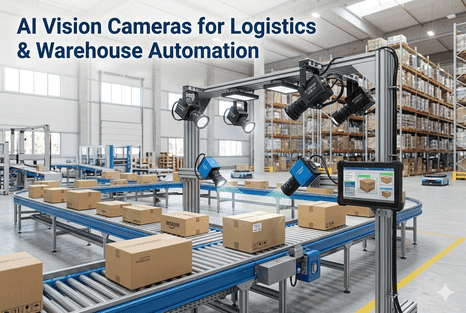
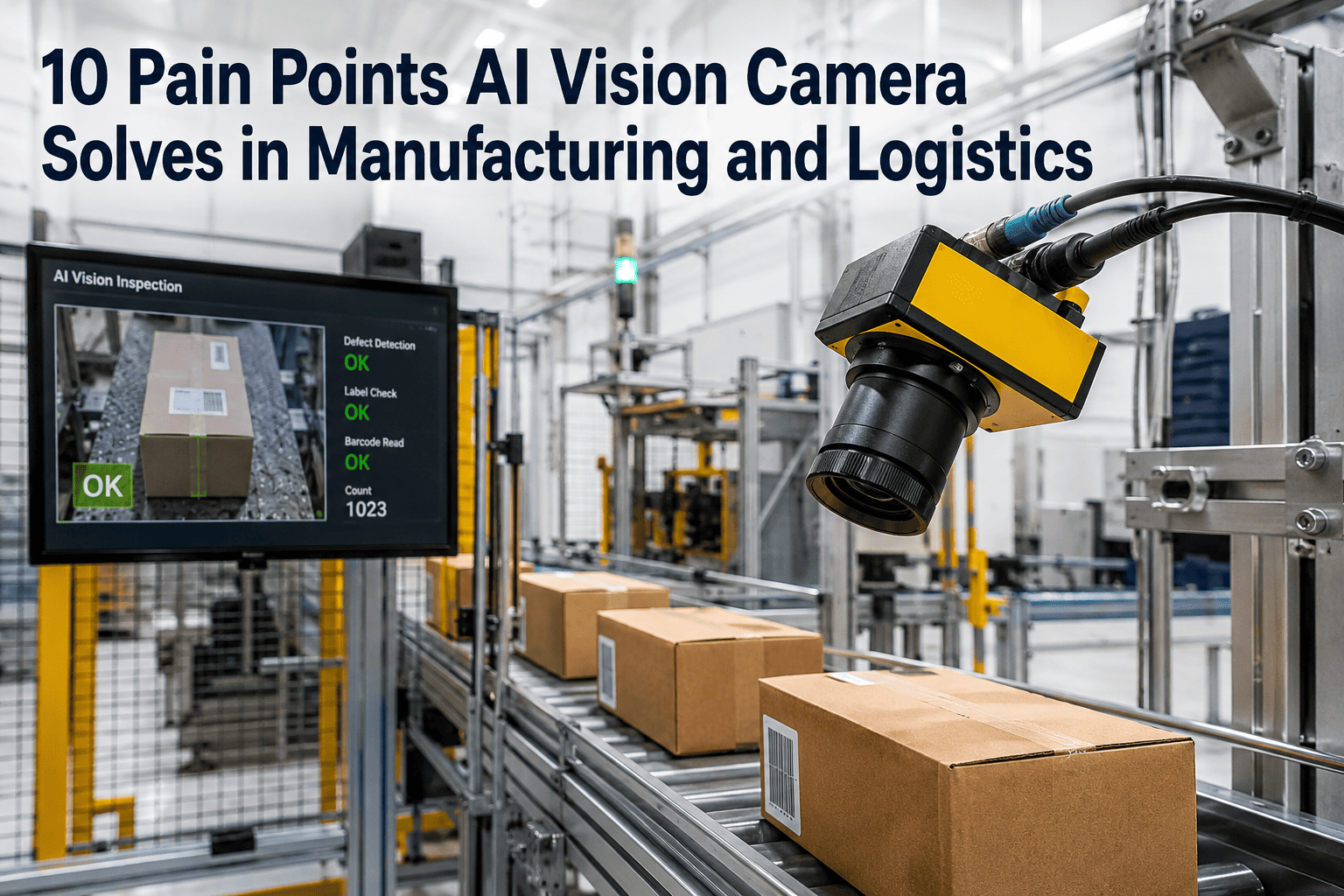
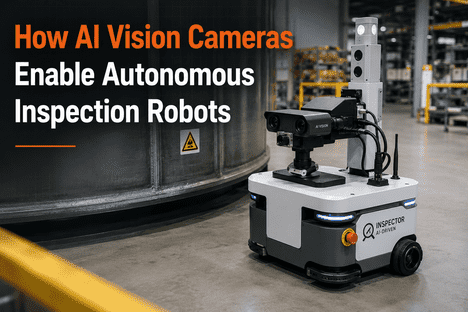
AI Vision Cameras are transforming logistics and warehouse operations by replacing manual scanning, paper-based verification, and reactive error correction with continuous, automated visual intelligence that works at the speed of physical freight movement. As shipment volumes hit record highs and labor shortages compress available headcount, the gap between what legacy barcode systems can deliver and what modern distribution centers require has never been wider. iFactory's AI Vision Camera platform closes that gap — automating label validation, multi-barcode capture, loading zone monitoring, and shipping error detection across every dock, conveyor, and storage aisle in the facility. Warehouse operations managers who Book a Demo with iFactory consistently discover that their existing camera infrastructure is already sufficient to deploy AI vision — delivering measurable throughput and accuracy gains without a full hardware overhaul.
AI VISION · LOGISTICS & WAREHOUSE · AUTOMATION
See How AI Vision Cameras Eliminate Manual Scanning and Shipping Errors
iFactory's AI Vision Camera platform automates barcode capture, label verification, loading zone monitoring, and real-time error detection — purpose-built for logistics managers who need measurable accuracy and throughput gains without replacing existing infrastructure.
Why Logistics & Warehouse Operations Can No Longer Rely on Manual Scanning
Modern distribution centers process thousands of shipments per shift, yet much of the scanning and verification technology on the warehouse floor has not evolved to match. Workers still stop to aim handheld scanners, capture one barcode at a time, and manually confirm shipment contents — and at scale, those seconds accumulate into hours of daily throughput loss. More critically, manual processes introduce transcription errors, missed scans, and retrospective documentation gaps that are virtually impossible to detect until a mis-ship reaches the customer or an inventory discrepancy surfaces during a cycle count. The structural problem is that trigger-based, human-dependent scanning cannot keep pace with the freight volumes that high-performance logistics operations require. AI Vision Cameras replace this dependency by continuously capturing visual data across every conveyor, dock door, and receiving zone — automatically decoding barcodes, verifying labels, and logging shipment events without requiring a single manual scan.
The business case for AI vision in logistics is grounded in hard operational data. The average warehouse maintains only 63% inventory record accuracy, meaning that on a $10 million inventory base, over $500,000 in stock is misallocated, misplaced, or phantom at any given moment. Every mis-ship, mislabeled pallet, or unverified load compounds this exposure. Logistics managers who want to quantify the accuracy and throughput opportunity in their specific operations are encouraged to Book a Demo with iFactory for a facility-specific assessment walkthrough.
63%
average warehouse inventory record accuracy without AI vision — a structural blind spot costing millions annually
50%
of warehouse operations projected to use AI vision scanning by 2035, up from 30% in 2025
Zero
manual scans required — AI cameras capture all barcodes, labels, and shipment data as freight moves
10ms
inference latency on edge AI — decisions happen at freight speed, not server round-trip speed
Operational Failure Modes
The Four Operational Gaps That AI Vision Cameras Eliminate in Logistics Facilities
Understanding where manual logistics processes break down is the prerequisite to deploying AI vision effectively. Warehouse operations managers who have investigated mis-ship events, inventory discrepancies, and dock-level errors consistently identify four failure modes that account for the overwhelming majority of throughput loss and shipping accuracy problems. iFactory's AI Vision Camera platform is designed to close each of these gaps systematically — through automated visual verification that operates continuously without fatigue, sampling gaps, or shift handover blind spots.
01
Manual Barcode Scanning Bottlenecks
Trigger-based handheld scanning requires workers to stop, aim, and capture one barcode at a time — creating a physical bottleneck at every receiving dock, pick station, and shipping lane. At high-volume operations, this scanning overhead costs hundreds of labor hours per week. AI Vision Cameras eliminate this bottleneck entirely by simultaneously decoding multiple barcodes on a single pallet as it moves through the facility — no worker intervention, no scanning pause, and no line-of-sight constraint on label orientation or pallet positioning.
02
Damaged and Unreadable Label Failures
Damaged, smudged, or incorrectly applied labels are one of the leading causes of shipment exceptions and receiving delays. Traditional barcode scanners fail completely when a label is unreadable, requiring manual intervention and retrospective correction that disrupts workflow. AI Vision Cameras detect degraded label conditions in real time — flagging damaged or unreadable labels at the point of receipt and triggering automated reprint workflows before the package moves downstream, preventing the cascading errors that a single unreadable label can cause across the entire sortation system.
03
Unmonitored Loading Zone and Dock Activity
Loading docks and staging zones are the highest-risk areas in any warehouse for mis-loads, unauthorized access, safety violations, and undocumented freight movement. Without continuous visual monitoring, these events go undetected until a customer complaint or audit surfaces the discrepancy — often days after the affected shipment has left the facility. AI Vision Cameras provide 24/7 monitoring of every loading zone, capturing time-stamped visual records of every load, unload, and staging event — with automated alerts for safety violations, unauthorized access, or load sequencing deviations that deviate from the planned outbound manifest.
04
Shipping Verification Gaps and Mis-Ship Events
Order accuracy failures — wrong items, wrong quantities, wrong destinations — represent the most visible and costly error category in outbound logistics. Manual verification at packing stations relies on worker attention and is easily compromised under time pressure. AI Vision Cameras verify every item placed into an outbound shipment against the order record in real time — identifying wrong items, quantity deviations, and packaging damage before the box is sealed. When an error is detected, the system alerts the packer immediately, preventing the mis-ship before it occurs rather than processing a return weeks later.
Platform Capabilities
How iFactory AI Vision Cameras Work Across the Warehouse: Five Core Capabilities
iFactory's AI Vision Camera platform does not simply digitize existing manual processes — it fundamentally redesigns the logistics verification architecture to prevent errors at source rather than detect them after freight has moved downstream. Warehouse operations directors evaluating AI vision platforms should assess every candidate system against these five capability dimensions to determine whether the platform delivers real-time prevention or retrospective recording. To see how iFactory's platform performs across each dimension in a live warehouse environment, Book a Demo with our logistics technology team for a facility-specific walkthrough.
01
Multi-Barcode Capture and OCR Label Reading at Full Conveyor Speed
AI Vision Cameras simultaneously decode multiple barcodes on a single pallet or package — including 1D barcodes, 2D QR codes, and data matrix formats — as freight moves at full conveyor speed without stopping or reorienting. Optical Character Recognition (OCR) extracts tracking numbers, SKUs, lot codes, and destination data from label text fields that barcode-only systems cannot read. Extracted data flows directly into the warehouse management system, updating inventory records and triggering downstream workflows without any manual data entry. This capability alone eliminates the trigger-scan bottleneck that limits throughput at high-volume receiving docks and sortation lines.
02
Real-Time Label Condition Analysis and Automated Reprint Workflows
Every label that passes an iFactory AI Vision Camera is analyzed for readability, placement accuracy, required field completeness, and barcode scannability. Labels that are damaged, misaligned, missing required compliance data, or carrying unreadable barcodes are flagged immediately — with the specific label condition documented and an automated reprint workflow triggered before the package advances to the next handling stage. This real-time label verification eliminates the downstream exceptions, manual corrections, and shipment delays that damaged or non-compliant labels cause in traditional operations that rely on worker visual inspection to catch label problems.
03
Loading Zone Monitoring with Time-Stamped Visual Audit Trail
AI Vision Cameras deployed at dock doors and staging zones continuously monitor loading and unloading activity, capturing a time-stamped visual record of every freight movement event. The system verifies that outbound loads match the planned manifest — flagging sequencing deviations, missing pallets, or unauthorized freight additions before the dock door closes. Safety monitoring runs in parallel, detecting PPE violations, pedestrian-forklift proximity events, and unauthorized zone access in real time with push alerts to the shift supervisor. The combined loading zone record creates a defensible audit trail for carrier disputes, customer claims, and internal loss investigations — replacing the gap-ridden manual dock logs that most facilities currently maintain.
04
Inventory Cycle Counting Without Stopping Operations
Overhead AI Vision Cameras continuously read barcodes, identify products visually, and update inventory records across storage aisles and pick faces — without requiring forklifts to stop, workers to scan, or operations to pause for a physical count cycle. The system recognises products, pallets, and storage locations visually and operates even when labels are damaged, missing, or obscured — providing a redundant accuracy layer that barcode-only inventory systems cannot achieve. WMS integration means AI-verified inventory data flows directly into existing stock level, replenishment, and demand forecasting workflows, eliminating the permanent gap between system records and physical reality that costs most warehouses millions in misallocated stock annually.
05
Outbound Shipment Verification and Mis-Ship Prevention
At packing and outbound staging stations, AI Vision Cameras verify every item placed into a shipment against the active order record — confirming correct product, correct quantity, correct packaging, and absence of visible damage in real time. Wrong items trigger an immediate packer alert before the box is sealed; quantity deviations flag automatically for supervisor review; damaged items are routed to quality hold before they leave the facility. Every shipment verification event is logged with annotated image evidence and order reference, creating a complete outbound audit trail that resolves carrier disputes and customer claims in minutes rather than days of manual investigation.
Performance Benchmark
AI Vision vs. Manual Operations: 2026 Logistics Performance Comparison
The following benchmark reflects operational performance data from logistics and warehouse facilities operating manual scanning, semi-automated, and fully AI vision-enabled workflows. The performance gap between manual processes and AI-driven platforms has widened significantly since 2023, driven by both the maturation of edge AI inference capabilities and the growing commercial consequences of shipping accuracy and inventory visibility failures in high-throughput distribution environments.
Logistics & Warehouse AI Vision Performance Benchmark — 2026
Integration Architecture
Built to Integrate With Your Existing WMS, ERP, and Conveyor Infrastructure
iFactory's AI Vision Camera platform is engineered for deployment in the physical realities of logistics and warehouse environments — not controlled laboratory conditions. The system integrates with any ONVIF-compatible or RTSP-capable camera already installed in the facility, eliminating the need to replace existing infrastructure as a prerequisite for AI vision deployment. Edge AI processing runs on NVIDIA GPU hardware deployed on-premise, with sub-50ms inference latency and zero cloud dependency — critical for high-speed conveyor and sortation environments where internet connectivity cannot be a single point of failure in the quality verification chain. Extracted barcode, label, and shipment verification data flows bi-directionally into existing WMS, ERP, and order management systems via standard API and industrial protocol integrations, updating stock levels, triggering replenishment, adjusting allocations, and feeding dispatch confirmation workflows without manual data bridging. When an AI detection event requires human action — a damaged label, a load sequencing deviation, a safety alert — the system raises a work order in the iFactory CMMS, assigns the responsible supervisor, and sends push and SMS notifications with annotated visual evidence attached. Logistics technology directors who want to map this integration architecture to their specific WMS and ERP environment can Book a Demo for a system-specific deployment walkthrough.
WMS & ERP Bi-Directional Integration
AI-verified inventory and shipment data flows directly into existing WMS and ERP platforms — updating stock levels, triggering replenishment orders, confirming receipt events, and feeding outbound dispatch confirmation without manual data entry or system bridging. Compatible with SAP, Oracle, Microsoft Dynamics, and custom WMS configurations via REST API and OPC-UA.
Conveyor & Sortation System Integration
AI Vision Camera outputs integrate with conveyor control and automated sortation systems to trigger real-time divert decisions based on barcode reads, label verification results, and destination data — routing packages without manual intervention and flagging exceptions for human review before they advance to the wrong sortation lane.
CMMS Work Order Automation
Every AI detection event that requires action — label reprint, load deviation, safety violation, equipment anomaly — automatically generates a work order in the iFactory CMMS with annotated image evidence, detection classification, and time stamp attached. Assigned to the right team member with push notification and SMS alert, with no manual escalation required.
Existing Camera Infrastructure Compatibility
iFactory supports integration with any ONVIF or RTSP-compatible camera currently installed in the warehouse — fixed ceiling cameras, dock door cameras, conveyor-mounted cameras, and mobile forklift cameras. The AI inference engine deploys as an intelligent overlay above existing hardware, requiring software and edge-processing upgrades rather than full camera replacement in most facility configurations.
Frequently Asked Questions
AI Vision Cameras for Logistics & Warehouse Automation — Frequently Asked Questions
Can iFactory AI Vision Cameras read damaged or partially obscured barcodes?
Yes. iFactory's AI vision models read barcodes and label text using both barcode decoding and OCR — meaning the system can extract data from degraded, smudged, or partially obscured labels that handheld scanners fail on. For fully unreadable labels, the platform automatically flags the exception and triggers a reprint workflow before the package moves downstream.
How many cameras are needed to cover a typical warehouse facility?
A single overhead camera can monitor an entire storage bay or aisle section. Typical deployments use 15–30 cameras for a 50,000 sq ft warehouse, with strategic placement at dock doors, high-value zones, pick faces, and shipping lanes. The system is modular — deployment starts with the highest-impact zones and expands as ROI is validated, without requiring a full-facility rollout upfront.
Does the platform require replacing our existing WMS or conveyor control systems?
No. iFactory integrates with existing WMS, ERP, and conveyor control infrastructure via standard API and OPC-UA protocols. The AI vision layer operates as an intelligent overlay above existing systems — adding real-time visual verification and automated action without requiring infrastructure replacement as a deployment prerequisite.
How does loading zone monitoring work with the AI Vision Camera platform?
Cameras deployed at dock doors and staging areas continuously monitor all freight movement activity and compare outbound loads against the planned manifest in real time. Sequencing deviations, missing pallets, unauthorized additions, and safety violations trigger immediate supervisor alerts with annotated visual evidence. Every loading event is logged with timestamp and image record for dispute resolution and compliance audits.
What is the typical ROI timeline for AI vision deployment in a logistics facility?
iFactory performs a data-driven ROI baseline assessment in 2–4 weeks using existing operational, accuracy, and labor data. Most logistics facilities with 3 or more active dock doors achieve full platform ROI within 60–120 days, driven by mis-ship reduction, labor reallocation from scanning to exception handling, and inventory accuracy improvement that reduces safety stock carrying costs.
Can the platform handle multiple product SKUs and mixed-pallet loads?
Yes. iFactory's AI models are trained to simultaneously decode multiple barcodes on mixed-pallet loads — identifying individual SKUs, quantities, and lot codes from a single camera pass. The system adapts to new SKU configurations and product line additions through rapid model retraining without requiring manual reprogramming or extended integration projects.
BARCODE CAPTURE · LABEL VERIFICATION · LOADING ZONE MONITORING · SHIPMENT ACCURACY
Deploy AI Vision Cameras Across Your Logistics and Warehouse Operation
iFactory's AI Vision Camera platform delivers zero-touch barcode capture, real-time label verification, continuous loading zone monitoring, and automated shipment accuracy — giving warehouse operations managers the throughput, accuracy, and audit-ready documentation they need to run a modern, high-performance distribution facility.